Daily insights for city builders, delivered every morning at 6 AM ET. I’m Brandon Donnelly — a Toronto-based real estate developer and founder of Globizen. I’ve been writing here since 2013.

Tag: cambridge

  • The top 20 US neighborhoods for venture capital investment

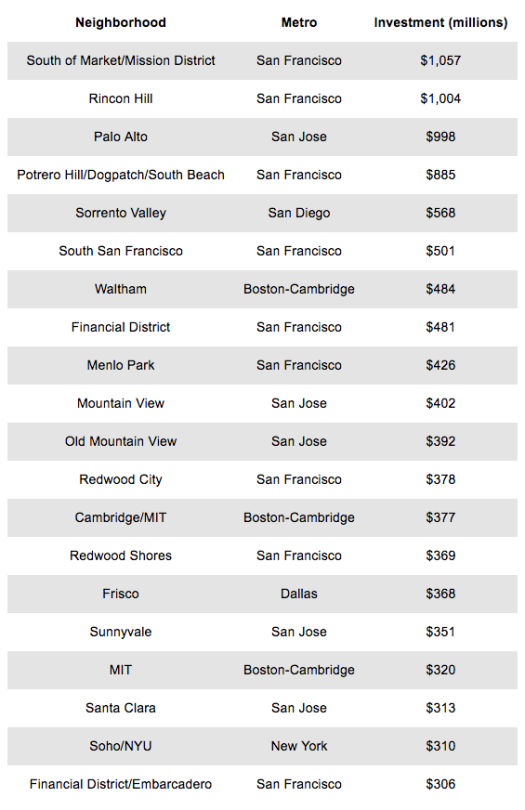
    There’s a lot of talk about how venture capital investment has shifted from the suburbs to cities and how it is also concentrated in certain metro areas. But a new report from the Martin Prosperity Institute has dug even deeper to look at the top 20 neighborhoods (zip codes) in the US for venture capital investment.

    Here’s a summary of what they found:

    “The top 20 neighborhoods or zip codes for venture investment include nine in San Francisco, five in San Jose, three in Boston-Cambridge (one in suburban Waltham and two in Cambridge close to MIT) and one each in San Diego (close to the University of California, San Diego), Dallas, and New York (close to New York University).”

    And here’s the full top 20 list:

    image

    Initially I looked at this list and thought that neighborhoods such as Menlo Park and Redwood City shouldn’t be labeled as San Francisco, since they are outside of the county. But technically they still fall within the San Francisco Metropolitan Area

    It’s amazing how San Francisco dominates this list.

  • The 5 objectives of Rejection Therapy

    In the business world – particularly in the startup world these days – there’s a lot of emphasis on the importance of failure. The mantra is: “fail early and fail often.” Because if you’re not failing, then you’re likely not pushing yourself hard enough and getting out of your comfort zone. 

    Some people think we’ve gone too far in our celebration of failure, but I think there’s a lot of value in not being afraid of making mistakes. I try and adopt the same mentality when I snowboard. If I’m not physically falling, then I’m likely not trying things I’ve never done before. (I may have taken that philosophy too far this winter.)

    Here’s a video from Gary Vaynerchuk’s #AskGaryVee show where Jack and Suzy Welch are guests and the first question has to do with this exact topic: the importance of failure.

    Given all of this, I was fascinated to learn about something new this week called Rejection Therapy. I was out for beers with some good friends of mine earlier in the week and one of them – who is an educator here in the city – started telling me the story of Jason Comely.

    Jason was a freelance IT guy from Cambridge, Ontario. His wife had recently left him for someone “better” and he went into a deep slump. Eventually, he realized that he had become terrified of rejection. His wife had rejected him and he never wanted that to ever happen again.

    Initially he withdrew from life. 

    But eventually he decided that he was going to experiment with the exact opposite approach. He decided that he was going to force himself to get rejected by someone every, single, day.

    It didn’t matter how it happened, but he had to get rejected. He would walk up to strangers and ask for a ride home. He would ask for a discount before buying something. The list goes on. 

    Eventually he thought it would be a good idea to start documenting all of his rejections: this is what I did today and this how I got rejected. It became a game for him. When he would get his rejection for the day, he would celebrate it. Then he thought to himself: why not turn this into an actual game that other people could purchase? And that’s what he did.

    He calls it Rejection Therapy and here are the five objectives that he lays out:

    1. To be more aware of how irrational social fears control and restrict our lives
    2. Smash the tyranny of fear and reap the treasures (treasures include wealth, relationships and self-confidence)
    3. Learn from, and even enjoy rejection
    4. To not be attached to outcomes, especially when it involves the free agency of other people
    5. Permit yourself to fail

    Playing Rejection Therapy may not be for everyone. But I think the lessons are universally applicable. There’s value in trying. There’s value in asking. There’s value in making mistakes. And there’s value in not being afraid of someone saying no.

  • Why Toronto-Waterloo needs all-day two-way urban rail service

    image

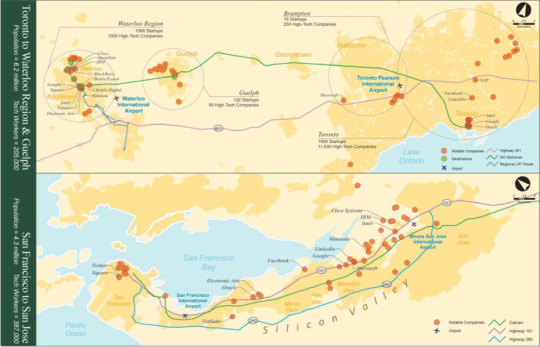
    This morning I stumbled upon an interesting Medium article talking about the need for an all-day two-way urban rail service between Toronto and Waterloo. 

    The argument is that along this corridor sits a technology ecosystem that is second in size only to San Francisco-Silicon Valley and that current connectivity levels represent a missed opportunity of epic proportions. Presently this rail service will feed you into Toronto during the morning rush hour and take you back out in the evening rush hour. But that’s it.

    According to this report prepared by the City of Kitchener (which is beside Waterloo), efficient train service would stitch together an ecosystem of approximately 12,800 technology companies, 2,800 startups, and 205,000 technology employees. It would also connect 6 universities and 4 colleges, many of which are ranked top in the world.

    There’s an argument here that this is exactly the sort of thing that governments should be doing to encourage innovation and entrepreneurship. Rather than trying to be heavily involved in actual startups, they should be creating an environment that maximizes output and then getting out of the way. 

    I think this makes a lot of sense. Don’t you?

    Image: The Innovation Express

  • Top 10 (US) cities for young smart people

    image

    I’m always on the lookout for great websites and communities dedicated to cities. And today, thanks to a friend of mine, I found a new one called City Observatory. It’s my new favorite site for city geeks.

    They describe themselves as a “data-driven platform for sharing, analyzing and discussing the success of cities.” As soon as I read that, I immediately subscribed. I’m a big believer in using data to elevate the discussions happening around our cities and to cut through the bullshit.

    I’m looking forward to digging into more of their articles, but I did already take a look at the first report they published, which is called: “The Young and Restless and the Nation’s Cities”. Click here to download the PDF.

    What the report talks about is a demographic group that they refer to as “Young and Restless”, and which they define as being 25-34 years old and having a 4-year degree. And they focus on this group because they see it as critical to driving local economic development.

    They’re the next generation who are going to start those companies and drive growth and innovation. And since the data shows that as people age, they become less willing to relocate (which intuitively makes sense), cities today are quickly realizing that they need to capture this group of smart people while they’re still restless (i.e. mobile).

    So if this is important, which cities (in the US) are winning right now? Here are the top 10 cities via City Observatory:

    1. Washington D.C. 8.1%
    2. San Francisco 7.6%
    3. Boston/Cambridge 7.6%
    4. San Jose 7.5%
    5. Denver 7.5%
    6. Austin 7.0%
    7. New York 6.6%
    8. Minneapolis 6.6%
    9. Raleigh 6.5%
    10. Seattle 6.1%

    The percentage represents the portion of the population that’s 25-34 years old and has a 4-year degree. I’ve just listed the cities here, but in reality they reference the entire metro areas.

    Do any of the cities on this list surprise you? None are surprises for me. It’s more or less what I would have expected to see, except maybe for the absence of Chicago (it’s 12th according to this ranking).

    Is your city doing enough to capture this group?

    Image: Flickr

  • How much does it matter what message a city sends you?

    In keeping with the recent theme about cities, their brands, and the messages they send, I thought I would revisit an old essay (2008) written by Paul Graham (of Y-Combinator) called “Cities and Ambition.” In it, he talks about the various messages that cities send us, such as:

    • You should make more money (New York)
    • You should be better looking (Miami?)
    • You should be smarter (Cambridge)
    • You should be more powerful (Silicon Valley)

    But the most interesting part of his argument is the belief that we are largely products of our environment. No matter how strong or formidable our personalities might be, the message a city sends us is hugely important. In fact, it might be impossible to escape it. Here’s how Paul puts it:

    How much does it matter what message a city sends? Empirically, the answer seems to be: a lot. You might think that if you had enough strength of mind to do great things, you’d be able to transcend your environment. Where you live should make at most a couple percent difference.

    But if you look at the historical evidence, it seems to matter more than that. Most people who did great things were clumped together in a few places where that sort of thing was done at the time.

    You can see how powerful cities are from something I wrote about earlier: the case of the Milanese Leonardo. Practically every fifteenth century Italian painter you’ve heard of was from Florence, even though Milan was just as big. People in Florence weren’t genetically different, so you have to assume there was someone born in Milan with as much natural ability as Leonardo. What happened to him?

    If even someone with the same natural ability as Leonardo couldn’t beat the force of environment, do you suppose you can?

    I don’t. I’m fairly stubborn, but I wouldn’t try to fight this force. I’d rather use it. So I’ve thought a lot about where to live.

    To some, this thought may depress you. I mean, if you happen to live in a city or place with the “wrong” message, you might feel as if you’re missing out. I know that thought certainly crossed my mind when I read his essay. But different messages resonate with different people, and so maybe the message your city is telling you is exactly the one you need to accomplish great things.

    In Toronto, I’d say that the message is similar to that of New York: You should make more money. Oh, and also that you should buy more condos 😉

    What message does your city tell you?