Daily insights for city builders, delivered every morning at 6 AM ET. I’m Brandon Donnelly — a Toronto-based real estate developer and founder of Globizen. I’ve been writing here since 2013.

Tag: buzzbuzzhome

  • The Livabl Launch podcast

    Matthew Slutsky (formerly of BuzzBuzzHome fame and now of Livabl fame) recently invited me on his podcast to talk about some of our current and upcoming condominium projects, as well as about the market in general.

    Despite my best attempts, I only briefly talk about NFTs and crypto (in the context of our One Delisle project). So if any of you are sick of hearing that from me, the episode should be overall fairly tolerable.

    To have a listen, click here. It’s about 30 minutes.

    Thanks again for having me, Matthew.

  • Current state of Toronto’s new condo market

    Ben Myers of Bullpen Research & Consulting was recently interviewed by Newinhomes.com about the state of Toronto’s new housing market. Ben is always interesting. And these are the sorts of things that I read in my spare time. So here’s an excerpt:

    The average price of popular new condo floor plans in the City of Toronto in October 2019 was approximately $1,275 per-square-foot (psf) and with growth of 3% a year, prices would hit $1,475 psf in 2024. I wouldn’t be surprised to see annual average growth of 4%, which would get you to $1,625 psf in five years in Toronto.

    This data was taken from BuzzBuzzHome and — by “popular new condo floor plans” — I believe he means that these are the floor plans that buyers tend to click on and review when they visit the site. So it’s a good indication of buyer demand.

    Here’s another quote that stuck out:

    Part of the reason that price growth has spiked is a rise in construction costs, development charges, and land prices – this cost-push inflation is passed on to consumers.

    That sounds right. And I have been writing about this phenomenon all year. Most of us can probably remember when $1,000+ psf was a high water mark for new construction condos. Now it’s pretty much a floor.

  • You can now buy a new home, online

    My friend Matthew Slutsky runs a company called BuzzBuzzHome that allows you to search for new construction homes. This week they launched a feature that allows you to put down a deposit on a new home – online – with your credit card. It’s live right now for the Barra on Queen in Kitchener, Ontario.

    I know that Matthew and his team have been working on this for years (I saw earlier demos), and so I wanted to publicly congratulate them on the blog. I’m not sure who their competitors are right now, but this feels to me like one of the first online real estate marketplaces where you can actually just hit “buy now.” Huge accomplishment.

    I am sure many of you will have objections that we will hear about in the comment section below. But I have little doubt that this is the future. People used to say that the masses aren’t going to buy clothes online because of the need to try things on. I own suits that I have purchased online. People will buy real estate online.

    The more important question: When will it go mainstream?

  • Pause button

    Councillor Kristyn Wong-Tam recently put forward a request for a report on the implementation of a 1-year moratorium (let’s ”hit the pause button”) on new tall building rezoning applications in the downtown core of Toronto. You can read the full letter here.

    Not surprisingly, the building industry doesn’t like this.

    But besides that obvious point, I did want to draw attention to the following comment made by Quadrangle Architects partner, Richard Witt (taken from this BuzzBuzzNews article):

    “The city has, for years, used the development charges that should have been used to upgrade infrastructure to artificially lower property taxes by putting the development charges into general revenue,” he says.

    The intent of development charges is that they fund the infrastructure required as a result of new development – everything from transit to water. In the US, they are (I think) more commonly called impact fees. In this case the name makes the intent quite clear.

    I am curious to what extent we are relying on development growth to fund the status quo. Because growth may not always be there. History has shown us that.

  • Is Toronto a world-class city?

    image

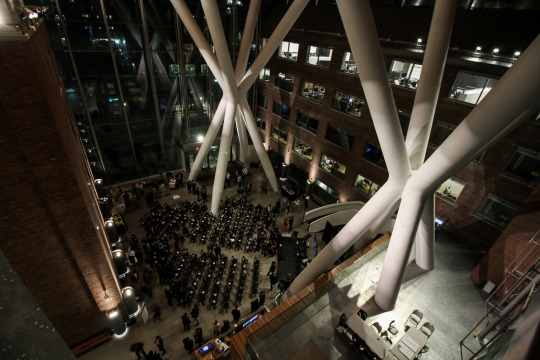
    Earlier this week I was on a panel discussion called Building Toronto Tomorrow. One of the questions was about whether or not Toronto is world-class city. It elicited a good discussion, so I thought I would talk about that today on the blog.

    Shamez Virani, President of CentreCourt Developments, responded by saying that he thinks Toronto is the greatest city in the world and that he wishes more people would just accept how incredible this city is. I agreed with him.

    I also responded by saying that I hate this question. I think it reeks of insecurity and I think it’s a bit of a red herring. It distracts from more direct and meaningful questions – questions such as our livability and our position as a global city.

    Because the reality is that Toronto is one of the most livable cities in the world and, in my view, we are the only true global city in Canada. We are an important node in the global economy for the flow of goods, people (we’re particularly good at this), capital, and now information. There’s a lot to be proud of.

    But that’s not to say that we’re perfect. Everyone knows we need better transit. And to name a few others (non-exhaustive list), I also think we need to:

    • Get a move on road pricing.
    • Loosen up our archaic alcohol laws and start using nightlife as a competitive advantage for attracting talent.
    • Acknowledge through our governance structures that cities are what drive today’s information economy.
    • Stop thinking about the Canadian/Toronto value proposition as being about cost savings. That is, buy this from us because our currency is weaker than yours. This is anti-innovation and there are much better ways to create sustainable value. (Innovation is still a weak spot.)
    • Focus on developing an information economy that leverages the unique talent and knowledge base of Toronto. For example, I think we’re in a great position for real estate + tech innovation.
    • Do everything we can to encourage big tech IPOs in this city. They are critical to developing the ecosystem.

    There’s a saying in Silicon Valley that you “make what you measure.” It means that whatever you decide to focus your attention on, is invariably what you end up making – regardless of whether or not you happen to be focusing on the right metric.

    In the context of Toronto, I think we’d be better served if we focused on and quantified our position in the global economy, as opposed to chasing some idea of “world-class.” The latter will grow as the former grows.

    I also think that this needs to be balanced against our livability. Sometimes there’s a tension. But there are cities – the best example is perhaps Tokyo – who have managed to pair a high quality of life with one of the strongest positions in the global economy.

    Is there anything else you think we should be doing? We can talk about it in the comments below.

    Image: Building T.O Toronto (BuzzBuzzHome Event)

  • Building Toronto Tomorrow

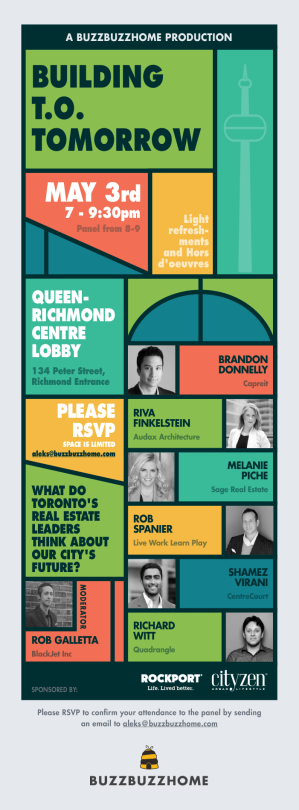
    I’m going to be speaking on a panel on May 3rd, here in Toronto, called Building T.O. Tomorrow. The topic is the future of this city.

    It is being put on by the good folks at BuzzBuzzHome and it will be held in the lobby of Allied’s new Queen-Richmond Centre (134 Peter Street). If you haven’t yet been to this building, that alone makes attending worthwhile.

    Here’s the event poster:

    If you’d like to attend, make sure you RSVP to aleks@buzzbuzzhome.com.

    On a largely unrelated note, I recently picked up the handlebar bicycle mount for my GoPro and I’m looking for some fellow city geeks who would like to ride around the city and film some – potentially cool – videos.

    I find that being on a bike is one of the best ways to experience a city (at least the cities that are actually bikeable). So I’m hoping some of that magic will translate into video. If that sounds at all interesting, drop me a line.

  • A guide to digital marketplaces

    Version One Ventures – which is an early-stage venture capital fund based in Vancouver – recently published a free handbook called, A Guide to Marketplaces.

    Online marketplaces are really fascinating because they are perhaps broader in scope than you might initially think. For example, Uber is a marketplace. There’s a supply-side (drivers with cars) and a demand-side (people needing rides). Uber connects these two groups together and acts as a kind of digital middle person. Uber does not own any of the cars.

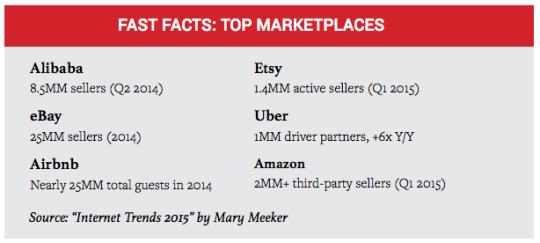
    This is an incredibly power business model and it can and is being applied in many different ways. Here are the top internet marketplaces (via the handbook):

    I have been interested in this space for years because I have been very curious as to why we haven’t seen more innovation when it comes to online real estate marketplaces. Yes, there are platforms like Zillow.com. But Zillow has not done to real estate what Uber is doing to urban mobility.

    My thinking is that it comes down to supply-side aggregation. Online marketplaces in general are hard to get started, which is why investors love them. They have defensibility. But real estate, in particular, is even harder to jumpstart compared to the incumbent models because of what I see as constraints on the supply-side.

    That’s why I am so excited about what BuzzBuzzHome.com is doing on the new construction side of the business. They are aggregating supply.

    If you’d like to download the guide to marketplaces in PDF, click here. It’s a great read and I’m glad that Boris and Angela took the time to assemble. Thank you 🙂

  • What a “buy now” button will mean for the new construction real estate industry

    Colored apartments by Pierre-Yves Babelon on 500px.com

    https://500px.com/embed.js

    Recently it has been in the news that BuzzBuzzHome.com – the new construction real estate site – will be launching a “buy now” feature in the new year (2016).

    This will allow people to buy condos and homes online with their credit card, which means that people will be able to pay the $5,000 deposit online and process all the paperwork that today happens within a sales office.

    This is huge.

    If you’re somebody who has used a computer and the internet before, the process today feels archaic. Typically you go online to register for a project and then somebody will call you to arrange an appointment. If you ask them to email you the price sheet and floor plans ahead of time, they’ll almost always tell you that they can’t do that and that you’ll need to come into the sales office for an appointment. 

    But what about if you end not liking the floor plans and you’re about to waste a few hours of your time? Too bad. The sales funnel requires you to be present in person. This is nothing against the many talented sales professionals working in new construction; it’s just that if I can design and price out a car online and if Mark Cuban can buy a $40 million jet online, then I should be able to shop for a new condo online.

    BuzzBuzzHome has been chipping away at the current model for years and they’ve managed to get a lot more information online than was previously available. When Matthew and Cliff first launched BuzzBuzzHome in the late 2000s it was almost unheard of for developers to put any sort of pricing and floor plans online. Now they at least have some of that on their site. I’m glad they stuck with it.

    Because what’s equally exciting about what BuzzBuzzHome is doing is that in order to offer a “buy now” feature, they also need to have an accurate account of all developer inventory on hand. And so alongside this “buy now” feature they’re also building out a full cloud-based inventory management system for developers. 

    This means that BuzzBuzzHome will soon be managing the supply-side of the new construction marketplace. Think of the data and analytics you can extract from a platform like this. It’s going to bring much greater transparency to this industry.

    But if your business is in any way connected to the new construction real estate market, I would take this morning and think about how the above innovations could impact your business model. I can think of a few winners and losers.

    Some of you might be thinking that people aren’t going to make the biggest purchase of their life online. But I would bet the farm that many people will. I know I would.