Daily insights for city builders, delivered every morning at 6 AM ET. I’m Brandon Donnelly — a Toronto-based real estate developer and founder of Globizen. I’ve been writing here since 2013.

Tag: buying and selling

  • Transparent offer platform

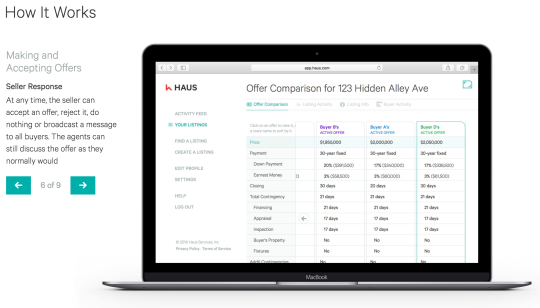
    A new “transparent offer platform” called Haus has just launched in California to serve the residential real estate market. The way it works is that all offers are submitted online. And once an offer has been confirmed, it – along with all of its terms – gets revealed to every other potential buyer. See image below.
    image

    I’ve seen a number of different iterations of this same idea, which tells me that this is a well-identified problem in the real estate market. Here’s a snippet from a recent TechCrunch article announcing Haus:

    “We think the openness will create a more efficient market and that the number of offers and price will ultimately be dependent on demand,” said Haus GM Sarah Ham. “Bidding wars are a common, almost accepted, part of the real estate process today. But with our approach, buyers know where they stand. Buyers will know what they need to offer to make their offer competitive, but they also won’t negotiate against themselves.”

    I completely agree that this is a problem that needs to be solved. It will create a more efficient marketplace. However, in this market, I suspect that the current information asymmetries largely benefit sellers, to the detriment of buyers. So I wonder if the supply-side of the marketplace will be willing to participate at scale. What’s really in it for them?

    Side note: Haus is the latest project from Expa, which is a “startup studio” that works on its own ideas, as well as partners with other founders. I am very interested in this approach to creation because I think you have to try and make a lot of things if you want to do truly innovative things.


  • A money back guarantee on your next home

    image

    I’ve written about Opendoor.com a few times. As far as I can tell, they are the furthest ahead in terms of disrupting the residential real estate market. So I like to follow them quite closely.

    They’ve recently launched some new features, so I figured it would be a good time to check-in on what they’re up to. But first – for those of you might not be familiar with Opendoor – here’s what they do.

    Opendoor offers instant liquidity to homeowners by buying homes site unseen. The fee they charge seems to amount to less than 10% of the value of the home. 

    They also say that they typically offer prices that are about 1-3% less than the market value of the home 3 months into the future. (Apparently 3 months is the average time-on-market for the cities in which they operate.)

    Once they’ve bought the home, they then make improvements and put it back on the market. As of today, they are buying about 10 homes a day in the two markets in which they operate (Phoenix and Dallas). They are spending about $75 million a month buying homes.

    To mitigate their risk, they won’t buy a home built before 1960, a home that was pre-fabricated, a home with a solar lease, and so on. They also stick to values that are between $100,000 to $600,000. But apparently this covers off about 90% of homes in the United States. (You can read their full FAQ here.)

    To accomplish all of this, they have raised about $110 million in venture capital.

    What’s fascinating about all of this is that they are starting to create a seamless marketplace. As they continue to buy more homes (and aggregate supply), more buyers are starting to come to their marketplace. They also allow people to easily find local contractors.

    Over time as they gain scale and as their algorithms improve, one could imagine their pricing becoming more competitive, them taking more of the market, and them bearing much less market risk as homes quickly trade. 

    They liken their model to car trade-ins. Apparently 60% of people who buy a new car are trading in an old one. That’s an interesting comparison that I hadn’t thought about before.

    So what’s new?

    Two things

    First, they are offering a 30 day full refund on new home purchases. In other words, if you buy a home through their platform and, for whatever reason, you end up not liking it, they’ll buy it back (minus some transaction costs and so on).

    Second, they are providing a 180-point inspection report to buyers and if anything breaks in the first two years of ownership (presumably it is something that contravenes the inspection), they’ll come and fix it.

    These additions are helpful because it starts to target buyers, which will help them fill out the other side of their marketplace. It also promotes greater transparency because now they’re partially on the hook for the home’s performance.

    I like what they are doing and, again, I can’t think of any other company making such big bets in this space.

  • When everyone thinks you’re wrong

    Sunset by Paolo Mastrogiacomo on 500px.com

    https://500px.com/embed.js

    I was recently talking to my good friend Jeremiah Shamess about the current state of development land sales in Toronto (he does this for a living) and he said something to me that I found really interesting.

    He said that because the market is so competitive, you can really only win development sites in one of two ways. Either you’re willing to spend the most money or you see something and have a vision that nobody else sees.

    And it was this second piece that really stood out to me because it reminds me of one of my favorite investing frameworks.

    Warren Buffet is famous for saying that you should be fearful when others are greedy and you should be greedy when others are fearful. And what I’m about to talk about is really that same core philosophy.

    Here’s how venture capitalist Fred Wilson put it (reiterating something that Bill Gurley said):

    I saw Bill Gurley say that you can only make money by being right about something that most people think is wrong. His logic was that you can’t make money by being wrong. And you can’t make money by being right about something everyone else knows. So you have to be right about something that most people think is wrong. I really like that framework.

    But this doesn’t just apply to technology companies or stocks. It applies to city building, most industries, and probably most things in life if you think about it.

    If all you’re doing are things that everyone else is doing, then how can you expect to outperform? You’re going to revert to the mean.

    Take, for example, billionaire Dan Gilbert and Detroit. Not everyone believes that Detroit will come back. In fact, I suspect there are probably more people who think it won’t come back, than people who think it will. Otherwise, it would already be back.

    But Gilbert is unquestionably long on Detroit (via Forbes):

    As you’ve likely heard, over the past four years Gilbert has become one of Detroit’s single-largest commercial landowners, renovating the city with the energy and impact of a modern-day Robert Moses, albeit bankrolled with his own money. He’s purchased and updated more than 60 properties downtown, at a total cost of $1.3 billion. He moved his own employees into many of them–12,000 in all, including 6,500 new hires–and cajoled other companies such as Chrysler, Microsoft and Twitter to follow.

    If/when Gilbert proves to be right about Detroit, then he will have been right about something that most people thought was wrong. And because of that, he will no doubt make a lot of money.

  • Why do more people in Quebec sell their home without an agent?

    If you ask most people, they’ll tell you that real estate agents will never ever disappear. 

    Despite the internet, mobile phones, social networks, and companies (here in Canada) such as comFree and PropertyGuys, the bulk of the market still employs an agent when it comes time to buy and/or sell a home. This is true both in Canada and the United States. And it may always be true.

    But there are lots of entrepreneurs and people in the real estate community experimenting with different models. OpenDoor and Open Listings are two new startups out of the US that I’ve been following closely.

    At the same time, there is a certain fraction of the market that is willing to go at it alone. By some estimates this number could be as high as 25% in Canada. Of course, this is a hard number to measure accurately since there isn’t just one method of selling a home privately and many transactions likely go untracked.

    But one thing that I’ve been wondering for awhile now is why the percentage of private home sales is seemingly so much higher in the province of Quebec. According to Wikipedia, this number might be greater than 50%. And a quick search on comFree (duProprio in Quebec) seems to suggest that this may indeed be the case.

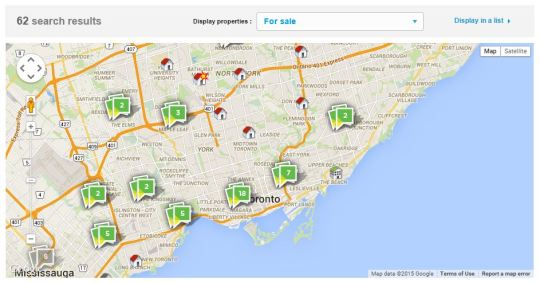
    Here are the comFree search results for downtown Toronto. There are 62 properties.

    image

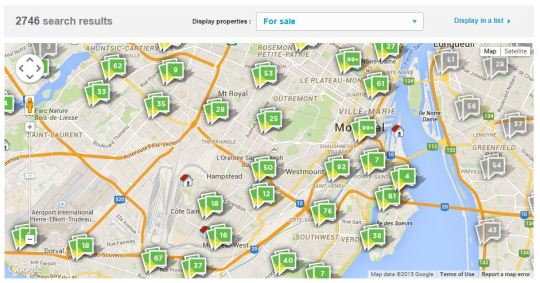
    And here are the duProprio search results for downtown Montreal (notice I tried to maintain the same zoom level). There are 2,746 properties.

    image

    If anyone has any insights on this phenomenon, I would love to hear from you in the comment section below. I don’t know why this is the way it is.

  • Opendoor.com launches in Phoenix

    Yesterday Opendoor.com finally launched their product in Phoenix. If you’re a regular reader of Architect This City, you might remember that back in July of this year I wrote about how they had just raised $10M of funding to make selling your home as easy as a few clicks.

    Well, since then, I’ve been following them like a hawk. I had all the founders on Twitter notification (so I got notified every time they tweeted) and I was eagerly anticipating their launch.

    Now that they’ve launched, we have a much better idea of how their business model is going to work. I say “better idea” only because there’s still portions of it that are a question mark for me.

    In any event, Opendoor basically provides instant liquidity to homeowners. You go on, tell them about your home, and they then make you an offer to buy, which looks like this and lasts for 3 days. The offer they make you is calculated using comparable sales and adjustments based on your home’s unique characteristics.

    Upon accepting their offer, they then schedule a home inspection (at their cost) to confirm your home’s condition. Once this is done, you just select your move out date and Opendoor handles the rest. The fee for all this is 5.5%, which the company claims is less than the 6% that realtors typically charge (this would be high for Toronto).

    After buying your home, Opendoor plans to turn around and resell it.

    What this reminds me of is a “bought deal.” In the world of investment banking, a bought deal is when the bank itself agrees to buy the entire offering of a particular security, as opposed to going out to the market and trying to raise the money. The advantage to the company (offering the securities) is that there’s no financing risk. They know they’re going to get their money. But it usually means the company gets a lower price.

    So what I wonder, is if this is what’s going to happen here. Since Opendoor is effectively taking on the selling risk, does that mean their offers will be lower? Or are all their costs built into that 5.5% and that’s truly their core business model? I’m sure some of this will surface in the coming weeks.

    I do, however, think they are smart to be focusing on the supply-side of the marketplace and offering virtually perfect liquidity to homeowners. Real estate is a unique asset in that it’s difficult to bring supply to the market. And so if control the supply-side, I think you have a pretty good shot at controlling the market as a whole.

  • Should you own or rent your home?

    image

    I was at a good friend’s wedding last night (congratulations again to Adrien + Rachel!), and one of the topics that came up at our table was whether it is better to own or rent your home. Now, in North America, conventional wisdom would suggest – almost mandate – that you have to own your place. If you’re still a renter, well then you’re “throwing away your money” my friend.

    But are you really? 

    A big part of the value of owning your home is that it’s forced savings. Every month when you make those principal and interest payments, you’re paying down your mortgage and socking away money for the future. And this can be a great thing for a lot of people, particularly if you’re not disciplined enough to save otherwise.

    But when you own a home, you’re also spending time and money on maintaining that home, and you’re also tying up capital that could be used elsewhere. So consider this: what if, instead of putting your savings towards a downpayment, you simply continued to rent and created an investment portfolio that you then contributed to on a regular basis just as you would a home?

    Depending on your assumptions, renting could turn out to put you further ahead financially. Here’s an example of that scenario from the Globe and Mail.

    Similarly, I remember being told in business school that companies that own their own real estate tend to under perform those that do not. And the rationale is that owning lots of real estate ties up capital that could otherwise be reinvested in the core business. In other words, if your core business is making widgets, then invest your money in making better widgets, not in real estate.

    But this is not to say that everybody should rent. Obviously I’m a big believer in real estate. And for a lot of people, owning may make sense. This post was really just to say that the owning vs. renting decision may not be as black and white as you might think.

    Image: Flickr

  • Thoughts on real estate marketplaces

    The responses are still coming in from yesterday’s real estate marketplace survey, but I wanted to thank everyone who took the time to complete it. I really appreciate it. I was reviewing the responses this morning and I thought there were a couple of interesting takeaways.

    First, most people who own a home have at one point or another thought about selling that home. And even the people who haven’t thought about it, said they would be willing to sell under the right circumstances. That is, they would sell for the right price, for a better place, and so on. At the time of writing this, nobody said they would never ever sell.

    I think this is interesting because, even though the real estate market is a highly illiquid market, my hunch is that it could be made a lot more liquid with the right frameworks in place and if the barriers to selling could be reduced.

    And sure enough, many of the folks who said they have thought about selling (but haven’t yet), said it’s partially because it’s too expensive and too much work to sell. But in addition to these barriers, two other points emerged that I hadn’t given a lot of thought to before – but make total sense. 

    Homeowners also said that they haven’t sold because they’re too emotionally attached to their home and because they’re afraid they won’t be able to find another place to move into. 

    Because of how illiquid the real estate market is and because home transactions are typically asymmetric (that is, buying and selling are independent actions), there appears to be a real concern that you could sell your home and never find anything better.

    And since a home is such an emotion filled asset (as opposed to, say, a stock), people are naturally afraid of making the wrong choice. But then that begs the question: Are we, as real estate consumers, being left with suboptimal outcomes because we’re simply too afraid of the making the wrong choice?

  • Should you buy or rent?

    image

    The decision to buy or rent your home can be a big one–it’s both personal and financial. If you buy, you tie up capital that could be put to use elsewhere. But if you rent, you don’t get to participate in any of the upside should home prices appreciate.

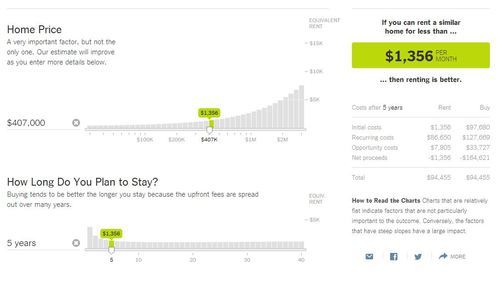
    To help with this decision, the New York Times recently put together an online calculator. It takes into account the opportunity cost of your capital, inflation rates, the expected home price growth rate, and a myriad of other factors. It’s the most detailed of these types of calculators I’ve ever seen.

    If you’re thinking about this decision, you may want to take a look. Although, keep in mind that it’s a US model and in the US you can deduct the mortgage interest on your principal residence. You can’t do that in Canada.

    I also wrote a post a few months ago called: What I see as the fundamentals of real estate investing. You’ll find it interesting if you are, in fact, thinking about buying or investing in real estate anytime soon.

  • Information wants to be free

    The Globe and Mail ran a piece this morning called, The Realtors of Oz: Bidding wars are unnecessarily sleazy.

    For anyone who has recently tried to buy a house in Toronto, you’ll know that multiple offer scenarios, also known as “bidding wars”, are a fairly common occurrence. Demand for housing in the city is great and interest rates are low. And so homes are frequently being priced below market to generate a feeding frenzy.

    When I read articles like this, I’m reminded of how much frustration I have for the way the real estate market operates today. There’s poor liquidity, there’s a lack of transparency, and there are high transaction costs. I’m a free market kind of a guy and so I’m bothered by how “imperfect” the real estate market remains.

    A lot of people in the business like things just the way they are, but I believe that markets function better, for everyone, when they are open and transparent, and all participants have access to information. Thankfully, I do believe that we’re headed towards a world with more transparency, not less. Information wants to be free.

  • The high cost of transacting

    This past Sunday I was over at my father’s place for dinner and we were talking about the high transaction costs associated with buying and selling homes. That is, we weren’t talking about the high price of homes in Toronto, we were only talking about transaction costs and barriers to market liquidity.

    For example, let’s say for the sake of simplicity that you own a home that’s worth $1 million and you’d like to sell it and buy a different home that also happens to be worth $1 million. In this case, you’d be making an entirely lateral move. You’re not down sizing or up sizing, you just want a different home–perhaps because you’d prefer a different neighborhood.

    In order to do this, you’re going to be faced with a number of costs. But the 2 most significant are real estate commissions and Land Transfer Taxes (both provincial and municipal). You only pay Land Transfer Taxes in Toronto when you buy (take title) of a new property, but they’re unavoidable, unless you’re a first time buyer, in which case you’d qualify for a bit of a rebate.

    Real estate commissions are technically optional, but 70-90% of the market in North America still uses a a real estate agent to sell their home (based on the estimates I’ve found). Typically a seller pays around 5% of the sale price. So in this example, you the homeowner would be paying around $50,000 in real estate commissions.

    Land Transfer Taxes would be roughly $32,000, and so you’re looking at a total somewhere around $82,000 in order to make this lateral move. This, of course, does not include legal fees or any other moving costs you might incur. It’s a hell of a lot of money and it’s a significant barrier to transacting.

    But my hunch is that we’ll eventually see real estate commissions come down. No real estate agent wants to hear this, but I think it’s almost inevitable. The internet, as a disruptive force, is bound to make it happen.