Daily insights for city builders, delivered every morning at 6 AM ET. I’m Brandon Donnelly — a Toronto-based real estate developer and founder of Globizen. I’ve been writing here since 2013.

Tag: business school

  • From utility to fear and greed

    image

    Roger Martin – who is the former dean of the Rotman School of Management and one of my favorite business thinkers – recently published a post on the Harvard Business Review blog called: The Dark Side of Efficient Markets.

    In it, he makes an interesting distinction between what he calls use-driven markets and expectations-driven markets, the latter of which is assumed to be the more efficient one:

    In the natural evolution of markets, as markets become more efficient, they turn from being use-driven to expectations-driven — like equities, real estate, or derivatives based on both.

    The example he starts off with is that of corn. In its simplest form, this market is about farmers growing corn, taking it to a local market, and then selling it to real humans who will then go home and eat it for dinner. Simple. And this is what he means by a use-driven market.

    But as markets grow and evolve, you have middle agents or market makers that insert themselves between buyers and sellers, suppliers and consumers. They help create greater marketplace liquidity and generally help buyers and sellers find each other and transact.

    However, as this happens, Roger argues that the game eventually shifts from being use-driven to expectations-driven. Now people buy, not necessarily to consume, but to invest, resell, and generally speculate on future values. In other words, they stop buying the corn to eat it. And instead buy it (or sell it) because of what they think it might be worth at some point in the future.

    Now, his argument is that even though this latter stage is considered to be more “efficient”, there’s a dark side to it: increased price volatility. When people are buying, not because they need something, but because of future expectations, it can lead to big price swings. And that’s because the market is now being driven by fear and greed, as opposed to utility. Interesting. 

    But I want to talk about something a bit different today. I agree with him, but I want to look at it from a different angle.

    What I’m instead curious about after reading his article are the following:

    • Are these non-use-driven markets really that “efficient”?
    • Is this a natural market evolution only because we had no other choice and no other distribution options?
    • And how does the internet change this natural evolution?

    Efficient markets are supposed to be based on perfect information. Buyers and sellers know the same things, prices accurately reflect intrinsic value, and all that other good stuff. But while this may be more true in some markets – such as perhaps the stock market – I would argue that it’s far from the truth in others.

    The real estate market in my view is actually an imperfect market. There’s lots of missing information and there’s overall poor transparency. And I’m sure this also leads to big distortions in the market. So I find it difficult to classify the real estate market as an efficient one – though it may still have a dark side.

    I also don’t think you can talk about markets, today, without talking about the internet. One of the most interesting things for me is how it’s completely rewriting distribution between buyers and sellers, producers and consumer.

    In the old days, we needed middle actors because it wasn’t cost effective to distribute on your own. If I wanted to write about cities every day, I would have had to get picked up by some newspaper or publication. But today (for better or for worse), I and anybody else can self-publish for basically no cost. The same goes for videos on YouTube, short-term spaces on Airbnb, and so on.

    Now, I’m not exactly sure how the changes taking place in marketplaces will ultimately play out in the financial markets, but I do think there’s room for our markets – the simple act of people buying and selling stuff – to get a lot more “efficient”. And as that happens, maybe the dark side won’t be as dark anymore.

    Image: Flickr
  • Frank’s Vault and virtual real estate

    Earlier this week a good friend of mine from Rotman, Frank Luengo, launched his own blog called Frank’s Vault.

    Given that he has used the same theme as I have here, I like to think it was inspired by ATC 🙂 But whatever the case may be, his mission is: “…to simplify the complicated, and to bring Bay Street and Main Street a little closer together.” In other words, it’s a finance blog. And I’m really enjoying it so far.

    Last summer Frank told me that he was thinking about starting this and so I’m thrilled that he finally decided to do it. I’ve talked many times before about the benefits of personal blogging, and so I won’t repeat them here. But I did want to mention one other thing. When Frank told me he launched, one of the first things I did was congratulate him on claiming frankluengo.com.

    And I did that because I’m a big proponent of owning your firstnamelastname.com. I look at internet domains as virtual real estate and I, therefore, look at firstnamelastname.com as your own piece of branded real estate on the internet. If you don’t buy it up, somebody else will. That’s obviously why I own brandondonnelly.com and why I host ATC on it.

    But since I’m such a believer in real estate – both the offline and online varietals – I actually own many others. I also own brandondonnelly.co, brandondonnelly.ca, and brandondonnelly.me. The latter one links to my tumblog, and the first 2 just redirect to this site. I don’t derive much utility from having all these URLs, but I just want them so that nobody else can get them.

    So if you haven’t yet thought about it, I would encourage you to think about claiming your own piece of real estate on the internet. I use Namecheap.com to buy my domains, but there are many others out there.

  • Should you own or rent your home?

    image

    I was at a good friend’s wedding last night (congratulations again to Adrien + Rachel!), and one of the topics that came up at our table was whether it is better to own or rent your home. Now, in North America, conventional wisdom would suggest – almost mandate – that you have to own your place. If you’re still a renter, well then you’re “throwing away your money” my friend.

    But are you really? 

    A big part of the value of owning your home is that it’s forced savings. Every month when you make those principal and interest payments, you’re paying down your mortgage and socking away money for the future. And this can be a great thing for a lot of people, particularly if you’re not disciplined enough to save otherwise.

    But when you own a home, you’re also spending time and money on maintaining that home, and you’re also tying up capital that could be used elsewhere. So consider this: what if, instead of putting your savings towards a downpayment, you simply continued to rent and created an investment portfolio that you then contributed to on a regular basis just as you would a home?

    Depending on your assumptions, renting could turn out to put you further ahead financially. Here’s an example of that scenario from the Globe and Mail.

    Similarly, I remember being told in business school that companies that own their own real estate tend to under perform those that do not. And the rationale is that owning lots of real estate ties up capital that could otherwise be reinvested in the core business. In other words, if your core business is making widgets, then invest your money in making better widgets, not in real estate.

    But this is not to say that everybody should rent. Obviously I’m a big believer in real estate. And for a lot of people, owning may make sense. This post was really just to say that the owning vs. renting decision may not be as black and white as you might think.

    Image: Flickr

  • An MBA post-mortem from a real estate guy

    image

    This post originally appeared on the Rotman Morning & Evening MBA blog

    As a recent graduate of Rotman’s Morning MBA program (and presumably because somebody over there reads Architect This City), I was asked to write a guest post for their MBA blog. More specifically, I was asked to share my thoughts on the real estate industry and on my time at Rotman. And since I haven’t really done a post like this before, I thought it would be worthwhile to do.

    But before I begin, I think it’s important to explain a bit about my background and my motivations for doing an MBA in the first place. Before going to Rotman, my first master’s degree was in architecture and real estate from the University of Pennsylvania. Basically it was a Master of Architecture combined with their MBA real estate concentration. So it included everything from real estate finance to real estate development.

    Having already done this 3-year program, there were a couple of things I wanted out of an MBA program. First of all, I wasn’t prepared to go full-time. Five years out of the workforce was simply too high of an opportunity cost for me and so part-time was all I considered. I also only applied to Rotman because I didn’t want to waste any time traveling outside of the city (or to other parts of the city). I also saw Rotman as a rising star and one of, if not the, best option in Canada.

    At the same time, I didn’t give much thought to the real estate curriculum being offered even though I fully planned to stay working in the real estate industry. I felt like I already had that sort of formal training and so, unlike some of my classmates who were looking to switch into real estate, I was after something else. I ended up majoring in Innovation & Entrepreneurship.

    What I was trying to do was really round out my skillset and fill in some of the missing holes: accounting, marketing, and so on. But even more importantly, I had drunk the kool-aid around Rotman’s focus on integrative thinking (renamed “business problem solving”) and “design thinking”. And since there will always be a part of me that thinks of itself as a designer, it seemed like the perfect program for me. 

    Because at the end of the day, it’s not that hard to learn how to create a real estate development pro forma or calculate your expected exit cap rate on some piece of real estate. That stuff is all fairly mechanical. It might seem quite mythical when you don’t know how to do it, but once you do, you quickly realize that a financial model is only as good as the assumptions you put in. As we’re told in school, garbage in = garbage out.

    The real value gets created in the assumptions. It’s created in the way you think about the market, your product, and your customers. And a lot of the time, the most value is created when you know or believe something that nobody else believes to be true. If you’re a lemming, you’re going to get lemming like returns and outcomes. So in a lot of ways, I went to Rotman to help me think better and think differently.

    In some industries, resting on your laurels can kill you in a relatively short period of time. See Blackberry. Real estate, on the other hand, is generally a bit slower moving. But that doesn’t mean that change doesn’t happen and that there isn’t room for loads of innovation.

    Just look at the Toronto of today versus the Toronto of 10-15 years ago. We’ve transformed ourselves into a city of high-rises where more and more people now want to live in the core of the city. This has brought commercial landlords back to the city center so that employers have downtown office space to attract the best human capital (see South Core) and it’s brought suburban retailers into the core to sell to these same urbanites. We’re seeing a complete reversal of the trends experienced with the last generation.

    Amidst all of this, I’ve been noticing a growing awareness and passion around cities. My blog Architect This City started as a forum for architects, planners, and developers, but it has grown into a community of thousands of people who simply love cities. They’re passionate about everything from architecture to grade-separated bike lanes (as geeky as that probably sounds).

    So I think that it’s not only the real estate market that’s changing, but also the professions involved with it. I’ve written a lot about the future of the architecture profession because I think we’re starting to see the emergence of new business models. Architects are becoming developers and developers are starting to become much more heavily involved in the shaping of the communities in which they build. Which is why in many ways, I think of my self as a city builder more than anything else.

    Finally, to make matters even more complicated, technology is starting to have a huge impact on the business. Zillow.com just bought Trulia.com for $3.5 billion to form a portal that will now serve around ¼ of the online US residential market. And Opendoor.com is getting ready to launch a product that seems entirely poised to disrupt the way homes are bought and sold in America.

    So what I’m getting at is that there’s absolutely no guarantee that the way we used to do something, is the way we’re going to continue doing it. In fact, I operate under the assumption that everything can and will be changed by somebody at some point. And if this is the way you approach things, then it should become abundantly clear to you that being able think critically is going to be one of your most important assets.

    When I was just starting at Rotman, I met for lunch with an upper year classmate who told me that one of the best things he’s taken away from the program is the ability to think about the way he thinks. That may sound silly to some, but in our uncertain world, it’s actually a great skill to have.

  • MBA

    image

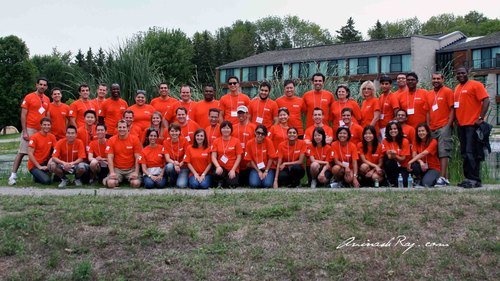
    Today was my MBA convocation at the University of Toronto’s Rotman School. Though I actually finished my degree last year (with a bit of fast-tracking), I had to wait until today in order to formally graduate with the rest of my cohort. I did what’s called the 3-year morning MBA. What that means is that I took most of my classes at 7am.

    The picture above is from our weekend retreat right before we started the program (I’m in the back row in the middle). It was taken in the summer of 2011. That feels like eons ago. It has been a tough slog.

    So today I’m taking the day off from writing about cities. Instead, I’m just going to enjoy the day off and the closing of this chapter in my life. An MBA is something I had been planning on doing even while I was in architecture school–so it’s nice to be able to check it off. But as I told my parents today after convocation: you ain’t seen nothing yet.

  • Studying to become a real estate developer

    Earlier this week I received a message from an undergraduate architecture student interested in moving into real estate development after school. That was his 10 year plan. And he had clearly read my blog post, “Transitioning from architecture to development.”

    In his message, he asked me if there were any books I would recommend he read to improve his real estate and finance knowledge, and, if I could have a “redo”, if I would still do a M.Arch (Master of Architecture) or just go straight to the MBA?

    After responding to his message, I thought: “This would make a good blog post, as well as an opportunity to talk about the current state of real estate education in Canada.” So here goes.

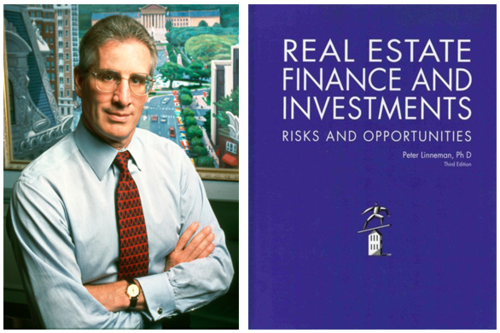
    If you’re looking for a good real estate book to get you started, I recommend checking out “Real Estate Finance and Investments: Risks and Opportunities" by Peter Linneman. It’s a much easier read and way more casual compared to most textbooks. When I was in grad school, people referred to this book as the "blue bible.” The cover on the previous edition was less purple and more blue. Unfortunately, he has also changed his glasses since the photo below.

    image

    To his second question, if I were to do it all over again, I wouldn’t change a thing about my education. I loved architecture school and combining it with business school classes and a real estate concentration was the best thing for me. I never wanted to be just a “numbers guy”, but I also never wanted to be a fanciful artist type who didn’t know how to build and manage a pro forma.

    Now, let’s talk about real estate education in Canada.

    I think we’re way behind. In the US, you can do a Master of Science in Real Estate Development, a Master of Real Estate Development, and all sorts of other real estate degrees. In Canada, you’re probably doing a MBA with a few elective real estate classes. Real estate is the largest asset class in the world. Does that not justify a dedicated degree?

    Part of the reason for this, I think, is because real estate development is still very much an entrepreneur’s business–though it has become more institutionalized in recent years. Because of this, people get into development from a variety of different professions. They just need that entrepreneurial hutzpah. And that’s all fine, but I still think that the profession, the economy and our cities would benefit from University trained developers.

    So if you’re reading this University of Toronto, I think–and I’ve thought this for awhile now–that The John H. Daniels Faculty of Architecture, Landscape and Design and The Rotman School of Management should get together and collectively form a real estate program. Who’s with me?