Daily insights for city builders, delivered every morning at 6 AM ET. I’m Brandon Donnelly — a Toronto-based real estate developer and founder of Globizen. I’ve been writing here since 2013.
Big Ben Myers of Bullpen Consulting doesn’t usually have strong opinions on Twitter (obviously joking), but I did see him respond to this tweet this morning:
During significant downturns, developers can’t sell the units, and can’t get financing to build rentals. It has nothing to do with their intelligence. https://t.co/7G7n4B65CI
The assertion he is responding to is basically this: “developers are stupid because they tend to hold onto land during downturns, instead of building through them.” On some level, I think I know where this line of thinking is coming from. It’s the whole Warren Buffet philosophy of “being fearful when others are greedy, and greedy when others are fearful.”
But what it ignores is development feasibility. Developers typically rely heavily on the availability of debt financing. First you need land financing in order to acquire the land, and then, once you have your entitlements, condominium pre-sales and/or any other requirements in place, you move onto a construction loan (which often “takes out” your land loan).
Maybe you have deep enough pockets to fund everything with cash, but most of the time that is not the case. And so if these debt facilities are not available to you, then you are not building.
The other part of this equation is that, during downturns, it can be harder to forecast your future revenues. What can I sell/rent this space for, and how long will it take to absorb? These are difficult questions in the best of times, but they’re even more difficult when you don’t have a lot of market activity/comparables to point to.
All of this contributes to debt being less available, especially for smaller developers. It also makes new sites difficult to underwrite. Because as we have talked about many times before on this blog, land should be the residual claimant in a development pro forma. Revenue minus development costs equals how much you can afford to pay for land.
If the math doesn’t work and if you can’t get financing, it almost certainly doesn’t matter how much “leading” you feel like doing. You’re not building.
Three quick and unrelated things for today’s post:
1.
A handful of years ago, before the pandemic, Bullpen Consulting, Slate Asset Management, and AD HOC STUDIO started a somewhat irregular basketball meetup for Toronto’s development industry called City Builder Ball. It, of course, fell off the rails during the pandemic, but as of this month we are officially back at it! We played over the weekend and I can’t tell you how much fun it was to run around a gym for an hour and play basketball very poorly — so much fun. The next meetup will be in January and if you’d like to join, drop Ben Myers of Bullpen an email to get on the mailing list. It is open to all.
2.
A few months ago I wrote about a passion project that I am working on with a friend, called Unlyst. The idea is to see if there is a way to leverage the “wisdom of crowds” to determine the current market value of housing. And the way it works is that we feature a home on the website, people (or the crowd) get 14 days to input what they think it’s worth, and then we come up with something we are calling an “unlysted value.” There’s a lot of evidence of this sort of thing working exceptionally well for other markets, so we’re very curious to see if it can work for housing. If you’re interested in contributing your home and/or just seeing how it works, check out unlyst.com.
3.
World Cup Finals. What a game! A huge congratulations to Argentina and, of course, Messi. I should, however, come clean and say that I know virtually nothing about football, I don’t know why the field is so big, and that my overall impression of the game used to be mostly consistent with this Simpsons’ take (albeit with more sensationalized flopping by men with faux hawks). But since Canada qualified this year, I felt it was my duty to watch — at least some bits and until we got eliminated. And since the finals are the finals, and since I have an open crush on France, I figured this would also be a good game to watch. Turns out I was right. And now, I am fairly certain that it has turned me into a true fan — or at the very least a “I could watch a finals game every 4 years” kind of fan. Who knew that soccer, I mean football, could be so thrilling?
As is the case every quarter, Bullpen Research & Consulting and Batory Management have just published their latest Greater Toronto Area land insights report (for Q3-2022). The average price per buildable square foot (pbsf) in this report remains the same as in Q2 at $95.
But once again, it’s important to keep in mind that this represents a fairly small sample size (34 land sales in the quarter versus 46 in Q2); that the range in land pricing can be significant across the GTA (here it is $24-274 pbsf); and that there can sometimes be a lag between a deal being struck and actual closing. Here is the summary data:
Another interesting data point from the report is land price compared to building height. The average price for high-rise development land was $88 pbsf, and the average price for mid-rise development land (5-15 storeys) was $131 pbsf.
This once again speaks to the cost differential between high-rise and mid-rise housing. The mid-rise scale is certainly a desirable form of infill, but it is also a more expensive form of housing.
Bullpen Consulting just released its latest land insights reports for the Greater Toronto Area. For the period of Q2-2022, Ben Myers and the team identified 46 high-density residential land transactions with an average price of $95 per buildable square foot. This is down from $112 pbsf in Q1.
In the core of the city (former City of Toronto), the average price for Q2-2022 was $135 pbsf. In North York it was $103 pbsf. And in Scarborough it was $50 pbsf. Overall land prices are down about 15% from last quarter (though it’s important to note that quarterly transactions can represent a relatively small sample size).
We have spoken before about how land prices tend to be fairly sticky in the face of changing cost structures. But what we are seeing right now is a bit of a perfect storm:
Hard costs have seen double digit increases (with some inputs increasing by 30-40%)
Inclusionary zoning is on the horizon and will add another additional cost to new housing
And rising interest rates are both increasing project costs (higher interest charges) and slowing the macro economy
All of this is naturally causing developers to be more cautious when it comes buying new land. And we are seeing that in the above pricing. But at the same time, this dip in pricing is not going to be enough to absorb all of the additional costs that new housing projects now face in today’s market.
If you’d like to download a full copy of Bullpen’s report, click here.
Marty over at Laneway Housing Advisors published this listing in his newsletter today. It’s for an entitled lot at 78 Gladstone Avenue in Toronto that has been approved (by way of a minor variance) for 6 units. Five units in the front where a house currently sits and one unit at the back in a standalone laneway suite. Though it also happens to be a corner lot and so the laneway suite isn’t really “in the back”.
It’s listed for $2.5M. And according to the description, you can build about 5,500 square feet (4,200 sf in the front with a 1,300 sf laneway suite). This ask translates into a land cost that is just over $450 per buildable square foot, which is far more than what high-density land typically trades for in the city right now. This is usually the case for smaller low-rise sites.
To help put this figure into some kind of context, Bullpen Consulting published in their latest insights report that the average high-density land price in Q4-2021 was $135 per buildable square foot in Toronto (416 area code only). Of course, averages only tell you so much. To truly evaluate the feasibility of a site like this, you’d need to create your own pro forma and do your own residual land value calculation. The value of development land depends on what you can build on it.
If you were to do that, I suspect that you would discover at least two things: 1) you would find it challenging to make the numbers work, particularly for rental housing, and 2) you would quickly realize that this sort of “missing middle” housing isn’t, in its current form, some undiscovered bastion of housing affordability.
Part of the problem is that these 6 units are not being delivered on an as-of-right basis. Somebody had to go out and entitle the land in order to secure these permissions. That means that time and money were spent and that the current owner is now rightly seeking a margin for their efforts. But if we collectively believe that this is an appropriate and sensible form of housing, then this should not be a necessary step in the whole process. Especially for only 6 units.
All of this being said, we know that Toronto and many other cities around the world are taking a hard look at this issue. And that there is a groundswell of interest in allowing more housing in our low-rise communities. It’s going to be a battle — just look at how Toronto’s new garden suite policies have now been appealed by various resident’s groups. But I’m certain that we’ll get there, just like we are getting there with laneway housing and other types of ADUs.
Yesterday I made a comment on Twitter about most people not understanding to what extent government bureaucracy inhibits the delivery of new housing in this city. It received a number of responses, including remarks about how development charges have also recently doubled and how this statement applies to pretty much every city out there. But there was also a comment about developers not being transparent and not properly explaining the impact to the public. In other words: please demystify the development pro forma. I thought that was a fair remark, and so this post is going to be a response to that comment.
Before I begin, it’s important to keep in mind that most developers have investors. These investors put up most of the money required for a project and in turn they take most of the profits. However, there is typically a “promote” in place, which is just an incentive structure that pays the developer more of the profits (disproportionate to the cash they invested in the project) if they perform and hit certain return benchmarks. All of this is to say that developers aren’t usually the ones holding all of the cash (which is what a lot of the public seems to think) and they are accountable to their investors to do what they said they would do.
Now let’s run through the costs that make up a “typical” development pro forma. For this example, I am going to assume that we’re talking about a 100,000 square foot mid-rise building; the kind that you might build and find along any one of Toronto’s Avenues. If we were doing this in real life, we would get more precise with the areas and consider gross construction area, gross floor area (city definition), and the net saleable/rentable areas. But to keep the math simple, we will ignore these differences. That’s the approach I’m going to take overall in the post. What you need to know, though, is that you have to pay to build the entire building, but you only get to collect revenue on a portion of it. That’s why the “efficiency” of a building matters.
Land
The value of development land is a function of what you can build and the revenue you can ultimately collect. So location matters a great deal. Based on the latest high-density land report from Bullpen and Batory, the average price of an unzoned mid-rise site in the City of Toronto is about $231 psf. So let’s assume a land cost for our project of $23.1 million. Assuming we can get land financing at 60% of the value of the land (loan-to-value), that would mean we’re putting up $9.24 million of cash (plus a loan guarantee!) and borrowing $13.86 million to start our project. At 5.25% per annum (interest-only loan), our annual interest charges would be about $727,650. From now on forward, we’re going to pay ~$60k in additional interest charges for every month that our project is delayed. Buckle up.
You should now begin to see why time is so valuable and why government bureaucracy can be so frustrating. As a developer, you’re heavily incentivized to move things forward, whereas it can often feel like everyone around you is trying to deliberately erect roadblocks in order to slow you down and make your project more expensive to build. Oftentimes, it is because it is less risky for them to punt things down the road and not make a decision. That is not the case for us and our project.
Hard Costs
Onto construction (or hard) costs. As many of you know, these have risen dramatically over the last 4 to 5 years. On some of our projects, we have added over $100 psf in hard costs alone. Part of this has to do with a busy construction market and part of this has to do with new building requirements: watertight undergrounds, new Green Standards, and so on. For our project, which is on the small side, let’s assume $360 psf for a total of $36 million. This would include our direct construction costs and our construction manager’s overhead (general conditions). We should also prepare for some of the trades to decline to bid on our project because it is too small and not worth their time.
Soft Costs
Soft costs include everything from consultant costs and interest charges to government levies and management fees. Like everything in your pro forma, these absolutely need to be broken out line by line. Don’t be lazy here. But for the purposes of this simplistic example, we’re going to use 75% of hard costs, which works out to be $27 million (or $270 psf). When I first started out in the development business, the rule of thumb was closer to 25% of hard costs. But times have changed. Government fees, alone, can make up about 1/4 of the price of a new condo in Toronto.
Adding up all of these costs, we’re at $861 psf or $86.1 million in costs. It’s now time to consider the revenue side. $1,000 psf seems like a nice round number, so let’s start there and assume we’re going to sell our condos for that. Typically in Toronto, the price you pay is inclusive of HST, so that liability will need to be deducted from our revenue line. It’s not a straight 13% because of the new home rebate, but the rebate also hasn’t been properly indexed since it was introduced and so the liability could still be upwards of 10%. (This is worthy of a separate blog post.) The result is $900 psf in revenue and a margin on costs that is less than 5%. No sensible developer would want to do this project. One misstep (or development charge increase) and you’re dead.
So let’s increase our condo prices to $1,100 psf. Maybe that will work. In doing that, we get to a margin on costs that is nearly 15%. Okay, now we’re in the range. But let’s say we just got delayed by 6 months (boom, interest charges) and our hard costs turned out to be off by $15. They’re actually working out to be $375 psf because of some new tariff and because the formworkers in the city are all tied up on bigger projects and couldn’t give a shit about our cute little infill project. Now we’re offside again in terms of our margin on costs. No problem, let’s try and push condo prices a bit more. Is $1,150 achievable? Perhaps. But ideally, given the above, we would want to be at $1,200 psf just to be safe.
This is an overly simplistic example of the math that goes into a development pro forma. But hopefully it begins to show you (1) just how many moving parts there are in a development project and (2) the kind of pricing that is required in today’s cost environment. Developers are reacting to the costs that they are being thrown and it is creating upward pressure on home prices. (See related post: Cost-plus pricing.) So far there has been enough elasticity in the market to absorb these price increases, but that may not always be the case. If you have questions about this post or disagree with any of my assumptions, feel free to leave a searing comment below.
Bullpen Consulting and Batory Management published their Q4-2019 land insights report for the Greater Toronto Area today. According to the report, there were 36 high-density apartment land transactions in Q4-2019. The average sale price was about $111 per buildable square foot and Bullpen estimates that these future projects — assuming they go condo — will sell for just under $1,000 psf on average.
But that’s blended across the entire GTA.
Looking at the core of Toronto (former City of Toronto boundaries), the average price per buildable square foot was about $187, which represents a year-over-year increase of 28%. There’s also a premium for mid-rise sites. Bullpen pegs the average price of a mid-rise site in the City — unzoned but with an active development application — at about $231 pbsf. These numbers will obviously translate into much higher condo/apartment prices.
If you’d like to download a copy of the report, click here.
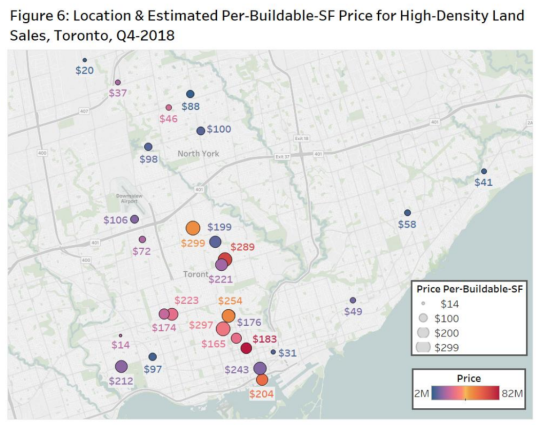
Bullpen Research & Consulting and Batory Management just published their Q4-2018 High-Rise Land Insights Report for the Greater Toronto Area.
Above is a mapping of the estimated per square foot buildable prices for the land that traded hands specifically in Toronto last quarter.
The average is $178 per square foot. And the projected average sale (condo) price is $1,097 psf. That sounds right. You basically need that kind of end pricing to make the math work with today’s costs.
Across the GTA, the average spread between zoned and unzoned land was almost $40 psf. $159 psf versus $120 psf, respectively.