
Yikes. To be completely honest, I was not expecting this post and this post to blow up in the way that they did. But hey, here we are and here’s the blogTO article: “Developer shames City of Toronto into issuing permit for bold new skyscraper.” What all of this suggests is that most people are shocked by how long it takes and how difficult it is to build a building. I mean, what I wrote about is just one sliver among the countless other things that need to come together for it to happen. But to my mind, these are productive discussions to be having. Because the more everyone is aware, the more likely we are to improve things.
Tag: building permit
-
We received our building permit!
As a follow-up to last week’s post about giving free land to the City of Toronto, I am now thrilled to report that, today at 12:14 PM, we received our building permit!
Some of you were keen to hear about what happened following the post. So here’s the update. I published the original post last Wednesday. And to be honest, it received far more attention than I was expecting.
On Thursday morning I received a call from the city. They weren’t thrilled about my post, but were very helpful and said that they would ensure the conveyance happened immediately. It then got done before noon that same day.
Planning then sent a note to buildings saying that the permit was ready for issuance. Yay. Buildings acknowledged that they were working on it, and on Monday of this week we received a summary of the outstanding fees and the instructions for the wire transfer.
We paid the fees immediately and on Tuesday we received a payment receipt from the city. Then today — Wednesday — we received the building permit. So it was exactly one week from post to permit. A big thanks to everyone who helped to finally move this forward.
Hopefully it’s clear that last week’s post came strictly from a place of prolonged frustration. I wasn’t trying to be mean. Our lawyer reminded me, after the post, that we’ve actually been working on this land conveyance for over 2 years.
-
How Japan increased its housing supply
River Davis’ recent article in the Wall Street Journal about Tokyo’s generally flat home prices had me, again, wondering about demographics. I mean, aren’t their demographics working in reverse? They have an aging population, low immigration, and a low birthrate. But Tokyo, which represents about 11% of Japan’s total population, is still growing. And their home price index looks like this compared to San Francisco and New York:

Davis’ argument, which of course has been made by others before, is that deregulation has allowed housing supply to actually keep up with demand. Land use policies were relaxed to allow taller and denser buildings to be built and some degree of decision making (I’m not sure how much) was moved to the central government in order to counteract the NIMBY problem that invariably attaches itself to local politics.
The result is housing numbers that look and compare like this:
In Tokyo last year, housing starts came in around 145,000, according to Japan’s land ministry. This figure is on par with the total number of new housing units authorized last year in New York, Los Angeles, Boston and Houston combined, based on the U.S. Census Bureau data. The same feat was achieved in 2017.
If we are to normalize against New York, it looks like this:

And the belief seems to be that it is working:
“A reason why housing prices in Japan are not rising as fast as in New York, for example, is the large number of housing starts,” says Masahiro Kobayashi, a director general at the Japan Housing Finance Agency, a state-run entity which supports the housing market by purchasing home loans.
One sentence that really stood out for me in the article is this one here: “Private consultants were given permission to issue building permits to speed up construction.” If any of you have tried to pull a building permit for a large project in Toronto, you’ll know that it can take a very long time (understatement). Maybe it is the same in your city. Should we be looking at this?
Charts: WSJ
-
The impact of laneway housing in Vancouver
In 2009, Vancouver created policy and legalized laneway homes. (If you’re not up on laneway housing, click here. I’ve written too much about this topic.)
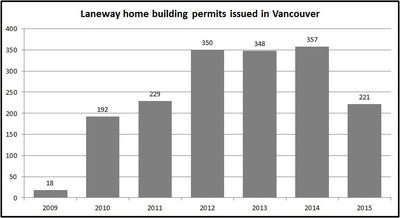
Since then, the number of laneway homes built in Vancouver has steadily increased to the point where roughly 350 new homes are built every year.
Here’s a chart I found showing the number of laneway home building permits issued in Vancouver since 2009 (the year to date number for 2015 is up to and including June):
This is pretty interesting in its own right.
But as soon as I saw this chart I started wondering how these numbers fit into the overall new home construction landscape. So I decided to dig up the City of Vancouver’s Statement of Building Permits Issued for June 2015.
As the chart above shows, the number of laneway dwelling units built (well, permits issued) was 221 as of June 2015. But what’s really fascinating is that this numbers exceeds the number of building permits issued for single family dwellings, which was only 192!
Also super interesting is the significant spread in building permit value.
For single family dwellings, the total value was $156,086,861 (or $812,952 per dwelling unit). On the other hand, for laneway dwellings the total value was $36,478,785 (or $165,062 per unit).
Now to be fair, if you add single family dwellings with a secondary suite into the mix, you get a total count of 608 new dwelling units (as of June 2015). But at 221 new units, laneway dwellings still make up a meaningful portion of the new construction market.
So while laneway houses might seem fringe for Toronto and other cities right now, they’re really not that fringe. In fact the numbers above start to show that they can be a viable source of new and relatively affordable single family housing.
Eventually other cities will realize this too.
-
The value of cheap housing

Houston Sunrise by Cliff Baise on 500px
Urbanists generally don’t like to talk about cities like Houston. It sprawls. It’s car oriented. It’s over air-conditioned. In other words, it’s the antithesis of the dense and walkable cities that urbanists today like to tout as being exemplary.
But despite all this, Houston is one of, if not the, fastest growing city in America. According to The Economist, the population of the Houston metro area grew faster than any other city in America between 2000 and 2010. And between 2009 and 2013, its real GDP grew by 22%.
So why is that? Here’s a snippet from that same Economist article (“Life in the sprawl”):
Paradoxically, perhaps the city’s biggest strength is its sprawl. Unlike most other big cities in America, Houston has no zoning code, so it is quick to respond to demand for housing and office space. Last year authorities in the Houston metropolitan area, with a population of 6.2m, issued permits to build 64,000 homes. The entire state of California, with a population of 39m, issued just 83,000. Houston’s reliance on the car and air-conditioning is environmentally destructive and unattractive to well-off singletons. But for families on moderate incomes, it is a place to live well cheaply.
So while Houston may not check off all of Jane Jacobs’ boxes, it does provide one important thing: cheap housing. And that’s clearly valuable for a huge number of people.
But the other interesting thing about the snippet above, is that it starts to illustrate how frequently supply constrained markets operate with housing deficits.
The fact that the entire state of California issued only about 30% more building permits than the Houston metro – which you could easily argue is closer to a “perfect market” – tells me that there’s probably a lot of people bidding for the same housing in California.
That’s less so the case in Houston.