
Daily insights for city builders, delivered every morning at 6 AM ET. I’m Brandon Donnelly — a Toronto-based real estate developer and founder of Globizen. I’ve been writing here since 2013.

Tag: bubbles

  • Boom: Bubbles and the End of Stagnation

    So Stripe, the payment-processing company, also has a book publishing division. It’s called Stripe Press, and its objective is to publish ideas that support overall business progress. Their latest book is called Boom: Bubbles and the End of Stagnation, and I must say that the website is pretty neat.

    Here’s what the actual book is about though:

    From the Moon landing to the dawning of the atomic age, the decades prior to the 1970s were characterized by the routine invention of transformative technologies at breakneck speed. By comparison, ours is an age of stagnation; of slowing median wage growth, rising inequality, and decelerated scientific discovery. In Boom, Byrne Hobart and Tobias Huber take an inductive approach to this problem. They track some of the most significant breakthroughs of the past 100 years—from the Manhattan Project and the Apollo program to Moore’s law and Bitcoin—and reverse-engineer how transformative progress arises from the same dynamics that govern financial bubbles, bringing together small groups with a unified vision, vast funding, and surprisingly poor accountability. Bubbles, they conclude, aren’t all bad—in fact, they create the ideal conditions for transformative innovation. Integrating insights from economics, philosophy, and history, Boom provides a blueprint for accelerating innovation and a path to unleash a new era of global prosperity.

    If you’re interested, it comes out on November 19, 2024.
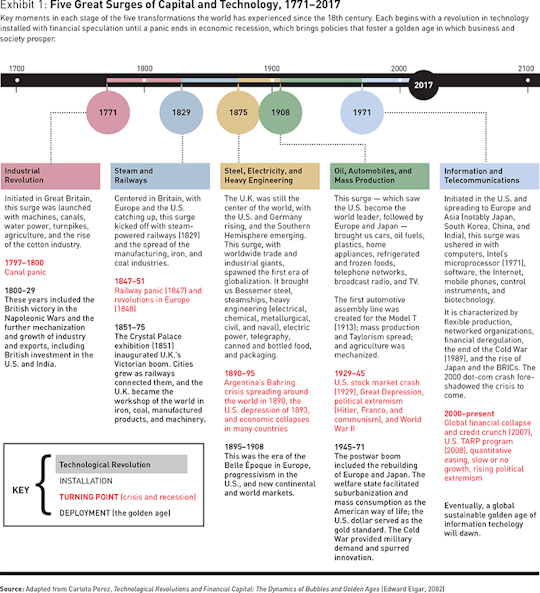
  • Five great surges of capital and technology, 1771-2017

    Carlota Perez is a professor that specializes in the social and economic impact of technological change. In 2002, she published an influential book called Technological Revolutions and Financial Capital: The Dynamics of Bubbles and Golden Ages.

    One of her arguments is that economic growth since the Industrial Revolution has occurred through a series of cycles and surges, ultimately culminating in a fifth great surge centered around information and telecommunications. This is our current economic environment.

    Perez was recently interviewed by strategy + business and they published this diagram (if it’s too small, click through to the article):

    The five surges of capital and technology since 1771 are:

    1. Industrial Revolution
    2. Steam and Railways
    3. Steel, Electricity, and Heavy Engineering
    4. Oil, Automobiles, and Mass Production 
    5. Information and Telecommunications

    Number 4 – oil, automobiles, and mass production – is what produced widespread suburbanization, a middle class filled with homeowners, and new forms of retail employment. And I am sure that most of you would agree that it’s not quite over yet.

    According to Perez, each cycle has two phases: an installation phase and a deployment phase. This latter phase is a “golden age.” But in between these two phases is a turning point that is typically characterized by some sort of crisis and recession. 

    Her belief is that we are in this turning point right now. You see it with Brexit. The demagogues being elected. And more. If you buy this, the key question naturally becomes: How do we cross this chasm and enter our next golden age?

    What’s also important to keep in mind about this theory is that it means that what we are seeing today, socio-economically, is not in fact new. We’ve been through this before. I’ll end with this quote from the interview with Perez:

    In the 1920s, wealth distribution looked the same as it does today. The top 1 percent received 25 percent of society’s total income. By the 1950s it was down to 10 percent. Every installation period brings inequality until the state comes back actively to reverse it and relieve social unrest.

    So what’s happening today may be temporary and it may be history repeating itself. If you’re interested in this topic, you can read the full interview here.

  • Depression babies

    Recently I’ve been seeing a number of posts/articles talking about the dot-com bubble. It seems to be driven by talk of a pending crypto bubble. 

    Whatever the case may be, the recounts are interesting. In this one by venture capitalist Fred Wilson, he talks about how 90% of his net worth went to zero following the crash. And the only reason it wasn’t all of his net worth was because he was fortunate enough to sell some tech stocks in advance of the crash to buy “two significant pieces of real estate.” The two properties were 10% of his net worth before the crash and 100% of his net worth after the crash.

    Fred goes on to talk about how he had to learn about diversification the hard way. And this reminded me of a theory that many of you are probably familiar with called “depression babies”. This is the belief that large macroeconomic shocks – such as the Great Depression and the dot-com boom – create a lasting impact on people’s propensity to take financial risks.

    And indeed, there’s evidence to suggest that this is in fact the case. In this 2010 paper by Ulrike Malmendier and Stefan Nagel, they came to the following conclusion: “Our results show that risky asset returns experienced over the course of an individual’s life have a significant effect on the willingness to take financial risks.”

    I often think about this with respect to my own career. I started working in real estate before the 2008 financial crisis. I also happened to be living in the U.S. at the time – where it was far worse than in Canada. We got off easy. I remember seasoned real estate professionals telling me that it was going to take at least 20 years before the U.S. would build another commercial office building. It was that bad. And that was the sentiment at the time.

    Of course, that wasn’t the case. It didn’t take two decades to resume building. But I like to think that 2008 will remain permanently etched in my mind. It’s my reminder that crashes can and will happen. Don’t forget that. Stay disciplined. At the same time, it’s my reminder that these periodic crashes create opportunities. Because fear invariably makes us overshoot the mark.

  • What are bubbles?

    Social Capital (Silicon Valley VC firm) recently published an interesting series on (economic) bubbles: what they are, how they form, when they are useful, and so on. It’s worth a read – you can start here.

    Here’s a taste:

    “Prices in markets turn out to have two roles: they tell us something about the past, and they influence our actions — and therefore, their own price — in the future. Sometimes, in a big way, this dual role makes a particular asset class — tulip bulbs, railway stock, Canadian real estate, a digital token — become attractive solely because its price is going up. George Soros characterized and mastered this phenomenon, known as Reflexivity: when our views and our actions reinforce each other. If an expensive price means that something is high quality or otherwise attractive, we will tend to buy more of it and drive the price higher, independently of whether or not the thing is any good. It’s true for sunglasses, it’s true for ICOs, and a whole lot more.”

    For obvious reasons I couldn’t resist posting this quote. Notwithstanding the shot at Canadian real estate, bubbles are a fascinating topic. They happen time and time again because we are greedy.

  • All sorts of bubbles

    Fred Wilson (New York VC) wrote a post on his blog this morning called The Bubble Question. In it, he talks about how everyone asks him whether or not there’s a tech bubble, which he has been asked for the past 4 years now. It reminded me of the debates that are also happening in the real estate community (particularly in Canada).

    The thesis of his post is this:

    I learned in business school that the multiple of earnings one should pay for a business is roughly the inverse of interest rates.

    In other words, as interest rates drop, people are willing to pay more for the business or asset in question. And it’s because they can’t find the yields anywhere else.

    The same phenomenon, you could argue, is also happening in the real estate space. Typically, income producing real estate assets are assessed using capitalization rates (or cap rates), which is defined by the Net Operating Income (NOI) of the property (revenue – expenses, but excluding financing costs), divided by the price of the property.

    The real estate equivalent of what Fred is talking about is cap rate compression. When cap rates drop it means you’re paying more for the same amount of yield (or NOI). One of the reasons that might happen is because people are anticipating that the asset will appreciate. But it could also be because interest rates are so low that investors will take whatever returns they can get. 

    So you could argue that the market is just responding to the macro economy. And since the feds are probably waiting for global growth to pickup (before raising rates), one could argue that the status quo is just going to continue. Ideally, it’ll continue until robust economic growth is able to take the place of cheap money.