Daily insights for city builders, delivered every morning at 6 AM ET. I’m Brandon Donnelly — a Toronto-based real estate developer and founder of Globizen. I’ve been writing here since 2013.

Tag: brutalist

  • A tale of two different kinds of Brutalism

    This article from the Guardian about two Brutalist housing estates in London is now more than five years old. But the story is perhaps just as interesting. The article is about two “New Brutalism” estates that were designed and built in the 1960s and 1970s.

    The first is the Barbican Estate (which appeared recently on the blog over here) and the second is Robin Hood Gardens (pictured above, partially). Both were designed by notable architects and both have been equally divisive when it comes to their aesthetic appeal. We’re talking about Brutalism. So it’s likely that you either love them or hate them.

    One of the big differences between these two housing complexes is that one is a private estate and the other is (or was) social housing. And perhaps because of this, the Barbican has remained desirable and Robin Hood Gardens was ultimately demolished starting in 2017. This is despite numerous outcries from the architecture and design community that it should be both preserved and listed.

    We could get into questions of funding and maintenance, as well as the design differences between the two complexes (I don’t have any of these details), but even without all of this, I find these two divergent outcomes pretty interesting. Architecture, it would seem, isn’t everything.

  • [Video] The Glenkerry House in East London

    The Open House festival is on this week in London. It’s an annual festival that celebrates London’s urban landscape and it is something that has been going on for the past three decades. (Toronto has something similar called Doors Open.) But this year, as is the case for all of us, they had to get a little creative with online events and other kinds of programming. Below is a short video that was created as part of the Open House Films collection. It is about the brutalist Glenkerry House in East London. Its architecture (by Ernő Goldfinger). Its ideals. And the people who call it home. Looking for more short urbanism films similar to this one? Look here.

  • New Brutalism in Dallas

    Mr. and Mrs. Gehan recently completed this home for themselves in the Preston Hollow neighborhood of Dallas. Mr. Gehan is the founder of a home building company called UnionMain Homes, but this home is like nothing the company builds. The architect, Scott Specht, describes it as being “new brutalist.” There’s exposed and ribbed concrete walls (which alone are reported to cost ~$720,000). But the sliding planes, cantilevered roof, and expanses of glass are reminiscent of the International Style, and in particular of the Barcelona Pavilion.

    At around 8,826 square feet, the house cost about $6 million to build (presumably this excludes the 1.5 acre land cost). That works out to around $680 per square feet, which once again goes to show you why “only the rich can afford this much nothing.” Minimalism is expensive. Here’s an excerpt from the WSJ: “He [Mr. Gehan] was amazed by the level of detail required and the complication involved in creating a clean and simple aesthetic. That less-cluttered, simpler look will start to make its way into his production houses, he says.”

    Photos: Specht Architects

  • Equatorial Brutalism

    Generally speaking, architects are the only people I know who like Brutalist architecture. In fact, architect, professor and author Witold Rybczynski once proposed the following litmus test to determine whether a building is indeed an example of Brutalism: “If people don’t hate it, it can’t be Brutalist.”

    But as I have argued before, sometimes architectural styles take a bit of time to settle in and become fully appreciated. Consider how improbable it would seem to demolish a beautiful old Victorian home today. And yet Toronto, and countless other cities, did this on many occasions. Regent Park, Toronto was once Cabbagetown South.

    Brutalism also took on different sensibilities around the world.

    I love this recent piece in T (NY Times Style Magazine) by Michael Snyder called, “The Unexpectedly Tropical History of Brutalism.” In it he uses the term “Equatorial Brutalism” (a new one for me) and discusses the “surprising apotheosis” of Brutalism in equatorial countries (and in particular Brazil). It is a good follow-up to my recent post on Oscar Niemeyer’s work.

    So here’s an excerpt from Michael’s article. If you don’t already like Brutalism, maybe it’ll get you a little bit closer.

    What these buildings shared, beyond an aesthetic — though they shared that, too, with their radical porousness, their blunt geometric forms and their extensive use of raw concrete — was a commitment to architecture as an instigator of progress. But in the tropics, Brutalism reached an unexpected apotheosis: Infiltrated by lush plants and softened by humidity, buildings that looked cold and imposing against London’s constant drizzle or Boston’s icy slush were transformed into fecund, vital spaces. Concrete surfaces bloomed green with moss. The panels of glass necessary for sealing rooms against the northern chill either disappeared or receded from view, encouraging cross-ventilation while also protecting interior spaces from direct sun. The openness and transparency that the Smithsons had pronounced became a practical reality in these humid environments, both theoretically and literally: Built from inexpensive, readily available materials, equatorial Brutalism was as accessible and functional as it was symbolically potent, resulting in buildings that would define new societies growing around them like vines. Here, Brutalism wasn’t only an architecture that shaped the future or confronted the past — it was an architecture of freedom.

    Photo by Samuel Zeller on Unsplash

  • For the love of Brutalism

    Brutalism is an architectural movement that most people, other than architecture nerds, hate. Derived from the French words for raw concrete – béton brut – Brutalist architecture is characterized by its use of exposed concrete and its imposing fortress-like qualities.

    Most people find it too cold, sterile, and impersonal. But this 99% Invisible episode perfectly sums of where I think we sit with this era of building:

    “Back in the 1960s, Victorian style buildings were considered hideous and impossible to repair. We were tearing batches of Victorians down to erect big concrete buildings. But some Victorians were saved—and today, some of them are considered treasures.

    Concrete architecture now finds itself at an inflection point: too outdated to be modern, too young to be classic. And a small, but growing band of architects, architecture enthusiasts, and preservationists, would like us to just wait a bit and see.

    Maybe, with a little time, we’ll come around to love these hulking concrete brutes.”

    Concrete can be a wonderful building material all on its own. I mean, just look at the work of Tadao Ando

    But all concrete is not created equal. Here is a taxonomy of concrete textures that was also part of that same 99% Invisible episode:
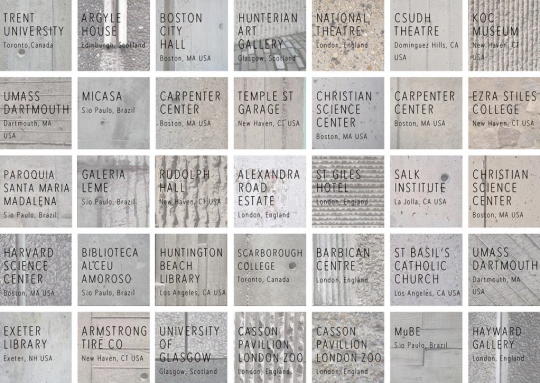
    image

    I say all this because if we believe that Brutalist architecture has no value then we are likely to believe that it doesn’t need to be preserved. And that may very well be the case for some Brutalist architecture. But if history is any indication, some or much of it may also be considered beautiful one day.

    Most cities have a rich history of demolishing (or almost demolishing) buildings and neighborhoods that today we would (or do) treasure. Which tells me that we’re not always very good at figuring out what has value or will have value in the future.

    So maybe some of those brutes are worth a second look.