Daily insights for city builders, delivered every morning at 6 AM ET. I’m Brandon Donnelly — a Toronto-based real estate developer and founder of Globizen. I’ve been writing here since 2013.

Tag: bridge

  • A fixed transport link between Great Britain and Northern Ireland

    Here is a report that was just published looking at the feasibility of a fixed transport link between Great Britain and Northern Ireland across the Irish Sea. It is part of a study known as the Union Connectivity Review, but according to the report, this idea has been floating around since at least the middle of the 1800’s. This recent report claims to be the most rigorous of the bunch though.

    What they discovered is that it would be — you guessed it — super expensive. Somewhere in the range of £209 billion for a tunnel crossing and £335 billion for a bridge crossing. And it would take some 30 years before something like this could be operational when you consider planning, design, construction, and the various legal processes that something like this would require.

    So the recommendation was to stop and do nothing. But if any of you are curious about what it would take to build across the Irish Sea, here’s your chance.

  • New 3D-printed bridge erected in Amsterdam

    This 12-meter 3D-printed stainless steel bridge was recently erected in Amsterdam. As is par for the course, some people hate it and some people love it. I’m in the latter camp.

    Designed by Joris Laarman Lab in collaboration with MX3D and Arup (engineering), the bridge was printed off-site over a 6 month period and then craned into place.

    3D printing stuff isn’t new; but it is interesting to see the technology being used for this real world application. Supposedly it’s the first 3D-printed stainless steel bridge. There are claims out there for other materials.

    What is also interesting is that the entire bridge has been outfitted with sensors so that things like pedestrian usage, corrosion, and load changes can be measured going forward.

    Construction is generally a messy process. And it’s kind of amazing how little it has changed over the years. I don’t think that there’s any question that this represents the future of building.

    Images: Thea van den Heuvel via Dezeen

  • Norway’s $47 billion coastal highway

    The E39 highway in Norway runs along the west coast of the country and connects Kristiansand in the south to Trondheim in the north. There’s also a ferry connection to Denmark that forms part of the route. The entire highway (excluding the ferry south to Denmark) is about 1,100 km. But it takes about 21 hours to drive it because Norway’s dramatic fjords (see above photo) mean that there are seven ferry crossings along E39. The Norwegian government wants to transform the route into a ferry-free highway, which would dramatically reduce travel times. But this presents a number of extremely difficult engineering challenges — some of which haven’t been solved yet. You can learn about a number of them in the below video from The B1M. If you can’t see it below, click here. It’s a fascinating video.

    Photo by Christiann Koepke on Unsplash

  • Good vibrations

    image

    There are 614,387 bridges in the United States and 55,707 of them are thought to be structurally deficient according to the US Department of Transportation (2016). About 188 million people cross “a deficient bridge” every day in the US (also a 2016 figure).

    Inspections are often infrequent and only visual, and so MIT Senseable City Lab is currently on a mission to come up with a more scientific approach. They believe that there’s a solution in crowd-sourced data and that it’s possible to create a community-driven maintenance program.

    What they discovered through a recent study, called Good Vibrations, is that mobile phone sensors can actually pick up the natural vibrations and oscillations of a bridge. And, that a mobile sensor located within a traveling car is actually 120x more precise than fixed sensors located on the bridge.

    Part of the problem is that fixed sensors have poor spatial coverage. They are located in specific locations. Whereas mobile sensors give you data across the entire span of the bridge as someone crosses it. And if you know how a bridge normally vibrates, you can quickly tell when something is off. 

    Here’s a quick video overview of the study. And here’s what you should do if you want to get involved.

    Photo by Joseph Barrientos on Unsplash

  • This river I step in is not the river I stand in

    image

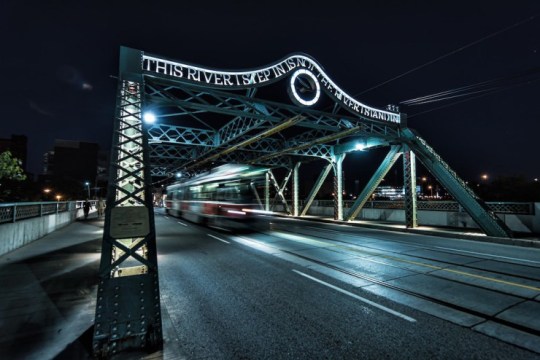
    I was over at the Riverside Bridge yesterday taking photos and I was reminded of Eldon Garnet’s installation called, TIME: AND A CLOCK (1995). 

    The work spans a few physical sites, but perhaps the most well known component is the line of text on the west side of the bridge, which reads in 18″ high letters: “This river I step in is not the river I stand in.” (Photo above from Garnet’s website.)

    If you’re from Toronto, you may be already be familiar with this installation. But I love the message and I think it’s an important one. So I thought I would reiterate it here on the blog. 

    The text is derived from the thinking of the Greek philosopher Heraclitus. Its meaning is a simple one: change is fundamental to the universe. 

    Neighborhoods change. Cities change. Industries change. We change. The river you first step into, is not the same river that you’ll be standing in. That initial river has come and gone, replaced by a new river. In the words of Heraclitus, “No man ever steps in the same river twice.”

    As people, organizations and cities age, there can be a tendency to resist change. I believe in fighting that tendency. 

    Because that’s how established rich companies get destroyed by young poor companies. They – the incumbents – underestimate the importance of change. They forget that the river is constantly flowing.