Daily insights for city builders, delivered every morning at 6 AM ET. I’m Brandon Donnelly — a Toronto-based real estate developer and founder of Globizen. I’ve been writing here since 2013.

Tag: brexit

  • The world’s biggest fishing port

    Here is an excerpt from a Guardian article that was published last year (by Tim Burrows) about Grimsby, England:

    In Grimsby’s 1930s heyday, fishermen used to head to Freeman Street as soon as they were off the trawler, straight to the Lincoln or the Corporation Arms to spend their bountiful earnings. A century previously, Grimsby had been a fairly sleepy fishing village, but by the 1890s it was on the way to becoming the biggest fishing port in the world. In the mid 20th-century, trawlers were bringing in 500 tonnes of fish a day.

    Today, Grimsby still has a thriving indoor market (paid for by the EU and the Enrolled Freemen of Grimsby, an organisation that dates back to the 13th century), but the further north towards the docks you walk, the emptier and more dilapidated things get. A local businessman says sex workers wait around at night for lorries to take them to the deserted docks. “It’s a legacy of the old fishing days.”

    There is scant legacy to be found elsewhere. After a long decline, the fishing industry died in the mid 1980s, its owners selling their trawlers to companies in Aberdeen or Japan. Unlike Hull across the river, currently basking in its year as Capital of Culture, Grimsby is the Humber city that never was.

    More than 70% of people in Grimsby, England voted to leave the European Union in the 2016 “Brexit” referendum. It was one of the highest shares in the country. But with one of the highest unemployment rates in the country, that outcome is not all that surprising.

    Supposedly, at its peak, there were eight onshore jobs for every one at sea in Grimsby. And like all thriving cities, there were economies of agglomeration, which resulted in things like the largest ice factory in the world. The fishing fleets needed crushed ice — and lots of it.

    The Grimsby story is, of course, not a unique one. You just have to replace fishing with some other industry. Many cities have managed to diversify their economies either out of necessity or because they saw the writing on the wall. But for others it has been a real struggle.

    It’s one of those things that is perhaps simple, but far from easy.
  • Open for business

    I just received the September issue of Monocle magazine. One of the features I always read is the “Observation” on the very last page. It reads as the editor in chief’s personal blog.

    In this issue he talks about the recent EU referendum and the changes he is making to his business in response to that. Monocle is headquartered in London, but he is now finding it challenging to be “an international media business in a country that hasn’t figured out how it’s going to move forward.”

    His response?

    They are shoring up the Zürich office. They are looking at the possibility of a second bureau somewhere on the continent. And they are similarly looking to increase staff in both Toronto and Singapore.

    When one place closes up, the companies and talent will find other cities that are open for business. 

    As someone who is closing one chapter this week and starting a new one, Tyler Brûlé’s Observation also reminded me of the importance of change. Oftentimes change feels uncomfortable. But that’s not necessarily a bad thing. In fact, it’s more likely a sign that you’re on to something.

    What have you done lately that made you feel uncomfortable?

  • How the UK voted

    For some reason, I woke up extra early this morning, well before my alarm. As soon as I came to and noticed the time, I immediately reached for my phone to pull up Twitter and see what happened with the UK referendum. And frankly, I was shocked to see that they had voted to leave the EU. 

    Once I saw what had happened, I then went to my computer and started looking for maps of the voting results. 

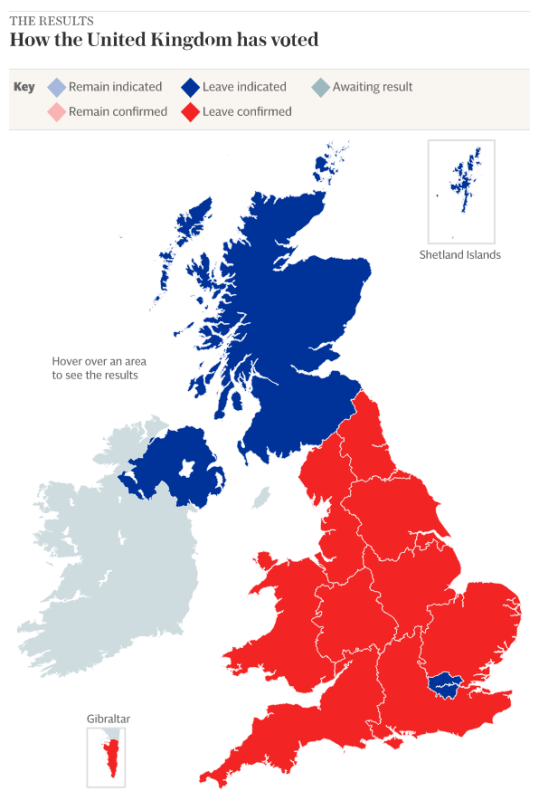
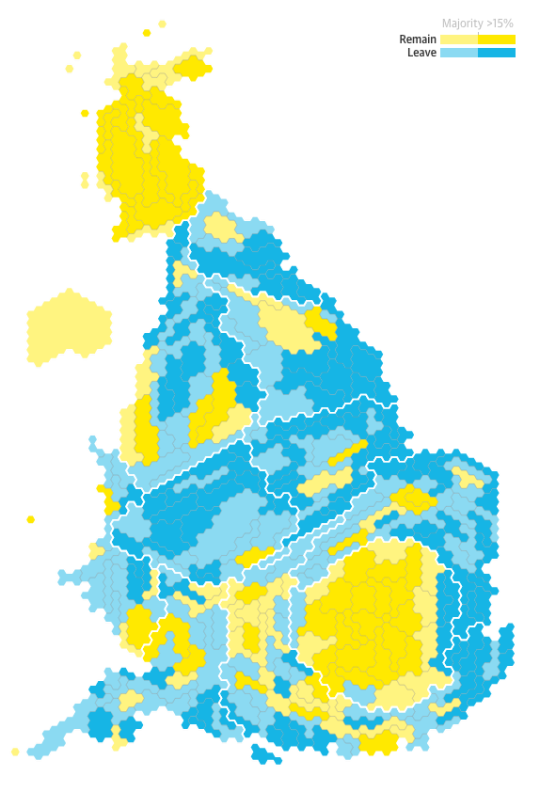
    Here’s one from the Guardian:

    image

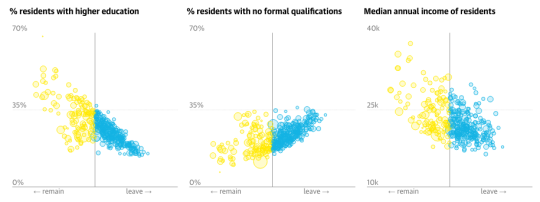
    They also found that the best predictor of how people voted (with Scotland being a bit of an exception) was whether or not they had a degree. Residents with higher education were more likely to vote “remain.”

    image

    Here’s another vote map from the Telegraph, broken down by 12 regions:

    image

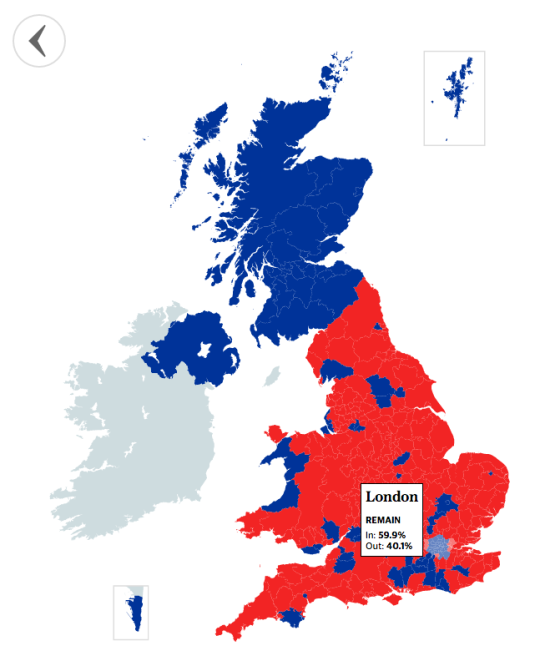
    According to these regions, only Northern Ireland, Scotland, and London voted to remain. If we get a bit more granular though, the map turns into this:

    image

    Not surprisingly, it is London and other big cities (remain) vs. the rest of England (leave). Here’s another case of urban divide.

  • Should I stay or should I go?

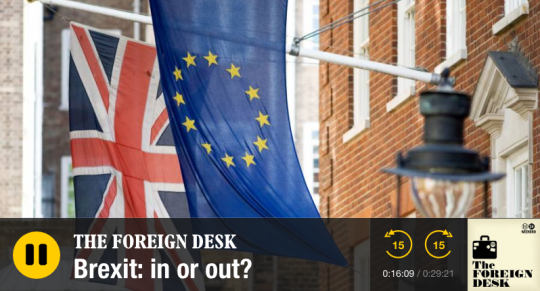
    I’m listening to The Foreign Desk this morning while I have my coffee. Steve Bloomfield is interviewing two different politicians: one who believes Britain should remain in the EU and one who believes Britain should leave the EU. 

    (Each interview is about 15 minutes short.)

    The back and forth is largely centered around two things: the economy and immigration. Will the British economy be better off in or out of the EU? And on the immigration front, will “in” translate into millions of Turks flooding into Britain should Turkey join the EU?

    For those of you who haven’t been following, Britain will be holding a referendum on June 23rd (2016) to decide whether they stay or go.

    My general view is that a strong economy should trump concerns over foreigners. But I don’t feel as if I know enough about this precise topic to take a firm position.

    Regardless, I very much enjoyed The Foreign Desk episode this morning and I would be open to discussing this issue in the comments below if any of you are also interested.