
Daily insights for city builders, delivered every morning at 6 AM ET. I’m Brandon Donnelly — a Toronto-based real estate developer and founder of Globizen. I’ve been writing here since 2013.

Tag: branded residences

  • Branded residences are a luxury good

    Elevate Miami, which I wrote about last month, just announced a number of new speakers and, more specifically, a number of new high-rise development projects that will be discussed at the conference. They are (not an exhaustive list):

    • Dolce & Gabbana Residences, Miami
    • Mercedes-Benz Places, Miami
    • Aman and One High Line Residences, New York
    • Indian Creek Residences & Yacht Club, Miami Beach
    • Edition Residences, Miami
    • AGE360, Curitiba, Brazil

    What should be clear from this list is that Miami is like a different planet. It is one of the places where the richest people in the world go to spend their money, much of it on real estate. Because of this, you can think of this real estate as a luxury good, which is why so many of them are now branded.

    In economic terms, a luxury good is typically defined as a good where demand increases — more than what is proportional — as incomes rise. For example, if a person’s income goes up by 1%, but their demand for a particular thing goes up by 5%, then this thing would be considered a “luxury good,” as opposed to a “normal good.”

    The technical definition is an income elasticity of demand that is greater than 1. More simply, this just means that as someone starts making more money, they will start spending a greater percentage of their income on luxury goods. This is in contrast to “necessity goods,” where it doesn’t matter how much money you make, you only need so much toilet paper, for example.

    What all of this suggests is that as people from all over the world get rich, they are likely to want more branded residences in a place like Miami. However, the flip side of this dynamic is that as incomes fall, the demand for luxury goods should, in theory, also fall more than what is proportional. It works both ways.

    So I’ll be curious to hear — from the developers at Elevate — how things are going right now. We’re at a time in the real estate cycle where everyone is rethinking their strategies. Or maybe, Miami truly is a different planet.

  • The art of high-rise living

    Today, I’m excited to share that I’ll be attending the second annual Elevate event this December as an industry ambassador. This means I get to ride alongside industry celebrities like Norm Li. (He better be DJ’ing.)

    Put on by Zonda, in partnership with Livabl and ARCHITECT Magazine, the event is focused exclusively on “the art of high-rise luxury living.” Everything from the overall state of the housing market to how to sell branded residences.

    Here’s the agenda and here’s the list of speakers.

    I wasn’t able to attend last year, but I heard from a number of industry friends that it was very well done, which is why I agreed to participate this year. That now means I have a discount code you can all use if you’d like to attend — BRANDONVIP30.

    For those of you who like art and culture things, the event also happens to fall right after Art Basel. This was done on purpose, and so now you have at least two good reasons to be in Miami Beach in December.

  • The growth of branded residences

    A branded residence is, as the name suggests, a residential building with a known branded attached to it. Historically, these have tended to be hotel brands. But it really just needs to be any brand that people know, care about, and will pay a premium for. So it could also be a fashion brand, a car brand, or whatever else.

    This is a growing segment of the residential market. According to UK-based Savills, there were only 15 or so of these “schemes” in the 1990s (the UK uses scheme in lieu of project, which always sounds conniving to me), but by the end of this decade they expect the pipeline of branded residences to exceed over 1,200.

    I would also argue that projects designed by celebrated architects and/or designers are a form of branded residence. And this is not being captured in Savills’ number above.

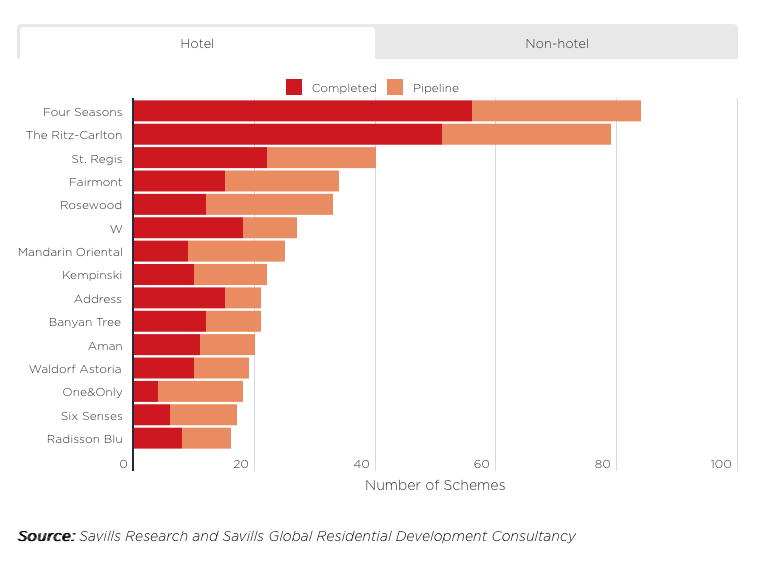
    Whatever your definition, today, the branded residence capital of the world seems to be Dubai, which feels right. And the biggest brands, by what appears to be a long shot, are Four Seasons and Ritz-Carlton (hotel side), and YOO and Trump (non-hotel side). Here are the full rankings from Savills:

    This is an interesting part of the real estate business for a few reasons. One, it makes sense. A New Balance shoe that gets co-branded with Aimé Leon Dore unlocks additional value for both sides. ALD has a brand that certain people care about. So, of course the same would be true of real estate paired with the right brand.

    Two, it’s a growing market, and I think this is aided by the fact that development is an intensely local business — so it can be hard to grow a globally-significant brand on your own. Sometimes you just need to borrow someone else’s.

    And three, it’s usually a less risky approach to getting your name on buildings. Branded residences typically operate on a licensing model, which means developers pay for the right to use the brand. The brand may also capture some of the upside in the form of a percentage of sales. That’s less risky than putting up your own money.