Daily insights for city builders, delivered every morning at 6 AM ET. I’m Brandon Donnelly — a Toronto-based real estate developer and founder of Globizen. I’ve been writing here since 2013.

Tag: brampton

  • The densest downtowns in Canada

    A few days ago I tweeted this chart out (from Statistics Canada):

    It is a list of the densest downtowns in Canada (people per square kilometer). But to be more precise, it is a list of the densest primary downtowns for each census metropolitan area.

    In the case of Toronto, for instance, it considers downtown Toronto, but it does not consider downtown Mississauga, downtown Brampton, or any other “downtowns” across the CMA. And in the case of Vancouver, it ignores important centers such as Burnaby.

    Many were quick to point this out on Twitter and it is a fair comment. Our cities are often more polycentric than a chart like this might make it seem.

    The other thing to consider is that these density numbers are dependent on what you assume as the boundary for each downtown. For downtown Vancouver it’s a fair bit easier because it is a peninsula surrounded by water.

    But for downtown Toronto, it’s more nebulous. Where do you draw the line? In this case, Statistics Canada is using the same downtown boundary as what’s in our Official Plan, but that happens to include the lower-density University of Toronto lands. So are we comparing apples to apples?

    I don’t know. But go Hamilton!

  • Brampton is building a ton of secondary suites

    Here is an interesting housing chart from Ryerson University’s Centre for Urban Research (CUR) using data from CMHC:

    What it shows is (1) the number of new housing using created through the addition of secondary suites, such as basement apartments and laneway suites; (2) the number of housing units lost to demolition or “deconversions”, such as when a duplex or triplex gets converted (back) to a single-family home; and then (3) the net new units added over the last three years.

    In looking at the chart, you’ll see that the City of Toronto actually lost about 2,000 units from its existing housing stock between 2019 and 2021. Again, these numbers only consider what’s happening in the city’s existing low-rise residential housing stock. They don’t factor any of the housing supply being delivered through new condominiums and multi-family apartments.

    Still, it’s evidence for something that is perhaps already well known: many of Toronto’s low-rise neighborhoods are losing people. They are losing people because the existing structures are housing fewer residents and they are losing people because we make it difficult to build new housing. We want them to be “stable.” But stable built form doesn’t necessarily mean that things aren’t changing on the inside.

    Now compare this to what’s happening in Brampton (a suburb of Toronto). CUR is calling Brampton the land of secondary suites. Over the last three years, it added nearly 11,000 housing units and was on pace (at the time the data was published) to create nearly 6,000 last year alone (most of which are basement apartments). This is all within its existing housing stock.

    With all of this, I think there’s an interesting question about about how much of this is being driven by market demand and how much of this is being driven by land use policies. There’s obviously demand for expensive single-family homes in Toronto, which is why “deconversions” are happening. But to what extent does this change if/when we become more permissive around multi-unit dwellings?

    I think it depends on how we craft the policies.

  • Suburban household debt in Canada

    Rachelle Younglai and Chen Wang’s recent piece in the Globe and Mail on suburban household debt (in Canada) has a number of interesting stats. Here are some of them:

    • Looking at debt service ratios across the country, the most financially stressed neighborhoods in Canada are almost exclusively in the suburbs. (Map of the Greater Toronto Area shown at the top of this post. Data from Environics Analytics.)
    • 34 of the top 100 most financially strained neighborhoods in Canada are located in Brampton, Ontario.
    • Brampton has grown at 2x the rate of Toronto over the last decade.
    • 43% of Brampton’s housing was built between 2001 and 2016.
    • 80% of homeowners in Brampton have a mortgage compared to 63% across the Toronto region as a whole.
    • 80% of Brampton’s property tax revenue comes from residential property (not surprising). In comparison, 47% of Toronto’s property tax revenue comes from commercial properties.
    • About 2/3 of Brampton’s work force leaves the city for their job. This makes sense given the above point.

    The other thing the article talks about is the increase in the average household size in many suburban communities as a result of people renting out parts of their house.

    One Brampton gentleman is quoted as saying that he rents his basement out to 3 or 4 students and his upstairs bedrooms to two truckers. This translates into typically 6 vehicles parked in his driveway.

    Assuming this is the trend, I wonder how much of this additional income is being reported to CRA. Because if it’s not, then it could be throwing of these debt ratios and making the financial situation look more dire than it is.

    In any event, I think this speaks to, among other things, the role that many suburban communities now serve for new immigrants coming to Canada. They are doing what they can to try and get ahead.

    It’s also worth noting that if you look at the above map of the Greater Toronto Area, the lowest “debt spots” are in fact where homes tend to be the most expensive — the core.

    Map: The Globe and Mail

  • Online shopping and “last mile” real estate

    The Globe and Mail recently published an excellent article on “how e-commerce is driving a real estate revolution.” This is a topic that I’m very interested in: how online manifests itself offline.

    Not surprisingly, the article talks a lot about Amazon, including their 4th warehouse in the Greater Toronto Area, which is an 850,000 square foot facility in Brampton equipped with 350-pound robots (8050 Heritage Road).

    The first thing I did after reading the article was figure out the location of all of Amazon’s fulfillment centers in the GTA. Amazon doesn’t seem to publish this. But according to TaxJar, they are here (I mapped out the addresses):
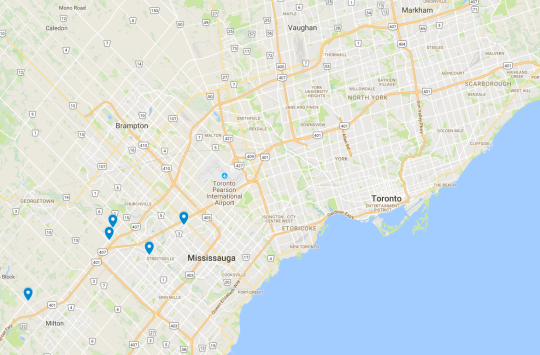
    There are two in Brampton at the precise location where Hwy 407 (toll route) and Hwy 401 meet. The other three are distributed along Hwy 401 in Milton and in Mississauga.

    Now let’s get back to that Globe and Mail article:

    – In 6 years, Amazon has leased over 2 million square feet of warehouse space in Canada.

    – Toronto is the third largest warehouse market in North America. It represents 43% of Canada’s total inventory.

    – Average net rents have increased 9.7% over the past year and vacancy rates have dropped to 2.7% (CBRE data). In Vancouver, those same numbers are 5.1% and 3%, respectively.

    – Online shopping is thought to account for about 6.5% of all retail sales in Canada. But in Toronto, 23% of all industrial space is already e-commerce-related (CBRE data, again).

    – CBRE believes that every $1 billion in new online sales per year requires an additional 1.25 million square feet of warehouse space. 

    – Based on online sales projections, Canada needs another 27.5 million square feet of industrial space over the next 5 years. We don’t have that much space in the pipeline.

    – Clear heights are increasing for stacking purposes. Amazon’s new Brampton facility is 45 feet tall / 4 floors. 10 years ago new warehouses were 26 feet tall.

    – Average sale price of warehouses in the GTA has gone from $119.35 psf to $142.19 psf over the last year.

    Perhaps the most interesting takeaway from the article is the discussion around “last mile” distribution hubs. These are fulfillment centers located closer to the city, which are used to offer shorter delivery times: 

    “…instead of having inventory stored for days or months, these fulfilment centres will turn over their inventory in one day, sometimes twice a day.”

    This is something that I addressed in my recent presentation about the “mall of the future” at B+H’s retail design charrette. Where do these physical distribution centers want to be as online sales continue to grow and delivery times continue to compress? Where’s the future growth?

    According to this article, it’s going to be in “last mile” fulfillment real estate – relatively smaller spaces that are located very close or directly in the city center.

    Photo by Samuel Zeller on Unsplash
