
Daily insights for city builders, delivered every morning at 6 AM ET. I’m Brandon Donnelly — a Toronto-based real estate developer and founder of Globizen. I’ve been writing here since 2013.

Tag: boulevard

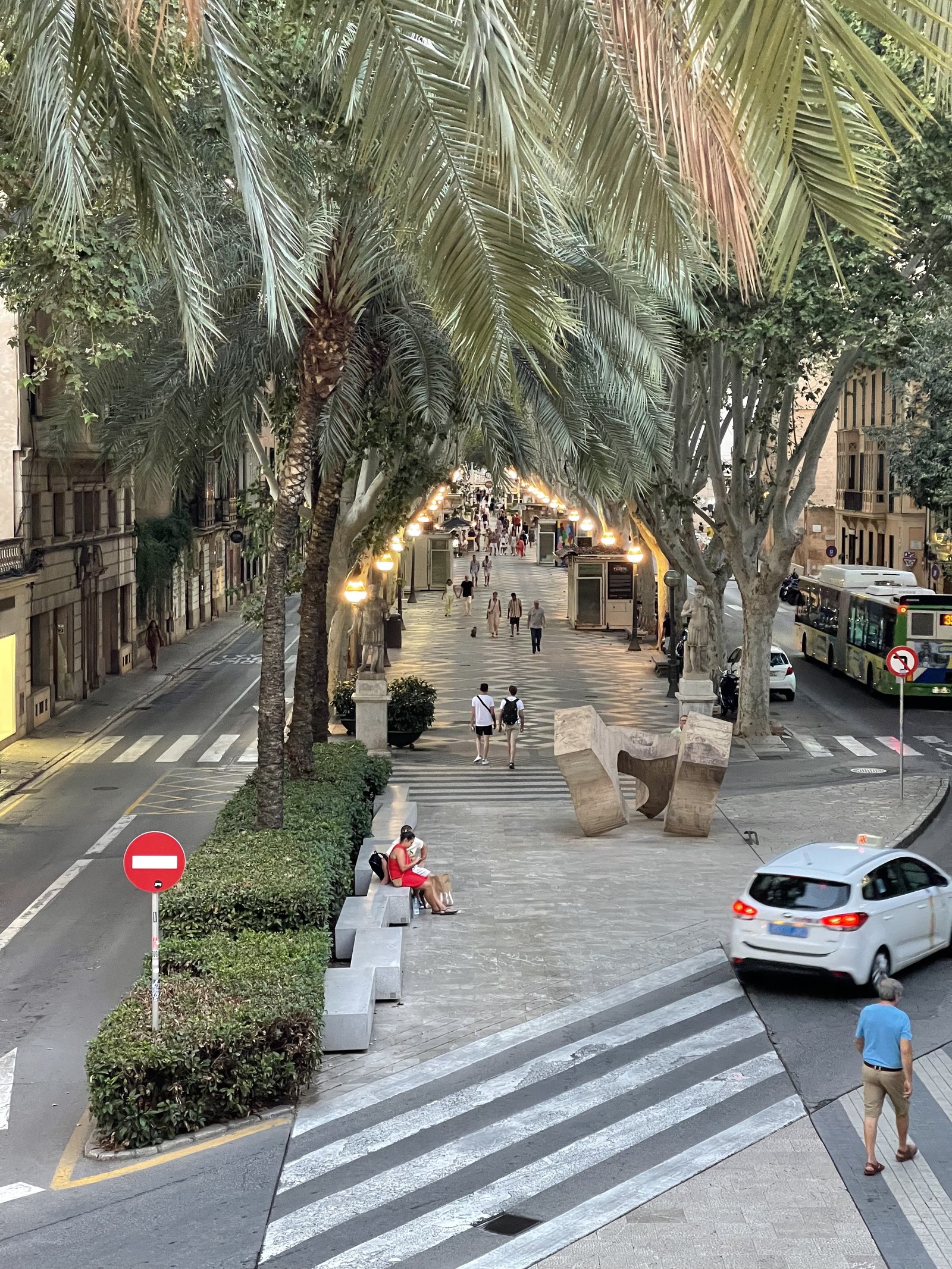
  • La Rambla

    It’s hard to think of Barcelona and not think of its famed street, La Rambla. But this same street design (and name) also appears in other cities throughout Spain. The above two streets are in Palma. The first is also called La Rambla (which is supposedly derived from an old Arabic word meaning sandy riverbed) and the second is called the Paseo del Borne. Both follow the exact same urban design principles. They’re broad tree-lined streets with a large center median dedicated to only pedestrians. All car traffic is relegated to the sides. What’s great about this design is the following. One, it reallocates public space according to who uses it the most (i.e. pedestrians). Two, it consolidates the main pedestrian realm (in lieu of just having larger sidewalks on either side of the street). And three, it establishes a clear hierarchy for the street. Pedestrians are most important here, and that’s why they get the center position. It’s surprising that more cities don’t adopt this same design.

  • Are multi-way boulevards at least part of the answer?

    This short video by City Beautiful makes the case for multi-way boulevards. The way to generally think about a multi-way boulevard is that it is a really big street that has been subdivided into areas that move cars relatively quickly and into areas that are a bit more conducive to calmer traffic and doing things like cycling and walking. More specifically, they are streets that have local access lanes on either side.

    And in this video, it is proposed as a possible fix for two kinds of situations: (1) as a solution for what to do when you take down an elevated highway and (2) as a solution for retrofitting suburban arterial roads. I thought this would be a good video to share given that I can think of an elevated highway that should come down and because I have written before about how challenging it can be to change streets after they’ve been built. They tend to be pretty sticky.

    But beyond this, it’s also a good primer on how suburban transportation approaches are highly effective at making cities that you can’t walk around in.

  • Before & After: Queens Quay Boulevard

    Yesterday I spent the evening walking Toronto’s new Queens Quay Boulevard, which fully reopened this past Friday after a number of years of construction. 

    It is part of Waterfront Toronto’s revitalization efforts and represents a solid decade in the making. West 8 of Rotterdam and DTAH of Toronto won the international design competition for the central waterfront back in 2006. And this past weekend a big component of that vision was unveiled.

    But first, let’s take a look at what Queens Quay Boulevard used to be like. Here’s a Google Streetview image from 2009:

    image

    The streetcars ran in the middle of the street. Cars drove on the north and south side on both sides of the tracks. And the sidewalks were fairly small and usually at capacity during the busy summer months. It wasn’t a great street.

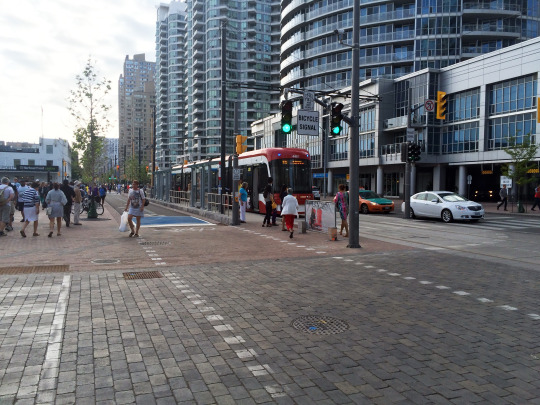
    Now here’s a photo that I took yesterday from that same vantage point (2015):

    image

    The street has been completely reorganized. On the north side of the streetcar tracks is where the cars now drive in both directions. On the south side of the tracks the lanes of traffic have been replaced with a 2-way bike trail (part of the Martin Goodman Trail). And on both sides the pedestrian areas have been greatly expanded. It’s now a magnificent street.

    If you haven’t yet been down to the new Queens Quay, I would encourage you to check it out on either foot or bicycle. (If you go on bicycle, let me know and I’ll join you.) 

    Toronto may have taken a giant step backwards with its recent decision on the Gardiner East, but we also took a giant step forward with the reopening of Queens Quay Boulevard.

  • On boulevards vs. freeways

    Toronto’s Director of Urban Design, Harold Madi, recently did a 20 tweet series on boulevards. And since today is Gardiner East day, it seems appropriate to share it with you all. Thanks to Shawn Micallef for using Storify to put it all together neatly. If you can’t see all the tweets below, click here.

  • 14 CityBuilders come together in support of removing the Gardiner East

    This will probably be my last Gardiner East post before the decision goes to City Council next week on June 10th. But I have such good news that I need to share it with you all.

    This morning 14 “CityBuilders” came together for the first time in support of removing the elevated Gardiner East and replacing it with a surface boulevard. They are real estate developers, investors, and other prominent business leaders in the city. And they sent a letter this morning to every single Toronto City Councillor outlining their position. 

    I can’t tell you how thrilled I am to see this happen, so I’d like to call out each and every member of the CityBuilders. They are (in alphabetical order):

    1. Castlepoint Numa
    2. Cityzen Development Corporation
    3. Context Development
    4. Continental Ventures
    5. Daniels Corporation
    6. Distillery Historical District
    7. Dream Unlimited Corporation
    8. Greybrook Capital and Greybrook Realty Partners
    9. Kerbel Group Inc.
    10. Manulife Real Estate
    11. QQE 162
    12. Streetcar Developments
    13. TAS
    14. Tridel Group of Corporations

    These are some of Toronto’s most important city builders and I am sure this will get the attention of both Mayor John Tory and the rest of City Council.

    If you haven’t yet signed the Gardiner East petition that Stephen and I started, please do so by clicking here.

    Happy Friday 🙂

  • 32

    Today is my 32nd birthday. It felt like a beautiful summer day here in Toronto and so I mostly took the day off from anything too serious.

    At 1:00pm though, I did participate in a Jane’s Walk taking place right around the corner from me. As part of that, I spoke briefly about why I think Toronto should remove the eastern portion of the Gardiner Expressway and replace it with a surface boulevard.

    Given what the other speakers had to say and given some of what I heard at the event, this is definitely not a universal position. In fact, one person commended me on taking a “courageous stance.”

    A number of people seemed to support Quadrangle Architect’s Green Ribbon proposal and/or the notion that, whatever is done, the Gardiner Expressway must remain in operation.

    At the same time, quite a few of the people I spoke to seemed unsure of any position and instead came to the walk simply to learn more about the options. Hopefully by the end of it they were closer to one.

    If I have one piece of constructive feedback on the walk it’s that it wasn’t interactive enough. It’s fine to standup and talk for 5 minutes, but it would have been great to also have a discussion and debate. At the very least, I would have liked to see where most people stand. Hopefully you will all share that in the comment section of this post.

    I continue to believe that removing the Gardiner East is the right city building decision. But I also respect anyone who is willing to take a firm stance. Toronto City Council has already punted this decision before. It’s now time to make a decision and own it.