Daily insights for city builders, delivered every morning at 6 AM ET. I’m Brandon Donnelly — a Toronto-based real estate developer and founder of Globizen. I’ve been writing here since 2013.

Tag: blue jays

  • October baseball in the city

    You can have one of the best records in the league or you can be slumping right before the post-season, and none of that matters when the month of October hits. Such is baseball. And such is life.

    What does help, though, is being bold. The Blue Jays got lucky on Sunday night with Odor’s throwing error. But Donaldson was also willing to take a chance and make a run for home plate. It paid off in a big way. His instincts were right.

    I found the above image on social media without a source. If I’m pissing anyone off by posting it here, let me know and I’ll take it down. I just love how it captures the exact moment – with the ball still in the air – when Donaldson proclaims victory.

    Baseball will always be a special sport for me. I have never been a big hockey fan and the Raptors didn’t exist until the mid-90s. So as a kid growing up in Toronto, I played baseball and watched the Jays.

    So here’s to more October baseball. The playoffs are always such a fun time in the city. It has a way of cutting through our differences and uniting us all around a common dream. That doesn’t always happen.

  • How cities get branded

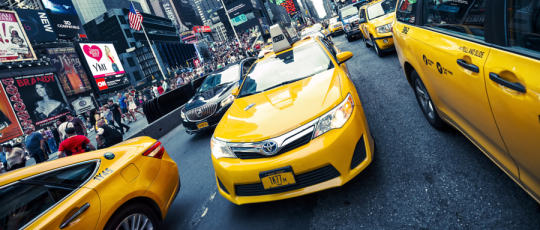
    Taxi on Times Square by frederic prochasson on 500px.com

    https://500px.com/embed.js

    I have been thinking a lot about city branding lately. It’s a topic I’m interested in to begin with, and all of the Blue Jays mania going on in Toronto right now has got thinking about our own brand.

    Because at the end of the day, yes, it’s baseball. But it’s also something much larger. It’s about civic and national pride, and it’s about who we are as a city. That’s why city branding has become a global industry and why it’s so closely connected to tourism, media, sports, and entertainment.

    Still, great city branding is incredibly difficult to do. Lots of cities have tried and lots of cities – from Adelaide to Toronto – have failed. Anyone remember the “Toronto Unlimited” brand of the mid-2000′s? It had absolutely zero stickiness.

    But in reality, cities are brand building all the time whether they realize it or not. Here in Toronto, our biggest brand builder right now is probably Drake. That might sound silly to some, but I believe it to be true. And next to that, you have people like Jose Bautista with his bat flips and his support of local brands like Peace Collective. In addition to their day jobs, these people are helping to shape the identity of the city.

    What, then, is professional city branding supposed to do?

    Well, in my opinion, it is their job to mine a city for the things that already exist. A city brand, no matter how great it may be, cannot be expected to create something from nothing. There has to be something there to begin with.

    But once you identify that something, a great city brand can tie it all together; create a cohesive and collective identity; and serve as a guide for future decision making. And when that’s done effectively, you actually begin to enhance the things that you initially started out with. The associations become even more powerful.

    So today I thought we could have a discussion in the comments about city brands. How would you describe the brand of your city in one sentence?

    For me, I would describe Toronto along the lines of being the most livable and multicultural 24/7 global city. And when you think of it this way, you can probably see why I think a 2AM last call at the bar is laughable.

  • The economic benefits of a winning sports team

    Jays Game 2 by Charles Bodi on 500px.com

    https://500px.com/embed.js

    I was having round 1 of (Canadian) Thanksgiving dinner with my father on Saturday night and we inevitably started talking about the Blue Jays.

    As I write this post, the Blue Jays are down 2-0 in the ALDS, but by the time you read this email in your inbox (assuming you subscribe), game 3 will have already happened. Either the Jays will be on their way to a great comeback or the season will be over. I am remaining fiercely optimistic.

    But in addition to the regular sports chatter, we also started talking about the possible economic benefits of the Blue Jays winning and being in the playoffs for the first time in decades. 

    We assumed that 50,000 people buying tickets, heading downtown, and spending money on food, alcohol, parking, transit, taxis, and hotels, would be a great benefit to the local economy. And immediately I thought to myself: this would make a great blog post.

    But it turns out that the local benefits of professional sports aren’t so clear cut.

    There’s been a lot of research on public funding for sports stadiums and a lot of the research suggests that it may not be in the best interest of taxpayers. A considerable amount of the spending does not get retained by the local economy and instead gets siphoned off to the respective league and to concentrated private interests.

    But Toronto already has the SkyDome, I mean, Rogers Centre. It’s a sunk cost. So looking forward, there must be some incremental benefits.

    Well, a recent article in the Chicago Tribune asked this same question in light of the Cubs heading to the playoffs. And it turns out that it’s also not so clear cut.

    Part of the problem is something called the “substitution effect.” When a sports team starts winning (and people jump on the bandwagon), money is simply redirected away from other forms of entertainment towards sports entertainment. In other words, instead of going to see a movie or going to the museum, people go to the game.

    In fact, a 2001 study by Dennis Coates and Brad R. Humphreys called, “The Economic Consequences of Professional Sports Strikes and Lockouts”, found that during sports stoppages, 37 metro areas with professional sports franchises actually experienced no negative financial impact. And in many cases they performed better.

    Interesting.

    Having said all this, there’s a powerful sense of solidarity that takes over a city when everyone is rooting for the same team to win. And that’s hard to attach a value to.

  • A sports and entertainment corridor

    On Sunday afternoon I went to see the Blue Jays. It was the last home game of the season before the postseason and the only game I’ve gone to see this season. (Thank you Chris for the ticket.)

    And what a last game it was. 

    We won 5-4, but we hustled for the win. We squeaked it out at the end with a pinch runner that stole 2nd base (and then tied the game in the bottom of the 8th) and with Josh Donaldon’s walk-off home run in the bottom of the 9th with 2 outs. I’m pretty sure the Jays were hungover from celebrating their first playoff berth in 22 years – that’s why it was so close. It certainly made for a gripping finish though.

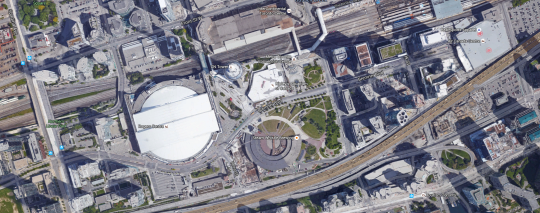
    After the game everybody was jazzed up and spilling out onto Bremner Blvd in front of the Rogers Centre. I’m not sure if it was premeditated or not, but the entire street was closed to cars. And it reminded me of something that I’ve thought for years: that Bremner Blvd should be made into a kinds of sports and entertainment corridor connecting the Rogers Centre in the west with the Air Canada Centre and Maple Leaf Square in the east.

    Bremner is not a long street. But it connects the place where Canada’s only (MLB) baseball team plays and where Canada’s only (NBA) basketball team plays. Right now it’s a fairly nondescript street. But it doesn’t have to be that way. It could be something really special.