Daily insights for city builders, delivered every morning at 6 AM ET. I’m Brandon Donnelly — a Toronto-based real estate developer and founder of Globizen. I’ve been writing here since 2013.

Tag: bloor street

  • The ROI of cycling infrastructure

    Toronto can’t make up its mind right now as to whether it would like to invest in additional cycling infrastructure. 

    Of course, we have a history of vacillating on topics like this. And I think it’s because we’re at a tricky inflection point. We are weaning ourselves off of the car, but most parts of the city remain underserved by transit and heavily dependent on the car.

    So today I thought I would share some numbers from a research study that was published last year by Stefan Gössling of Lund University and Andy S. Choi of the University of Queensland. It’s called, Transport transitions in Copenhagen: Comparing the cost of cars and bicycles.

    Much of the focus of the paper is on the cost-benefit analysis that the City of Copenhagen uses to make its cycling investment decisions. Here is an excerpt from ScienceDaily:

    “If the costs to society and the costs to private individuals are added together, the impact of the car is EUR 0.50 per kilometre and the impact of the bicycle is EUR 0.08 per kilometre.

    The study by Stefan Gössling and his colleague also shows that if we only look at costs/benefits for society, one kilometre by car costs EUR 0.15, whereas society earns EUR 0.16 on every kilometre cycled.

    “The cost-benefit analysis in Copenhagen shows that investments in cycling infrastructure and bike-friendly policies are economically sustainable and give high returns,” says Stefan Gössling.”

    So there you have it. Now I thought we could debate this in the comment section. Your thoughts?

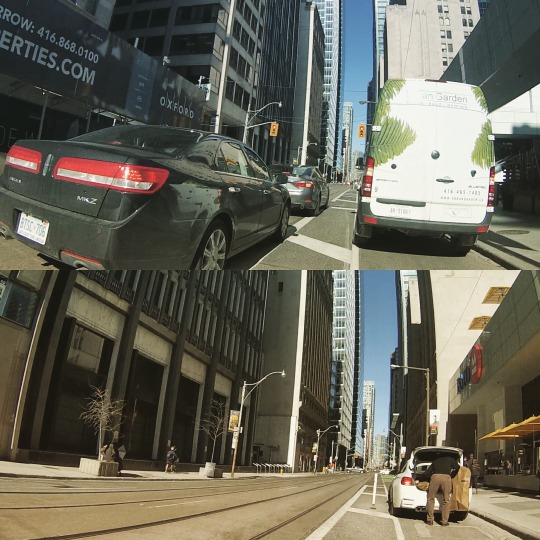
    P.S. The images at the top of this post were taken by me using my new GoPro bicycle handlebar mount.
  • Toronto’s Bloor-Danforth subway corridor is a land use crime scene

    image

    Yesterday after my post on leveraging LRT, I stumbled upon an interesting and timely article written by Richard Joy, who is the Executive Director of the Urban Land Institute (Toronto).

    The article talks about some of the transit-oriented development that we’ve seen at various nodes along Toronto’s Yonge subway corridor (St. Clair, Eglinton, Sheppard, and so on). But it goes on to argue that these are exceptions to the rule. For the most part, we’ve missed the boat:

    The tragic history of our massive capital investments into transit infrastructure is massive under-development.

    Indeed, the Bloor-Danforth subway corridor is a land use crime scene.

    His main argument is that until we expand the supply of transit-oriented land (through increased intensification), we will continue to undersupply the kinds of walkable and transit-oriented neighborhoods that many, if not most, people actually prefer. And that, out of necessity, will force people into their cars. Because affordability trumps location preference.

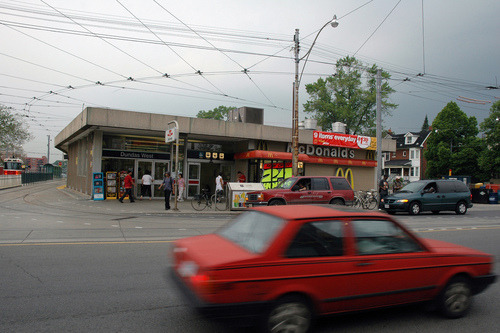
    As one example, he talks about the intersection of Bloor Street and Dundas Street in the west end of the city. Next to Union Station, this is probably the best connected mobility hub in the region. You have the Bloor-Danforth subway line, a streetcar line, and a GO regional rail line which all feed into it. Next year it’ll also become a stop for the new express train to Pearson airport.

    And yet the city has a history of opposing intensification in this location, including the old Giraffe Condominiums proposed by TAS. Does that make sense to you?

    Image: Flickr

  • A brief history of T. Eaton Co.

    image

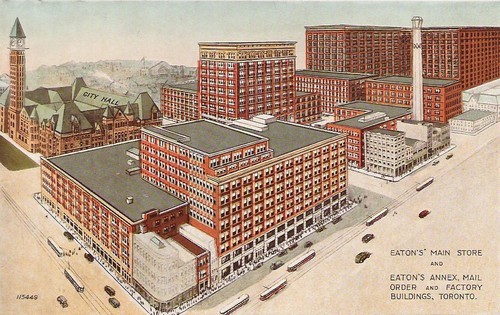
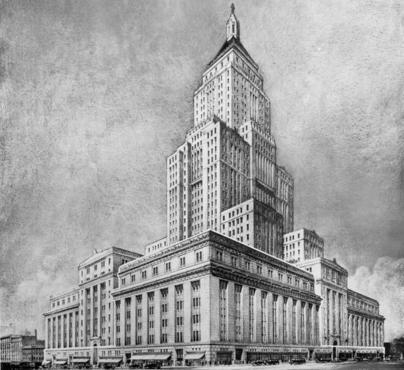
    I was out last night near Yonge and College for a friend’s going away party and the topic of the College Park building came up (originally an Eaton’s department store). We talked about how in the 1920s it was planned as a 38-storey Art Deco tower (see above photo), but that the Great Depression forced Eaton’s to scale back their plans. They ended up building a 7-storey building, albeit an impressive one.

    Then today, thinking about that discussion, I became curious about the story of Eaton’s. Where exactly did it start and how did they get to a point where they were planning the largest retail and office complex in the world?

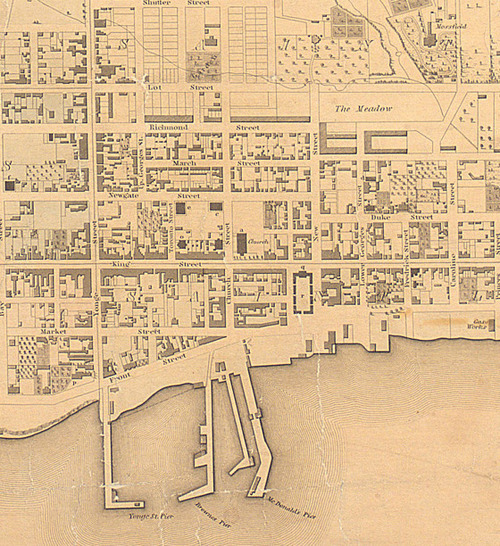
    Well, as many of you probably know or can guess, the first Eaton’s store was opened where the Toronto Eaton Centre mall currently sits today. The exact address was 178 Yonge Street, which is just north of Queen Street. But what was interesting about this location is that, at the time, it was considered to be far removed from Toronto’s center of fashion and retail. That was King Street East. Below is a map from 1842.

    image

    In 1869 when Timothy Eaton opened his first store, the heart of Toronto was what is today known as Old Town (although most people would probably just refer to it either as King East or as the St. Lawrence Market). People shopped along King Street between Yonge and Jarvis, and Queen Street probably would have felt out of the way.

    image

    But Eaton’s succeeded at Yonge & Queen, along with rival store Simpson’s, and retailing shifted northward. With Eaton’s College Street, the company was once again looking north. In fact, they wanted to move their entire operation from Queen Street up to College Street, and they even tried to get Simpson’s department store to do the same (somebody clearly understood agglomeration economies).

    But since the full build out of Eaton’s College Street never actually happened, both stores were kept in operation and a customer shuttle bus was run between the two of them (until the Yonge subway line opened up in the 1950s). With the opening of the Toronto Eaton Centre mall in the 1970s, Eaton’s closed both Queen and College Street locations, and consolidated operations near Dundas Street.

    In 1999, after 130 years of operation, the company went bankrupt.

    What I find interesting about this story is that it speaks to how dominant the department store business model was at the time and how it was shaping the city around it. If Eaton’s had achieved its vision for the corner of Yonge & College, Toronto might look a lot different today. Perhaps we’d all be shopping for fashion along College Street.