Daily insights for city builders, delivered every morning at 6 AM ET. I’m Brandon Donnelly — a Toronto-based real estate developer and founder of Globizen. I’ve been writing here since 2013.

Tag: billionaires

  • Billionaire wealth in China grew by 1146% over the last decade

    UBS and PwC’s recent report on billionaire wealth highlights some interesting trends about the global economy and global wealth.

    • Billionaire wealth in mainland China is now second to only the United States, having grown by about 1146% from 2009 to 2020, compared to 170% in the US. As of the middle of this year, it was sitting at about USD 1.7 trillion in China, compared to USD 3.6 trillion in the US.
    • Hong Kong remains a force with only 1,105 square kilometers of land (not all of which is developable). Billionaire wealth grew by about 208% to USD 356 billion over the same time period as above. That puts it ahead of the United Kingdom, Canada, and Brazil in total dollars.
    • About half of all billionaires seem to have a significant amount of their wealth invested in real estate. Somewhere between 21-40% of their net worth.
    • At the same time, the report identifies the real estate industry as having the fewest number of “innovators & disruptors.” Only 17% of billionaires (whose wealth is primarily derived from real estate) are classified in this way. The report calls out the sector as being “especially slow to embrace technology to boost efficiency.”
    • Perhaps the most interesting takeaway is that, even within the rarified billionaire community, tech is driving polarization. For most of the last decade, the sector didn’t matter all that much. The rich were getting richer. Now it’s more so the tech rich. And COVID-19 seems to be accelerating this trend.

    This is not to say that I think people are particularly worried about billionaires who maybe aren’t getting as rich as they used to. That’s like complaining about being too good looking. But it is clear that tech is driving a bunch of macro shifts in the global economy and this is just another example of that playing out.

    Image: UBS and PwC
  • Value of distribution and reach for consumer facing products

    image

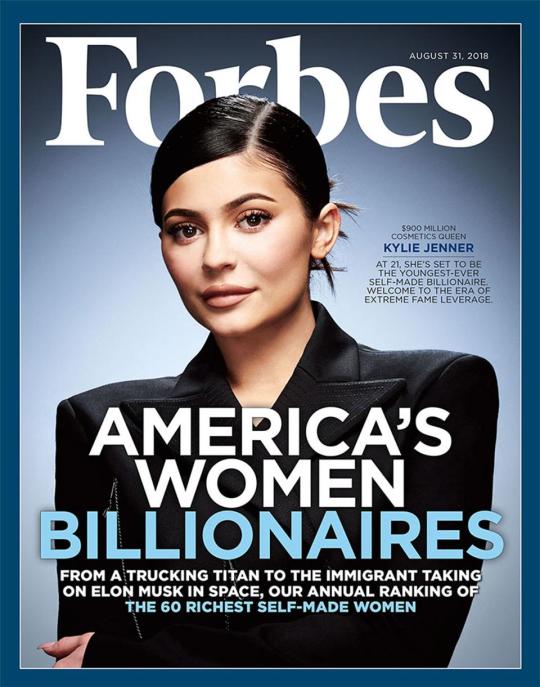
    Forbes recently pegged social media influencer Kylie Jenner’s net worth at somewhere around $900 million. That makes her the youngest (she’s 20) person on Forbes’ annual ranking of “America’s Richest Self-Made Women.” 

    And if the trend line continues, she’ll be the youngest self-made billionaire, ever. Mark Zuckerberg apparently holds that title right now. But he was a classic underachiever and only became a billionaire at age 23.

    Most of Kylie’s net worth is derived from Kylie Cosmetics, which launched less than 3 years ago, but did an estimated $330 million in revenue last year. Forbes values the company at almost $800 million. And Kylie owns every bit of it. 

    The reason I am mentioning this today is because I was fascinated by the above Forbes article. It’s such a powerful example of social media leverage. Forbes put it differently: “Social media has weaponized fame.” 

    Kylie has 111 million followers on Instagram (plus many more on her other social channels) and that’s really the most important part of this equation. She has the distribution and reach to acquire boat loads of customers. It doesn’t matter what you’re selling if nobody knows you’re selling it.

    The rest of her business is pretty much outsourced. Seed Beauty (out of Oxnard, California and Nanjing, China) handles the manufacturing, packaging, and shipping fulfillment. Shopify (headquartered in Ottawa) is her e-commerce platform.

    We could of course have a debate about whether a celebrity-fueled business is really all that sustainable. And perhaps there’s risk in relying so heavily on social for customer acquisition. But youngest billionaire is youngest billionaire.

    Image: Forbes

  • Jeff Bezos’ regret minimization framework

    Who better to talk about on Black Friday than Amazon’s Jeff Bezos. Supposedly he’s now worth $100 billion.

    I just finished watching this short 60 Minutes clip about Amazon from 1999. If you can’t see it below, click here.

    [youtube https://www.youtube.com/watch?v=fjjUOemW-_Q?rel=0&w=560&h=315]

    Amazon was founded in 1994, so this was 5 years in. Already the company had gone public and had a market cap of somewhere around $30 billion.

    Now, keep in mind that this was right in the middle of the dot com bubble, but already Bezos was a billionaire on paper.

    What is clear from the above clip is just how obsessed Bezos was and is on the long game (”I don’t go in for carpe diem”) and on his customers. Here he is worth quite a bit, but driving around in a Honda Accord. 

    Bob Simons, the interviewer, pokes fun at him a few times for his reluctance to spend money. But Bezos says that it’s all about spending money on things that matter to customers and not spending money on the things that don’t.

    That’s customer obsession.

    P.S. The title of this post will make sense once you watch the video.

  • Winner-take-all cities

    Richard Florida, Charlotta Mellander, and Karen M. King have a new working paper out called Winner-Take-All Cities.

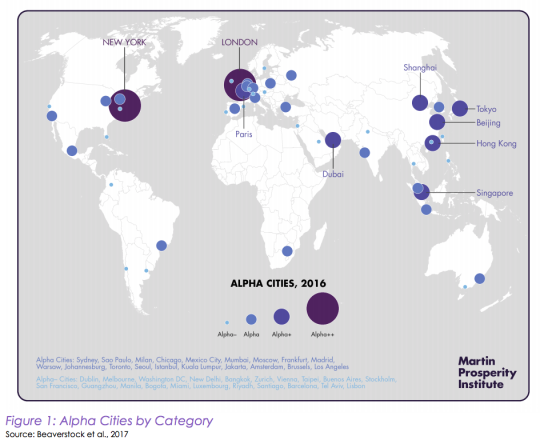
    It is about the phenomenon of “winner-take-all urbanism” and how a select number of alpha cities seem to overrepresent when it comes to talent, economic activity, innovation, and wealth creation.

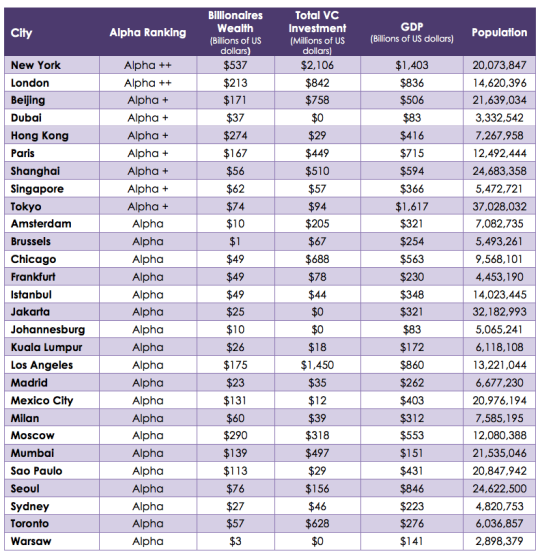
    In this study they look at economic output, innovation (venture capital-backed startups), and billionaire wealth in each city. They then compare these factors to the distribution of the population.

    Here are the Alpha cities they looked at:

    In some cases the above concentrations were multiples of what the city’s population would lead you to predict. Their conclusion: “We find clear evidence of a winner-take-all urbanism
    across the global economy and the world’s cities.”

  • Where the world’s billionaires live

    The Martin Prosperity Institute here in Toronto recently published an interesting report called The Geography of the Global Super-Rich.

    What they did was use the Forbes 2015 Billionaire List to chart billionaires and billionaire wealth by location and by industry. They also looked at the wealth gap in each location and whether the wealth was self-made or inherited.

    A correlation analysis was also done to see what key variables – such as population, density, economic output, global city standing, VC investment, and so on – were positively correlated with a greater concentration of super rich people.

    There are 1,826 billionaires across the world according to Forbes. The researchers were able to match 99% of them to a specific metro area / primary residence.

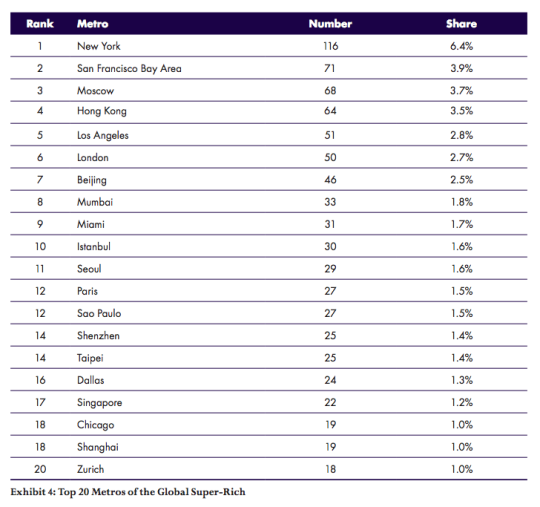
    Here are the top 20 metro areas in terms of the number of billionaires:

    image

    Look at Miami at #9. 

    I suspect that this may surprise some of you. But Miami has grown into a significant global city. As one of my friends from Miami likes to tell me: “The best thing about Miami is that it’s a Latin American city that’s so close to the United States.”

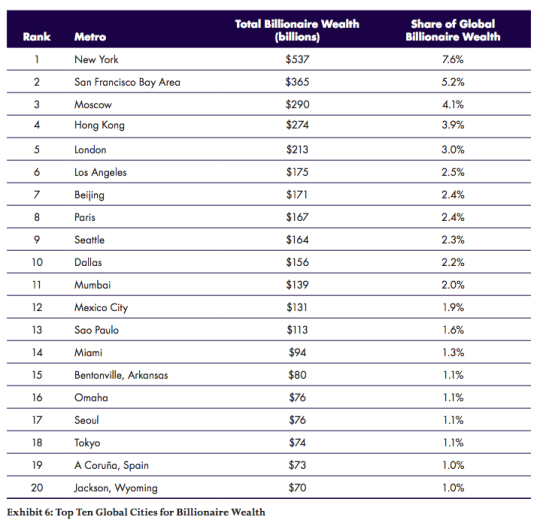
    Here are the top 20 metro areas in terms of total billionaire wealth: 

    image

    A bunch of changes on this list because of extremely wealthly people and families in places like Bentonville (Arkansas) and Omaha.

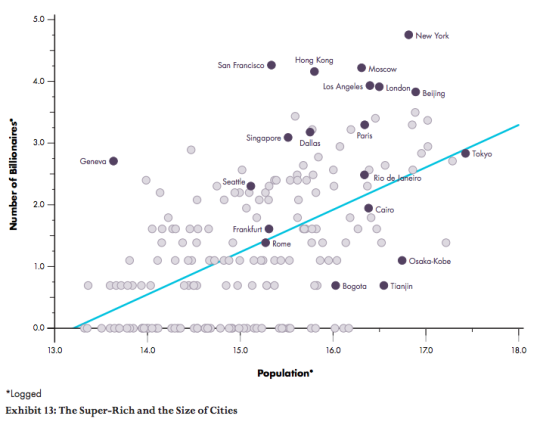
    One of the conclusions of the report is that the size of the city generally matters:

    “The geography of the super-rich is a function of larger cities. Both the number of billionaires and their net worth are positively associated with the population of global cities, with correlations of 0.56 for the number of billionaires and 0.44 to their net worth.”

    Here is a chart comparing population to the number of billionaires:

    image

    Cities such as New York, Moscow, and Hong kong, which sit far above the blue line, have more billionaires than their population size would predict.

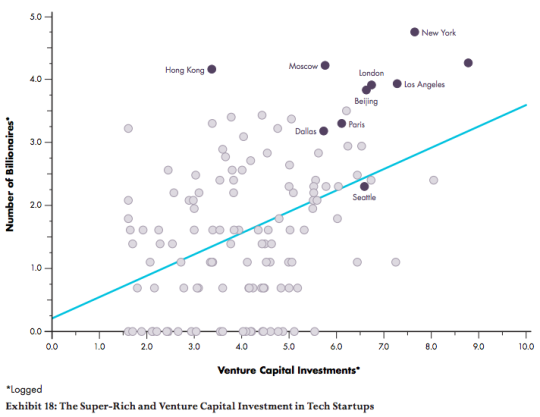
    Here is a similar chart comparing venture capital investment to the number of billionaires:

    image

    Once again, there is a positive association.

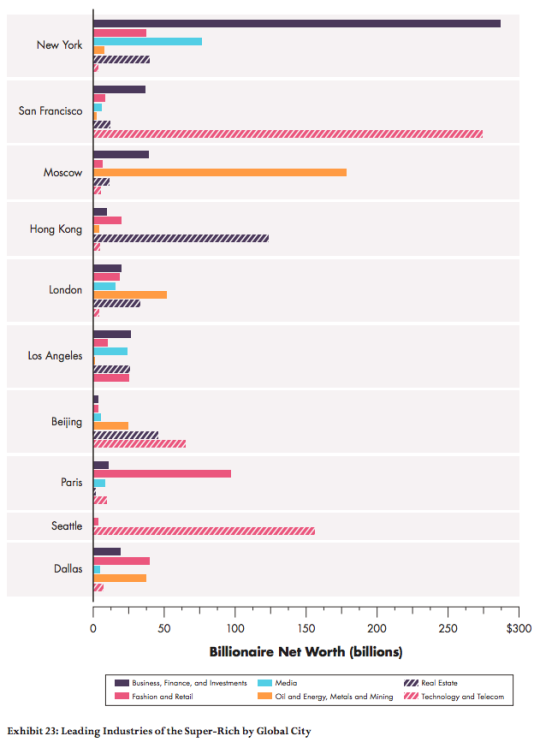
    Finally, here are a two charts that show which industries have produced the most billionaires:

    imageimage

    If you’re interested in this study, you can download the full report here. All of the charts were sourced from the report.