
Daily insights for city builders, delivered every morning at 6 AM ET. I’m Brandon Donnelly — a Toronto-based real estate developer and founder of Globizen. I’ve been writing here since 2013.

Tag: bill gurley

  • In defense of the gig economy

    Bill Gurley – who by the way is an investor in Uber – has an interesting piece up on his blog about the thing he loves most about Uber. It is the ability for the network to level load on its own. And here’s what he means by that:

    In spite of all the ink that journalists, analysts, and pundits have spilled on Uber over the years, no mainstream article has focused on what I consider to be the most elegant feature of this now ubiquitous, high growth global service — no driver-partner is ever told where or when to work. This is quite remarkable — an entire global network miraculously “level loads” on its own. Driver-partners unilaterally decide when they want to work and where they want to work. The flip side is also true — they have unlimited freedom to choose when they do NOT want to work. Despite the complete lack of a “driver-partner schedule” this system delivers pick-up times that are less than 5 minutes (in most US cities (with populations over 25K) and in 412 cities in 55 other countries. The Uber network, along with Mr. Smith’s invisible hand, is able to elegantly match supply and demand, without the “schedules” and “shifts” that are the norm in most every other industry.

    When surveyed, most people seem to prefer a job where they set their own schedule and get to be their own boss, compared to a steady 9 to 5 job with benefits and a fixed salary. Assuming that’s true, then this is a feature worth talking about.
  • How technology might transform health care

    Below is an interesting podcast with venture capitalist Bill Gurley talking about how technology might transform and improve health care.

    Based on their discussion, the US spends about 17-18% of GDP on health care. In most Western European countries and in Canada, it’s about half of that.

    In Singapore, it’s only 4% of GDP and there doesn’t appear to be any demonstrable differences in terms of health outcomes.

    If you can’t see the podcast embedded below, click here.

    https://art19.com/shows/the-ezra-klein-show/episodes/5bef0efc-97ce-412b-89dc-cb5d9d476f6f/embed?theme=dark-blue

  • When everyone thinks you’re wrong

    Sunset by Paolo Mastrogiacomo on 500px.com

    https://500px.com/embed.js

    I was recently talking to my good friend Jeremiah Shamess about the current state of development land sales in Toronto (he does this for a living) and he said something to me that I found really interesting.

    He said that because the market is so competitive, you can really only win development sites in one of two ways. Either you’re willing to spend the most money or you see something and have a vision that nobody else sees.

    And it was this second piece that really stood out to me because it reminds me of one of my favorite investing frameworks.

    Warren Buffet is famous for saying that you should be fearful when others are greedy and you should be greedy when others are fearful. And what I’m about to talk about is really that same core philosophy.

    Here’s how venture capitalist Fred Wilson put it (reiterating something that Bill Gurley said):

    I saw Bill Gurley say that you can only make money by being right about something that most people think is wrong. His logic was that you can’t make money by being wrong. And you can’t make money by being right about something everyone else knows. So you have to be right about something that most people think is wrong. I really like that framework.

    But this doesn’t just apply to technology companies or stocks. It applies to city building, most industries, and probably most things in life if you think about it.

    If all you’re doing are things that everyone else is doing, then how can you expect to outperform? You’re going to revert to the mean.

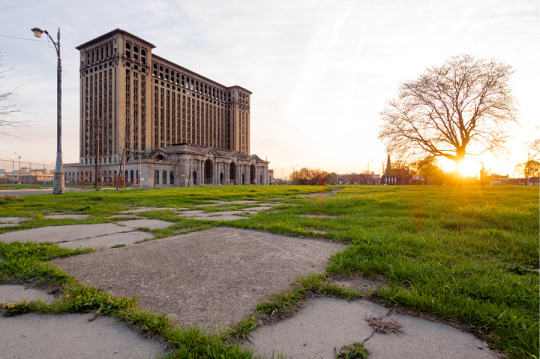
    Take, for example, billionaire Dan Gilbert and Detroit. Not everyone believes that Detroit will come back. In fact, I suspect there are probably more people who think it won’t come back, than people who think it will. Otherwise, it would already be back.

    But Gilbert is unquestionably long on Detroit (via Forbes):

    As you’ve likely heard, over the past four years Gilbert has become one of Detroit’s single-largest commercial landowners, renovating the city with the energy and impact of a modern-day Robert Moses, albeit bankrolled with his own money. He’s purchased and updated more than 60 properties downtown, at a total cost of $1.3 billion. He moved his own employees into many of them–12,000 in all, including 6,500 new hires–and cajoled other companies such as Chrysler, Microsoft and Twitter to follow.

    If/when Gilbert proves to be right about Detroit, then he will have been right about something that most people thought was wrong. And because of that, he will no doubt make a lot of money.

  • How Uber is driving down the cost of transportation

    A few days ago, Bill Gurley – who is an investor in Uber – wrote a really fascinating blog post called, Uber’s New BHAG (Big Hairy Audacious Goal): UberPool. Bill doesn’t update his blog very often, but when he does it’s incredible stuff.

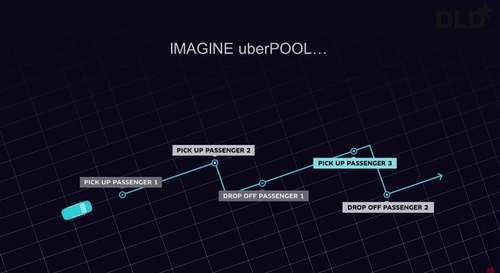
    I’ve touched on UberPool briefly before. But basically it’s a true “ride sharing” service where people with overlapping routes can easily share the same car – much like people do today informally. The obvious advantage of this is cost. It’s cheaper to share.

    image

    What’s most fascinating about this service though is how it fits into Uber’s larger mission to drive transportation costs down. And there’s a specific reason for that (via Bill Gurley):

    When Uber launched its low-cost UberX offering in the summer of 2012, the company quickly realized that the demand for its transportation services is HIGHLY elastic. As the company achieved lower and lower per-ride price points, the demand for rides increased dramatically. A lower price point delivered a much better value proposition to the consumer, yet still remained a great business decision due to the remarkable increase in demand.

    So what Uber quickly figured out was that if they could increase the utilization rate for drivers (the time actually spent with passengers), they could charge consumers lower prices while at the same time maintaining driver salaries. Prices went down, but volume went up.

    One way to do that is to obviously decrease driver downtime by improving liquidity on the marketplace. But another way is to simply increase the number of passengers being transported at one time. Hence the creation of UberPool.

    But it doesn’t stop there.

    Because of all the transportation data that Uber now has (the company has a data group called the “math department”), they can fairly accurately predict what a price cut will do to their ridership levels. This allows them to “forward invest” their capital in new services – such as UberPool – before they even have the revenue from the anticipated increase in ridership.

    So what does this all mean?

    It means that Uber is going to get cheaper and cheaper and cheaper. Uber is trying to get to what they call “The Perpetual Ride”, which basically means that drivers will always have customers (100% utilization). That’s quite a goal, but it would mean the absolute lowest prices for consumers (barring any other changes to their cost structure). 

    Dirt cheap transportation is a pretty compelling value proposition, which is why I continue to believe that cities should be hard at work trying to figure out how to harness this transportation shift.

    If you’re interested in this topic, I would encourage you to give Bill Gurley’s blog post a read.

  • A true marketplace needs natural pull on both the consumer and supplier side of the market.

    Bill Gurley

  • It turns out that the average rake at Priceline Group is even higher today, as they allow merchants to voluntarily bid up their rake for better placement in the network (you can see this in the table above). This is one of my favorite marketplace business model “tweaks.” You start with a low rake to get broad-based supplier adoption, and you add in a market-driven pricing dynamic that allows those suppliers who want more volume or exposure to pay more on an opt-in basis. This way no one leaves the network due to excessive fees, yet you end up with a higher average rake over time due to the competitive dynamic. And when prices go up due to bidding and competition, the suppliers blame their competition not the platform (part of the genius of the Google AdWords business model). This also allows you to extract more dollars from those suppliers who desire to spend more to promote themselves (without raising the tax on those that don’t).

    Bill Gurley

  • All Markets Are Not Created Equal: 10 Factors To Consider When Evaluating Digital Marketplaces

    All Markets Are Not Created Equal: 10 Factors To Consider When Evaluating Digital Marketplaces

  • I saw Bill Gurley say that you can only make money by being right about something that most people think is wrong. His logic was that you can’t make money by being wrong. And you can’t make money by being right about something everyone else knows. So you have to be right about something that most people think is wrong. I really like that framework.

    @fredwilson