Daily insights for city builders, delivered every morning at 6 AM ET. I’m Brandon Donnelly — a Toronto-based real estate developer and founder of Globizen. I’ve been writing here since 2013.

Tag: big cities

  • Where Americans moved over the last decade

    Today’s post is perhaps a good follow-up to yesterday’s post about housing supply in Ontario. Below are a few charts taken from a recent article by Wendell Cox looking at net domestic migration across the US. The takeaway here is that the shift from larger cities to smaller cities seems to be accelerating, following a trend that started before COVID.

    The data in these charts is organized according to population and by Core Based Statistical Areas (CBSAs). At the bottom are America’s two megacities: New York and Los Angeles. Both have metro areas that exceed 10 million people. As you can, these two city regions have been losing the most people, both in terms of total humans and on a percentage basis. The goldilocks sweet spot seems to be cities in the 500k to 1 million range.

    But the most telling figure is probably this one here:

    This chart adds up all major metropolitan areas with a population greater than 1 million, and then shows net migration over the last decade. Here you can see when this trend started (around 2016) and how it has been accelerating. In this case, it does appear that COVID added some fuel to the fire. But the question remains: Why is this longer-term trend even happening?

    Is it a short-term phenomenon? Is it because once a city reaches a certain size it simply becomes more annoying to live in it and people would prefer to live elsewhere? Or is it more about overall affordability? That is, if we could figure out how to deliver more affordable housing in our cities, could we stymie the bleeding toward smaller and more affordable ones?

    I don’t know the answers to the questions. But they have been widely debated and I still think they’re interesting ones. If all things were equal (or closer to equal), how and where would most people choose to live? Put differently, how much of this is some sort of natural market outcome and how much of it is a direct result of our actions (or inactions)?

  • Cities are the destinations

    image

    Resonance Consulting out of Vancouver has a new report out: 2018 Future of Millennial Travel. You can download a free copy here. Resonance does great work and really gets content marketing.

    The first chapter immediately caught my attention, perhaps because it’s called, Cities are the Destinations. It talks about how big cities as a travel destination are a highly underreported tourism metric. Historically it’s been all about beach vacations and escaping.

    According to their survey, Millennials (aged 20 to 36 years old as of March 16, 2017) are almost as likely to travel to a major city (38%) as they are to travel to a beach resort (40%) in the next 24 months. (I wonder where the mountains fit in.)

    Also interesting is that this number increases when household earnings increase beyond $100,000. This subset of respondents is most likely to visit a major city on their next vacation (40%). It’s all about new experiences.

    I’m not an expert on travel and tourism, but Resonance is calling this a sea change and a likely indicator that, in the near future, big cities will become the dominant travel destination. Is your city ready?

    Photo by Nathan Ziemanski on Unsplash

  • Moving to the big city

    When I was 18 years old, I
    moved from the suburbs of Toronto to Waterloo, Ontario, which is about an hour
    west of the city.

    I largely did this for two reasons.

    Firstly, I had started
    visiting friends at both Wilfrid Laurier University and the University of
    Waterloo while I was in high school, and I thought that I wanted
    that kind of University town experience.

    Secondly,
    I started University as a Computer Science student and I figured that Waterloo
    was a pretty good place to study that. Research In Motion (later renamed to
    Blackberry) was an important company at the time and interesting things were happening.

    Though
    to be clear, I was a student at Laurier and not at the University of Waterloo – the better of the two schools for Computer Science – because I didn’t have
    the grades for the latter.

    But a
    funny thing ended up happening. I hated living in Waterloo. I felt so out of
    place. So much so that I spent every weekend back in Toronto visiting my
    friends who had instead decided to go to the University of Toronto.

    And I
    remember vividly how I felt during those weekends. I would stand in my friend’s
    apartments – most of which had dens and solariums that were hacked into
    bedrooms so that they could afford to live there – and I would look across the skyline and
    think to myself: why the hell do I not live here?

    So I
    transferred to the University of Toronto. And that solved that.

    The
    reason I bring up this story today is that I was reminded of it while reading a recent CityLab article by Richard Florida called, The
    Self-Confident City
    .

    The three
    main arguments in the article are:

    (1) Where
    we choose to live has a massive impact on our life outcomes.

    (2) Self-confident
    people – according to a recent study – seem to be drawn to big cities.

    (3)
    Self-confidence can also be a self-fulfilling prophecy
    for people in big cities.

    Now,
    I don’t know if it was really self-confidence and youthful hubris that told me I needed to live in a bigger city than Waterloo. (It was probably part of it.) All I know is that I
    wanted to live in a super dynamic place that felt bigger than me. I wanted to
    feel like I was a small fish in a big pond trying to make some sort of
    meaningful dent.

    That
    was true for me when I was 18. And it remains true for me today at 32.

  • People in big cities walk faster

    One of the most interesting things about cities is that as they grow their “urban metabolism” also tends to increase. People become more productive. Economic output increases. It becomes easier to hail a cab (which is a test I like to use). And, according to this recent article by CityLab, people walk faster.

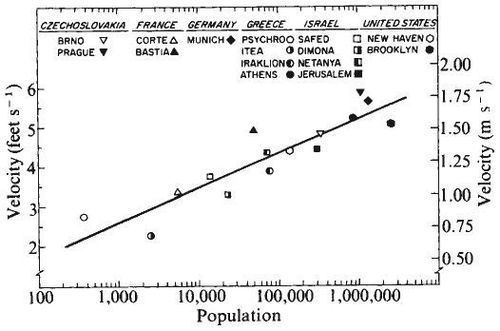
    Yes, research has shown that there’s a correlation between population size and the speed in which people walk. And some of the studies go as far back as the 1970s – like this one from psychologists Marc and Helen Bernstein:

    image

    In many ways, this makes intuitive sense. Life in the big city is a fast paced one. But why exactly do people start literally walking faster? The most probable answer seems to be, quite simply, that time is money. Subsequent research from the 1980s and 1990s has revealed that the best predictor of fast walking is economic output.

    When a city grows larger, they wrote, wage rate and cost of living increase, and with that the value of a resident’s time. As a result, “economizing on time becomes more urgent and life becomes more hurried and harried,” Walmsley and Lewis suggest. (Source: CityLab)

    The first thing that crossed my mind when reading all of this is that there must be some sort of upper limit. Humans don’t just keep walking faster and faster as the city in which they live in grows bigger. If that were the case, the mega cities of the world – such as Tokyo – would have people sprinting around all the time. But that’s obviously not the case.

    So this is a topic that could probably use some more data. And I would imagine it would be a lot easier to collect today given that we all now walk around with mobile sensors in our pockets (our smartphones). And pretty soon we may have mobile sensors on our wrists (smart watches).

    I would certainly like to see more data on this. The idea of an “urban metabolism” has always interested me.

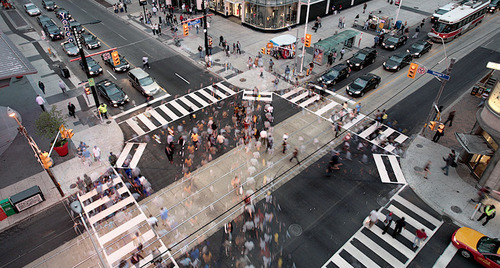
    Image: Dundas Square, Toronto via Flickr

  • Big cities have rebounded the fastest since 2008

    Josh Lehner of the Oregon Office of Economic Analysis published a study earlier this summer where he looked at employment growth according to city size across the US.

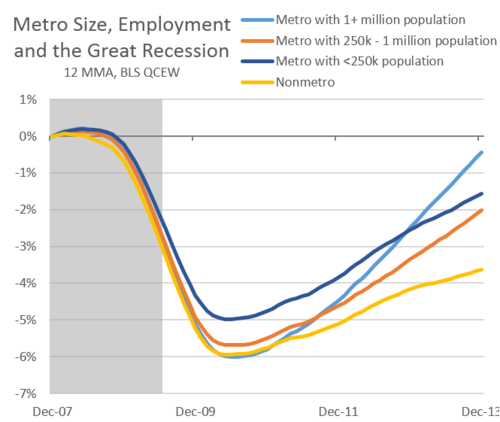
    What he found since the Great Recession of 2008-2010 is that larger metros – with populations greater than 1 million people – have rebounded the fastest. They are shown in the light blue line below:

    According to Josh:

    This is at least partially due to the fact that all those good economic things — agglomeration effects, knowledge spillovers, clustering, etc — happen in certain locations, which are usually bigger cities.

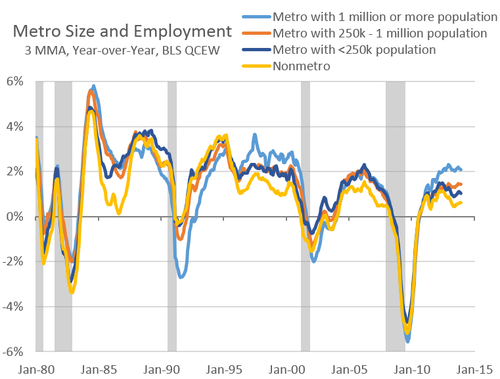
    However, if you go back to the 1980s, you find that this trend isn’t consistent. Large metros outperformed in the late 90s. But they were more or less on par with smaller metros during the housing boom of the early 2000s and actually under performed in the early 90s recession.

    One possible explanation for this – which Josh proposes – is that the recent housing boom acted as a sort of equalizer for smaller metros. It created stronger population growth outside of the bigger cities.

    I buy that.

    But then does that mean that going forward big cities will continue to outperform? Is this going to be more or less the new norm? Intuitively, I would think yes.

    You can find Josh’s blog post, here. Richard Florida also wrote one for CityLab, here.