Daily insights for city builders, delivered every morning at 6 AM ET. I’m Brandon Donnelly — a Toronto-based real estate developer and founder of Globizen. I’ve been writing here since 2013.
Duany is the father of New Urbanism and Stevens runs a great blog called The Skyline Forum where he interviews notable city builders, developers, architects, planners, and so on. If you can’t see the video below, click here.
Once again it’s a great reminder that so much of what we do and build in our cities is dictated by parking requirements. One of the ways Duany differentiates New Urbanism from “old urbanism” is that the new explicitly provides for the car.
Regrettably, I think we do that almost everywhere nowadays. But I take his point that New Urbanism happens almost as an intervention in areas where there are few or no other mobility options besides the car.
I also thought it was interesting that Duany refers to big box stores as the new noxious-use in cities, rather than industry. He describes the parking, not the stores themselves, as creating a “flume of unwalkability.”
Earlier this week on the day before April Fools’, Amazon launched two new services. The first was called Amazon Dash (see above video) and the second was called Amazon Home Services. The entire internet seemed to think that Dash was actually an April Fool’s joke, but it turns out it’s not. In fact, it’s actually an incredibly smart product.
The way it works is simple. Each branded Dash Button is about the size of a pack of gum. You mount it in, on, and near things that you replace on a regular basis, such as laundry detergent, coffee refills, and so on. Then all you have to do is push the button and your order gets sent to Amazon. Shortly after the product arrives at your door. I say “shortly” because you can be certain that Amazon’s goal is to make that time frame as short as physically possible.
I don’t know about you, but I could definitely see myself using this product. There are a number of essentials – such as laundry detergent and toilet paper – that I just hate shopping for. I have to create reminder appointments in my calendar just so I don’t forget. In fact, I did that today and I still forgot to pick everything up on my way home (my phone died).
But what’s even more interesting about Dash, I think, is that it increases the threat to brick-and-mortar retailing and, more specifically, big box stores. Because if same day and same hour delivery is a big threat to big box stores, just imagine one button and same hour delivery. And, is it only a matter of time before something like this comes to Apple Watch? It seems like the right medium for it.
Isn’t it interesting how something that most people believe is a silly joke could actually turn out to be a huge innovation? I try to always remain open minded. Sometimes it’s hard. But it’s good practice.
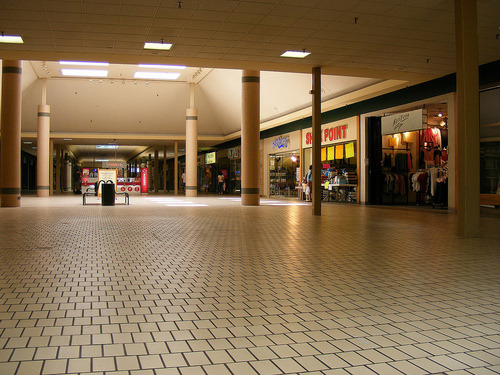
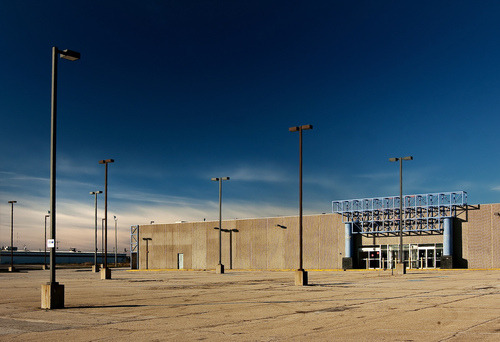
A lot of shopping malls are dying. You’ve probably heard this before. But how bad is it and what exactly is happening?
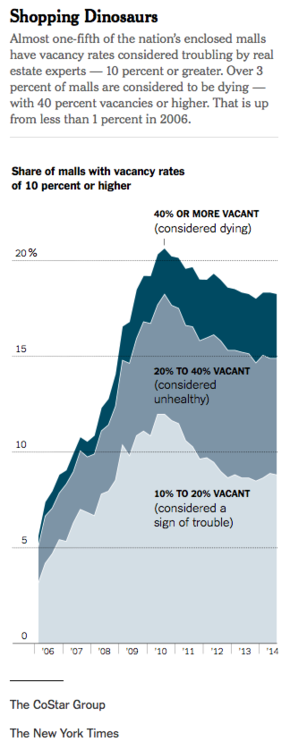
Well, a new report by CoStar (heard through the New York Times) found that nearly 20% of the 1,200 malls in the US are presently in trouble. “Trouble” is defined as a mall with a vacancy rate of 10% or more.
But what’s perhaps most disconcerting about this number is that, as recently as 2006, only about 5% of the malls in America would have been pegged as being “in trouble.” Here’s a chart from the New York Times (I’d love to see this same graph with a longer time horizon):
But not all malls are dying. The general sentiment seems to be that the high-end A malls are and will continue to thrive, and that it’s only the B and C malls that are dying:
Tom Simmons, who oversees the mid-Atlantic shopping center division of Kimco, another real estate giant, is more blunt. “There are B and C malls in tertiary markets that are dinosaurs and will likely die,” he said, but “A malls are doing well.” (NY Times)
So why is this happening? Some think it’s because the US is over-retailed. And some think it’s because of rising income inequality – which would explain why the high-end malls continue to thrive. But the experts seem to agree that it’s not the result of more people shopping online:
One factor many shoppers blame for the decline of malls — online shopping — is having only a small effect, experts say. Less than 10 percent of retail sales take place online, and those sales tend to hit big-box stores harder, rather than the fashion chains and other specialty retailers in enclosed malls. (NY Times)
I wrote a post 2 months ago where where I argued that big box stores will be the most impacted by online shopping (which is why so many of them now sell groceries). But I don’t believe that they are the only retailers that will be affected. Quite the opposite: Every retailer is or eventually will be impacted by the internet.
This threat is real.
Millennials have no hesitations about buying things online and, in many cases, they would prefer to do so. It has already been well documented that we (I’m a Millennial) don’t like driving as much as previous generations. So what makes you think we’d enjoy the process of driving to a mall?
But the other factor at play, I think, is that malls are no longer the “public space” of young people. Their position as a kind of cultural institution is waning. At the same time, more and more people are craving uniqueness. They like independent shops, not malls that all look and feel the same. And as these young people become old people, we might find that even the A malls start becoming impacted.
I don’t believe, for a second, that retail nodes within cities will ever disappear. But I think our attention would be better spent figuring out what the mall of the 21st century will be, as opposed to hiring PR firms to try and spin doctor our way out of this dead mall phenomenon.
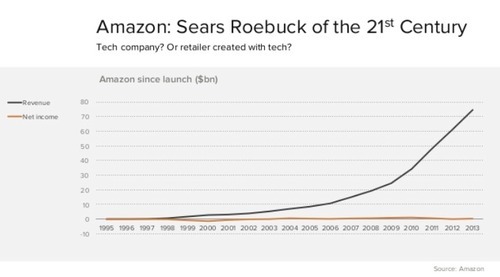
One company that came up during our discussion was not surprisingly Amazon.com. But the initial comment was that they don’t make any money. Fortunately for me I had just gone through a presentation by venture capitalist Benedict Evans the night before called: Mobile is eating the world. And so I pulled out my phone and presented this slide:
The fact that Amazon operates with basically no net income is on purpose. Look at their revenue growth! So I wouldn’t dismiss them as being a fad. They may only account for 1% of all US retail sales today, but I’d put money on that percentage growing.
The other reason I bring up Amazon is because, in some ways, I think of them as the online equivalent of a big box store. Just like a Walmart or Costco, where you can buy everything from tires to groceries to prescription drugs, I buy a lot of different things, besides just books, off of Amazon.com. You might do the same as well. And this is where I see the immediate threat to offline retailing and retail real estate: big box stores.
In the second half of the 20th century, big box stores were incredibly disruptive to the retail landscape (and to cities). They used cheap land on the outskirts of cities, cheap buildings, and economies of scale to offer rock bottom prices to consumers. The value proposition was about cheap, not about differentiation. But as cheap as they may be, the internet can still do it cheaper.
And retailers know this, which is why I think they all now sell groceries. Groceries have a very low online penetration. Basically everybody still buys groceries in-person. So if you offer that, you have a reason to draw people inside your store, where they will hopefully buy all the other stuff that they need. But as the online value proposition continues to get stronger, I think we’ll see many other, more significant, changes.