Daily insights for city builders, delivered every morning at 6 AM ET. I’m Brandon Donnelly — a Toronto-based real estate developer and founder of Globizen. I’ve been writing here since 2013.

Tag: bicycles

  • Planners on bikes getting coffee

    Over the weekend, Jason Thorne, who is the General Manager of Planning and Economic Development at the City of Hamilton, tweeted this out. He said, if Jerry Seinfeld can do Comedians In Cars Getting Coffee, then he was going to do Planners On Bikes Getting Coffee. And that’s exactly what he did in Barrie with their Chief Planner, Andrea Bourrie.

    I immediately responded by asking: Is this really a thing you are doing? Because if not, it is something you should absolutely start. He was kidding but I think the response he received on Twitter got him reconsidering if he should make it a thing. I think this is a great idea, and so I hope he does consider it. If you agree, maybe send him a tweet.

    I have a GoPro, gimbal stabilizer, and a bicycle. So if this doesn’t become a thing, maybe there needs to be a Developers On Bikes Getting Coffee.

  • Oh boy bicycle house

    image

    A new “bicycle house” recently opened up in Malmö, Sweden. It is a 7 storey apartment building that has been designed entirely around the bicycle. It’s called Cykelhuset Ohboy.

    Bicycle house means:

    – There’s no parking for cars in the building. Apparently it’s the first building in Sweden to do that, which is surprising to me. I thought that would be more common.

    – All of the access corridors were made wider so that it’s easier to maneuver your bike around, larger bikes can fit, and there aren’t any access issues when bikes are left outside of your apartment.

    – All of the doors in the complex are 10cm wider than they need to be (and have door openers). The elevators are also larger and open up on both sides so you don’t have to turn your bike around.

    – The building is equipped with cargo bikes and kid friendly bikes so that you can grocery shop and wheel your family around. The building does have larger family sized apartments and, according to Copenhagenize, the building is fully occupied.

    In most, if not all, condo buildings here in Toronto, you’re usually not allowed to take bicycles in the elevators. And bikes sitting on balconies is considered a highly undesirable outcome.

    But clearly that’s just one frame of reference for how the world should work.

  • The VanMoof hack

    8 years ago the Amsterdam-based bicycle company VanMoof started shipping bicycles to its customers. And since that time, they struggled to find a quality shipping partner that wouldn’t damage the bikes in transit. 

    They tried every varietal of shipping company, but the problem persisted. And since their goal was and is to sell 90% of their bikes online by 2020, they knew that they needed to solve this problem.

    So here’s what they did. This is a great story.

    They noticed that their bicycle boxes were about the same size as a large flatscreen TV. And since flatscreen TVs seem to always arrive in perfect condition, they decided to print a TV (along with an image of their bicycle) on the box.

    Here’s what that looks like (via QZ):

    The result? They immediately saw a 70-80% drop in shipping damages. That’s all it took. I love that.

    Since I know that a lot of you are cyclists, I thought you might appreciate this little hack. Their bikes are also quite stylish and reasonably priced if you happen to be in the market. (I am waiting to hear back on whether they ship to Canada.)

  • From bicycles to cars in Beijing

    image

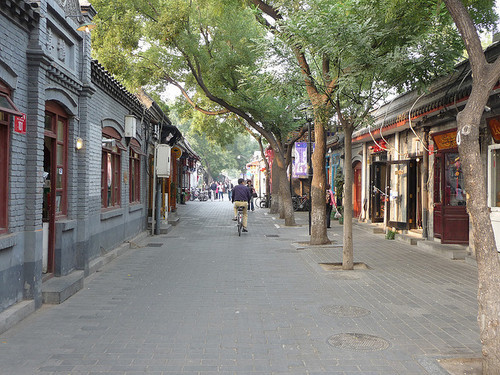
    Earlier this week, a friend of mine shared this TED talk on my Facebook wall talking about the state of climate change in the world. The talk is by Nicholas Stern. And at one point he talks about the incredible urban transformation that has taken place in Beijing over the last couple of decades; specifically, the shift from a bicycle oriented city to a now automobile oriented city.

    I knew that this was the case, but it got me thinking. Because alongside this mobility change, there’s also been – not surprisingly – pronounced changes to the urban fabric of the city. The most significant is perhaps the demolition of the city’s hutongs and siheyuan. Hutongs are basically narrow alleys (see above photo) and siheyuan are the traditional Chinese courtyard houses.

    For centuries, these alleyways and courtyard houses have defined Beijing. And while I realize that not all of them were as glamorous as Melbourne’s laneways, only about 1,000 of Beijing’s original 6,000 hutongs remain (according to Time). Which makes me wonder: Is China making the same mistakes that we made in the 20th century?

    Because as the developed world moves toward transit oriented development, bike lanes, heritage preservation, and compact urban living, China has seemingly gone and done the exact opposite. They got everyone off bicycles and into cars, and they went and erased a scale of urbanism that has been in place for centuries.

    This is not to say that China doesn’t deserve to have the same standard of living as the developed world. It absolutely does. It just seems a bit ironic to me that the things we’ve become sharply critical of, are exactly what China seems to want to recreate.

    Image: Flickr

  • This Built America: Shinola

    If you’ve been reading this blog since last year, you’ll know that I’m hugely interested in Detroit. I went for a visit last fall and I hope to go back sometime this summer. I think the city has tremendous potential and I would love to see it come back. I’m rooting for it.

    Between people like Dan Gilbert and consumer brands such as Shinola, there’s a palatable sense of momentum developing in the city. Here’s a short video of the Shinola story from This Built America–which is a project focused on the people and companies that are rebuilding America and its manufacturing base.