Daily insights for city builders, delivered every morning at 6 AM ET. I’m Brandon Donnelly — a Toronto-based real estate developer and founder of Globizen. I’ve been writing here since 2013.

Tag: berlin

  • Incubating new ideas in cities

    A couple of days ago I wrote about a documentary series called Real Scenes. It’s a fascinating series that examines the electronic music scene in a bunch of different cities from New York to Berlin to Tokyo. 

    What’s fascinating about these films is the inside look it gives you into how these “scenes” develop. Berlin, for example, is absolutely on fire right now. It has a thriving startup scene and a reputation for being a major force in the world of electronic music.

    How did that happen?

    The documentary leads you to believe that Berlin was able to establish itself as, arguably, the techno music capital of the world by having lots of empty buildings and nobody cracking down on squatters after the Berlin Wall fell. Quite literally, the scene appears to have started as a result of illegal techno parties being thrown in abandoned buildings. 

    It’s a perfect and perhaps extreme example of Jane Jacobs’ famous line that new ideas require old buildings. The rents are simply too high in new buildings for anything experimental. Landlords naturally prefer to rent to triple-A tenants who will pay the highest rents. And who can blame them. 

    But just like there’s tremendous value in incubating new startups before they’re even close to turning a profit, there’s obviously value in empowering new ideas, new concepts, new retailers, and new businesses to flourish within cities. 

    I’m not exactly sure how that could be done in the context of new developments, but it’s on my mind right now as a result of some discussions I’ve been having with some incredibly smart and ambitious people in this city.

    So today I’d like to turn it over to you. How could we make it so that new ideas flourish even in new buildings? Since investment naturally drives up rents, does that mean it will always put pressure on those crazy instigators who just need cheap space?


  • Real Scenes Documentary — a look at New York’s electronic music scene [Video]

    image

    I just stumbled upon a fascinating documentary series called Real Scenes. Each film explores “the musical, cultural and creative climate” within a particular city. 

    Below is Real Scenes: New York (click here if you can’t see it below). It’s an inside look at the underground music scene that has developed in Brooklyn, but that is at the same time being threatened by development and rising rents. Disclaimer: There’s a lot of f-bombs and a lot of hating on gentrification.

    [youtube https://www.youtube.com/watch?v=LDtf0uIUPuE?rel=0&w=560&h=315]

    I’ve only watched the New York video from this series, but I plan to watch each and every one of them. The other cities are Tokyo, Johannesburg, Paris, Berlin, Detroit, and Bristol.

    What’s fascinating about these short documentaries is that they give you a glimpse into a particular undertone within each city – one that would otherwise be hard to get if you weren’t living there and engrossed in the scene.

    It’s also interesting to see how some people view change within cities. 

    To some, transforming a neighborhood from one that looks like a “bomb went off” to something more pristine, is a good thing. But to others, it’s the worst possible outcome. It all depends on your frame of reference.

    Now, how do I get them to make a Real Scenes: Toronto? 🙂

    Image: Resident Advisor

  • East Room co-working space

    image

    Amy Bath needs to leave comments here on ATC more often because she has great feedback and insights.

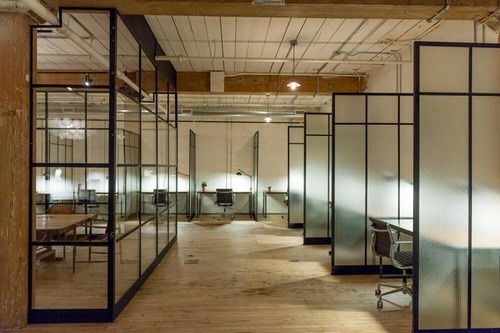
    This morning she tipped me off to a brand new co-working space on the east side of Toronto called East Room. If you haven’t yet heard of it, I would encourage you to check out their website. They’re in a gorgeous heritage building along the Don Valley and they seem to have executed really well. I love their design aesthetic.

    //platform.instagram.com/en_US/embeds.js

    They currently offer two different memberships: a resident membership ($500/month) and a club membership ($250/month).

    image

    This is exciting to me because I have a soft spot for both good design and the east side of Toronto. But probably more importantly, it speaks to the changing nature of work and the workplace, as well as to the shifts in how space is being consumed.

    Co-working spaces are, of course, blowing up all over the world from Philadelphia to Berlin. The internet has empowered new ways to freelance and make money, and these kinds of spaces are really a result of that. Because even though it’s entirely possible for many of us to work remotely at home, we still crave the social interaction that comes from being within an office environment. And that’s a big part of what these spaces are. They’re a social fabric.

    Amy’s hope is that condos will eventually start including amenity spaces that are similar to co-working spaces, and I think that’s a really interesting idea. The challenge, however, is that most developers today (and property managers) aren’t equipped to operate these kinds of environments.

    But maybe it’s only a matter of time before some do become equipped, because I’m sure we’re going to see more, not less, of these kinds of urban spaces.

    Images: @eastroom_

  • How are you attracting and retaining top talent?

    Yesterday I received a comment on my post about service and product companies with a suggestion to check out an interesting Fast Company article talking about the future of work (thank you Amy). The article was based on a research report – commissioned by CBRE and a real estate developer in China (Genesis) – called Fast Forward 2030: The Future of Work and the Workplace.

    This is a topic that’s getting a lot airtime right now because Millennials are starting to impact work in a big way. But what’s interesting about it is how broad these impacts will be. Changes in how we work will affect the way we design our cities; the way architects and developers build and lease space; the type of people and roles companies will need to hire and create; and so on.

    Here’s a snippet from the report:

    “Providers of commercial buildings and places to work will need to develop new, sometimes counter intuitive, business models and work with partners who understand service and experience in order to compete with emerging workplace competitors. Successful providers will work with tenants to unlock ‘win win’ solutions that reduce occupier costs, increase flexibility, and simultaneously provide enhanced levels of community, amenity and user wellbeing. Cities will have a role to lead and nurture changes that will support the changing landscape of work.”

    I plan to go through the report in more detail this weekend, but I did want to point out one thing. When business leaders from around the world were asked what their biggest competitive advantage would be by the year 2030, the top choice was: the ability to attract and retain top talent. This topped organizational vision and even the ability to innovate.

    This might not come as a surprise to some of you, but it’s worth repeating. And in many ways, it’s a chain that begins first with cities. 

    If you’ve ever watched The Startup Kids documentary, you’ll know that when Alexander Ljung (CEO of Soundcloud.com) was about to found his company, he actually started by first traveling around Europe looking for the coolest city in which to base his company. The last city on his trip was Berlin and that just so happened to be the team’s favorite. So that’s where Soundcloud was founded.

    My point with that story is simply that the “workplace” of today – forget the future – means so much more than just your rentable area. Yes, that’s important. But there’s a lot more to consider when trying to get the best people. Cities play a huge role.

  • Where Uber operates and where it’s banned

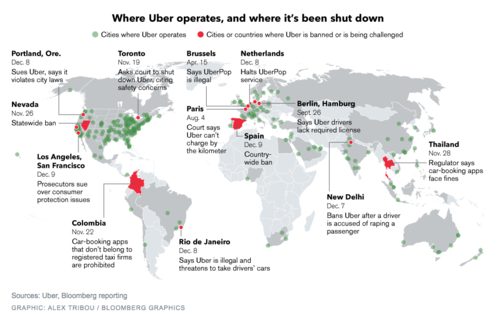
    Earlier this month, Bloomberg published this map showing where Uber operates and where it’s been banned (or is being challenged). You can click on the map for a larger version.

    image

    Uber operates in about 250 cities across the world. But it’s being challenged in a lot of them, including Portland, San Francisco, Los Angeles, Toronto, Rio de Janeiro, Paris, Berlin, as well as others.

    I don’t want to dismiss any of the safety concerns that have arisen lately, because those are very serious and they need to be addressed. Life safety is paramount. But I continue to believe that banning a service that many people clearly want to use isn’t the right solution.

    On top of that, I think it could lull many of the local taxi communities into a false sense of security about the future. Uber is moving incredibly quickly. UberX launched in Toronto in September of this year. And UberPOOL – their new carpool service – is likely next.

    With these releases, Uber is working towards a specific vision for the future: Their goal is to eliminate the need for private vehicle ownership. Should they be successful, this will not only impact taxis, but also car manufacturers and urban mobility in its entirety.

    So as difficult as it might seem right now, I think urban leaders would be better served trying to figure out how to harness these innovations. Cities have been trying for decades to get people out of their cars. Uber wants to do the same.

  • 8,000 glowing balloons are recreating the Berlin Wall

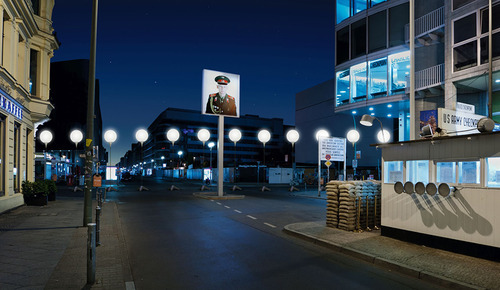
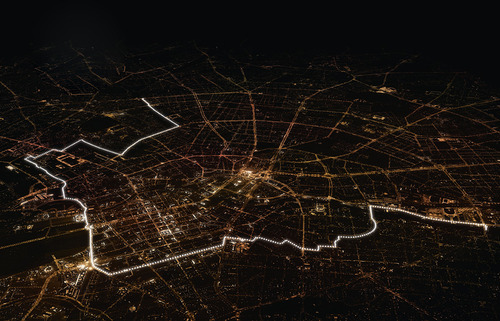
    Starting today and running until the end of the weekend, 8,000 glowing balloons will recreate a 15 km long section of the former Berlin Wall. It’s to commemorate 25 years since the fall of the wall. 

    Here’s an aerial view of what it’ll look like:

    I think this is a fascinating art installation. And I wish I could be there to see it first hand. My friend Nick Iozzo is there right now with his wife, so hopefully they’ll respond to this blog post with some highlights.

    Lots of cities today feel divided in some way.

    Here in Toronto, we talk about the divide between the core and the inner suburbs – the latter of which has become known as Ford Nation. We also talk about an east vs. west divide, though it’s not really a legitimate concern. Developer Urban Capital actually has an event next week on this very topic that I’ll be attending. They’re calling it: “an intelligent discussion on a not so important topic.”

    But none of these divides are anything like the divide faced in Berlin. The Berlin Wall was arguably the most visible physical manifestation of the entire Cold War. Once a major point of entry for Eastern Bloc emigrants, East Berlin was basically bleeding people before the wall went up in 1961. It was designed to keep East Berliners in place.

    I can’t even imagine what it would be like to live in a place like that.

    Images: Daniel Buche

  • Revisiting Charlotte

    image

    Earlier this week, I wrote about the Charlotte Apartments in Berlin and tried to back into some of the numbers for the project. I wanted to compare the economics behind a mid-rise project in Berlin to one in Toronto.

    After I wrote that post I forwarded it to Michels Architecture – who are the architects behind the project. I thought they might be interested in reading about my (crappy) back of the napkin type of assessment and I was also hoping that they might be able to shed some additional light on the details.

    Well, they responded and graciously offered to do exactly that. So today I thought I would write a follow-up post with some additional details. I obviously don’t have everything – because they weren’t the developer for the project – but I still think you’ll find the information I got interesting.

    The building has a total of 3 parking spots and they’re all on the ground floor (you can see them in this post in the second photo towards the right). They were for the penthouse maisonette/duplex units. This means that there’s only one level below grade and it’s basically for mechanical systems, storage, and waste disposal. So why does this matter?

    It matters because it means lower construction costs and the ability to develop smaller sites where you may not be able to properly layout a parking garage without car elevators and other clever strategies. This is possible because, unlike Toronto, Berlin doesn’t have any parking minimums or maximums. 

    With respect to unit sizes, the penthouse units are 135 square meters or 1,453 square feet which, according to the architect, are small. From the 2nd to 6th floor, there are 4 units per floor and the sizes are 37 sm / 398 sf, 65 sm / 699 sf, 68 sm / 732 sf, and 81 sm / 872 sf. On the ground floor there are 5 units and they’re at 34 sm / 366 sf (x 2), 42 sm / 452 sf, 45 sm / 484 sf, and 76 sm / 818 sf. I would say that this is comparable to what you might find in a downtown Toronto condo project. Side note: Apparently the smallest units sold the quickest.

    As of December 2011, the average sale price was 4,120 € per square meter. At today’s exchange rate, that would convert to $5,815 per square meter or $540 per square foot (in Canadian dollars). If we translate that into 2014 dollars, that’s about $575 per square foot, which would be low for prime locations/buildings in Toronto.

    A big thanks to Michels Architecture for providing this additional information. It’s always great to get local insights. I hope you all enjoyed it – happy Friday.

    Images: Werner Huthmacher

  • Looking at Berlin from the back of a napkin

    image

    Depending on who you ask, the current condo boom in Toronto might be viewed as either a good thing or a bad thing (most will have an opinion). Some people think we’re simply building too many condos. And that too many of them are small, crappy, and geared towards investors – as opposed to end-users.

    While I do agree that we could be doing more to create complete communities – that is communities which serve everyone from young singles to families with 3 kids – I think there are also a lot of positives associated with Toronto’s condo obsession (full disclosure: I’m a real estate developer). It has made us more sustainable, more reliant on alternate forms of (non-car) transport, and it has made us a generally more exciting place to live.

    But that doesn’t mean we can’t do better.

    Lately I’ve been wondering about how other cities do it. Specifically, those European cities that somehow seem to always be able to build awesome housing projects. So today I thought I would pick one and profile it. What I really wish I had was a financial pro forma to share with you all, but in the absence of that, I’ll try and back into some of the numbers on my own.

    image

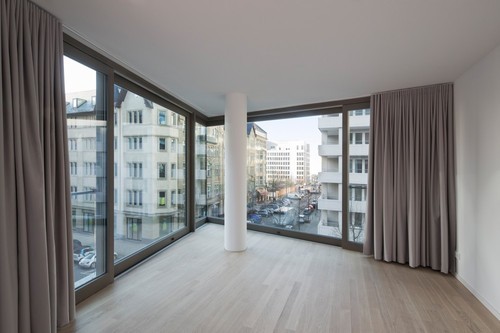
    Shown above is the 9-storey Charlotte Apartments in Berlin. It was developed by WI Concept and designed by Michels Architecture Office. I chose this building because I think it’s an attractive one and because it’s of the (mid-rise) scale that Toronto is trying to promote along its many avenues. Here are the stats I was able to find online:

    • Site area: 347 square meters / 3,735 square feet
    • Building area: 3,000 square meters / 32,291 square feet (says gross floor area, but I don’t know if that means the same thing as it does here)
    • Construction costs: €3.6 million / C$5,065,691 (as of today’s rate)
    • Units: 28 (sold within 1 week of launch)
    • Market: ~70% of buyers in Berlin are believed to be foreign investors

    Now, if we were actually building a development pro forma, we’d want to get a lot more granular in our calculations than what I’m about to do. We’d want to know gross construction area, net saleable areas, and so on. But for the purposes of this post (and because I have very little information), I’m going to simplify and do a back of the napkin set of calculations.

    Based on above, the FSI (or density) is about 8.65 (32,291 sf / 3,735 sf). That’s roughly in line with many of the residential developments we’re seeing in downtown Toronto. The average unit size works out to be about 1,153 sf (32,291 sf / 28 units), but in reality it would be less if that 32,291 number is truly the gross floor area. You would need to subtract the corridors and other non-saleable areas from it before doing this calc. Either way, that is big compared to most downtown Toronto condos, but small for Berlin standards according to this ArchDaily article. Finally, if we look at construction costs, we get $157 per square foot in Canadian dollars ($5.065M / 32,291 sf). That’s low. I wonder what the land costs were.

    Again, these numbers are rough rough. But I wanted to try and dissect a European development project and compare it to Toronto. The most surprising figure seems to be the low construction costs. If you have any additional insights, I would love to hear from you in the comment section below.

    Images: Werner Huthmacher

  • A century of homeownership and renting in England and Wales

    This morning while I was reading about gentrification in Berlin, I clicked through to an interesting overview of homeownership and renting in England and Wales over the last century. Here’s a video. If you can’t see it below, click here.

    [youtube https://www.youtube.com/watch?v=LDnGryGJ1ZA]

    The video starts in 1918, where the vast majority of households (77%) rented. As of 2011, this number has reversed. 64% of households in England and Wales now own their home.

    If you compare this housing trend to what happened in the United States and Canada, you’ll see a similarity. Although, the US was ahead in terms of promoting homeownership. They reached 50% ownership somewhere in the mid 1940s, whereas England and Wales didn’t reach this number until around 1971.

    image

    All of this is an interesting reminder that our obsession with homeownership is a relatively new one. But it’s also not a universal one. The homeownership rate in Berlin is 15.6%, and it’s only 49.5% in London. People in big cities tend to rent more.

  • Urbanization in the developing world

    A few days ago I asked a reader of this blog if there was anything, in particular, that she’d like to see more of on here. She responded by saying that she’d love to learn more about how other cities—outside of Toronto—are managing urbanization, as well as how we shape cities and cities shape us.

    It’s an interesting and important question because, frankly, the challenges are greater outside of Toronto. One of the stats that often gets cited here in the media is how the Greater Toronto Area gets approximately 100,000 new immigrants every year. This doesn’t include domestic migration though, so I would assume that our total number is even greater.

    But if we stick with 100,000 for now, it means the GTA receives about 11.4 new immigrants every hour (100,000 people / 8,765 hours in a year). Lagos, Nigeria, on the other hand, receives between 50-60 new people every hour. In fact, it’s predicted to be 7th fastest growing city in the world between now and 2020. 

    If you take a look at the complete list of the world’s fastest growing cities (all estimates, of course), you’ll likely notice that the vast majority of the cities are in the developing world. And that’s really the challenge. The world is rapidly urbanizing and becoming the most urban it’s ever been, but the changes are the greatest outside of developed nations. This poses entirely unique challenges.

    Of the kinds of cities I’m talking about, I’m most familiar with Dhaka, Bangladesh. In my last year at Penn, I was part of a studio led by KieranTimberlake Architects that focused on water and housing issues in that city. It was a partnership with the University of Dhaka. We spent roughly 2 weeks there and it was an eye opening experience.

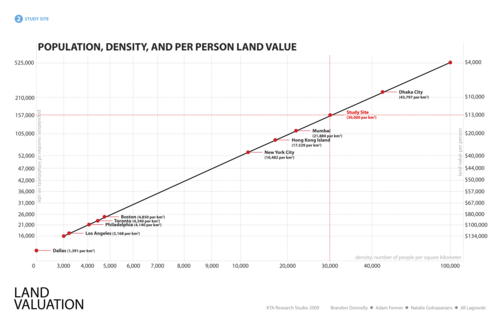
    Here’s a telling slide from our final presentation:

    image

    What we were trying to do with this chart was compare population and per person land value for our development site according to various city types. In other words, we were essentially asking: If we were to build out our proposed site in the same way, as say, Dallas, Los Angeles, Hong Kong, or what is typical for Dhaka, how many people could we fit and what would be the resulting per person land value?

    I don’t remember where we got the land value figures from, but we were trying to be cognizant of the fact that every city requires a unique solution. Using the same per person land values in Dhaka as in Dallas would be unimaginable because Dhaka has over 40,000 people per square kilometre (top right on the diagonal line above) and Dallas has under 1,400 per square kilometre (bottom left on the diagonal line above).

    The challenges of urbanization in the developing world are profound, particularly in places like Dhaka where most of the city is subject to severe annual floods. By some estimates, 18% of the city’s land area gets flooded every year—talk about adding another layer of city building complexity.

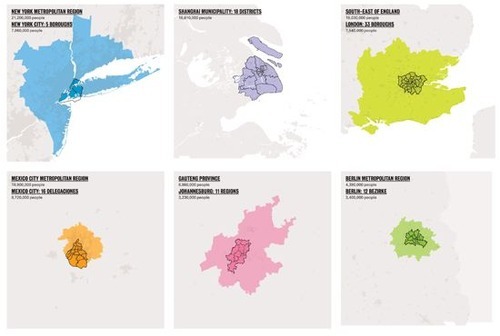
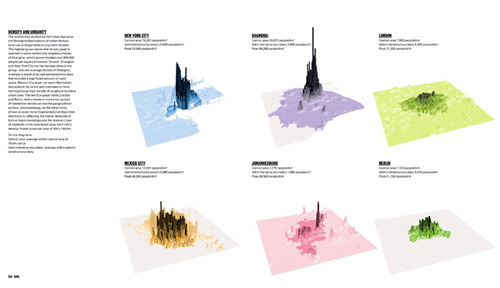
    We didn’t solve all of the problems in that studio and we’re not going to do it here, but I do think it’s important to fully understand the problem. One of my favorite books on cities is called “The Endless City.” It examines New York, Shanghai, London, Mexico City, Johannesburg and Berlin, and has a ton of great data and diagrams.

    Here are a two that outline densities and land use patterns for the above 6 cities (same order starting on the top left):

    image

    image

    If you’re interested in cities, it’s definitely worth having it on your coffee table. And fitting to @PhatNancy’s tweet, ”The Endless City doesn’t just show how cities are changing but also how they are changing us.”