Daily insights for city builders, delivered every morning at 6 AM ET. I’m Brandon Donnelly — a Toronto-based real estate developer and founder of Globizen. I’ve been writing here since 2013.

Tag: berlin

  • What’s in a roof?

    Over the weekend I stumbled upon this illustrated Medium post by Alfred Twu comparing sloped and flat roofs. The argument is that these two roof types are coded. In this part of the world, at least, sloped roofs signal low-rise “house” and flat roofs signal big city “high-rise.”

    I’m not yet convinced of this association with height, or of all the claims made in the article. Did New York City really make the flat roof commonplace in our cities? But the idea that a roofline can trigger certain associations — or even become divisive — is a fascinating one.

    Take, for example, Am Fischtal in Berlin. On one side of the street you have, still to this day, homes with flat roofs. And on the other side you have homes with sloped roofs. This clean divide is the result of a supposed “roof war” that took place during the Weimar Republic.

    At this moment in time in the suburbs of Berlin, the kind of roof you chose to live under was a proclamation of your political orientation. I’m not sure roofs have as much gravitas as they did in the 1920’s on Am Fischtal, but they still do say something.

    Image: Alfred Twu

  • Multi-Unit Housing in Urban Cities: From 1800 to Present Day

    I just ordered a copy of Multi-Unit Housing in Urban Cities: From 1800 to Present Day by Katy Chey. I figured this was a book that we should have hanging around our office. I also like to support the Daniels Faculty.

    The book covers the following multi-unit housing typologies:

    • Back-to-backs in Birmingham
    • Tenements in London
    • Haussmann apartments in Paris
    • Tenements in New York
    • Tong lau in Hong Kong
    • Perimeter block, linear block and block-edge in Berlin
    • Perimeter block and solitaire in Amsterdam
    • Space-enclosing structures in Beijing
    • Kyosho jutaku in Tokyo
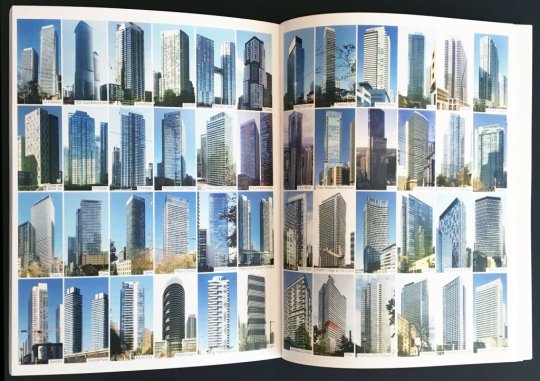
    • High-rises in Toronto

    In addition to each typology, the book analyzes the connection between the housing type and the city. Why did certain typologies flourish where they did and how have they helped to define their city?

    It reminds me of what I was trying to do with some of my recent posts about Hong Kong’s typical tower plan, albeit with far less rigor than what I am sure has been applied to this book.

    I am also curious to read what has been written about high-rises in Toronto. It goes to show you just how defining the current real estate cycle has been for this city. That’s our multi-unit housing typology.

    Image: Daniels Faculty. My multi-unit home made the book.

  • 2017 year in review

    I just finished going through my list of 2017 goals. I didn’t accomplish everything I wanted to, but I did manage to check off a number of professional and personal goals.

    Some of the remaining goals have been pushed to 2018. But there are also items that I have since realized aren’t worth pursuing and so I have dropped them from the list.

    All that said, it was a great year. Here is a rapid-fire summary of 2017 told through posts from this blog.

    Thanks for reading. Onward my friends.

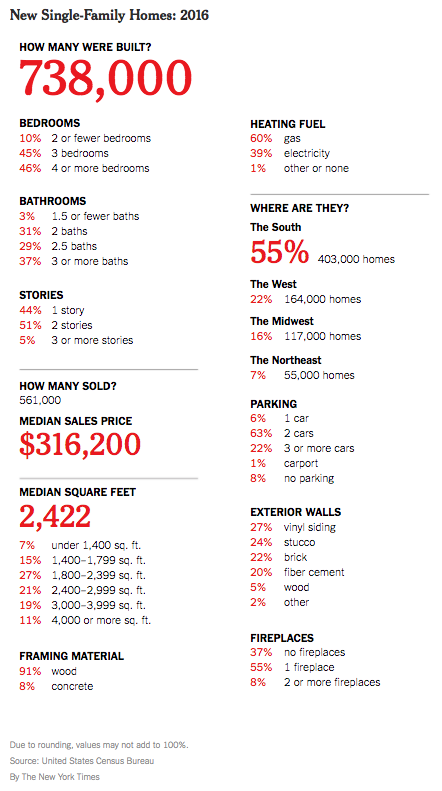
  • 738,000 single-family homes were built last year in the US

    The New York Times recently published “a portrait of new single-family homes” in the US in 2016. Here’s that portrait:

    For those of those living in dense urban centers, this portrait is perhaps a reminder that in many other places a large single-family home can be had for about the price of a studio apartment.

    Nothing in the above portrait likely surprised you, but it’s interesting to note that over half of all new single family homes delivered last year were in “The South.” Only 7% were built in the dense northeast.

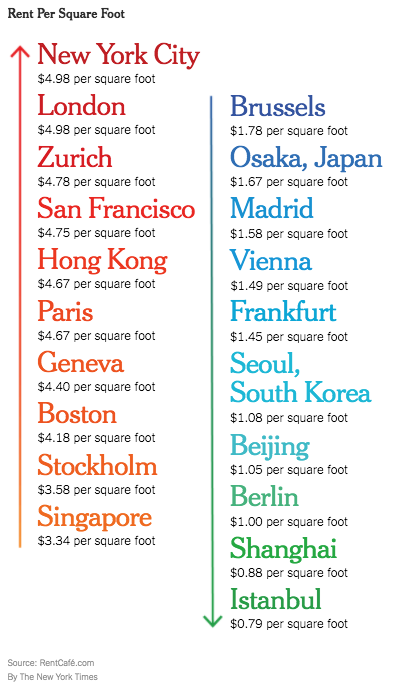
    The New York Times also recently looked at “international rents per square foot” using data from RentCafe. Here they are:

    New York City sits at the top with an average rent of $4.98 psf. This is across all boroughs. I am surprised by how low some of these international rents are. But averages rarely tell you the whole story.

    In any event, I do think that these two graphics start to speak to the economic spikiness that we are seeing across the US. 

  • The post-Wall techno music of Berlin

    image

    I’ve written about Berlin many times before on this blog. It’s such a fascinating case study for me because of its history, its urban development patterns, and its famous techno scene.

    Last month, Nick Paumgarten wrote a piece in the New Yorker, called Berlin Nights, where he dives into the city’s club culture and its reputation as the cradle of techno music. 

    But in doing that, he is necessarily forced to talk about the once divided city and its unique “post-Wall” condition. When the Wall came down, the East became – as a result of its under-utilized built form – a breeding ground for the pent up energy and creativity of the West.

    Here is an excerpt that speaks to the importance of those empty spaces and sparsely populated neighborhoods:

    The post-Wall abundance of derelict building and excess housing was decisive. “Empty spaces allowed there to be a club culture,” Robert Henke said. “With no empty space, you get a closed-at-2 a.m., restrictive-alcohol culture.” At first, the reclamation seemed slapdash, improvisational, anarchic, as squatters took over buildings and neighborhoods and set off a period of cultural ferment. But the powers that be had been dreaming up developments for years before the Wall came down, and now—amid a boom in real-estate speculation and investment (everyone spoke of the Swedes)—empty space, and the sense of wildness that comes with it, has become harder to come by. “Flats are getting more expensive,” Hegemann said. “But we still have many free spaces. This is the secret for why Berlin is still alive.”

    And here is the story of one such building:

    Some empty spaces have completed their life cycles. One afternoon, I visited the old Reichsbahnbunker, a five-story fortress of reinforced concrete built by the Nazis in 1942 as an air-raid shelter. The Soviets turned it into a jail for P.O.W.s. Then it was used to store bananas and other tropical fruit. It was abandoned. In the nineties, it became an infamous techno night club, the Bunker. No ventilation, no fire exits. The government eventually shut it down. In 2003, an advertising executive and his wife bought the building and converted it into a museum to house their collection of contemporary art. They also built a glass-and-steel penthouse on the roof, to house themselves. Now the collection is open to the public, by appointment only. I joined a tour one afternoon. The guide, a young art student with a sweet monotone, took us into a cell-like space featuring giant manipulated photographs of the night sky, by Thomas Ruff, and explained that it had been the original dark room of Berlin. “It was very extreme,” she said. “It was hot, damp, loud, and dark. It was said to be the hardest club in the world. I’m sure you can imagine the things.” She gave a coy smile.

    If you’re interested in cities and/or electronic music, the essay is well worth a read.

  • I love neon

    “As the manufacture of storefront signage becomes increasingly standardized,” says a circular from Berlin’s Buchstabenmuseum, “the tradition of idiosyncratic signs created by skilled craftspeople, reflecting regional differences and a firm’s unique character, is dying out.”

    The above quote is from this Globe and Mail article talking about the lost art of sign making and about an exhibition that starts today (until January 27) in Montreal at the Media Gallery of Concordia University’s Communication Studies and Journalism Building. It is called Tel Quel / As Is and it is by the Montreal Signs Project.

    Cities all around the world are facing a decline in distinctive local signage, which is not all that different than the decline in regional architecture. We are living in a global village.

    Montreal has responded with the above project. Berlin has responded with the Buchstaben Museum (letter museum). And here in Toronto, Mark Garner of the Downtown Yonge BIA has been trying to convert one of our laneways into a haven for restored Toronto neon signs. Great idea.

    It can be challenging to repurpose old signs. There are often issues of appropriateness and scale. Sometimes a new or renovated building looks good with its old signage. But in other cases – and perhaps more often than not – it wouldn’t. So then what do you do with it?

    Still, it behooves us to try. Signs, like buildings, are a snapshot of a moment in time. They are part of the environment that we create for ourselves. They are part of our history.

  • A 50′s gas station in Berlin

    I have written about the Berlin-based publication Freunde von Freunden (FvF) before. I love the content that they put out – particularly their interviews. They’re personal and genuine. Pretty much the opposite of traditional marketing, though you could call some of it content marketing.

    One series that they do – called Home Stories – is done in collaboration with Siemens Home Appliances. What they do is explore innovative urban living solutions through the lenses of global city inhabitants. 

    There’s everyone from a marketing consultant who built a house boat to an architect who converted an old lingerie factory into an “antivilla” along the water.

    Below is a video of Juerg Judin explaining how and why he decided to convert an old 50′s gas station in Berlin into a home and gallery. Click here if you can’t see the video below.

    [youtube https://www.youtube.com/watch?v=lPsbOT2dG9A?rel=0&w=560&h=315]

    In this case, he bought the gas station in 2005. But he first saw the for sale sign in 1992. And that was a good seven years after it was originally listed. So this property had been sitting for a while. 

    It’s hard to imagine a central property like this sitting for so long in a place like Toronto. But I think it’s partly opportunities such as these that have made Berlin the city that it is today. New ideas require old buildings.

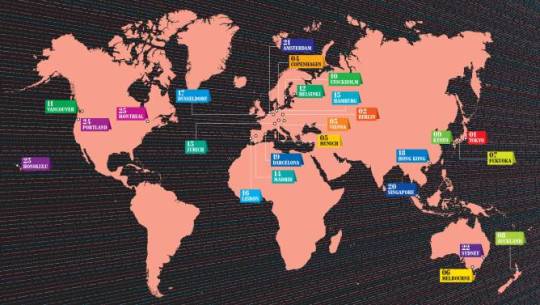
  • Monocle’s Top 25 Liveable Cities — 2016 Edition

    Monocle’s annual survey of the top 25 most liveable cities in the world was just released. It’s now in its 10th year. I found it in my inbox this morning and it was a good reminder that it was about time I renewed my subscription. I’ve been a regular reader of Monocle since 2007, but I let my membership lapse last year.

    Of course, any sort of list like this is going to be subjective. It all depends on the methodology you use. Still, their annual survey is an interesting way to see what each city is up to and where the tides are going. This year Monocle put extra weighting on each city’s nightlife. If you’re not a subscriber, here’s a short video you can watch. It will give you a rundown of all the cities. (I was happy to see Montréal creep onto the list. Incredible city.)

    This focus on the night is something that I’ve been writing about a lot both on this blog and elsewhere. It’s an idea that’s picking up momentum around the world as an economic development strategy. But for whatever reason, uptake seems to be slower here in North America.

    I like how architect Anna Dietzsch puts it in this video. She says that Rio may have the beaches, but Sao Paulo (where she’s based) has the night. That’s exactly how cities should be thinking about this opportunity. It used to be that cities thrived almost entirely because of location, waterways, transport, and other natural features (example: Buffalo). But increasingly, it’s becoming about things like nightlife.

    Vancouver may have the mountains, but Toronto has…

    Image: Monocle

  • What I’m doing next

    image

    A number of you have asked if I’m moving to New York. I can see why that was inferred from some of my posts, but that was actually not my intention. I am not moving to New York. (Sorry New York friends. I’ll visit soon.)

    Toronto is home base. I hope it’s clear how much I love this city. Sure, I’m a big fan of New York and Miami and Vancouver and Berlin and Tokyo and Jackson (to name some of the places I have on my phone’s weather app), but I made a deliberate choice to station myself here.

    Because unlike some of the other industries I write about on this blog, city building is hyper local. What I do involves the built environment. And that doesn’t generally happen via a laptop on a beach in Bali (at least not for extended periods of time).

    It happens by being on the ground, interfacing with local communities, meeting face-to-face with the city, and poring over drawings with smart people who know far more about their respective disciplines than I ever will. It is a collaborative and local effort. It’s about getting into the details.

    And so to be successful in this business, I think it helps to find a home and take long bets. I’m not saying that I will never work on projects in other cities (I have and I would), but I am saying that I’m not moving to New York right now and that home remains Toronto.

    On that note, here’s what I have to tell you. Later this year I’ll be joining Slate Asset Management as VP of Development.

    A bit about Slate:

    Slate is one of the most active acquirers, owners, and managers of real estate in Canada right now. Founded in 2005 by two brothers (Blair and Brady), Slate has over $3 billion of assets under management across over 16 million square feet and over 130 properties.

    All of this is done through four main investment vehicles: 

    1) The first is Slate Advisors. It acts on behalf of and alongside private institutional investors — such as Greystone.

    2) The second is Slate Office REIT (TSE:SOT.UN). It is a pure play Canadian office REIT focused on downtown and suburban properties all across the country.

    3) The third is Slate Retail REIT (TSX:SRT.U). It is a pure play REIT entirely focused on grocery-anchored U.S. retail properties. (Remember how many times I’ve written on this blog about how grocery has one of the lowest online shopping penetrations?)

    4) And the fourth: Slate is also starting a grocery-anchored retail platform in Germany. It is similar to #3, except that it’s in Germany.

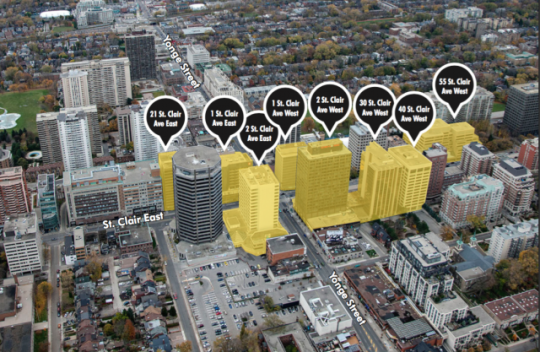
    Most recently, Slate has been in the news because of the position it has taken at Yonge + St Clair in midtown Toronto — a perfect example of “finding a home and taking long bets.” Slate, in partnership with Greystone, owns all 4 corners of the intersection and about 60% of the properties along the St. Clair corridor.

    Here’s a diagram of those Slate buildings:
    image

    In case you didn’t put two and two together, the 8-storey mural I wrote about two weeks ago is going up (right now) on the side of a Slate building (1 St Clair Avenue West — shown above). The British street artist known as Phlegm is doing it.

    Up until today, the focus of Slate has largely been on acquiring undervalued / overlooked real estate and creating value through re-leasing and overall repositioning. That will certainly continue. But given what I do, I am sure you can posit what’s also next.

    I’m genuinely excited to be joining such a talented group of real estate professionals. As I mentioned last week, I wasn’t in the market for anything new. I was heads down working on cool projects. But life happens. And Slate quickly demonstrated to me that the incredible success they have seen to date is precisely because of how progressive, nimble, and entrepreneurial they are.

    On that note, I have “one more thing” to share today.

    In parallel to all of this, and with the support of Slate, I am also starting a boutique city building company called Globizen. The name is derived from Global + Citizen.

    The objective is to build a company that embodies everything I write about on this blog. I want it to be lifestyle and design-driven. I want it to leverage technology to improve the way that cities and the building industry operate. And I want it to function as a vertically integrated real state + design firm, focused on sustainable urban infill development. Think of it as city building by and for the responsible global citizen.

    It’s still early days, but the thinking is that this new platform could compliment the larger Slate platform in some way. It’s too early to say how exactly, but everyone is open to having those discussions. And that’s what matters at this stage.

    I am going to end with a quote. It’s by Partner and Co-Founder, Blair Welch:

    “On all of our deals we have had people say ‘can’t’ to us. They say ‘Can’t be done, can’t do that, can’t raise money, etcetera.’ At Slate, we don’t do ‘can’t’ well.”

    I like that a lot. So here’s to finding a home, taking long bets, and not saying can’t. Onward my friends. 

  • Rinse and repeat

    image

    Venture capitalist Matt Turck has a post up on his blog that is packed full of information about the New York City tech ecosystem. (He has also written similar posts about Berlin and Paris.)

    His overall thesis is that New York – as a startup/tech hub – is only now starting to catch up to the hype of 4 or 5 years ago. He now refers to NYC as the de facto Number 2 after the Bay Area.

    If you’re interested in all of this, you can go read his full post. But I would like to pull out 2 points. The first is about the “rinse and repeat” cycle that happens over time that allows cities to become substantive startup hubs:

    As any student of emerging tech ecosystems knows, the key dynamic to success is the “rinse and repeat” cycle. You need several waves of successful tech companies to go through the whole cycle of founding, financing, scaling and significant exit.   Post-exit, the hope is that successful founders, employees and investors then contribute back both money and expertise to the next generation of tech startups, a few of which eventually become highly successful themselves and then provide money and expertise to the following generation.

    The trouble is, each successive cycle takes years, because the average successful startup takes 5 to 10 years to get to a large exit.

    One key reason the Silicon Valley has become such a powerful network is that this “rinse and repeat” cycle has been happening there for decades, at least since the 1940s and 1950s (Hewlett Packard), with a real acceleration in the 1970s and 1980s (Apple IPO, founding of Kleiner Perkins, etc).

    I’ve written about this idea before, but didn’t refer to it as “rinse and repeat.” I’m thinking about adopting that terminology going forward.

    The second is a list of New York-based startups. Matt uses it as an example of how entrepreneurial activity in New York is operating across a broad cross-section of different industries. That’s an important characteristic to identify.

    However, I also thought you might find it valuable to see what startups are out there, particularly if you happen to work in one of the below verticals/horizontals. I certainly went right to the real estate line.

    Fintech: Betterment, IEX, Fundera, Bond, Orchard, Bread
    Health: Oscar, Flatiron Health, ZocDoc, Hometeam, Recombine, Celmatix, BioDigital, ZipDrug
    Education: General Assembly, Schoology, Knewton, Skillshare, Flatiron School, Codecademy
    Real estate: WeWork, HighTower, VTS, Compass, Common, Reonomy
    Enterprise SaaS: InVision, NewsCred, Sprinklr, Namely, JustWorks, Greenhouse, Percolate, Mark43, Movable Ink
    Commerce infrastructure: Bluecore, Custora, Welcome Commerce
    Marketplaces: Kickstarter, Vroom, 1stdibs
    On Demand: Handy, Via, Managed by Q, Hello Alfred
    Food: Blue Apron, Plated, Maple
    IoT/Hardware: littleBits, Canary, Peloton, Shapeways, SOLS, Estimote, Dash, GoTenna, Raden, Ringly, Augury, Drone Racing League
    AR/VR/3D: Sketchfab, Floored

    I was happy to see my friends at Floored in the above list. They are under AR/VR/3D, but they service the real estate industry.