Daily insights for city builders, delivered every morning at 6 AM ET. I’m Brandon Donnelly — a Toronto-based real estate developer and founder of Globizen. I’ve been writing here since 2013.
Today, one of the top landscape architects in Canada — Claude Cormier — died from complications associated with something known as Li-Fraumeni Syndrome. He was only 63.
Claude, and the firm he founded CCxA, have been responsible for some of the most beautiful, whimsical, and critically acclaimed public spaces in Canada.
Those of you familiar with Toronto will know Berczy Park, Sugar Beach (pictured above), the new Love Park, and others. These are easily some of the most successful public spaces in the city, and for good reason.
CCxA is also the landscape firm behind our 100 Lombard project, where we have been similarly working to create a new and whimsical public space in downtown Toronto.
We’re all sorry to see you go, Claude. Canada is a better — and more fun place — because of your work.
The ambition was to discover why some urban plazas are successful and why many others fail. And to do that, he went out and studied urban plazas throughout New York using video and simple observation, such as head counting.
His work has been hugely influential for architects, designers, and other urbanists. But if you think about how often we fail at creating urban spaces that actually attract people, I think it’s worthwhile revising what Whyte discovered way back in the 70s and 80s.
Some of the principles – such as providing places to sit – are dead simple and intuitive. But again, a lot of urban spaces suck. So we’re clearly not doing it.
The other thing I feel we often forget is that it’s not just the space itself that matters, it’s also the urban fabric around it. The Seagram Building in New York plays a central role in Whyte’s work as an example of a successful urban plaza.
But we can’t forget that Mies van der Rohe’s simple gesture of setting the tower back from the street is strengthened by the remaining urban fabric and the activity along Park Avenue. The plaza acts as a kind of release.
Alongside the book, Whyte also published a 60 minute video. If you’ve never seen it, I highly recommend you watch it when you get a chance. Click here if you can’t see the video below.
To close out this post, I thought it would be fun if everyone shared their favorite public urban space in the comment section. It can be in your city or it could just be a place you’ve visited.
To kick things off, I’m going to go with with a space that’s close to home: Berczy Park. It has lots of places to sit, including movable chairs. There’s a great water feature. And it’s well connected to the rest of the area and surrounding streets. I often sit there during lunch or when I just want to think.
But by the end of it, I was just sad. As a lover of cities, it always makes me upset to see great buildings disappear. I think you too will be surprised at what I found.
The following picture depicts the north side of Front Street East, about 2 blocks east of Yonge Street. I don’t know what year it is, but look at how stunning these buildings are. It looks like Soho, New York meets some glamorous European capital.
Can you imagine what we could do with these buildings today?
If there’s any doubt in your mind that this is Toronto or that it’s Front Street East, take a look at the spire in the far left hand side of the picture. It belongs to the Toronto Board of Trade Building, which used to sit at the north east corner of Yonge Street and Front Street. When it was built in the late 1800s, it was considered one of the first “skyscrapers” in Toronto. It was demolished in the 1950s.
Here’s a picture of the Board of Trade Building so that you can compare. Again, take a look at the spire.
For those of you who might not be familiar with the area, here’s a map to help you out. The Board of Trade Building is shown on the bottom left hand corner. And the buildings in the first picture are in the triangular land area between Wellington and Front.
Now, let’s fast forward to the late 1960s. Those same buildings shown in picture number one have been demolished and in their place is the following parking lot. It’s a bit less glamorous looking. There are still heritage buildings on the south side of Front Street, but the balance of the area seems to have been blown out. What a shame.
Finally, here’s an aerial view of the area. It’s also from the late 1960s or early 1970s. You can see the same triangular land area, with only the Flatiron Building still standing at the very tip of it.
Obviously the St. Lawrence Market has come a long way since the 70s. That triangular area has since become Berczy Park, which is actually in the midst of being completely revitalized, and all of those parking lots have been filled in. But I still can’t help but wonder what the neighborhood would be like today had we preserved all of those heritage buildings.
I think cities work best when you can figure out that delicate balance between preservation and progress. It’s not always the simplest approach, but as most things in life, the right decisions are often the toughest ones to make.
Earlier this week a friend of mine was live tweeting a public consultation meeting for the revitalization of Berczy Park in the St. Lawrence Market neighborhood of Toronto. And since I live in the neighborhood, it’s a project that I’ve been following particularly closely–although anything related to the built environmental generally fascinates me.
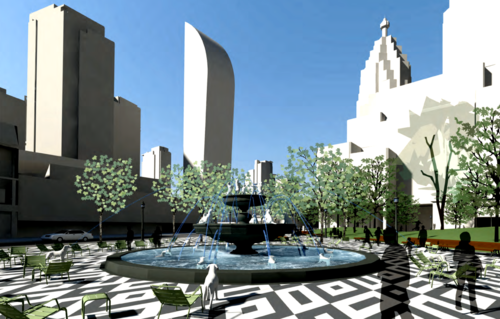
As soon as I saw the pictures he was tweeting out, I was immediately excited. And after reviewing the full design package (which you can download here), I must say that I think it’s going to be a brilliant change for the neighborhood.
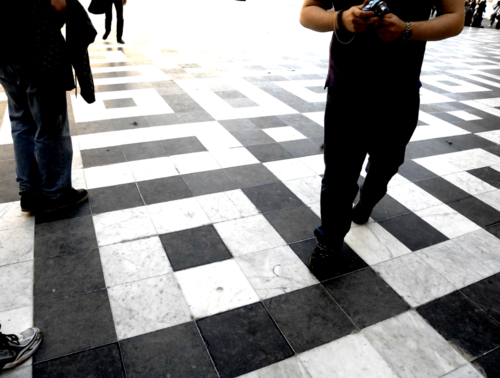
On an entirely superficial level, I like the paving motif they’ve chosen; even if it does appear to be be a copy from somewhere else (see above photo). I don’t think one should underestimate how small details, like paving, can have a huge impact on how one feels in a space, whether inside or out. It all counts.
But beyond just cosmetic changes, there are a couple of significant design changes being proposed.
First, a larger kid-friendly green space is being proposed on the west side of the park. And what was interesting to see was how the community overwhelmingly expressed a need for this play area. I’d like to believe that this speaks to the growing acceptance of raising kids downtown. There are certainly lots of families in the St. Lawrence.
Second, the south portion of the park is being “opened up” with a much larger hardscape area. The result will be a bigger promenade along Front Street, as well as, what I hope, will become an “urban stage” for people to hang out, breakdance, busk or try and sell me things I don’t need.
But equally exciting is the fact that along with the revitalization of Berczy Park will come a public art competition. It’s already in the works, but there aren’t any pretty images to share, just yet. Regardless, I think the topic of public art is an interesting discussion.
In a lot of cities around the world, there are mechanisms in place to encourage or mandate public art. Commonly, it comes in the form of a “Percent for Art” program, which means that, in the case of a new construction project, 1% of the construction costs would or should go to public art.
But the fact that we, at least in some cities, have programs to mandate it, should immediately signal to you that public art is not something universally believed in. And certainly it’s one of those things where it’s hard to measure the return-on-investment.
But that doesn’t mean it doesn’t or can’t exist.
In fact, I would argue that in today’s information and digital age it’s only going to become more important. We are living in a world of too much information and too little time. We’re living in a noisy world and, whether you’re a corporation or a city, the only way to stand out is to be remarkable. You need to bring delight to people.
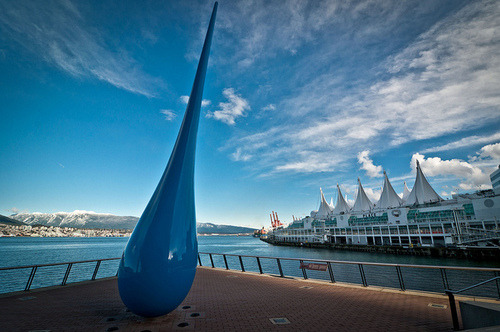
Because when you do, you get noticed (and probably shared on Facebook, Twitter, Instagram, Tumblr, Snapchat, Vine, 500px, Flickr and maybe even Google+). As one example, how many of you recognize the public art piece below? It’s in Vancouver and I’ve seen it pop up a number of times in my social news feeds. It’s something that brings delight to people.
But at the same time, it’s something that speaks to and creates a sense of place. What could be more Vancouver than a giant blue raindrop along the waterfront? And that’s really one of the ironies of today’s digital world. Despite the fact that, no matter where we are, we’re all hyper connected through technology, more and more of us are gravitating back towards cities. We want to live close to other people and we want to feel a sense of place.
When done properly, public art can help cities achieve that. Whether it’s the famous LOVE sculpture or Richard Serra’s controversial Tilted Arc, public art can make you stop and take notice of your environment. It can give you that sense of familiarity or it can take you by surprise. Either way, it gives you a sense of place.
This week was the first public meeting for the revitalization of Berczy Park in the St. Lawrence Market neighbourhood of Toronto. I wasn’t able to attend the meeting but, as a resident of the area, I am interested in the project and will be following.
In browsing through the project’s site, I came across an incredibly depressing photo of the St. Lawrence area from the 1970s. Here it is:
The empty greenish plot of land in the foreground is where Berczy Park sits today. The building at its point is the Flatiron Building, which is easily one of the most photographed buildings in the city.
What’s obviously remarkable about this image is just the sheer number of surface parking lots. There is no neighbourhood, really.
But even more depressing is the fact that all of this was seemingly deliberate. We tore down buildings to make way for all those parking areas. And that’s always upsetting. Here’s a photo of the same area in the 1920s (the Flatiron Building is at the bottom right):
It just goes to show how planning ideologies change.
But to our credit, look how far we’ve come since the 1970s. Today, the St. Lawrence Market neighbourhood is one of the most vibrant downtown neighbourhoods. It’s become a model for mixed-income urban renewal – both here and abroad – and it continues to see strong investment.
So while we screwed it up before, we are making amends.