Daily insights for city builders, delivered every morning at 6 AM ET. I’m Brandon Donnelly — a Toronto-based real estate developer and founder of Globizen. I’ve been writing here since 2013.

Tag: benjamin tal

  • Over-building and then under-building: Is Toronto headed for a severe shortage of new rental housing?

    As we know — because here’s the data — this is the current state of affairs:

    The GTA condo market is in a state of economic lockdown. The math doesn’t make economic sense from both the demand side (investors) and the supply side (developers), leaving the market at a standstill.

    The above excerpt is from a recent CIBC Capital Markets article by Benjamin Tal (CIBC) and Shawn Hildebrant (Urbanation). And what it ultimately means is that the supply of new condominiums in the GTA is falling and will continue to fall for the foreseeable future. Below are two charts, from the same article, that show that.

    Because of this, I actually think that, if you need or want a place to live, right now is a near ideal time to buy a condominium, especially if it’s from developer inventory (in an already completed project) or it’s a resale. Of course, most people won’t want to do this because they’d rather buy when most other people in the market want to buy. This is how markets tend to go.

    It has been a while since the GTA has gone through one of these real estate cycles, but it is typical: developers are prone to both over-building and under-building. It simply takes too long to build a building, and so it is natural for there to be moments when supply and demand don’t exactly line up.

    Pre-selling condominiums is — in theory only — supposed to protect against too much overbuilding. But as we have spoken about many times before, it can be challenging for end users to buy a new home so far in advance. And so the new condominium market has come to rely on investors who want to buy early and then either sell later or rent later.

    According to the above article (and MLS data), the share of newly completed condominiums used as rentals reached a peak of 34% in 2023. So a third of new condos. My gut tells me that the actual number is much higher. Many rentals never reach MLS. Overall, I think it’s very safe to assume that the majority of new condominiums are owned by investors.

    But right now, fewer investors want to own condominiums, which is why the number of resale listings has spiked this year:
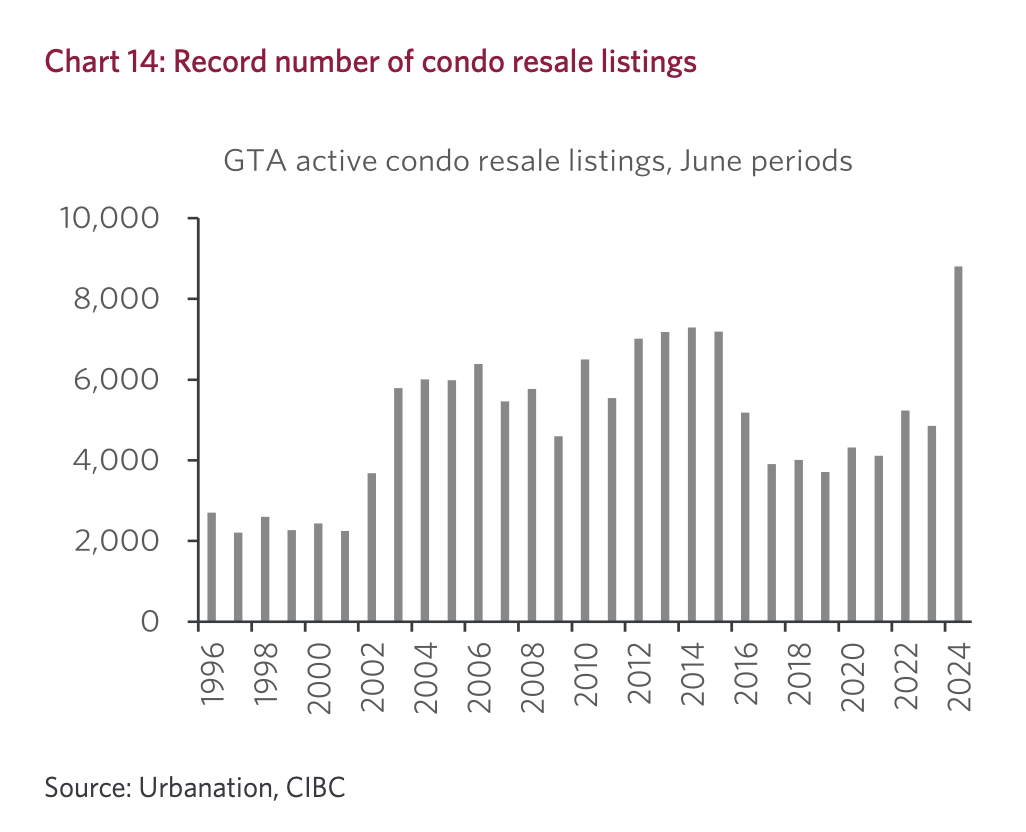
    This is, again, why I think right now is an excellent time to buy a condo. You know, be greedy when others… Regardless, this inventory will need to get absorbed and that will ultimately happen. Some of it will go to end users and some of it will go to investors who can make sense of the rental math and/or want to take a long view on Toronto. But if more goes to the former, we will be losing a lot of new rental housing.

    At the same time, while all of this is going on, construction starts are likely going to remain depressed (chart 3 above). It’s impossible to know how long this lasts, but at some point we will reach a moment in the cycle where we are under-building new housing. Maybe we’re already there. Development simply can’t turn on fast enough when demand spikes. There will almost always be a lag.

    So, since the majority of new condominiums have been serving as new rental housing, there’s a strong case to be made that at some point we will run into a potentially severe shortage of rentals. Condo investors are sometimes vilified in the media, but we will soon find out what happens when you take a big chunk of them out of the housing market.

  • Interest rates are expected to start coming down this summer

    Last week was “forum week” in Toronto. (That is, it was the Toronto Real Estate Forum.) And as is the case every year, Benjamin Tal, deputy chief economist of CIBC, opened up the event with his usual macro view of the world. For those of you who missed it (as I did), here are some of his key points (via RENX):

    • The Bank of Canada’s overnight rate will ultimately/likely settle into the 2.75-3% range (currently it sits at 5%). He expects rates to start coming down this summer.
    • Inflation is down, but we’re not yet at the 2% target. The “last mile” is always the toughest.
    • But as we know, the BofC will take a recession over high inflation, any day.
    • The mortgage market has fallen faster than in the early 90s recession. Tal said that the residential real estate market in Canada is right now facing “the biggest test” since then.
    • Canada is in what he calls a “per capita recession”. But for the million or so immigrants that the country accepted over the last year, we’d be in a full-blown official recession.
    • Finally, he called this correction in the housing market both “real” and “healthy”; he spoke about normalcy returning in 1-2 years; and he posited that the market will be “crazy” when it does return because of a supply deficit.

    This last point is an important one. New housing supply is mostly shut off right now. I say mostly because there are obviously still projects under construction, and there have been and there will continue to be some successful launches. But by and large, most developers are waiting right now, principally because the absorption isn’t there. They have no other choice.

    But Canada continues to grow. People from around the world continue to want to move here. And there continues to be a need for a lot more new housing. So when the market does return — and it, of course, will — there is going to be a supply-demand imbalance. And as is always the case in real estate, there will be a lag in responding to this imbalance.

    This is what Tal means by “crazy”.

    Photo by Wiktor Karkocha on Unsplash

  • We should waive the HST on purpose-built rentals

    We have spoken recently about the reset taking place in the development industry right now. It is difficult to underwrite new projects.

    But even before this current environment, it was challenging to make new rental housing pencil. Condominium projects almost always look more attractive (at least here in Toronto) and generally speaking, the spectrum for rental housing feasibility goes from “no, this doesn’t work” to “yeah, maybe this will work if we trend rents over a long enough time horizon.”

    The problem with this is that we know more rental housing would be a positive thing for our cities. So how do we address this? Here are some common solutions that get thrown around:

    • Make condominium projects less attractive to build. If fewer developers want to build condominiums and if fewer investors want to buy them, then maybe new purpose-built rentals will become more enticing to build. On some level, this makes sense. It should create downward pressure on land values. But this doesn’t help rental housing supply if it isn’t feasible to begin with. And why limit overall housing supply? (Related post, here.)
    • Make rental housing projects less attractive to build. I know this sounds counterintuitive when I say it this way, but we do do this. Rent controls, to give just one example, generally make it harder to build new rental housing. Yes, it can help those who are already housed, but it can disincentivize proper building maintenance, it can lead to more people being over-housed, and it absolutely hurts new supply. So there are trade-offs.
    • Make rental housing projects more attractive to build.

    I find this last one intriguing, and so here’s one specific idea that I have raised before. Though this time, I’m quoting Benjamin Tal of CIBC:

    But, by far, the most pragmatic step to take in the immediate future would be to waive or defer HST payments on purpose-built rental projects from first occupancy to the sale of the building, while keeping the same valuation methodology as the current regime.

    It’s the most realistic option since it’s relatively easy to implement, and Ottawa will have a willing partner in the Ontario government. Buried in page 84 of the recent Ontario budget was the following sentence, “we call on the federal government to come to the table on potential Goods and Services Tax/Harmonized Sales Tax (GST/HST) relief, including rebates, exemptions, zero-rating or deferrals”.

    Such a move alone would shave close to $60K from the unit cost of that 400-unit project in Toronto, resulting in a meaningful reduction in rent, while at the same time unlocking tens of thousands of rental units across the country in short order — clearly a step in the right direction.

    We should do this.

    P.S. Sam, thanks for sharing Tal’s article with me.

  • Economic update with Benjamin Tal — get ready for the second half of this year

    Benjamin Tal — CIBC’s Deputy Chief Economist — is seemingly everywhere. And earlier today, he was delivering an annual economic update at an online event hosted by Brattys LLP (our condo lawyers) in partnership with CIBC. Below are a handful of slides that I found interesting and that I tweeted out during the event.

    All of our personal risk curves changed during this pandemic. When the first wave hit, we all had no idea how bad this was going to be and what to expect. And so we all stayed home and washed our hands and our groceries. That changed with each subsequent wave. And now we’re all ready and anxious to be done with this.

    Tal referred to this as one of the most unequal recessions we’ve ever seen. If you had a high paying job, you probably kept it. And after you stopped spending money on eating out, entertainment, travel, and watching the Leafs lose in person, you likely had a meaningfully higher savings rate. That has created some $100 billion of “excess cash” sitting on the sidelines.

    This cash wants to be spent and I think we’re going to see it flying out the door in the second half of this year. Much of it will also flow into services, which should help to prop up the hardest hit segments of the economy. So while there has been some real pain, many are expecting the economy to snap back pretty quickly. Get ready for some euphoria in the second half of this year.

    This last slide is particularly relevant to the kind of things we often talk about on this blog. It is essentially showing the increased demand for housing outside of the city during this pandemic (as of Q4 2020).

    A flatter line (Vancouver, Calgary) indicates that year-over-year price growth was less affected by “distance from the city center.” On the other hand, a steeper line (Toronto, Ottawa) indicates that price growth was stronger the more you moved outward from the core. In the case of Toronto, it was nearly 20% YoY when you got about 60-70 kilometers out of the city.

    But it’s important to keep in mind that the core of Toronto still grew at about 5% year-over-year. About the same as in Vancouver. And in the case of Ottawa, the number looks to be about 17.5% in the city center. These are meaningful numbers and not the kind of symptoms you would expect to see from downtowns in the middle of a death spiral.

    I would argue, as I have many times before, that this last chart is the result of short-term phenomena. I bet we’ll see a number of these pitches reverse by the time Q4 2021 arrives.

  • Toronto condos on the rise again

    CIBC Deputy Chief Economist Benjamin Tal was recently interviewed by Larysa Harapyn of the Financial Post about the state of the housing market in the Greater Toronto Area. The message he delivers is pretty clear: “If you think that Toronto is unaffordable now, you wait.” The long-term fundamentals in this market remain strong. Demand is outstripping supply and will likely continue to do so, which is why Tal also stresses the importance of delivering more purpose-built rental housing. If you can’t see the video above, click here. (And with that, I think it’s time to switch topics for tomorrow’s post. That’s enough Toronto housing for one week.)

  • Canadian real estate fundamentals

    Last week was the Vancouver Real Estate Forum. Benjamin Tal (chief economist at CIBC) opened things up, as he usually does, and he was pretty candid about what might be coming this winter. Here is an excerpt from a recent Globe and Mail article summarizing the event:

    “It’s reasonable to assume that the next six months will not be very pretty,” said Mr. Tal. “The honeymoon of the summer is basically over. Now we enter the winter months, and I think the next few months will be much more difficult. We will have a situation where we will clearly see a second wave, and it’s already starting. This second wave will overlap with the flu season, so everybody will be very confused. The fear factor will rise, and that’s something we have to take into account when we look at the trajectory of the economy.”

    Indeed, today kind of feels like the official start of the second wave. Here in Toronto, indoor dining, gyms, and a bunch of other things were just shut down for the next 28 days.

    But I think the more important takeaway from the article is this one here: the fundamentals around Canadian real estate remain incredibly strong. Another excerpt:

    “Let’s visit the market in 2023: I suggest the market will show the same trend we have seen in as 2019. This is a pause, but the fundamentals of the real estate market in Canada are so strong that the demand factor will continue to be there and supply will be limited. I suggest that after a two- to three-year period of some sort of softness, despite the V-shaped recovery that we are seeing, I see continuation of the trend.”

    As I’ve said before on the blog, it’s easy to get caught up in shorter-term and ephemeral headlines. But if one can look through some of that to the other side of this health crisis, I think we would all be in a position to make better decisions.

    As a general rule, I don’t like making long-term real estate decisions based on what is expected to take place in the next 6 months.

  • Half of Toronto condos completed last year became new rental housing

    image

    Shaun Hildebrand (Urbanation) and Benjamin Tal (CIBC) published a report today called, “A Window Into the World of Condo Investors.” In it they revealed that last year (2017 data) no less than 48% of the Greater Toronto Area’s newly completed condo units were closed on by “rental investors.” In other words, almost half of the units became new rental supply.

    This stat was not surprisingly turned into clickbait-y type headlines like, “Half of Toronto condos bought last year were by investors”; whereas an alternate headline might read: “Half of Toronto condos completed last year became new rental housing.” Not as jarring, I know.

    In any event, there are a bunch of other interesting stats in the reports. Here are a few of them:

    – 80% of all new home sales in the GTA last year were condo.

    – Average resale condo prices (per square foot) increased by 26% last year and rents grew by 9%.

    – Over 20% of condo investors purchased their property with no mortgage.

    – Average down payment made by investors was 20%; non-investors were closer to 15%, likely because of mortgage insurance and other factors.

    – Out of the condo investors who took possession in 2017 with a mortgage, no less than 44% are in a negative cash flow position – meaning their rental income isn’t covering their carrying costs. 

    – The returns, which the report calls exceptional, have been coming in the form of price appreciation.

    – As a stress test for the market – what if all these negative cash flow investors suddenly sold their condos? – the report also estimates that if you took all of the rental investors who closed in 2017 with a mortgage and who are in a negative cash flow position greater than $500 per month, it would represent only 3.4% of the total annual supply of condos (both new and resale product).

    If you would like to check out the full report, you can do that over here.

    Photo by Scott Webb on Unsplash

  • The Toronto and Vancouver housing markets

    CIBC World Markets recently published this report by Benjamin Tal talking about the Toronto and Vancouver housing markets. Here is an excerpt:

    “But when the fog
    clears it will become evident that the
    long-term trajectory of the market will
    show even tighter conditions. The supply
    issues facing centres such as Toronto and
    Vancouver will worsen and demand is
    routinely understated. Short of a significant
    change in housing policies and preferences,
    there is nothing in the pipeline to alleviate
    the pressure.”

    It’s a good read. Worth your time.

    One stat that stood out and directly relates to some of the topics that we frequently talk about on this blog is the shift in Toronto from low-rise to high-rise housing.

    In the report there’s a chart showing the “change in [housing unit] completions” in 2016 as compared to 2000. The switch from low-rise to high-rise is almost 1:1 in Toronto. In other words, we substituted high-rise housing for low-rise housing. 

    I think this speaks volumes about the fundamentals underpinning the Toronto condo/apartment market. We are continuing to build up because it is the future of housing in this city.