Daily insights for city builders, delivered every morning at 6 AM ET. I’m Brandon Donnelly — a Toronto-based real estate developer and founder of Globizen. I’ve been writing here since 2013.

Tag: barcelona

  • Paris and Vancouver population densities compared

    In this January 2018 report from the Fraser Institute, they pegged the average population density of Paris to be about 21,067 inhabitants per square kilometer (2014 population year). It is the second densest city in their report after Hong Kong, but the densest in Europe. By comparison, Vancouver sits at around 5,493 inhabitants per square kilometer (2016 population year).

    Now, these are of course city averages. Some neighborhoods will be higher and some will be lower. According to a January 2018 study by Alasdair Rae — who is a works in the Department of Urban Studies and Planning at the University of Sheffield — these are the most densely populated square kilometers across Europe (or at least within the 39 countries that he looked at).

    Paris, once again, comes in near the top with a peak density somewhere around 52,218 inhabitants per 1km square. The square in question is in the neighborhood of Goutte D’Or. And the only square within the study to come in denser is one from the L’Hospitalet de Llobegrat in Greater Barcelona (53,119 inhabitants per square kilometer).

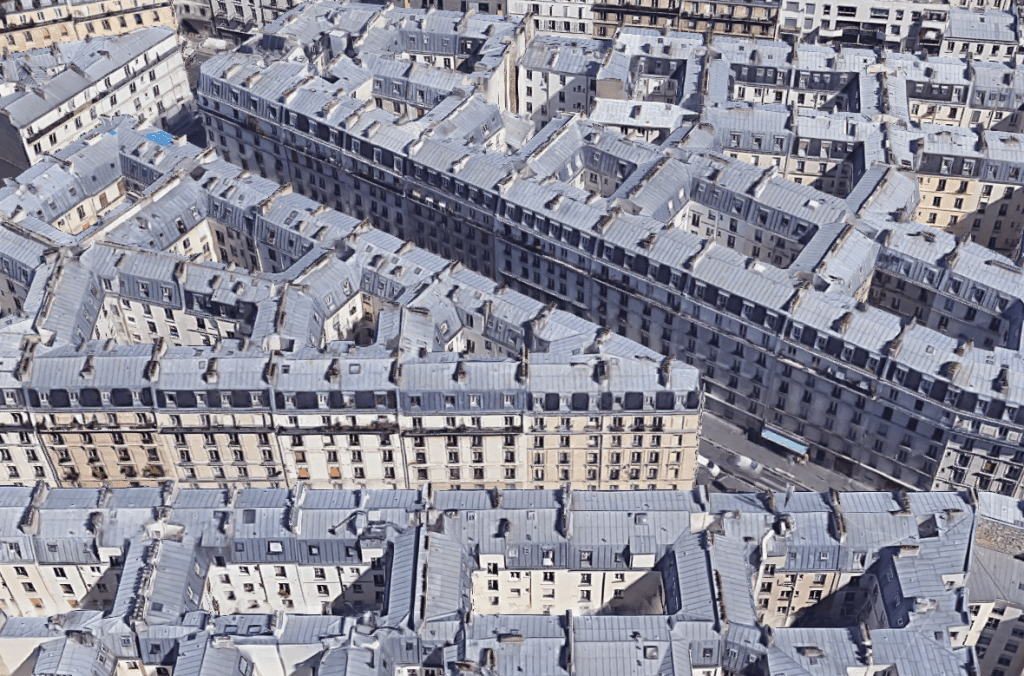
    Now let’s take a look at how these sorts of densities actually manifest themselves. Below is an aerial capture from Google Maps showing a section of Goutte D’Or in Paris. The buildings are all pretty much 7 storeys (mid-rise), but the blocks are mostly filled in. Lots of interior courtyard apartments. This is one way to get to over 50,000 people per square kilometer.
    Returning to Vancouver as a point of comparison, below is an aerial capture from downtown Vancouver at exactly the same scale as the Paris capture. I couldn’t find a density map of downtown, but it’s probably safe to assume that it’s greater than 5,493 and a lot less than 52,218 residents per square kilometer.
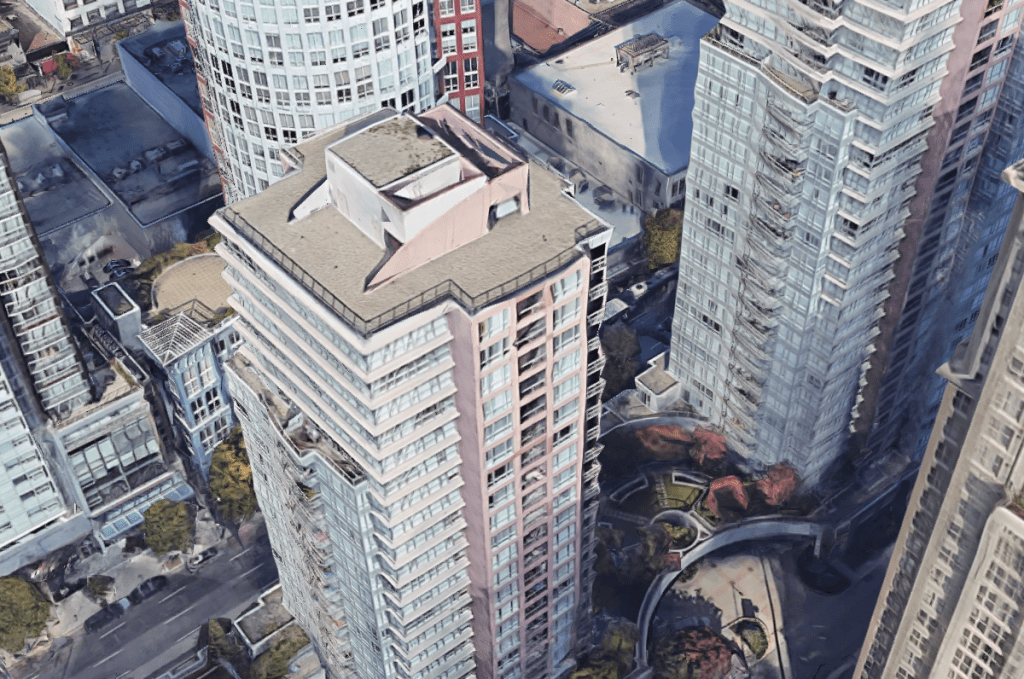
    What you see here is typical Vancouverism. Lots of slender point towers, careful tower positioning and spacing, and generally low podiums. It is a perfect demonstration that height and density do not necessarily correlate. It is possible to have low buildings and high density, which is something that Europe obviously does very well.

    But here’s the important question: In which of these two examples would you rather live? Please leave a comment below.

  • Skateboarding to debut at the Summer Olympics in Tokyo

    The 2020 Summer Olympics, which will be held in Tokyo, have added 5 new sports, one of which is skateboarding. As someone who grew up skateboarding as a teenager, and is all too familiar with being chased out of public spaces, this lends a great deal of legitimacy to the sport.

    It’s hard to think of a sport that is more closely connected with architecture and, more specifically, public architecture. Curbed’s recent long-form article about “the public spaces that shaped skateboarding” is a good reminder of that. Here is an excerpt (EMB refers to Embarcadero Plaza in San Francisco, which was previously known as Justin Herman Plaza):

    When skateboarding debuts at the Tokyo Olympics next summer, some three decades after the first polyurethane wheels hit the bricks at EMB, it will have completed the long, improbable trip from criminal act to social and institutional acceptance. But even as an Olympic sport, skateboarding will remain a direct physical response to the varied terrain of American public architecture.

    Interestingly enough, one could go on to argue that the history of skateboarding is really steeped in the adoption of public spaces that had, in many cases, failed to serve their intended purpose. In other words, skateboarders were often the only people using these urban spaces:

    “What made Justin Herman Plaza attractive to skateboarders and work for skateboarders was its inappropriateness to the traditional city scale and function,” King says. “You had all these planners and architects in the 1950s and ’60s saying cities need these grand, celebratory spaces—and they really didn’t.” But apparently skaters did.

    Welcome skateboarding to the 2020 Summer Olympics in Tokyo.

    Photo by Frans on Unsplash


  • Barcelona from above

    Barcelona is one of the densest cities in Europe. And Márton Mogyorósy’s recent photo series, called Barcelona from above, does an excellent job of demonstrating that. My favorite photo is this one here, showing La Barceloneta neighborhood adjacent to the beach:

    None of the buildings are particularly tall (maybe 6 or 7 storeys at the most), but the streets are probably only about 6m wide, including sidewalks. This is one way that you can achieve density without height and it is a good example of what I was getting at in my post, European-style height, but not density.

  • The challenges of the metropolis beyond Habitat III

    This morning I woke up to an email from the Urban Ecology Agency of Barcelona. They are a public consortium dedicated to urban sustainability and made up of the City Council of Barcelona, the Municipal Council and Metropolitan Area of Barcelona, and the Barcelona Provincial Council. The email was about this upcoming “urban congress” taking place in Barcelona from May 22-24:

    Sadly, I have no plans to be in Barcelona next month. But if any of you are based or traveling there, the conference is all about the future challenges that cities will face and about contributing to the new urban agenda. The main topics are: sustainability, city planning, social cohesion, and competitiveness. 

    Habitat III – which is in the title of the conference – was a United Nations conference on housing and sustainable urbanization. It took place in Quito, Ecuador in October 2016. However, it forms part of a much larger framework around sustainable global development. More info here.

    Barcelona is also one of my favorite cities, so I am happy to share this one with all of you. If you’d like to register for Post-Habitat III, head over here.

  • Barcelona’s new superblocks

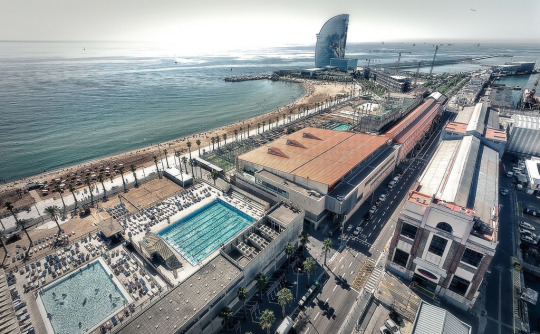
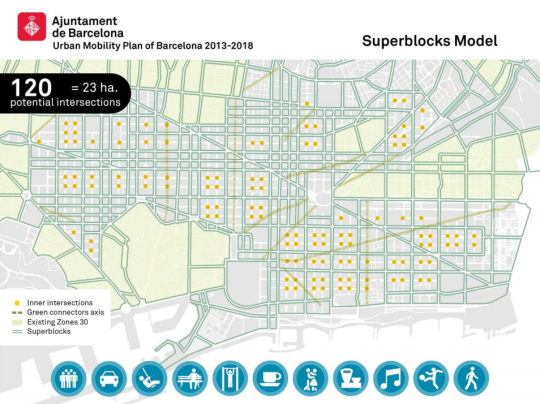
    Barcelona is in the midst of dramatically rethinking its urban fabric to address issues around urban mobility and climate change. Initially laid out in this 2014 Urban Mobility Plan for Barcelona, the city is now implementing something it calls superilles (or superblocks in English).

    Here’s what it looks like:

    The idea is to concentrate transit and vehicular traffic onto the edge of these new superblocks and then convert the interiors into livable spaces for pedestrians and cyclists. Here’s a description from the Agència d’Ecologia Urbana de Barcelona:

    “Superblocks are made up of a grid of basic roads forming a polygon, some 400 by 400 meters, with both interior and exterior components. The interior (intervía) is closed to motorized vehicles and above ground parking, and gives preference to pedestrian traffic in the public space. Though the inner streets are generally reserved for pedestrians, they can be used by residential traffic, services, emergency vehicles, and loading/unloading vehicles under special circumstances. The perimeter, or exterior, of Superblocks is where motorized traffic circulates, and makes up the basic roads.”

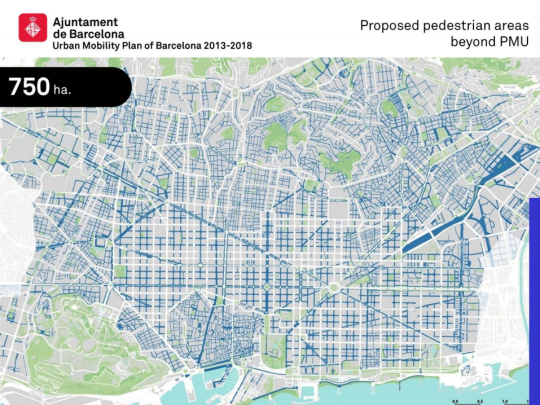
    The result is going to be an absolutely radical shift in the amount of public space given to drivers, pedestrians, and cyclists. When their 2014 report was issued, it was estimated that 73% of public space was allocated to cars (versus pedestrians). This plan will completely flip that ratio. With the superblock model, it is estimated that 77% of public space will now be allocated to pedestrians.

    Here’s what that is expected to look like…

    Before:

    After:

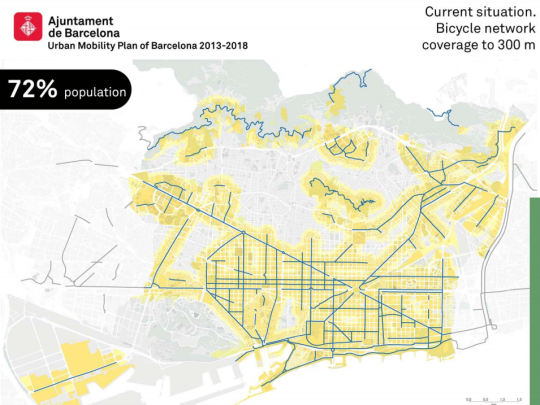
    There are also plans to expand the bicycle network to roughly 95% of the city’s population.

    Before:

    After:

    If any of you are from Barcelona, I would love to hear a local perspective on this mobility plan. Were and are there cries of a war on the car?

    Images: Top image from Tom Walk (Flickr); Maps from Urban Mobility Plan of Barcelona 2013-2018

  • Residential population densities compared

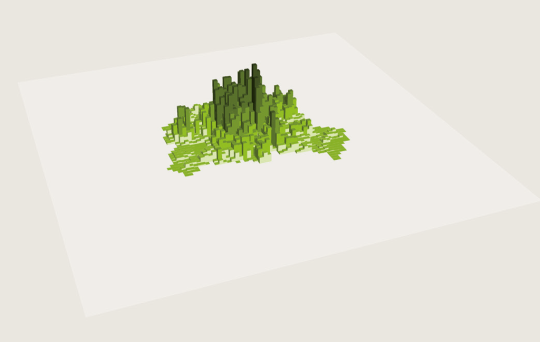
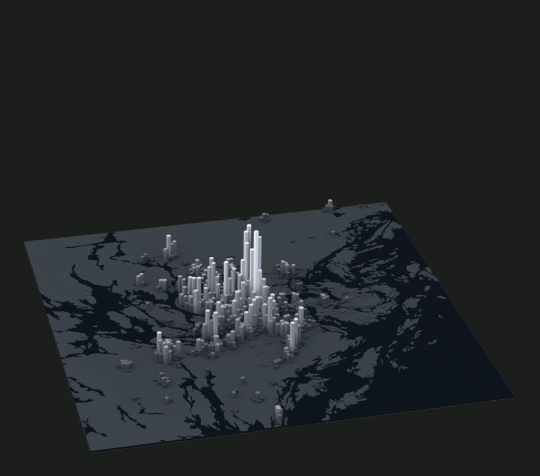
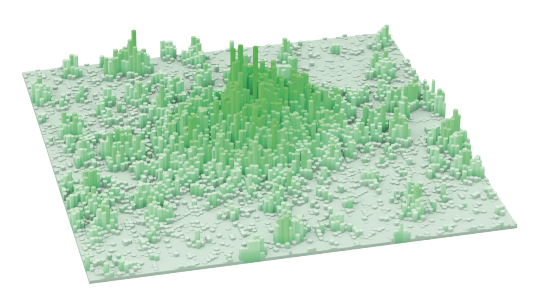
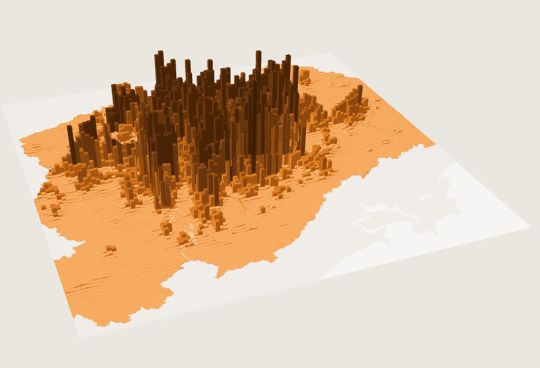
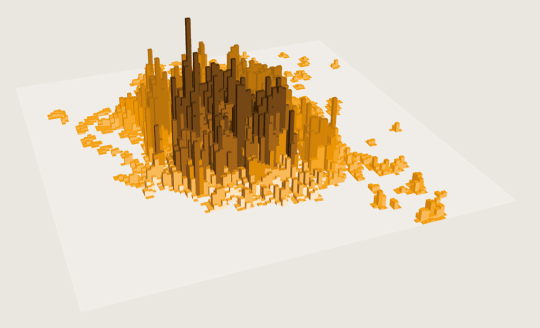
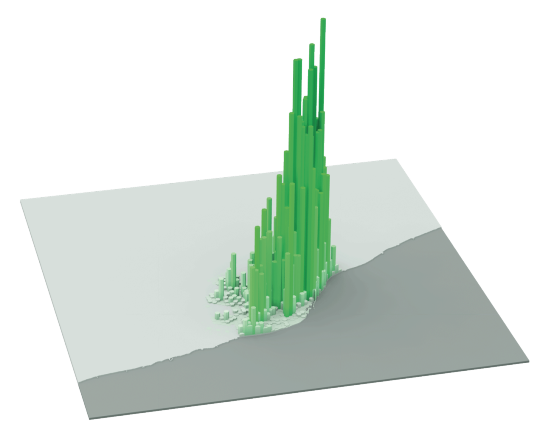
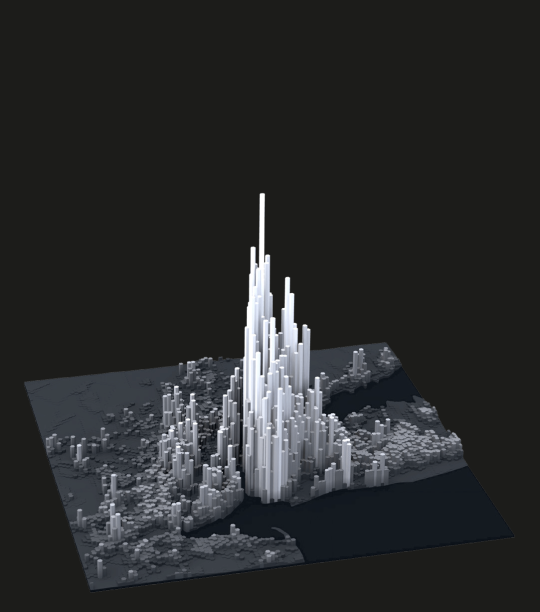
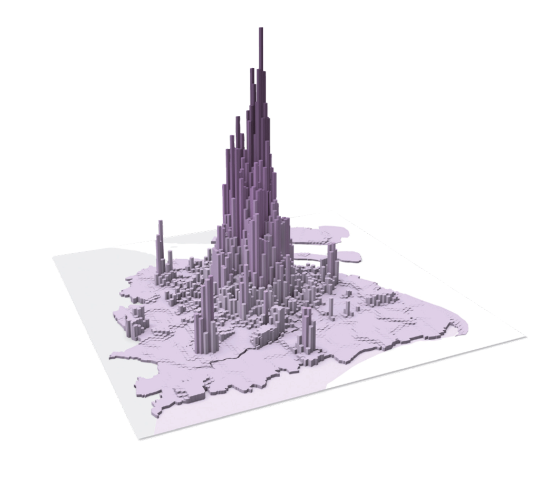
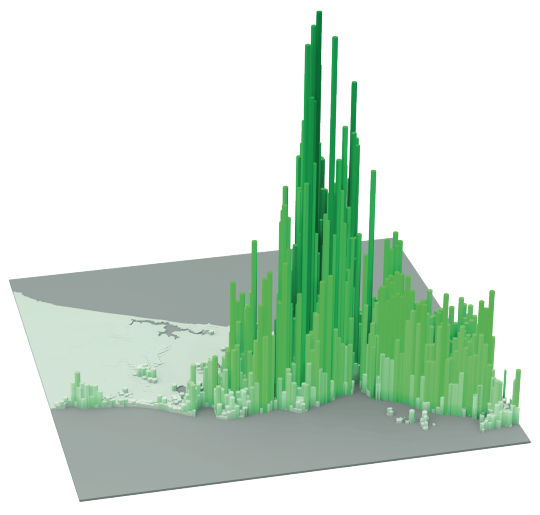
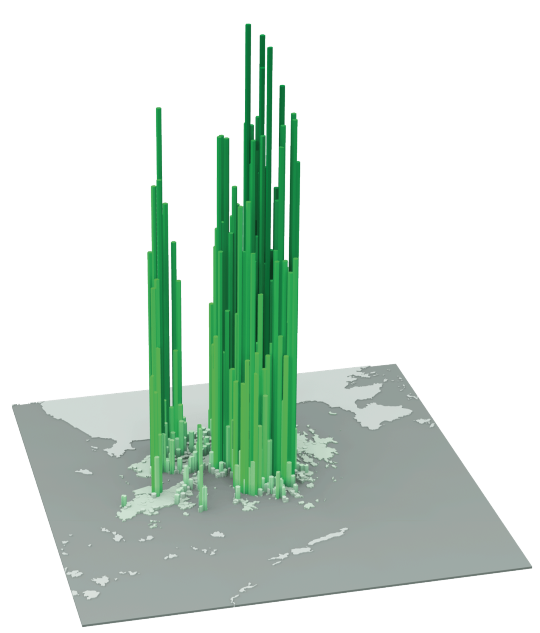
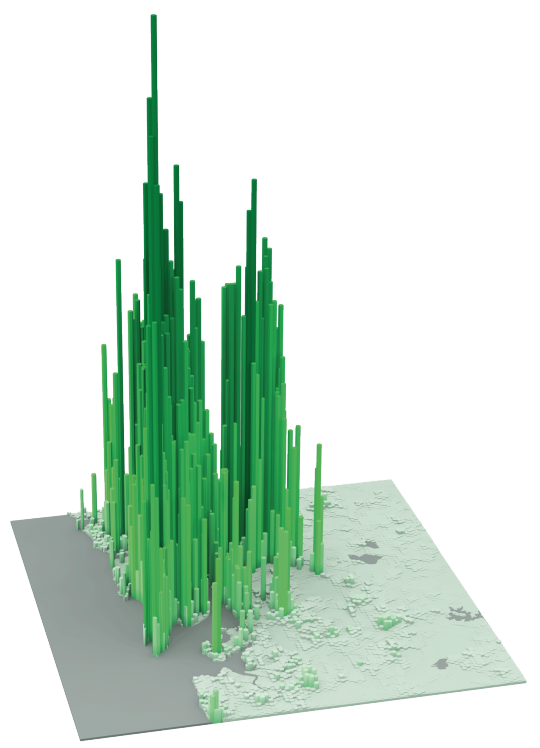
    The following diagrams were taken from LSE’s Urban Age website. I’ve sorted them from lowest to highest peak residential population density. In each case I’ve also included the year of the dataset. 

    It’s amazing how much these simple extrusion diagrams can tell you about the city. It also shows you that high population densities don’t necessarily need to equate to tall buildings. Barcelona, in particular, stands out for me.

    Berlin (Peak residential density: 21,700 people/km2, 2009)

    image

    Stockholm (Peak residential density: 24,900 people/km2, 2012)

    image

    London (Peak residential density: 27,100 people/km2, 2013)

    image

    São Paulo (Peak residential density: 29,380 people/km2, 2009)

    image

    Mexico City (Peak residential density: 48,300 people/km2, 2009)

    image

    Barcelona (Peak residential density: 56,800 people/km2, 2013)

    image

    New York (Peak residential density: 59,150 people/km2, 2012)

    image

    Shanghai (Peak residential density: 74,370 people/km2, 2011)

    image

    Istanbul (Peak residential density: 77,300 people/km2, 2013)

    image

    Hong Kong (Peak residential density: 111,100 people/km2, 2013)

    image

    Mumbai (Peak residential density: 121,300 people/km2, 2013)

    image

  • The Entrepreneurs, Barcelona

    Last week Monocle published their latest edition of “The Entrepreneurs” series. In this episode they look at Barcelona and a handful of entrepreneurs that are helping to grow the city. The video is only about 7 minutes long.

    I enjoy Monocle’s short films and I’ve always been impressed by Barcelona as a city. So here’s the video:

    [youtube https://www.youtube.com/watch?v=Q1wLBjlecac?rel=0&w=560&h=315]

  • The Olympics are dead. Or are they?

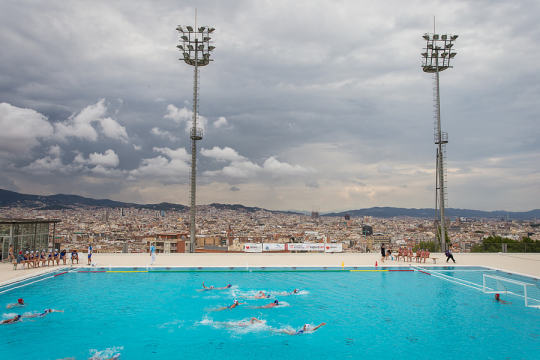
    Olympic Pool – Barcelona, Spain by Tom Weightman on 500px.com

    https://500px.com/embed.js

    Early this morning Professor Robert Wright – who is a regular reader and commenter on this blog – sent me an article from The Guardian called, ‘The Olympics are dead’: Does anyone want to be a host city any more? And that got me thinking.

    With Toronto having just hosted the Pan Am Games (the Parapan Am Games are still going on), there’s a lot of talk and debate happening in this city right now about whether or not we should make a go at hosting the 2024 Summer Games. The deadline for cities to express their interest is September 15th, 2015.

    The supporters (of which I would include myself) say it’s a great opportunity for civic (re)branding and urban renewal. It creates real deadlines to get things done. But the naysayers argue it’s a fiscal disaster waiting to happen. See 1976 Summer Olympics in Montreal.

    But in my view there are ways to host the Olympics and there are ways not to host the Olympics. Montreal (1976) is an example of what not to do. And Los Angeles (1984) and Barcelona (1992) are some of the best examples of what to do.

    The key is to think of the Olympics not as the end, but more as the beginning. In Olympic talk, they refer to this as legacy. Here’s what Los Angeles managed to accomplish as a result of the 1984 Summer Games (via Gizmodo):

    In 1979, the L.A. organizing committee had made a deal. If the games saw any profits, LA84 would give 60 percent back to the U.S. Olympic Committee and keep 40 percent for Southern California. At the end of the games, the total expenditures came in at a respectable $546 million, but even more impressive was the profit: A surplus of $232.5 million, meaning $93 million would stay in the region. This was huge. The only other games at the time which could claim to be financially successful at all were the other L.A. Olympics: The ones held in the city in 1932.

    The profits were used to create an endowment called the LA84 Foundation, which funds youth sporting events, resources, and facilities throughout the area. With smart management, the endowment has grown over the years, and over $214 million has helped an estimated three million children and 1,100 organizations in Southern California. Recently, the LA84 Foundation helped raise money to pay coaches and buy equipment at LAUSD high schools after budget cuts decimated their programs.

    The rest of the above article is definitely worth a read. It’s a great example of fiscal prudence.

    So what I am suggesting is not that we run blindly into hosting the Summer Games. But that we instead open our minds to the opportunities. Let’s great creative. If we could catalyze further city building, turn a profit, and leave meaningful legacies for this region (like what LA did), then why wouldn’t we want to have a go at it?

  • On boulevards vs. freeways

    Toronto’s Director of Urban Design, Harold Madi, recently did a 20 tweet series on boulevards. And since today is Gardiner East day, it seems appropriate to share it with you all. Thanks to Shawn Micallef for using Storify to put it all together neatly. If you can’t see all the tweets below, click here.

  • 4 design strategies for your cold-climate waterfront

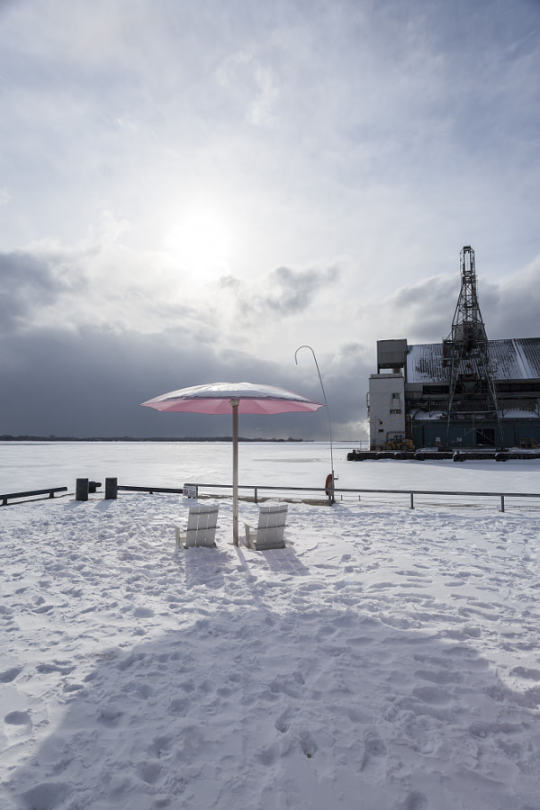
    Photograph Sugar Beach in Toronto by christophmarten on 500px

    Sugar Beach in Toronto by christophmarten on 500px

    Since we’ve been discussing waterfronts lately, I thought I would share this post from ArchDaily talking about 4 ways that cold-climate cities can make the most of their waterfronts.

    They are:

    1. Plan for winter sun
    2. Create plazas that block wind
    3. Break up outdoor spaces with comfort stations (not sure why they just have to be stations)
    4. Design for active winter programming

    These, of course, aren’t new design strategies. Cities have been built around their climates since, probably, the beginning of cities. It wasn’t until more recently that we started basically ignoring local climates and focusing more on what mechanical systems can do to make us feel comfortable.

    But I think that was a mistake. I don’t think that mechanical systems are bad though. I just think that there’s a lot that we can do first – without mechanical systems – to address local climates.

    If you’ve ever sat on a patio during a swing season (i.e. right now) where the wind was blocked and you were in the direct sun, you already know that there’s a lot that can be done without relying on active systems.

    But the other thing I like about this post is that it acknowledges the fact that winter waterfronts require just as much, if not more, design attention than a warm-climate waterfront.

    Saying that we’ll (insert cold-climate city name here) never be Miami or Barcelona or Sydney is just giving up.