
Daily insights for city builders, delivered every morning at 6 AM ET. I’m Brandon Donnelly — a Toronto-based real estate developer and founder of Globizen. I’ve been writing here since 2013.

Tag: bank of canada

  • The Bank of Canada raised rates, but mortgages are still relatively cheap

    The Bank of Canada raised its policy rate by 25 basis points this week to 2.5%. It was the first increase since July 2023, and it was largely because of high oil prices:

    Given persistently high oil prices, CPI inflation has been around 3% since April and is expected to rise to about 3½% by the end of the year. Excluding gasoline, inflation was 2.2% in September and measures of core inflation remain close to 2%. But cost pressures are building, with high fuel prices raising the costs of production and transportation. Imported industrial and electronics input prices have also increased. While businesses have mostly absorbed higher input costs so far, Bank surveys suggest cost pass-through will increase over the next year. Near-term household and business inflation expectations have risen, while longer-term inflation expectations remain well anchored.

    David Rosenberg of the Globe and Mail called the hike “totally unnecessary and premature” given that this is an energy cost problem and that the bank seems to be wearing rose-coloured glasses when looking at GDP growth estimates.

    Cue the mortgage renewal scare articles:
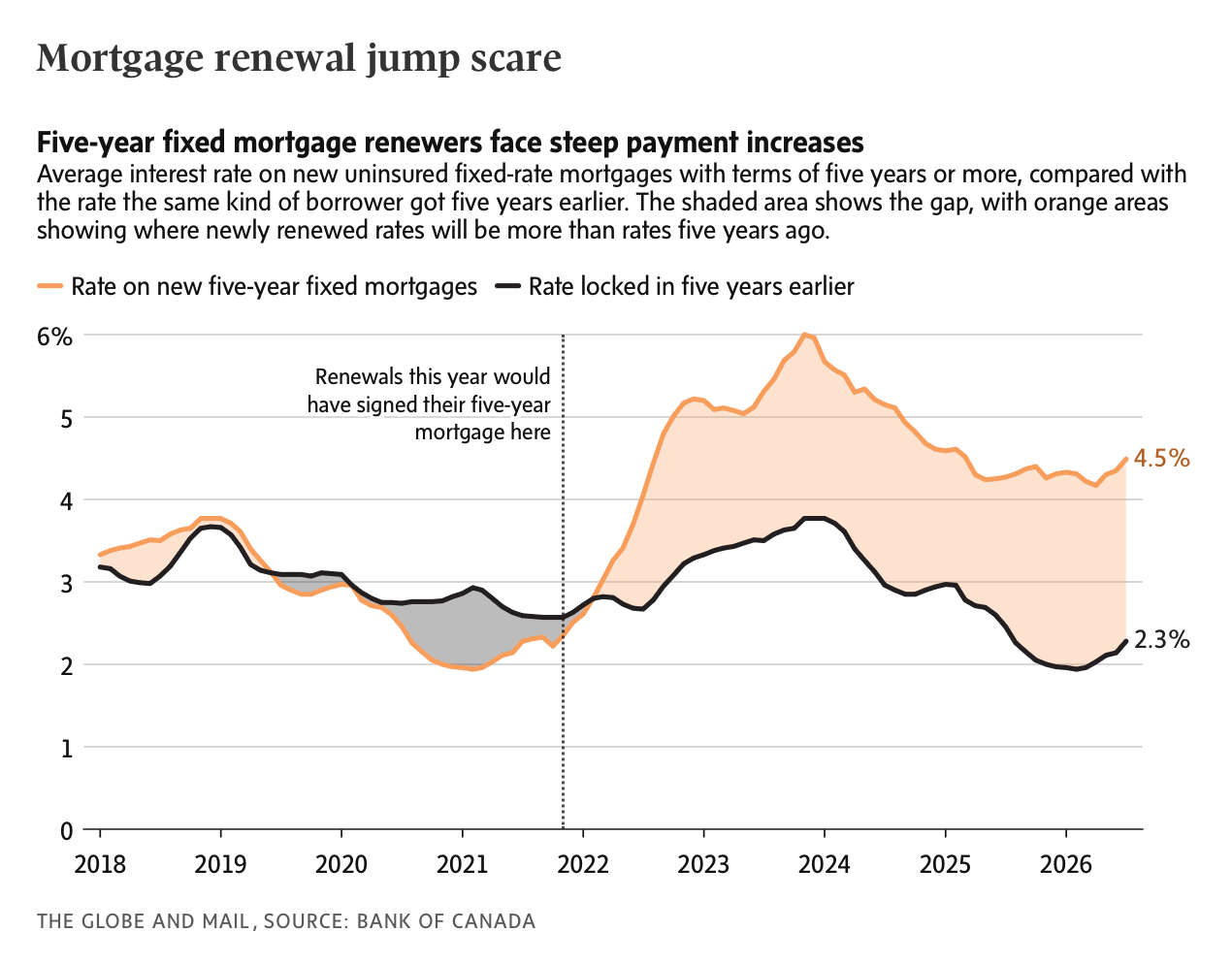
    But let’s keep in mind that 4.5% is not that high. Historically, this is still relatively low-cost debt. The concern isn’t the absolute level — it’s the delta, and the fact that real estate values are highly sensitive to interest rates and get re-priced when rates change.

    Now, when it comes to Canadian housing, a five-year mortgage is very typical, and then the rate resets to market. That’s why 2026 was predicted to be an alarming year for homeowners. That hasn’t been the case. And the faster the market normalizes, the healthier it will be.

    On the other hand, I often think about the US where 30-year fixed-rate mortgages are possible and there are homeowners sitting on 2-3% rates with a powerful economic incentive never ever to move. This is going to be a massive generational distortion to the housing market.

    When people don’t move, inventory declines, people become over-housed, and urban labour markets become less dynamic. Canada’s 5-year resets might create periodic jump scares, but they force reality into the housing market.
  • Incomes caught up with inflation. So why does everyone feel broke?

    Early on in my career, I used to run development pro formas where I would assume that our costs would increase at some rate in and around inflation. Combined with a conservative contingency allowance, I used to think I was being prudent. How cute.

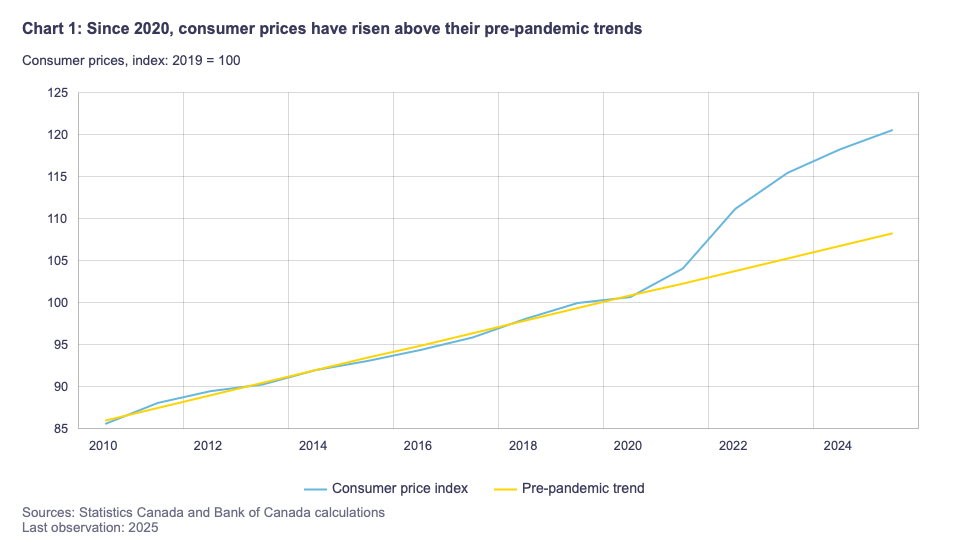
    The pandemic made this approach seem silly. Our pro formas did not contemplate 40-50% cost increases for certain line items. But even without these outliers, the pandemic did cause things to become more expensive than one would have expected from pre-pandemic trends. Here’s a recent chart via the Bank of Canada:

    But the cost of things is only one side of the equation. For things to be “more expensive,” we also need to look at their relationship to income, and that’s what Yaz Terajima has done here. Interestingly enough, household disposable income seems to have kept pace with the additional cost of things, at least on average.

    Between 2020-25, the average household spent about $6,500 more per year relative to pre-pandemic trends, but disposable income increased by about $7,400, creating a positive income-expense gap of about $900.

    So why, then, does it feel like things are more expensive? Well, for one thing, there is a meaningful difference across age groups and income levels. Yaz also found that younger and lower-income households did not, in fact, see their incomes rise sufficiently to cover these higher costs.

    On top of this, this study does not factor increases in overall wealth due to assets appreciating, which tend to be more concentrated among wealthier households. So the full-picture reality is almost certainly a bigger socioeconomic divide across age groups and income levels.

  • What might happen in 2024

    Yesterday we looked in the rear-view mirror. Today we’re looking forward:

    • The market consensus right now is that this cycle of interest rate increases has come to an end, and that we should see rates start to come down next year. Having confidence that rates won’t go any higher in the near future is what markets need in order to start making more decisions. So this is, of course, positive. At the same time, I don’t think anyone should expect a return to ultra-low rates. Rates today are still low when viewed historically.
    • Lower rates are good for levered assets such as real estate, but I don’t think that our industry has fully felt and processed the impacts of higher rates. Unfortunately, I think that things will get worse (in 2024) before they get better (maybe toward the end of 2024 or perhaps in 2025). This is when a “risk-on” approach will return in commercial real estate. A year ago today, I thought 2023 would be the year for this, but as I said yesterday, I was overly optimistic in terms of my timing.
    • On the residential resale side, I think we will see greater optimism sooner, certainly for the most in-demand cities and areas. There is pent up demand waiting on the sidelines and, once we can get past the current bid-ask spreads and deadlock, I believe we’ll return to a more balanced market in 2024. To be clear, I’m not expecting bidding wars and the like. And because of our housing affordability crisis, I also think the Bank of Canada will be more resistant to lowering rates compared to other central banks. This will help the Canadian dollar.
    • If you’re a buyer of real estate, I generally believe that 2024 will turn out to be a pivotal year for you. Roughly speaking, you win acquisitions in one of two ways: either (1) you pay the most or (2) you believe in something that most other people in the market don’t. This second approach is harder to achieve in bull markets. But in slower markets, the door is open and history has taught us that it can be the foundation in which great fortunes are made.
    • As I mentioned yesterday, I agree with the prognostications that hard costs will soften further next year (perhaps even more than 5% on average). Obviously every market is different. But here in Toronto, I just don’t see us returning to the level of construction starts that we have seen over the last number of years.
    • Since 2021, I have used my hyper scientific Jimmy the Greek Reopening Index to keep tabs on office utilization and the overall return to office. And based on this, 2023 was a positive year. Initially, souvlaki consumption appeared dramatically lower on days like Monday. But I noticed discernible increases as the year went on. However, if you look at actual data, such as what we have from swipe cards, the great return to office seems to have stalled out at around 50%. I don’t think this will hold, though. I continue to believe that of the people who work in offices, most will spend > 50% of each week there. And we will see that in 2024.
    • 2023 was the year of AI. But Fred Wilson makes an excellent point, here. AI is 40+ years in the making. Last year only became the year of AI because a consumer-facing app — ChatGPT — was revealed that captured everyone’s attention. Crypto will eventually have this moment, but it will likely need to marinate a bit longer. Instead, I think 2024 will be the year of augmented reality (AR) and a further blurring of our offline and online worlds. Think digital art, fashion, and other collectibles (such as NFTs).
    • Right now, autonomous vehicles feel like they’re in the trough of disillusionment (within the hype cycle). There were moments last year where it felt like we were finally moving beyond this phase. But then some very suboptimal things happened. I think AVs are our reality in the next 5+ years, which means that for next year we likely want to be focused on the inputs: vision/LIDAR, battery tech, etc.
    • Zooming out, we should be thinking about the above two trends in the context of a broader shift toward greater automation. I think it will feel more insidious than immediate (certainly in 2024), but the longer-term impacts are going to be profound for our society. The so-called gig economy is likely to be impacted first. Eventually the overall economy will create new jobs, but we are still going to need to manage this transition toward more automation.
    • TikTok Shop is where to look for the future of shopping. I think the platform will continue to see strong adoption and ultimately prove to be a dominant e-commerce platform throughout 2024. Amazon, Meta, and others will see this, and try their best to catch up and copy it.
    • At the time of writing this post, the total crypto market capitalization is about $1.74 trillion. This is down from nearly $3 trillion at the peak of the market in 2021. The recent gains suggest that the so-called “crypto winter” might be over, and so combined with lower interest rates and more real-world use cases, I think that 2024 will be another strong year for crypto. Total crypto market cap at the end of the year will exceed its 2021 peak.

    And there you have it. My current thoughts for this upcoming year. I should note that I’m not an economist, analyst, or an expert on souvlaki demand for that matter. But I enjoy writing this post as an annual discipline. It forces me to think critically about the topics that interest me. And in the paraphrased words of Howard Lindzon, it gives me an archive that I can go back to and either cringe at or think to myself, “hey, I could have been a somebody!”

    And with that, a big thanks to everyone who has read this daily blog over the last year. This year marked its 10th anniversary. I wish you much success and happiness in 2024. Happy new year!

  • The neutral rate and housing supply

    Below are two interesting excerpts from this recent Globe and Mail interview with Tiff Macklem (the current governor of the Bank of Canada of the former dean of the Rotman School).

    The first has to do with where he believes the “neutral rate” will be in the foreseeable future. He believes it will be higher than where it has been in the past:

    We have different models we use to estimate the neutral rate [the central bank’s estimate of where its policy rate would settle if the bank were neither trying to stimulate nor restraining the economy]. … Those models, based on the data we have, still suggest a neutral rate in the range of 2 to 3 per cent.

    When we look forward, and we look at a number of the forces, it seems more likely that the neutral rate is going to be higher than that … [rather] than lower than that. We don’t have that data yet. But there are a number of factors.

    More people are retiring. The labour market looks like it could be sort of structurally tighter going forward. Globalization has at least stalled, if not reversed. That could create more cost pressures. We’re going to need a lot of new investment in cleaner technologies if we’re going to meet our emissions-reduction targets. When I say ‘we,’ it’s the world – so that’s going to affect global real interest rates.

    So when you look forward, it seems more likely that the neutral rate is higher, not lower. And the message is that households, businesses, governments, the financial system, they need to be prepared for that possibility.

    The second is about his view on Canadian housing:

    The fundamental issue in the housing market, and this has been an issue in Canada for 10 years, at least, is structurally the demand for housing is growing faster than the supply. And so yes, interest rates go up, the housing market will slow. But it’s only going to slow so much because there is a sort of structural shortage of supply relative to demand.

    I think what you’re seeing is that with supply growing less than demand, the housing market has started to tick back up, housing prices have started to tick back up. That’s something we need to take into account in monetary policy. But we’re not targeting the housing market. We have one target: CPI inflation.

    These two forces are opposing ones. Higher rates create downward pressure on home prices. But, as we all know, a structural housing supply problem does the opposite. Where these two forces balance out is anybody’s guess. But as Tiff mentions above, his concern is not home prices; it is inflation.

    I am not an economist, but my view is that the broader real estate market is still going through its reset. There will be more pain and less housing supply overall in the short-term. Risk and leverage are still being unwound and that takes time. It also sucks.

    Because of this, I think if you ask most people today, they will likely tell you to wait: “We haven’t yet hit the bottom of the market.” This is likely true. But I have zero ability to time the bottom of a market. And at the same time, the future does feel a lot more knowable compared to a year ago.

    My philosophy is more akin to what I blogged about earlier in the week: If it’s cheap, if the thesis is sound, and if you have the ability to think long-term, then these downturns are when you want to buy. And that is how I’m starting to feel about things right now. This includes everything from real estate to NFTs.

    Disclaimer: This is not investment advice.

  • Competitiveness and currency

    The Globe and Mail published an article yesterday morning called, “Why a lower loonie is (mostly) good for Canada.” It talks about the recent decline of the Canadian dollar from parity last May to roughly USD $0.92 today. But that the drop is essentially because of a rising US dollar. 

    Irrespective of what’s causing the devaluation though, the article takes the tone that it’s generally good for the country:

    “On net, this could be seen as a good thing because it’s making Canadian goods and services more competitive,” said Michael Devereux, a professor at the University of British Columbia’s Vancouver School of Economics.

    But this viewpoint always gets me concerned. 

    Canadian goods and services shouldn’t be competitive because they’re cheaper; they should be competitive because they’re the best damn good and services in the world. And so my fear with statements, like the one above, is that it almost makes us believe that a weak dollar is a prerequisite for competitiveness. It’s not.

    In fact, research done by Professor Walid Hejazi at the Rotman School has shown that a weak Canadian dollar actually lowers productivity levels and creates a disincentive for innovation. Why bother to innovate when you can always get your goods and services to market at a lower cost than your competitors?

    Thankfully, the outgoing Senior Deputy Governor of the Bank of Canada (and upcoming Dean of the Rotman School), Tiff Macklem, has acknowledged this perspective. In a talk at Queen’s University last January, he said:

    “What should Canadian businesses do? First, don’t count on a weaker Canadian dollar. Hoping for a weaker Canadian dollar is not a business plan. A sustainable export strategy cannot rely on expectations of a more favourable exchange rate, since Canada is likely to remain an attractive investment destination.”

    That sounds like good advice to me.