Daily insights for city builders, delivered every morning at 6 AM ET. I’m Brandon Donnelly — a Toronto-based real estate developer and founder of Globizen. I’ve been writing here since 2013.
This is an interesting video by Phil Andrews of Maxinomics talking about the economics of Uber and what it could stand to gain from autonomous vehicles.
As part of this, he touches on the exclusive partnership that was announced between Uber and Waymo back in September. That was a big deal.
I find this topic fascinating because it’s hard to imagine it not reshaping the landscape of our cities. And it continues to get more real by the day.
One of the reasons why I’m interested in the autonomous vehicle space is that I know our built environment is sticky. And because we’ve designed so much of it around the car, it’s hard to imagine this dependance going away anytime soon.
In fact, there’s a very real possibility that autonomy leads to further decentralization. That is typically what happens when we make it easier and cheaper for people to travel longer distances. They sprawl. So we ought to start preparing ourselves for the positive and negative externalities.
I’m not a deep expert on autonomous vehicles, but as an interested observer, Waymo appears ahead of Tesla in delivering this future. Waymo has been offering fully driverless rides since 2020 and Tesla is still at L2 autonomy, which means a driver needs to be present in the vehicle.
I hear from lots of people that their Full Self Driving (FSD) software is pretty good, but according to some studies, it can require human intervention as often as every 13 miles. This doesn’t necessarily mean that Tesla won’t be first to “solve autonomy,” but their Cybercab isn’t here yet.
If you’re interested in this topic, here is an article by Timothy Lee summarizing a discussion that he recently had with the co-CEO of Waymo, Dmitri Dolgov. Some of it is a little technical, but it does offer a comparison between Tesla and Waymo.
That is, how their approaches differ and what the future might look like.
I watched Tesla’s We, Robot event last night. As many of you know, Elon and his team showcased a Cybercab, Robovan, and a humanoid robot that dances funny, all of which will be available in the market for purchase at some unknowable date in the future. What was obvious is that Elon himself has no clear idea of when this will be.
What I will say, though, is that the designs look cool. The Cybercab looks like a Porsche and a Cybertruck had a love child, and the Robovan looks like an Art Deco rendition of what the future is supposed to be like. I first wondered why they’d create a robotaxi with only two seats. But thinking about it now, most Uber rides probably only have 1-2 passengers.
Despite these pretty designs, the overwhelming reaction to the event seems to be one of disappointment. We’ve heard what was said before. Public transportation is bad (I disagree). Autonomy will free up your time and remove unnecessary parking spaces from our cities (allowing for more public space). And soon you’ll be able to put your under-utilized car to work and earn extra cash.
Cool, but when?
Waymo and Uber are not, as far as I know, hosting similarly flashy events. But as far as I can tell, they’re making meaningful progress in advancing toward full autonomy. As of June of this year, Waymo had already logged over 22 million rider-only miles. And in September, they announced a partnership that would bring AVs to Austin and Atlanta by way of the Uber app.
At this point in the hype cycle, I don’t think anyone is interested in hearing promises about what the future of autonomy will be like, especially without any firm dates. They want to know: Are we there yet? So I think it’s no surprise that people, including investors, weren’t all that pumped up by the event.
On a more important note, Tesla had bicycles with brightly illuminated wheels circulating around their event set (at Warner Bros.) to presumably demonstrate that their Cybercabs can successfully navigate around moving objects (when brightly illuminated). If you missed them, look at the 29 second mark in the below video:
I can’t be the only one who thought: “What are those? Now, that’s what I want!” So I’ve asked Elon when they’ll be available and when I can buy one. I’ll keep you all posted on his response.
Waymo and Uber just announced a partnership that will bring Waymo’s autonomous vehicles to the Uber app in Austin and Atlanta. Notably, this is an exclusive partnership, meaning the only way you’ll be able to summon a Waymo vehicle in these cities will be through Uber.
The people who follow this space closely, people like Reilly Brennan of Trucks (VC) and Harry Campbell (The Rideshare Guy), think this is a really big deal for a number of reasons.
One, it signals a bifurcation in the industry where there will be companies, like Waymo, that supply autonomous vehicles, and companies, like Uber, that operate them and manage the overall ride hailing marketplace. As part of this deal, Uber is going to handle all of the maintenance and cleaning of the vehicles. This split is similar to the airline industry.
Two, it suggests, and this is Harry’s argument, that Waymo needs Uber more than Uber needs Waymo. One of the reasons for this is that a 100% AV fleet is simply too expensive to operate if you’re solving for peak demand loads. Because during off-peak times, you then need to pay for downtime.
Uber, on the other hand, doesn’t pay for downtime with its human drivers. Most of its drivers are part-time and only plug in when they want to or when the surge pricing becomes too attractive to pass up. So they’re the perfect compliment to an AV fleet. Harry argues that this is part of Uber’s competitive moat.
And three, it signals that AVs are really starting to arrive, if not already here. The hype cycle certainly hit its trough of disillusionment and everyone switched to thinking that AVs weren’t going to happen for many years, if not decades. But now it’s happening. City by city.
Waymo has started releasing statistics for its autonomous vehicles. Here’s the link.
There are a number of important considerations when comparing human-driven and autonomous vehicles. For instance, the two have different definitions of a crash. AV operators have to report any kind of physical contact (property damage, injury, or fatality). Human-driven cars, on the other hand, don’t typically report accidents unless it was bad enough to necessitate a police report. So there are nuances to keep in mind.
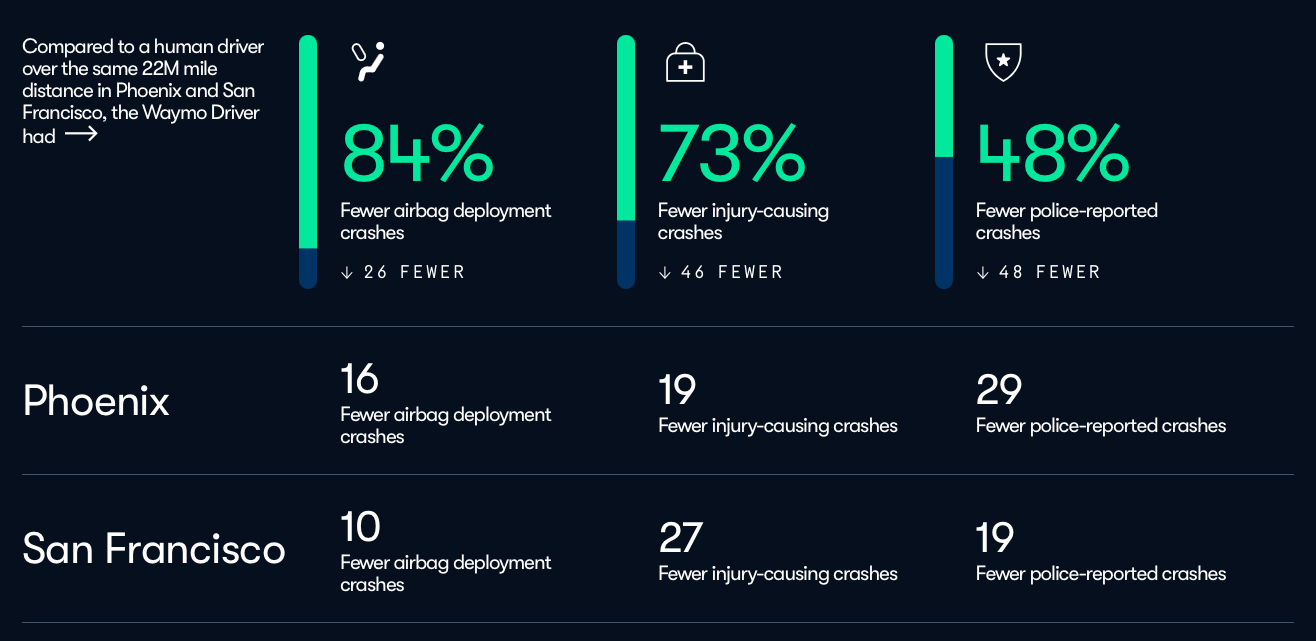
That said, there is an argument to be made that AVs are already safer than human-driven ones. Through to June 2024, Waymo had already logged over 22 million rider-only miles. And here is what it is now reporting in terms of airbag deployments, injury-causing crashes, and police-reported crashes:
All of them are lower than their respective benchmark crash rates.
A few days ago, Waymo announced (on X) that its robotaxis are now doing more than 50,000 paid trips every week across Phoenix, San Francisco, and Los Angeles.
This means that the company is getting an average of 300 bookings every hour or five bookings every minute. And if you add in Austin, where it’s currently offering a limited number of rides, the company has completed a total of over one million rider-only trips.
In the announcement, Waymo also went on to say that “fully autonomous ride-hailing is a reality and a preferred mobility option for people navigating their cities every day.” All of this is something.
But perhaps the most important takeaway, right now, is that the company continues to claim — by way of a study from Swiss Re — that its robotaxis are already significantly safer than human-driven vehicles.
I don’t personally know if this is true, but it’s not hard to believe. I mean, human drivers suck. And assuming it is true, we should all want more robotaxis on the road, because statistically, we would be significantly safer.
The problem, though, is that autonomous vehicles suffer from a perception bias. We’re all looking for them to fail. If a robotaxi gets into an accident, it’s news. But if a human driver gets into an accident, it’s standard operating procedure. It’ll be interesting to see how and when this flips.
Remember Wuhan? Well, it turns out that it is emerging as an important hub for driverless vehicles. Right now it is home to the largest fleet in the world:
In Wuhan, 500 robotaxis, mostly run by Baidu, China’s rival to Google, recorded more than 730,000 ride-hailing trips last year. That compares with combined orders of more than 700,000 last year in Phoenix, San Francisco and Los Angeles, according to Waymo, the self-driving car developer of Google’s parent company Alphabet. Waymo told the Financial Times that it had “a couple of hundred cars” in each of the three fully autonomous zones.
One of the things that is allegedly helping Chinese companies is that they have access to more data. The networks of cameras and other infrastructure that make Chinese cities the most surveilled in the world are, coincidentally, also good for training machine learning models.
This has some industry experts speculating that China could reach an autonomous vehicle “tipping point” sometime around 2027. Meaning, the technologies will be significantly safer than human drivers (at least 10x) and ready for mass adoption.
I don’t know if this is the right timeline. There have been many forecasts made over the years. But I do know that competition is good for progress and that having a rival can be an important motivator. And right now, this is yet another example of the US vs. China.
One of the realities that we will have to face in, oh I don’t know, 5 or so years, is that there will be a mixture of different cars on the road. Some will operate with drivers. And some will operate with no drivers. Assuming that the cars with no drivers do well at their job, I would imagine that this will become the default. But in the interim, it’ll probably be useful to know which is which. And that’s why Mercedes-Benz (and probably others) has been working to establish a new internationally-accepted signal for computer-driven cars.
The decision so far: turquoise lights.
The company has just received permits from the states of California and Nevada for its Drive Pilot system, and as part of this, turquoise lights were earmarked for this exact purpose. Supposedly turquoise was chosen because it’s distinct and because there’s nothing else on the road that uses it. But I think the real reason is that it looks cool and kind of cyberpunk. So I hope this does become the standard way that we all visualize our shift toward autonomy. I can already imagine the long-exposure photography that will follow of our roads.
The market consensus right now is that this cycle of interest rate increases has come to an end, and that we should see rates start to come down next year. Having confidence that rates won’t go any higher in the near future is what markets need in order to start making more decisions. So this is, of course, positive. At the same time, I don’t think anyone should expect a return to ultra-low rates. Rates today are still low when viewed historically.
Lower rates are good for levered assets such as real estate, but I don’t think that our industry has fully felt and processed the impacts of higher rates. Unfortunately, I think that things will get worse (in 2024) before they get better (maybe toward the end of 2024 or perhaps in 2025). This is when a “risk-on” approach will return in commercial real estate. A year ago today, I thought 2023 would be the year for this, but as I said yesterday, I was overly optimistic in terms of my timing.
On the residential resale side, I think we will see greater optimism sooner, certainly for the most in-demand cities and areas. There is pent up demand waiting on the sidelines and, once we can get past the current bid-ask spreads and deadlock, I believe we’ll return to a more balanced market in 2024. To be clear, I’m not expecting bidding wars and the like. And because of our housing affordability crisis, I also think the Bank of Canada will be more resistant to lowering rates compared to other central banks. This will help the Canadian dollar.
If you’re a buyer of real estate, I generally believe that 2024 will turn out to be a pivotal year for you. Roughly speaking, you win acquisitions in one of two ways: either (1) you pay the most or (2) you believe in something that most other people in the market don’t. This second approach is harder to achieve in bull markets. But in slower markets, the door is open and history has taught us that it can be the foundation in which great fortunes are made.
As I mentioned yesterday, I agree with the prognostications that hard costs will soften further next year (perhaps even more than 5% on average). Obviously every market is different. But here in Toronto, I just don’t see us returning to the level of construction starts that we have seen over the last number of years.
Since 2021, I have used my hyper scientific Jimmy the Greek Reopening Index to keep tabs on office utilization and the overall return to office. And based on this, 2023 was a positive year. Initially, souvlaki consumption appeared dramatically lower on days like Monday. But I noticed discernible increases as the year went on. However, if you look at actual data, such as what we have from swipe cards, the great return to office seems to have stalled out at around 50%. I don’t think this will hold, though. I continue to believe that of the people who work in offices, most will spend > 50% of each week there. And we will see that in 2024.
2023 was the year of AI. But Fred Wilson makes an excellent point, here. AI is 40+ years in the making. Last year only became the year of AI because a consumer-facing app — ChatGPT — was revealed that captured everyone’s attention. Crypto will eventually have this moment, but it will likely need to marinate a bit longer. Instead, I think 2024 will be the year of augmented reality (AR) and a further blurring of our offline and online worlds. Think digital art, fashion, and other collectibles (such as NFTs).
Right now, autonomous vehicles feel like they’re in the trough of disillusionment (within the hype cycle). There were moments last year where it felt like we were finally moving beyond this phase. But then some very suboptimal things happened. I think AVs are our reality in the next 5+ years, which means that for next year we likely want to be focused on the inputs: vision/LIDAR, battery tech, etc.
Zooming out, we should be thinking about the above two trends in the context of a broader shift toward greater automation. I think it will feel more insidious than immediate (certainly in 2024), but the longer-term impacts are going to be profound for our society. The so-called gig economy is likely to be impacted first. Eventually the overall economy will create new jobs, but we are still going to need to manage this transition toward more automation.
TikTok Shop is where to look for the future of shopping. I think the platform will continue to see strong adoption and ultimately prove to be a dominant e-commerce platform throughout 2024. Amazon, Meta, and others will see this, and try their best to catch up and copy it.
At the time of writing this post, the total crypto market capitalization is about $1.74 trillion. This is down from nearly $3 trillion at the peak of the market in 2021. The recent gains suggest that the so-called “crypto winter” might be over, and so combined with lower interest rates and more real-world use cases, I think that 2024 will be another strong year for crypto. Total crypto market cap at the end of the year will exceed its 2021 peak.
And there you have it. My current thoughts for this upcoming year. I should note that I’m not an economist, analyst, or an expert on souvlaki demand for that matter. But I enjoy writing this post as an annual discipline. It forces me to think critically about the topics that interest me. And in the paraphrased words of Howard Lindzon, it gives me an archive that I can go back to and either cringe at or think to myself, “hey, I could have been a somebody!”
And with that, a big thanks to everyone who has read this daily blog over the last year. This year marked its 10th anniversary. I wish you much success and happiness in 2024. Happy new year!
As per tradition around here, I like to bookend the new year with two posts: a post that revisits my random predictions for the year and a post that talks about what might happen in the year to follow. Today’s post is the former. So let’s see how I did:
I thought the interest rate hikes would come to an end in Q1-2023. But that didn’t happen until the summer. I also thought this would lead to a mild recession in Canada. Technically, we are not actually in one, but according to some, we kind of are.
I thought the real estate sector would start seeing some distress in the first half of the year, and that a new equilibrium would be found in the second half. This proved to be overly optimistic in terms of timing. A lot ended up being on pause for the entire year, and I now think that my forecast was at least a year too early. The sea change is still underway.
Given the overall slowdown in real estate, I felt that construction costs had to see some softening. This did, in fact, happen with some of the “earlier trades”, such as shoring and excavation, and we did see some specific trade pricing, such as concrete formwork, come down by as much as 30%. The smart cost consultants we work with now expect to see overall hard costs come down by a further 5-6% next year in Toronto. This makes sense given construction starts are way down.
With me expecting the interest rate increases to stop in Q1, I thought that pre-construction condominium sales would return in a meaningful way by the spring. While we did see some buoyancy around that time, it was short lived. Sales remained nearly shutoff for the entire year, but for maybe a handful of projects. The more successful projects tended to be outside of the Toronto core and at lower price points.
With respect to home prices in more tertiary/fringe markets, my sense then, as it is now, was that these prices would remain below the peaks for many years. In addition to the upward momentum created by low rates, my view was/is that some of this pricing was the result of a bet on urban decentralization. I don’t think that has played out as many expected it to, so that’s why I think it will be many years before the pricing we saw in early 2022 returns.
The momentum around “expanding housing options” in our low-rise neighborhoods is many years in the making. And a lot of progress was made in 2023. Here in Toronto, we adopted new multiplex policies that now allow fourplexes plus an accessory dwelling (so 5 homes in total) on an as-of-right basis. I continue to believe that this momentum is only going to grow. I also think we will see the arrival of more mixed-use opportunities.
I believed that, broadly speaking, urban transit ridership would remain below pre-pandemic levels for all of 2023. This proved to be the case for most US and Canadian cities. But things are improving. For Canada as a whole, it looks like we’ll see full recovery sometime in 2024 based on this trend line.
I thought 2023 was going to be the year I took my inaugural ride in an autonomous vehicle. Sadly, this didn’t happen. The sector as a whole also saw some setbacks. Hopefully I’ll get a chance next year.
I assumed that Apple would finally release its augmented reality device. And though they didn’t technically releaseVision Pro, they did announce it. So I guess that counts for something. I also thought that 2023 would be a big year for “phygital” goods. Maybe it was. Or maybe it was more of a building year. A lot of people are curious to see how Vision Pro does in 2024. It’s not set up for the mass market, just yet, but I think it will do exactly what it is supposed to once it’s out in the wild.
Finally, crypto. I know that a lot of you like to skip over these posts, but it is something that I feel strongly about. A year ago, though, I was pretty bearish on Solana. Boy was I wrong. Solana ended the year as the best performing major crypto asset — up 933% at the time of writing this. Oops! However, Ether is also +91%, and I continued to dollar-cost average in all throughout the year.
Next up: What will, or more accurately, what might happen in 2024.