Daily insights for city builders, delivered every morning at 6 AM ET. I’m Brandon Donnelly — a Toronto-based real estate developer and founder of Globizen. I’ve been writing here since 2013.

Tag: autonomous cars

  • Mass transit with on-demand service

    Here’s what we know:

    In the mid-20th century, the US made a pivotal choice that shaped its cities, economy and lifestyle. It chose highways and cars over public transit. At the time, this seemed like the future: the freedom of the open road, the allure of suburban living, and the booming post-second world war economy all converged to push America towards a car-centric culture.

    The Federal-Aid Highway Act of 1956 cemented this vision, unleashing a highway system that encouraged suburban sprawl, fuelled the automotive industry and sidelined public transit. Rail systems were seen as relics of a slow, industrial-era technology ill-suited to America’s postwar aspirations. The car was king. 

    But this congested system is breaking. In 1950 about 30 per cent of the world’s population lived in cities. By 2030 this is expected to reach 60 per cent. Infrastructure cannot keep up with this growth. An increase in cars further reduces street capacity.

    What we don’t have a clear consensus on, though, is the path forward. Is it more highways? More public transit? More bike lanes? Or will autonomous vehicles finally arrive and bail us out? The answer will depend on who you ask.

    In this recent opinion piece, venture capitalist Vinod Khosla makes the case for something else: personal rapid transit systems (or PRT). Conveniently, he also happens to be an investor in one — a company called Glydways.

    The promise is an on-demand mass transit system that offers the convenience of a personal car, but with the capacities and price points of public transit. And it is based on small autonomous vehicles riding in their own dedicated lanes.

    Each lane only needs to be 1.5 meters wide, which is less than the 2.3 meters that the Dutch see as the ideal width of a one-way bike lane. And with this, the company claims that it can reach capacities of up to 10,800 people per hour.

    To further put this into perspective, the standard width of a two-way parking drive aisle here in Toronto is 6 meters. So this would mean that each drive aisle could, in theory, have 4 lanes dedicated to these “Glydcars.” That’s how narrow they are.

    Here’s a video of them in operation:

    This, of course, isn’t an entirely new idea. You might remember that Masdar City in Abu Dhabi claims to have opened the world’s first PRT system in 2010 — a 1.4 km line with only two stations. That said, Glydways has already been awarded three projects in the US. So for fun, I think I’ll keep an eye on them.

  • More drivers, more supply

    This week, Lyft announced that it is going to be selling its autonomous vehicle division to Toyota for some $550 million. (Apparently $200 million of this will be paid upfront, with the remaining $350 million paid out over a five year period.) This is notable because Uber did the exact same thing last year when it sold its autonomous vehicle business to Aurora (which happens to be working with Toyota), and because the reasons for selling seem clear: getting to full autonomy is going to cost a bunch more money and both Uber and Lyft are determined to reach profitability sooner rather than later.

    The other thing that you might be able to glean from these announcements is that neither company seemingly feels like they need to fully own/control the autonomous piece. Presumably the thinking is that someone else can spend the money on developing full autonomy and they’ll just stick to building out their ride-hailing network. Once we have autonomous taxis, they’ll need a network to run on anyway, right? I guess. But wouldn’t this dramatically undermine the network effects of Uber and Lyft?

    If you go back to Uber’s S-1, there was a diagram that explained Uber’s “liquidity network effect.” See above. It starts with more drivers and more supply (1), because more cars driving around means that wait times and fares are lower (2) and so more people are likely to use Uber (3). Network size matters. But if you no longer have drivers — only autonomous vehicles — isn’t it relatively easy to add more supply to any network? I suppose this partially depends on how the ownership structure will end up working for these autonomous taxis. Still, I wonder about the barriers to entry under this scenario.

  • Electric vehicle startup Canoo launches first wave waitlist

    LA-based startup, Canoo, is trying to rethink urban transport and, more specifically, how people use and consume electric vehicles. They aren’t planning on launching in Los Angeles until next year, but here’s what is apparent so far.

    (1) The vehicles (pictured above) are far more utilitarian in their design — though still attractive. The focus does not seem to be on creating objects of desire, which is how cars have historically been sold.

    (2) The interiors are more living room-like in their seating configurations. This makes them feel less like a car and more like public transit (or a prom party limo).

    (3) The plan is for these vehicles to be available through a commitment-free monthly membership, as opposed to through a traditional lease or purchase option.

    These features are the sorts of things that many have been predicting would happen. But they remain signals for the future of the “car.” They are also perfectly well suited to autonomy.

    If you’d like to join their waitlist, you can do that here. I just did and apparently I’m #5967 in line. I have no idea when they hope to launch in Toronto, but who doesn’t love a good waitlist? The illusion of scarcity can be a powerful motivator.

    Update: My position in line has improved to #229 because of all of the “referrals” generated by this post. Canoo has done a good job using their waitlist system to generate exposure and solicit early customer feedback.

    Update: #46.

    Image: Canoo

  • iPhone as a Service

    At the beginning of this year – January 2nd to be exact – Apple revised its earnings guidance, downward. It was the first time in 15 years that the company had to do this. 

    Tim Cook’s letter to shareholders, which can be found here, focuses a lot on China and its “economic deceleration.” But M.G. Siegler of 500ish Words believes that a greater pivot could be underway. His piece can be found here. It’s a good read.

    Firstly, Apple’s current growth period is probably over. And secondly, the company is likely going to need to diversify away from high margin hardware/software sales and continue to grow its Services business (something that Microsoft has, ironically, already done).

    Here is an excerpt from M.G. Siegler’s essay (Apple’s Precarious and Pivotal 2019):

    The iPhone has simply been too good of a business. And it’s hard to see what tops it. Certainly in the near term. If Services is to carry Apple in the future, it will likely be only after years of relatively stagnant iPhone revenue growth mixed with a rising overall market. In other words, time and the broader world will have to catch up. And then Apple can have their “Microsoft Moment” — a services-based resurrection of growth.

    As Tim points out in his letter, most of Apple’s Services revenue is tied to its installed base, as opposed to current period sales (also: less exposure to China). Last quarter that number was $10.8 billion – a new record.

    So what we may see in the near future is the end of outright phone purchases and instead some sort of iPhone as a Service (or iPaaS). Pay Apple every month in perpetuity; always have the latest iPhone.

    Of course, Apple has many other irons in the fire. Apple Watch has turned out to be a big business and the company is said to have 2,700 “core employees” working on its autonomous driving project. 

    Maybe some of these businesses will also end up as Services.

  • Tesla is winning the arms race

    “If we have data, let’s look at data. If all we have are opinions, let’s go with mine.” – Jim Barksdale, former Netscape CEO

    Fred Wilson wrote a post yesterday about Tesla’s data advantage in this self-driving car arms race that we are currently living through. (I found the above quote in the comment section of the post.)

    In their Q3 2016 update, Tesla claims to have logged more than 1.3 billion miles on its vehicles equipped with Autopilot hardware. This is important because the more data it collects – across diverse road and weather conditions – the better the vehicles get at driving without human intervention. As Fred Wilson put it: “more data is better than more software engineers.” So that places Tesla ahead of Google, Uber, GM, et al.

    I spent a lot of time driving over the past week, certainly more than usual, and I couldn’t help but think about how much better it would have been to instead sit in the backseat and read a book (or mindlessly scroll through Instagram).

    I always try and use cruise control on long drives, but unless the road is fairly empty, I find it doesn’t work very well. Everyone is driving at different speeds and so I usually end up having to reset it / adjust it every so often.

    The big question in my mind is still: How does the world look when driving longer distances doesn’t suck so much? What changes when you can get into your / a car (important distinction) at bedtime, fall asleep, and then wake up in a new place?

    A lot, I think.

  • Everything you ever wanted to know about automated vehicles

    Last fall, David Ticoll (who is a research fellow at the Munk School of Global Affairs at the University of Toronto) published a thorough discussion paper called Driving Changes: Automated Vehicles in Toronto

    If you’re interested in driverless cars, and I know that a lot of you are, then it’s definitely worth a weekend read. It’s fairly long. He gets into the various automation levels, the transition period, the implications for policy makers, the benefits, and so on.

    Here’s a quick snippet on the topic of benefits:

    “This report provides bottom-up analysis based on Toronto-specific data. The result is a conservative estimate that were AVs to be at a 90% adoption rate in Toronto today, the result would be annual savings of $6 billion, or 4% of the City’s $150 billion gross
    domestic product. This includes $1.2 billion from reduced collisions, $2.7 billion out of congestion costs, $1.6 billion from insurance, and $0.5 billion from parking fees and fines. AVs will provide other quantifiable social and economic benefits that range from fewer deaths and hospitalizations thanks to lower particle emissions, to productivity gains in many business sectors.”

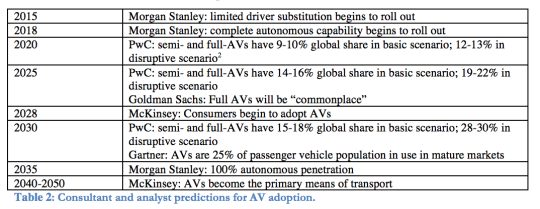
    But of course there’s the question of: when will this happen? Below is a chart from the paper that was assembled using various consultant/analyst predictions. Based on this, we’re still over a decade away from the consumer adoption of automated vehicles.

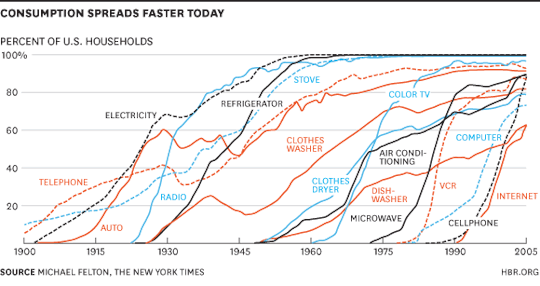
    However, these are just estimates and history has shown us that the adoption rate for new technologies has been increasing over time. Below is a chart by Michael Felton, which is also from the paper, that shows this phenomenon. Take a look at the telephone in comparison to the internet.

    Maybe I’m being overly optimistic (it wouldn’t be the first time), but consumer-facing driverless cars, at least to me, feel pretty close to the horizon.

  • 16 mobile theses and how tech might change the built environment

    Caucasian woman standing near passing subway in train station by Gable Denims on 500px.com

    https://500px.com/embed.js

    One of the things that I try and do here on this blog is examine the intersection of design, real estate, and technology. I didn’t explicitly set out to do that, but more and more I find myself thinking that way when I’m writing and when I’m giving talks.

    Part of that is because of my passions, but part of it is because there is a big and important overlap. One example of that is autonomous, self-driving cars. The tech community is enamoured with driverless cars, but everyone involved in the built environment should also be thinking about their impacts. Because it’ll be significant.

    Benedict Evans – who is a venture capitalist with Andreessen Horowitz in the Valley – recently published a post called, 16 mobile theses. It’s a look at 16 topics, trends, and shifts that are happening in the tech space. (There’s also a related podcast discussion.)

    If you’re involved in internet products, you absolutely need to give it a read. But I also think it’s interesting to read it through the lens of a designer or real estate person. Productivity is changing. Notions around the living room are changing. And yes, autonomous vehicles are going to have a profound impact on the urban landscape of our cities – just as cars did initially.

    Below are 3 excerpts from Benedict’s post that I really enjoyed.

    The first is about mobile and just how massive it is:

    “The mobile ecosystem, now, is heading towards perhaps 10x the scale of the PC industry, and mobile is not just a new thing or a big thing, but that new generation, whose scale makes it the new centre of gravity of the tech industry. Almost everything else will orbit around it.”

    The second is about how “networked” is quickly becoming a given:

    “Our grandparents could have told you how many electric motors they owned – there was one in the car, one in the fridge and so on, and they owned maybe a dozen. In the same way, we know roughly how many devices we own with a network connection, and, again, our children won’t. Many of those uses cases will seem silly to us, just as our grandparents would laugh at the idea of a button to lower a car window, but the sheer range and cheapness of sensors and components, mostly coming out of the smartphone supply chain, will make them ubiquitous and invisible – we’ll forget about them just as we’ve forgotten about electric motors.”

    And the third is about those self-driving cars:

    “The move to electric and the move (if and when) to autonomous, self-driving cars fundamentally change what a car is, but also what the whole automotive system might look like. Electricity changes the mechanical complexity of cars and hence changes who might build them and what they might look like. Autonomy and on-demand services change who buys them, meaning the buying criteria will be different. But they could also change the urban landscape just as much as cars themselves did – what do mass-market retail or restaurants look like if no-one needs to park?”

    Can you think of other ways in which tech will impact cities and the spaces we occupy?

  • The second coming of the car

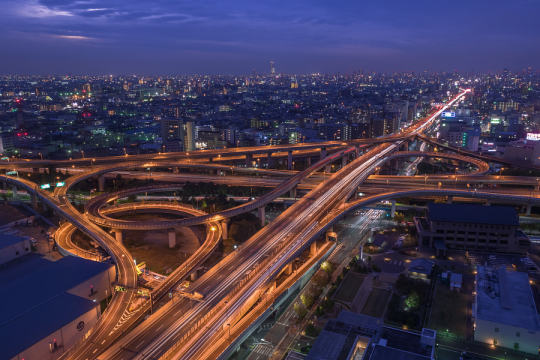
    Blue hour by Ryusuke Komori on 500px.com

    https://500px.com/embed.js

    As a kid growing up in the suburbs of Toronto, I remember when getting my driver’s licence and getting a car were some of my biggest priorities. 

    As soon as I turned 16, I went immediately to get my learner’s permit and then enrolled in a driving school so that I could shorten the time required until I could drive on my own. Every month counted at that age.

    It was such an important milestone that people born earlier in the year were seen as lucky. Because someone born in January, for example, could gain their driving independence before someone born at the end of the year even got their learner’s permit. As silly as it sounds to me right now, that spread was huge back then.

    But the world has changed and we are at the dawn of a new era: driverless cars. 

    Sooner than most people think, we are no longer going to drive ourselves around cities. I absolutely believe this. That means no more steering wheels. No more traffic calming measures on quiet residential streets. Safer streets. Perfect traffic information because all the cars will be networked. And a dramatic increase in urban efficiency. (Relevant post: The tragedy of the commons.)

    I can’t wait for this happen.

    Reid Hoffman, who is the co-founder of LinkedIn, recently wrote a fascinating article on autonomous vehicles called, Driving in the Networked Age. And in it he argues that cities should be starting to look at banning human-driven cars and generally putting in place policies to support networked autonomous cars. In fact, he sees it as an opportunity for Detroit to reestablish itself as the 21st century motor city.

    Again, I don’t doubt that this transition will happen. I think it’s a question of when, not if. But I also think that it’s going to be incredibly important to think about what driverless vehicles will mean for our cities and the built environment. 

    It’s once again an example of Marshall McLuhan’s famous phrase: The medium is the message

    Cars as a medium have had a profound impact on the way we live and the way we build our cities. We know this. But the medium is now changing. And while simply taking out the driver may seem like a small change, it is not. Have a read of Hoffman’s article.

    I’m excited about the possibilities. I don’t really like driving anymore. But let’s make this second coming of the car more positive for cities than the first. Deal?