Daily insights for city builders, delivered every morning at 6 AM ET. I’m Brandon Donnelly — a Toronto-based real estate developer and founder of Globizen. I’ve been writing here since 2013.

Tag: athiscity

  • What Rio de Janeiro looks like through an 80 megapixel camera

    Here’s a stunning time-lapse video of Rio de Janeiro that was shot with an 80 megapixel camera. It was done by LA-based photographer Joe Capra.

    [vimeo 119343870 w=500 h=281]

    10328×7760 – A 10K Timelapse Demo from SCIENTIFANTASTIC on Vimeo.

    Make sure you watch it full screen.

    As far as videos and photos go, it’s probably as close as you’re going to get to actually being there. And if you’ve never been to Rio de Janeiro (which I haven’t), it’s a great way to see and understand the city’s built environment. I loved looking at all of the details.

  • Why Toronto-Waterloo needs all-day two-way urban rail service

    image

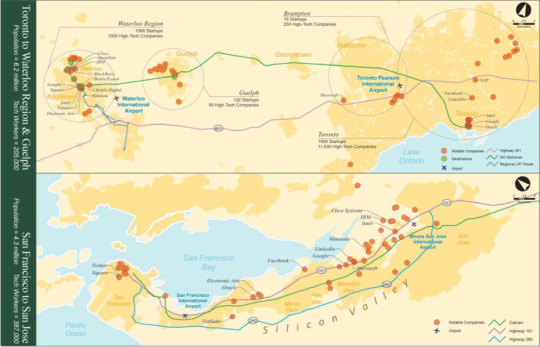
    This morning I stumbled upon an interesting Medium article talking about the need for an all-day two-way urban rail service between Toronto and Waterloo. 

    The argument is that along this corridor sits a technology ecosystem that is second in size only to San Francisco-Silicon Valley and that current connectivity levels represent a missed opportunity of epic proportions. Presently this rail service will feed you into Toronto during the morning rush hour and take you back out in the evening rush hour. But that’s it.

    According to this report prepared by the City of Kitchener (which is beside Waterloo), efficient train service would stitch together an ecosystem of approximately 12,800 technology companies, 2,800 startups, and 205,000 technology employees. It would also connect 6 universities and 4 colleges, many of which are ranked top in the world.

    There’s an argument here that this is exactly the sort of thing that governments should be doing to encourage innovation and entrepreneurship. Rather than trying to be heavily involved in actual startups, they should be creating an environment that maximizes output and then getting out of the way. 

    I think this makes a lot of sense. Don’t you?

    Image: The Innovation Express

  • Moving downtown

    Last month it was announced that Amazon will be taking 127,000 square feet across 5 floors in a new office tower in Toronto’s emerging South Core neighborhood. The space will be used for about 800 employees and they’re expected to take occupancy this fall.

    At the same time, I learned that Amazon will be joining Apple (positioned 6 floors below them in the same tower) and Cisco in South Core.

    On top of all this, a friend of mine then tweeted out a list of major tenant re-locations here in the city. The data is from CBRE and the timeframe is from 2009 to 2014 (Q1).

    The first thing I noticed when I looked at the data is that there’s a clear trend towards downtown. Perhaps that was the point of the study, but it’s still interesting nonetheless. 

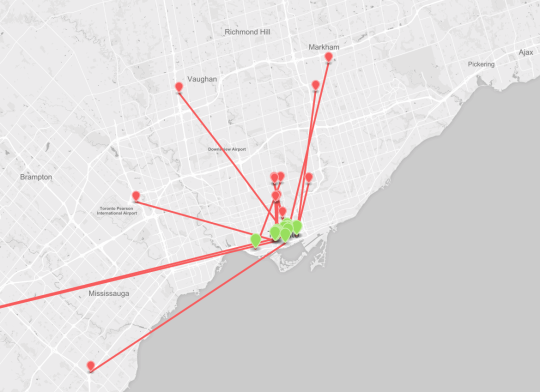
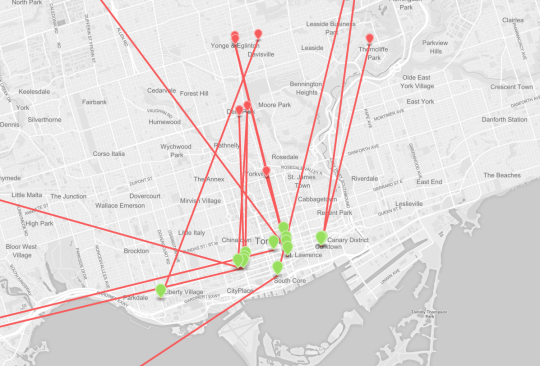
    From Google and Deloitte to eBay and Aol, every single tenant in the CBRE list is or will be moving downtown (or to the shoulders of downtown).

    Here’s what that looks like from a regional scale (red marker is where they were; green marker is where they are going):

    image

    And here’s what it looks like zoomed in closer:

    image

    This, of course, is a trend that has been happening for years. But I still think it’s worthwhile repeating how clearcut it seems to be. 

    Companies know that their greatest asset is human capital. And they have quickly realized that a lot of young smart people want to live and work in dense walkable communities. They’re simply moving to where people already want to be.

    So here’s a question for the Architect This City community: On a scale of 1 to 10, how important is a company’s location when determining whether or not you’d like to work for them? Let’s talk about it in comment section below.

  • A comparison between low-rise and high-rise housing costs

    Earlier this week the Globe and Mail reported that the average price of a house in Toronto has risen to $613,933 and that the average price of a detached house has risen to $1,042,405. Those are a big numbers.

    Low interest rates are a big part of this story. But there’s also a supply story at play here. The low-rise housing market in this city is heavily supply constrained and so we have an environment where people with more money simply outbid those with less money.

    The high-rise side of the market, on the other hand, is creating lots of new supply. And in my opinion that’s why its price growth has been more moderate in recent years and why the pricing spread between low-rise and high-rise housing continues to widen.

    Assuming these trends continue, one of the things I’ve thought about and written about in the past is whether we’ll eventually seeing a point where high-rise housing actually becomes a more affordable option for families. Because right now, if you’re in the market for a 3 bedroom home, a low-rise house is likely your most affordable option.

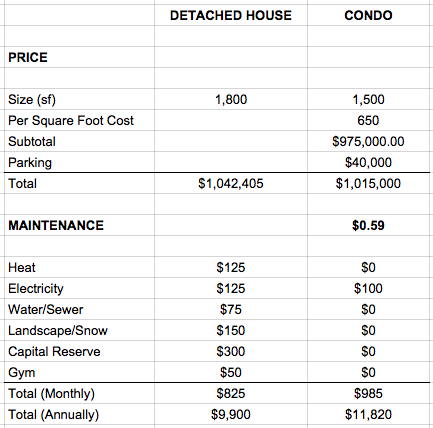
    Here’s a quick comparison that I did up this morning between a detached house and a high-rise condo:
    image

    For the detached house, I assumed 1,800 square feet at a price of $1,042,405. That’s the average price mentioned above. 

    For the condo, I assumed a 1,500 square foot 3 bedroom home. I priced it at $650 per square foot (which would be above average for the city) and then added $40,000 for a parking spot. Here you have a slightly smaller condo, but it’s also priced slightly less.

    I then compared operating/maintenance costs. For the condo, I assumed a maintenance fee of $0.59 per square foot (which I think is reasonable) and then added $100 per month for electricity. Typically electricity is billed outside of maintenance fees.

    For the detached house, I tried to create a similar living situation. I assumed that the owner wouldn’t be cutting their own grass or shovelling their own snow. I assumed that money would be put away each month as a capital reserve for future house expenses (similar to the reserve fund in a condo). And I assumed a gym membership since most condos have a gym. I ignored property taxes and insurance.

    The detached house still works out to be a less expensive to operate in this scenario, but not by much. Overall, the two appear quite comparable. Which is why I wouldn’t be surprised if we see a tipping point in the future where all of a sudden families start finally adopting the mythical 3 bedroom condo.

    I have published my spreadsheet to the web in case you disagree with my assumptions and want to create your own.

  • 10 ways that cities can take advantage of the urban manufacturing revival

    image

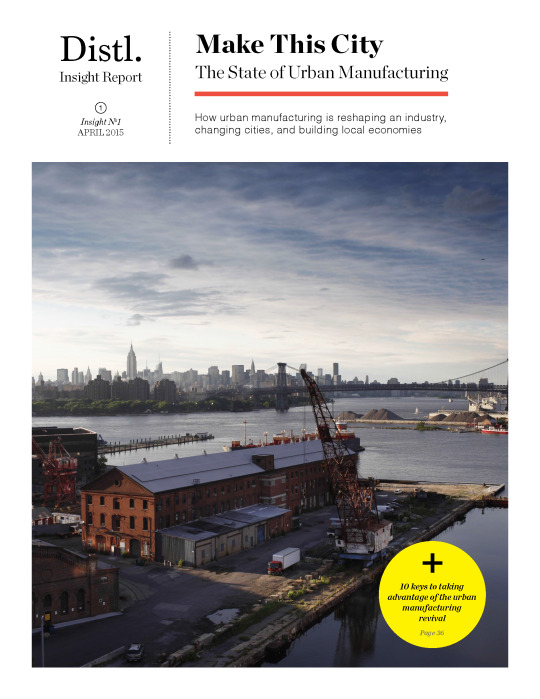
    My good friends over at Distl here in Toronto have recently published their first Insight Report. It’s called, Make This City: The State of Urban Manufacturing, and it’s available via free download here. I like the title 😉

    The report is 39 pages and is really well put together. There’s research, case studies spanning San Francisco to Toronto, and some great takeaways for city builders.

    Since the internet likes listicles, here’s a preview of some of those takeaways – 10 ways that cities can take advantage of the urban manufacturing revival: 

    1. Preserve urban industrial areas
    2. Focus on the niche
    3. Public investment is a good investment
    4. Think mixed-use
    5. Diversify learning
    6. Redefine industrial assets
    7. Connect supplier & retailer
    8. Leverage your city’s brand
    9. Form supportive organizations
    10. Leverage partnerships with both the private and public sectors

    But it’s definitely worth a complete read and I plan to do exactly that this weekend. Click here to download Make This City.

  • The new Toronto 2030 District

    Photograph Financial District, Downtown Toronto, Canada by Yeonju SEONG on 500px

    Image: Financial District, Downtown Toronto, Canada by Yeonju SEONG on 500px

    Today I learned about something new called 2030 Districts. They are: “designated urban areas committed to meeting the energy, water, and transportation emissions reduction targets of the 2030 Challenge for Planning.”

    Toronto’s new 2030 District is downtown, which is bound by the lake in the south, Bathurst Street in the west, Dupont Street and Rosedale Valley in the north, and the Don Valley in the east. 

    It’s the first district outside of the US. The other established districts are in Seattle, Pittsburgh, Los Angeles, Denver, Stamford, San Francisco, and Dallas.

    The goals for Toronto’s district are as follows (quoted from 2030 Districts):

    • To cut district-wide emissions in half, including zero-emissions from new buildings by 2030.
    • Support a better understanding of where and why energy use, water use, and GHG emissions occur across the District.
    • Work in partnership with building owners, service providers and conservation groups to accelerate the adoption of best practices for building design and management.
    • Facilitate broad stakeholder dialogues to uncover and overcome systemic barriers to long term reductions in energy use, water use and GHG emissions.

    I’m looking forward to following and learning more about this initiative. I think many of us can agree that producing less, not more, GHG emissions in the future would be preferable. And we know that the bulk of it comes from both buildings and transportation.

  • Why do more people in Quebec sell their home without an agent?

    If you ask most people, they’ll tell you that real estate agents will never ever disappear. 

    Despite the internet, mobile phones, social networks, and companies (here in Canada) such as comFree and PropertyGuys, the bulk of the market still employs an agent when it comes time to buy and/or sell a home. This is true both in Canada and the United States. And it may always be true.

    But there are lots of entrepreneurs and people in the real estate community experimenting with different models. OpenDoor and Open Listings are two new startups out of the US that I’ve been following closely.

    At the same time, there is a certain fraction of the market that is willing to go at it alone. By some estimates this number could be as high as 25% in Canada. Of course, this is a hard number to measure accurately since there isn’t just one method of selling a home privately and many transactions likely go untracked.

    But one thing that I’ve been wondering for awhile now is why the percentage of private home sales is seemingly so much higher in the province of Quebec. According to Wikipedia, this number might be greater than 50%. And a quick search on comFree (duProprio in Quebec) seems to suggest that this may indeed be the case.

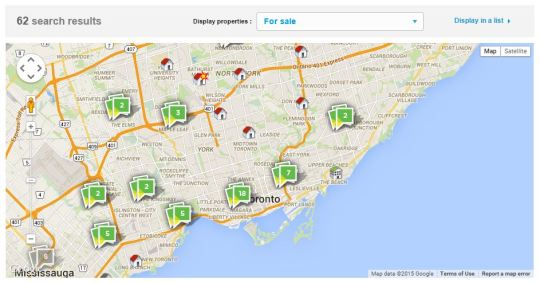
    Here are the comFree search results for downtown Toronto. There are 62 properties.

    image

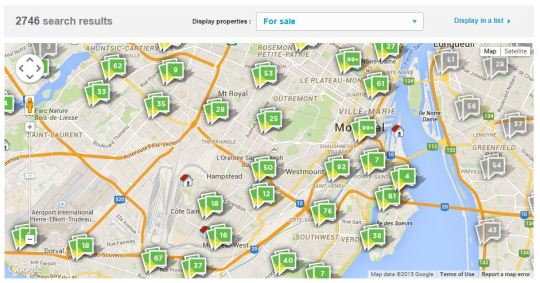
    And here are the duProprio search results for downtown Montreal (notice I tried to maintain the same zoom level). There are 2,746 properties.

    image

    If anyone has any insights on this phenomenon, I would love to hear from you in the comment section below. I don’t know why this is the way it is.

  • The high cost of poor land use

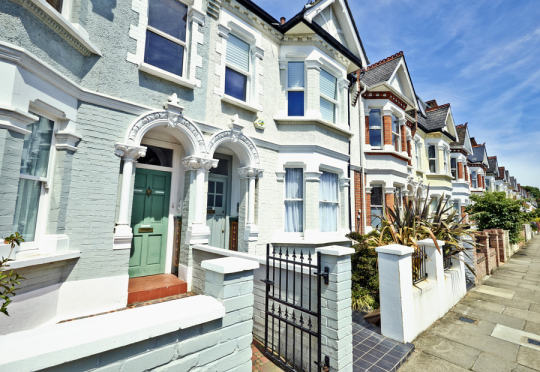
    Photograph London street of early 20th century Edwardian terraced houses by Bombaert Patrick on 500px

    London street of early 20th century Edwardian terraced houses by Bombaert Patrick on 500px

    Over the weekend The Economist published an interesting article called, Space and the city: Poor land use in the world’s greatest cities carries a huge cost. The argument is that land isn’t scarce. It’s the land use policies we have created that are artificially limiting supply and driving up real estate values.

    In fact, land is not really scarce: the entire population of America could fit into Texas with more than an acre for each household to enjoy. What drives prices skyward is a collision between rampant demand and limited supply in the great metropolises like London, Mumbai and New York. In the past ten years real prices in Hong Kong have risen by 150%. Residential property in Mayfair, in central London, can go for as much as £55,000 ($82,000) per square metre. A square mile of Manhattan residential property costs $16.5 billion.

    And part of the reason this has become so prevalent is because of the shifts we’ve seen in our economy and the great return back to cities.

    In the 20th century, tumbling transport costs weakened the gravitational pull of the city; in the 21st, the digital revolution has restored it. Knowledge-intensive industries such as technology and finance thrive on the clustering of workers who share ideas and expertise. The economies and populations of metropolises like London, New York and San Francisco have rebounded as a result.

    So how do we get better at meeting real estate demand in our cities? The Economist has two suggestions.

    One:

    First, they should ensure that city-planning decisions are made from the top down. When decisions are taken at local level, land-use rules tend to be stricter. Individual districts receive fewer of the benefits of a larger metropolitan population (jobs and taxes) than their costs (blocked views and congested streets). Moving housing-supply decisions to city level should mean that due weight is put on the benefits of growth. Any restrictions on building won by one district should be offset by increases elsewhere, so the city as a whole keeps to its development budget.

    Two:

    Second, governments should impose higher taxes on the value of land. In most rich countries, land-value taxes account for a small share of total revenues. Land taxes are efficient. They are difficult to dodge; you cannot stuff land into a bank-vault in Luxembourg. Whereas a high tax on property can discourage investment, a high tax on land creates an incentive to develop unused sites. Land-value taxes can also help cater for newcomers. New infrastructure raises the value of nearby land, automatically feeding through into revenues—which helps to pay for the improvements.

    These recommendations will probably be unsettling for a number of people. 

    I would imagine that many communities would prefer to have planning and growth decisions happen bottom up, as opposed to top down. But I think there’s some truth to this recommendation and I don’t think it has to mean completely excluding bottom up feedback. Communities and individuals are naturally going to look out for their own self-interests. And so I think many would agree that there’s value in having a holistic urban strategy in place.

    Recommendation number two pertaining to land value taxes is a loaded one. So I’m going to save my specific comments for a dedicated post on LVTs. 

    But I will say that I don’t think trying to squeeze landowners into development via taxes is the most efficient and immediate way to address supply shortages. In advance of this, we should be examining the current barriers to development. Because we’re talking about hyper competitive global cities with perpetual supply deficits. And I don’t believe the problem is incentive-based. The problem is finding sites. The problem is finding ways to build.

    What do you all think? This is an interesting topic of discussion.

  • But what about integrative thinking?

    After yesterday’s post about speed, price, and quality, a friend of mine from Rotman emailed me and said: but what about integrative thinking?

    When I was doing my MBA at Rotman and Roger Martin was the dean, integrative thinking was a significant part of the curriculum and the messaging for the school. 

    Here’s how Roger explains it:

    Over the past six years, I have interviewed more than 50 such leaders, some for as long as eight hours, and found that most of them share a somewhat unusual trait: They have the predisposition and the capacity to hold in their heads two opposing ideas at once. And then, without panicking or simply settling for one alternative or the other, they’re able to creatively resolve the tension between those two ideas by generating a new one that contains elements of the others but is superior to both. This process of consideration and synthesis can be termed integrative thinking. It is this discipline—not superior strategy or faultless execution—that is a defining characteristic of most exceptional businesses and the people who run them.

    So what my friend was getting at is why – when it comes to speed, price, and quality – do you only get to “pick any two?” Doesn’t that go against the rules of integrative thinking? Isn’t that a failure to look for a more holistic and integrated solution?

    It’s a great point. And it’s a thought that crossed my mind while I was writing yesterday’s post. The fact that “something had to give” made me second guess myself.

    In general, I’m a believer in integrative thinking. I think there are lots of opportunities to create new hybrid solutions and models that are superior to what might exist today.

    But what I was getting at yesterday was perhaps a bit more low level in thinking.

    Let’s say for instance you’re a developer constructing a new building and you and your construction manager are in the process of tendering for curtain wall. You receive 3 bids back and 2 of them are roughly the same, but one them is $5 million cheaper.

    My immediate thoughts would be: Why is that one bid so much lower? Did they bid on the same scope? Are they missing something? Will the curtain wall arrive on-site on time? And if it does, is it going to leak like a sieve?

    I’ll be the first to admit that the construction process is fraught with inefficiencies and ready for integrated solutions. I’m certain that the trade-offs between speed, price, and quality could be better managed.

    But more often than not, a rock bottom price usually means that something did in fact give. After all, great integrative thinking is a pretty rare trait.

  • Speed, price, and quality

    Project-triangle.svg

    Project-triangle” by Cosmocatalano – Own work. Licensed under CC0 via Wikimedia Commons.

    When I was in business school, one of my friends – who runs his own agency – explained to me the Project Triangle and the “pick any two” philosophy. 

    Whether you’re building a building or building a mobile app, projects can be typically broken down in terms of 3 constraints: speed, price, and quality. The “pick any two” philosophy is that – because these dimensions are interrelated – you can only really get 2 of these dimensions at any one time.

    So for example:

    • If you want a project done really quickly and you want it to be high quality, then it’s not going to be cheap. It’s going to be expensive.
    • If you want something done really quickly and you want it at the lowest price possible, then it’s not going to be high quality. It’s going to be low quality.
    • Finally, if you want something high quality and you want it done cheaply, then it’s not going to be done quickly. You might get it done, but it will be deprioritized by whoever is doing it.

    Few things in life are truly black and white, but I really like this framework. It acknowledges the fact that something has to give. It’s unsustainable to think you can always get super fast, high quality work at rock bottom prices.