Daily insights for city builders, delivered every morning at 6 AM ET. I’m Brandon Donnelly — a Toronto-based real estate developer and founder of Globizen. I’ve been writing here since 2013.
I have an announcement to make on Architect This City today.
Next week I’m joining the development team at CAPREIT (TSE: CAR.UN) here in Toronto. CAPREIT is one of Canada’s largest residential landlords. They are a growth-oriented real estate investment trust with over 41,839 residential units in major urban centers across both Canada and Ireland.
They also happen to be headquartered in the St. Lawrence Market area, which means I now live and work in the same neighborhood. As we discussed here, location matters a lot.
So here’s to a new chapter. I’m looking forward to diving into the multi-family business. Change is good.
I recently heard Brad Burnham (venture capitalist at Union Square Ventures) say in a talk that if you’re thinking about Bitcoin just as a currency, then you’re thinking about it in the wrong way. If you take nothing else away from today’s post, I think you should remember that. Bitcoin, and the underlying block chain architecture, have the potential to be very transformative.
The Fast Company article was written by Matt Weiss of IDEO (the powerhouse design and innovation firm). Here’s an introductory snippet:
Insert block chains: a relatively new and promising technology that could transform the way we digitally exchange value, similarly to how Internet protocols, like TCP/IP, transformed the way we exchanged information. For example, to transfer ownership of a home today, there are countless check of authenticity and intermediaries involved to insure the transfer is legitimate. By using a distributed database (a.k.a. “a block chain,” the same technology behind Bitcoin) to prove authenticity, we could legitimately transfer ownership immediately without the need of a middleman. In fact, when we think about block-chain technology and the industries it could disrupt, real estate tops the list. While Trulia, Redfin, Angie’s List and others have brought some transparency to the opaque world of home buying and home ownership, most of our experiences in this industry are fraught with incomplete, inaccurate, and asymmetric information.
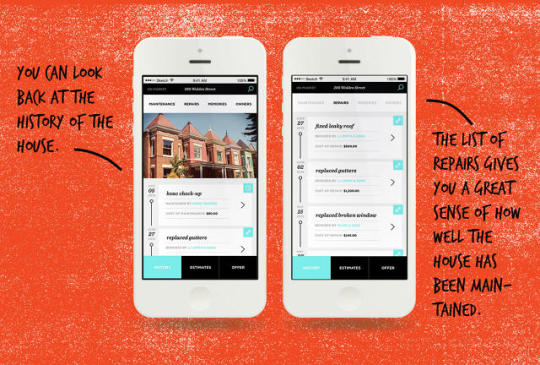
Following this, he goes on to talk about what it might be like – each step of the way – to buy a house using the block chain technology. There are even mockups of what the app could look like. I highly recommend you give it a read if you’re interested or involved in this space.
The real estate industry hasn’t seen a lot of innovation. It remains an opaque market with lots of information asymmetries. I have no doubt that will one day change; it’s just a question of when. Perhaps it’ll be the block chain that makes that happen.
Given what the other speakers had to say and given some of what I heard at the event, this is definitely not a universal position. In fact, one person commended me on taking a “courageous stance.”
At the same time, quite a few of the people I spoke to seemed unsure of any position and instead came to the walk simply to learn more about the options. Hopefully by the end of it they were closer to one.
If I have one piece of constructive feedback on the walk it’s that it wasn’t interactive enough. It’s fine to standup and talk for 5 minutes, but it would have been great to also have a discussion and debate. At the very least, I would have liked to see where most people stand. Hopefully you will all share that in the comment section of this post.
I continue to believe that removing the Gardiner East is the right city building decision. But I also respect anyone who is willing to take a firm stance. Toronto City Council has already punted this decision before. It’s now time to make a decision and own it.
By accident, this week on Architect This City seems to be turning into Elon Musk week.
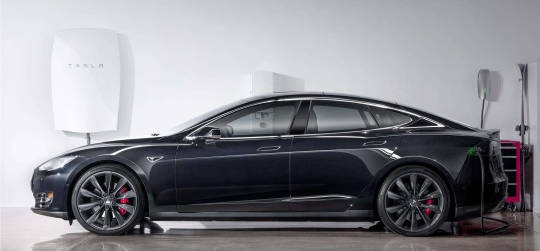
Yesterday, Musk announced something called the Powerwall home battery. Measuring about 3′ x 4′, the shield looking battery pack will charge using the electricity generated from solar panels (or from the grid when rates are at their lowest) and then power your home.
It’s designed for consumers and will cost between US$3,000 – $3,500 depending on capacity. The individual Powerwalls can also be daisy chained to increase capacity. It will be available starting this summer.
A wall battery may not seem all that interesting to some, but I think this is actually a big deal for a few reasons.
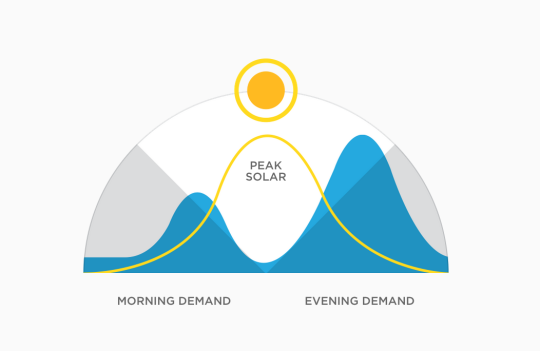
Renewable energy is often both intermittent and produced when you don’t need it. Here’s a great chart from Tesla that shows what I mean:
During peak solar hours, most people aren’t home and most people aren’t consuming at peak levels. That’s why it’s important to be able to store the energy that you collect, whether it be from solar, wind or other renewal energy source. And from what I hear from my friends in the industry, storage has been a bit of an Achilles heel for adoption.
It will also help to further decentralize energy production. What is produced locally (from say solar panels) will be stored locally for when it’s needed locally. This is in contrast to centralized production or producing energy locally and then feeding any excess capacity into the grid for use somewhere else. That requires transmission and will be by definition less efficient.
Finally, the other interesting thing about Powerwall is that it closes the loop on two of Musk’s businesses: SolarCity and Tesla. SolarCity is about the production of renewable energy and Tesla is about the consumption renewable energy. But as the chart above shows, storage is often needed to link those two activities in an efficient way.
All of this makes me excited about Powerwall.
If any of you are an expert in this industry (which I am not) or you just have additional thoughts, I would love to hear from you in the comment section below.
There are significant racial income gaps in the United States (as well as in Canada). According to City Observatory, the average black household earns 42% less than the average white household in America. There is, of course, lots of regional variation, but this is what it looks like nationwide.
The interesting thing about this racial income gap though, is that there’s one factor that seems to account for the bulk (up to 60%) of the variation: residential segregation. In other words, the more segregated a city becomes, the more this black/white income disparity increases.
Here’s a snippet from Joe Cortright of City Observatory:
…there are good reasons to believe that high levels of segregation impair the relative economic opportunities available to black Americans. Segregation may have the effect of limiting an individual’s social networks, lowering the quality of public services, decreasing access to good schools, and increasing risk of exposure to crime, all of which may limit or reduce economic success. This is especially true in neighborhoods of concentrated poverty, which tend to be disproportionately neighborhoods of color.
We also know that there are all kinds of negative externalities associated with income inequality. Therefore, there’s a strong case to be made for addressing segregation and the spatial organization of our cities.
Today I’m thinking about extraversion and third places within cities.
As many of you I’m sure know, the idea of a third place is that after your home (first place) and your work (second place), cities have what are known as third places. This could be a coffee shop, a barber shop, or a public space (to name only a few examples).
But with the rise of the internet and freelancing, third places are becoming even more important. That’s why coffee shops have become arguably the best example of a third place in today’s cities. They’ve even become the new second place for some (many?) people.
But beyond just a place to meet and socialize, I’ve been thinking today (while I was at a third place) about the psychological benefits of these spaces.
For example:
One of the key differences between extraverts and introverts is where they draw their energy from. For introverts, they tend to draw it from within. In order to recharge, they often feel the need to retreat and be left alone. Extroverts, on the other hand, draw their energy from the outside world. They charge up by being around other people.
When I was completing my MBA at Rotman, one of the things they had us do at the beginning and at the end of the program was complete the Myers-Brigg personality test.
In both instances, I was as extroverted as they come (I am consistently what is known as an ENTJ). And from experience, I can say that I definitely feed off the energy of other people.
So if you too classify yourself as an extroverted person, then third places are more than just a busy coffee shop or a vibrant public space. They are where you derive your energy and where you feel alive. And that’s a pretty powerful thing in my view.
Yesterday I posted a video about the career of Elon Musk. And it reminded me of something that’s been on my mind as I think about transportation, cities, and the future.
Elon’s story for why he founded SolarCity, Tesla, and SpaceX is incredibly compelling. He chose problems and industries that he felt would move humanity forward. He felt that we needed sustainable forms of energy production (SolarCity), sustainable forms of transport (Tesla), and a way for humans to occupy other planets (SpaceX). That’s incredible ambition.
Today though, I just want to focus on the transportation piece.
Electric and driverless vehicles, I believe, are a step in the right direction. I honestly believe that at some point in the not too distant future we’re going to look back at that time when people used to drive their own cars and wonder how we ever allowed that to happen.
But fundamentally, I think there still remains a question of how best to plan our cities.
There’s lots of talk today about peak car and the death of the automobile. Certainly within planning and urbanist circles, there’s an almost universal belief that planning (most of) our cities around the car, as opposed to people, was a huge mistake. Multimodal solutions with a public transit backbone are now the way forward.
But will that always be the case as the notion of the “car” evolves?
Intuitively, driverless vehicles feels like a massive opportunity to leverage data and better optimize our private transport assets. We know that the utilization rate for most private cars is incredibly low and so there’s lots of room to improve how we use and share private vehicles and how we move people around cities.
But how big is that opportunity? Does a city filled with driverless electric vehicles and with networks like Uber mean that public transportation now becomes less important? And if so, how much less important?
I can’t help but feel like private and public transport are on a collision course right now. I suppose that isn’t anything new. But this time around I wonder if private transport won’t figure out a way to achieve similar efficiencies to large scale public transport.
It’s about 45 minutes long, but well worth it. What’s astounding is both is willingness to go all-in and his commitment to solving big, meaningful problems. Click here if you can’t see the video above.
In 2007, I spent the summer working in Dublin, Ireland for a boutique real estate consulting firm called Urban Capital. (For those of you who are from Toronto and know the industry, there’s no connection between the Urban Capital in Dublin and the Urban Capital in Toronto.)
At the time, they were working with a number of government agencies on the development of masterplanned communities, as well as on specific development projects. Real estate was booming and everyone wanted to be a part of it – including the band U2.
But as you all know, the following year (2008) wasn’t kind to the real estate industry and, in particular, to Ireland. That year the country fell into recession for the first time since the 1980s and became labeled as one of the “PIGS.”
I really wish I had started this blog by that point because it would be interesting to look back today on my posts from that summer and see how I was thinking about the Dublin real estate market. I remember having many Guinness-fueled discussions about whether the bull market could continue.
In any event, the Irish economy is coming back.
This year GDP is expected to grow by 5.4%, which would make it the fastest growing economy in Europe. National debt is also falling. At the end of 2013 it stood at €215 billion or about 123% of GDP. And at the end of 2014 it had fallen to €203 billion or about 109% of GDP. The national debt is expected to fall below 100% of GDP by 2018.
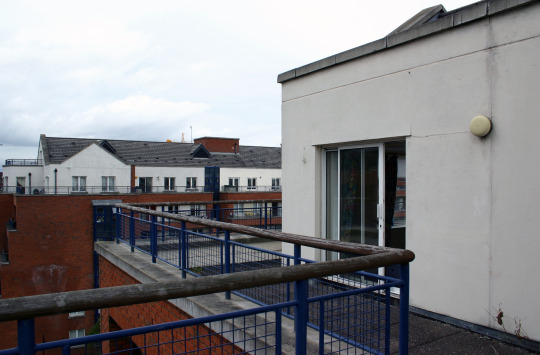
I’m thinking and reading about all of this today because I was looking through my photo collection this morning and I stumbled upon a folder titled “Dublin 2007.” The photo at the top of this post was the terrace that I had outside of my apartment in the Docklands area. I don’t think I used it once that summer.
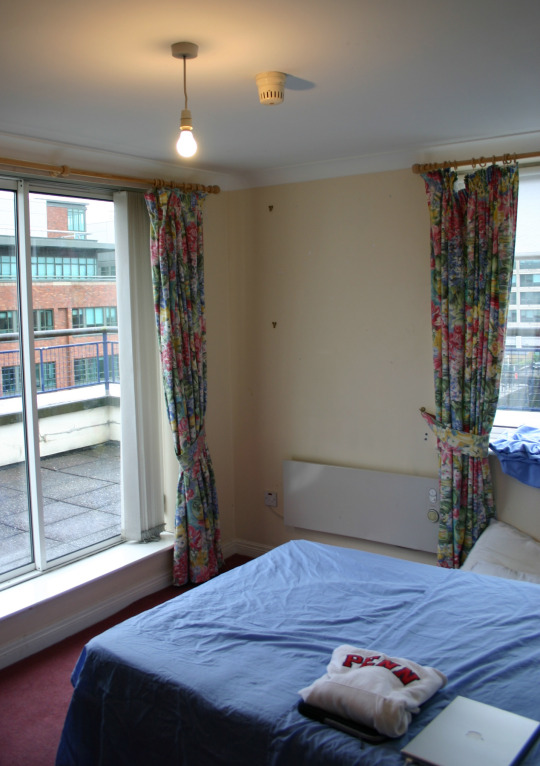
And here’s a photo of my bedroom. It must have been the curtains that sold me on the apartment.
I had a great time in Dublin that summer. It’s a fun and young city and I remember being incredibly impressed by the quality of city building that was going on. I’m sure that wasn’t lost in the Great Recession.
This morning I was interviewed for a Montreal-produced TV show called Ports D’Attache. The English version of the show is called “Waterfront Cities of the World” and it airs on Discovery.
Rather than a travel show, it’s a look at the “spirit and soul” of each waterfront city through the lens of “local personalities.” There’s definitely a lot of fodder for city geeks and so I thought you all might find the series interesting.
Toronto was the last stop of season 5. The other cities from this season include Philadelphia, Budapest, Rome, Taipei and Kuala Lumpur, to name only a few of them.
I’m glad that they decided to come to Toronto and I’m delighted that they invited me to be on the show. The team was great and, if you haven’t already noticed, I love supporting this city.
The show will first be released in French (with my comments dubbed over), but an English version will follow. Once that version is released, I’ll circulate a link.