Daily insights for city builders, delivered every morning at 6 AM ET. I’m Brandon Donnelly — a Toronto-based real estate developer and founder of Globizen. I’ve been writing here since 2013.

Tag: athiscity

  • How to encourage traffic congestion in your city

    City
    Observatory recently republished their
    commentary
    on a report (released earlier this year) called Who Pays
    for Roads
    . I missed their original post, so this is new to me.

    The report
    and commentary are all about the mispricing of roads/driving and the fallacy
    that “user fees” (gas taxes, tolls, and so on) are enough to completely cover
    the costs associated with driving.

    I have been
    a vocal supporter of road pricing and/or congestion charges here in Toronto, and
    so I’d like to share two pieces from their commentary.

    The first
    is this paragraph, which talks about how mispricing leads to demand issues
    (i.e. traffic congestion):  

    The conventional
    wisdom of road finance is that we have a shortfall of revenue: we “need” more
    money to pay for maintenance and repair and for new construction. But the huge
    subsidy to car use has another equally important implication: because user fees
    are set too low, and because, in essence, we are paying people to drive more,
    we have excess demand for the road system. If we priced the use of our roads to
    recover even the cost of maintenance, driving would be noticeably more
    expensive, and people would have much stronger incentives to drive less, and to
    use other forms of transportation, like transit and cycling. The fact that user
    fees are too low not only means that there isn’t enough revenue, but that there
    is too much demand. One value of user fees would be that they would discourage
    excessive use of the roads, lessen wear and tear, and in many cases obviate the
    need for costly new capacity.

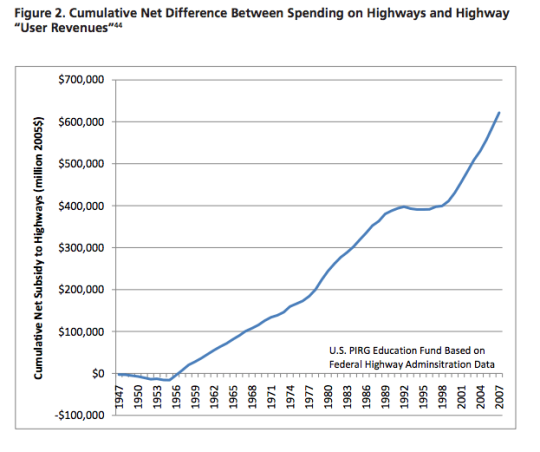
    And the second is this chart, which shows the cumulative net
    subsidy to highways in the US from the late 1940’s:

    image

    The point of all this is that when you subsidize something
    it’s because you’d like to see more, not less of it. So why then are we even surprised by the crippling traffic that plagues our
    cities? We are doing a lot to encourage exactly that.

  • How small is too small?

    I was up early on Sunday morning and I tweeted this out:

    //platform.twitter.com/widgets.js

    It’s a link to a Dwell article about a New York family of four that lives in a 620 square foot apartment. It’s technically a one-bedroom apartment but the way they have it set up is that the two kids share the bedroom and the parents sleep in the living room similar to as if it were a studio apartment.

    And my question in the tweet was, could you do it?

    Part of the reason the article caught my attention was because I currently live in a 640 square foot apartment – but as a family of one. And not surprisingly it’s more than enough space for me. Would I still feel the same way if it were a family of two? I believe so. But what about if it were a family of 3 or 4? I suspect it wouldn’t be as effortless, though certainly not impossible.

    I love the idea of distilling one’s life down to only what is absolutely necessary. And if you happen to live in a city, like New York, where the median price of a one-bedroom apartment is somewhere around $3,400 per month, there can certainly be lifestyle advantages to doing more with less.

    So I’d like to re-ask the question here to the Architect This City community: Could you do it? How minimalist could you go?

  • A Detroit story of single family homes and pianos

    NO MORE MUSIC by Shawn Whitehead on 500px.com

    https://500px.com/embed.js

    I was reading Aaron Renn’s blog this morning and a post called, How Urban Planning Made Motown Records Possible, caught my attention. 

    His argument – taken from a book called Once in a Great City: A Detroit Story – is that the prevalence of pianos in black working class and middle class families was a key ingredient in Detroit ultimately punching above its weight musically.

    Here’s an excerpt that Aaron Renn shared on his blog:

    The family piano’s role in the music that flowed out of the residential streets of Detroit cannot be overstated. The piano, and its availability to children of the black working class and middle class, is essential to understanding what happened in that time and place, and why it happened, not just with Berry Gordy, Jr. but with so many other young black musicians who came of age there from the late forties to the early sixties. What was special then about pianos and Detroit? First, because of the auto plants and related industries, most Detroiters had steady salaries and families enjoyed a measure of disposable income they could use to listen to music in clubs and at home. Second, the economic geography of the city meant that the vast majority of residents lived in single family homes, not high-rise apartments, making it easier to deliver pianos and find room for them. And third, Detroit had the egalitarian advantage of a remarkable piano enterprise, the Grinnell Brothers Music House.

    Detroit is obviously not the only city with lots of single family homes. But it’s fascinating to think that this housing typology, combined with a number of other socioeconomic factors, could be what ultimately led to the creation of the Motown Sound.

    It’s also interesting to think about what kind of talent we might be squandering in our cities. I mean, look what happens when people have access to things like pianos (in the case of Detroit), computers (in the case of people like Bill Gates), and cheap/vacant space (in the case of Berlin and its clubs). They create amazing things.

    This is one of the reasons why I think we sometimes underestimate the importance of small scale moves when it comes to spurring innovation in cities. We forget that people will do incredible things when they are, quite simply, given the freedom to work on projects they are passionate about.

    If we could harness these passions instead of focusing so often on big political announcements, I think we’d all be better off.

  • Make Way for Laneway

    I was speaking with a friend this morning and he told me that he had a Pavlovian association between me and laneways. That made me happy. 

    If you’re a regular reader of this blog, you’ve heard me go on and on about the great potential of laneways and laneway housing (accessory dwelling units) in Toronto, as well as in other cities around the world.

    So I won’t do that today. Instead, I’m going to link to a report that was just released by the Pembina Institute called Make Way for Laneway: Providing more housing options for the Greater Toronto Area.

    The report is obviously about Toronto, but there’s no reason that the lessons and ideas won’t also apply to your city. So I would encourage you to give it a read.

    For those of you who have emailed me about my own laneway house, the project is still on hold. And it will likely remain that way until the city becomes a bit more accepting of this housing typology. Hopefully that will happen soon.

  • The London Crossrail

    On Thursday afternoon the mayor of Toronto, John Tory, was in London meeting with their mayor, Boris Johnston, and talking about Toronto-London business relations, the economy, and transit.

    Here is the tweet:

    //platform.twitter.com/widgets.js

    On the topic of transit, the big item to see and discuss was The Crossrail. For those of you who might not be familiar with it, here are a few bullet points from their website:

    Crossrail is Europe’s largest construction project – work started in May 2009 and there are currently over 10,000 people working across over 40 construction sites.

    The Crossrail route will run over 100km from Reading and Heathrow in the west, through new tunnels under central London to Shenfield and Abbey Wood in the east.

    Crossrail will transform rail transport in London and the south east, increasing central London rail capacity by 10%, supporting regeneration and cutting journey times across the city.

    Crossrail will bring an extra 1.5 million people to within 45 minutes of central London and will link London’s key employment, leisure and business districts – Heathrow, West End, the City, Docklands – enabling further economic development.

    And below is a neat diagram that I found in this City of London report. I think it does a good job summarizing some of the spatial impacts of The Crossrail.

    image

    In the past I’ve been negative about John Tory’s SmartTrack proposal, which is clearly inspired by The London Crossrail. I had my reasons for that. But I want to be clear that I am not in any way negative on Regional Express Rail as a mobility solution.

    Toronto would benefit greatly from RER and Metrolinx is working diligently to deliver it to the region. I can’t wait for that to happen so I can drive even less than I already do.

  • Technology is eating the world

    Large Gantry Crane on Sunset by Sasin Tipchai on 500px.com

    https://500px.com/embed.js

    Earlier today the comment section of an old post I wrote about UberX was revived with a discussion around technology and what it means for human capital.

    The concern expressed was that technology and machines are going to put us all out of a job. And it stemmed from a discussion around driverless cars. Clearly we are headed in that direction and so eventually we will no longer need to drive or have people drive us around. This means that something that was once a job will no longer exist.

    But I am not yet convinced that it will be as dire as some believe it will be – though it could very well necessitate some significant structural changes in the economy.

    Here are two things to consider:

    Marc Andreessen has written and tweeted a lot about the topic of “robots eat all jobs” and his argument is that this line of thinking often revolves around something called a lump-of-labor fallacy. This is the idea that there is a fixed amount of work to be done. And so when technology replaces humans, we are just making the labor pie smaller.

    But the reality appears much different. Human wants and desires increase and we find new ways to put people to work. One of the examples I’ve heard Marc give, that I really like, has to do with buildings. In the past, there used to be a guy whose only job was to shovel coal into a furnace. He physically heated the building. But eventually technology did away with that requirement and that job. Is that not progress? Or should we go back to that in order to put people to work?

    All this said, unemployment and job displacement are still serious issues for cities and countries. Which is why some people – including many capitalists – believe that minimum wages will not be enough going forward. We will also need to look at things like a “basic income guarantee” to redistribute wealth and ensure that, no matter what, everyone has a certain amount of money to live.

    At first blush, this doesn’t feel right. But I think it’s important to remain open minded and engage in discussion. Hopefully we can do a bit of that today in the comments below.

  • City building every way you can

    Tonight I attended and gave a short talk at a city building themed PechaKucha night here in Toronto. If you aren’t familiar with the PechaKucha 20×20 presentation format, click here.

    The first PechaKucha night was held in Tokyo, but it has since expanded to over 800 cities around the world. Each city has a local organizer who acts as a steward and here in Toronto it is Amy Bath. She did a fantastic job this evening.

    Tonight’s event was all about non-traditional forms of city building. It was not so much about how architects and developers are shaping the built environment – thought there was some of that. It was more about how interdisciplinary artists, graphic designers, bloggers, and others, are having an impact on cities. So in my case, I was speaking as a blogger, rather than as a real estate developer, which was a bit unique for me.

    What excited me about tonight is the amount of talent and passion that we have in this city, and how so much of it is being harnessed to make cities better.

    Jay Wall of Studio Jaywall is doing incredible work at the intersection of graphic design and city building. My friend Mackenzie Keast of Distl and NXT City Prize is organizing public space competitions and then working with the city to get them built. And my friend Justin Broadbent, who is an interdisciplinary artist, is just killing it and putting Toronto on the map. I don’t know how else to say it.

    And this is just naming a few of the people in attendance.

    I have so much respect for people who love the city they call home and actively try to make it a better place. That’s a lot harder to do than just complain about why your city isn’t (insert other allegedly better city here). But it’s also a lot more productive.

  • The contradiction in American housing policy

    I really like this post by Daniel Hertz talking about the inherent tension in American housing policy.

    Here’s his conclusion:

    We are, in conclusion, profoundly conflicted as a nation when it comes to housing: we want it to be affordable, but we also want its prices to rise fast enough to be valuable as a financial investment. That’s a contradiction we need to acknowledge if our housing policy debate—and, ultimately, our housing policy—is going to be coherent and constructive.

    Of course, this situation isn’t unique to the US. Though the US does have homeownership subsidies – such as the mortgage interest tax deduction – that other similar countries, like Canada, do not have.

    Still, I feel a similar kind of contradiction here. We worry about excess supply and housing bubbles when the reality is that both of these things are desirable outcomes if, and only if, the primary objective is to maintain housing affordability.

    But I don’t think that is the primary objective in practice. At least in this part of the world, I think we worry first and foremost about making sure that home prices continue to go up and that wealth is being built. Then, we worry about providing affordable housing for those that are unable to participate.

    I’m not making a judgement call on whether or not that’s a good or bad thing. It just strikes me that this tension, and there certainly is a tension, is not an equal one.

  • What tax policy could be doing to home sizes in Ontario

    Golden City (of Toronto) by Evgeny Tchebotarev on 500px.com

    https://500px.com/embed.js

    In yesterday’s post I made a remark that we have antiquated tax policies here in Ontario that encourage the building of smaller new construction condominiums. There seemed to be a lot of interest in that comment, and so I’d like to talk about that today.

    Some people thought I was referring to development charges, but I was actually thinking of the GST/HST New Housing Rebate in Ontario

    The way it typically works in Ontario is that when buy a new construction home, the price you pay is inclusive of HST (harmonized sales tax) and net of any applicable rebates, such as the rebate program mentioned above. 

    This means that the price you see on your agreement is usually the price you pay. I say usually only because there are ways that you could disqualify yourself from the New Housing Rebate program. But that’s a different post.

    So what does this mean in practice?

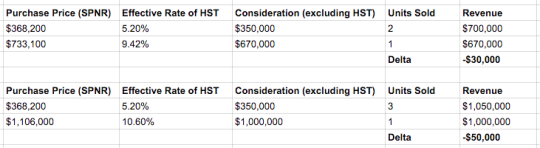
    Let’s say you went out and bought a new construction condo for $368,200 (there is a reason I’m picking what seems like an arbitrary number). If there was no such thing as the New Housing Rebate program, then the sales tax owing on this home would be the full 13%. And that would mean that the price paid before any taxes is actually $325,841 (x 13% = $368,200). This is an important number because it represents revenue to the developer.

    But since there is a New Housing Rebate program, the effective tax rate actually works out to be 5.20% for this particular sale price, which means that the price paid before any taxes is now $350,000 (a nice whole number). And so because of rebates and because they are now paying less HST, the developer’s revenue number has increased. It has gone from $325,841 to $350,000.

    The way this logistically works is that purchasers usually assign the New Housing Rebate benefits to the developer who then processes all the paperwork. This is what I mean when I say that the “sticker price” is inclusive of HST and net of any rebates – it already factors in the possible deductions.

    So far things are looking good. And I want to be clear that I don’t have concerns with the New Housing Rebate program in its entirety. In fact, it’s a hugely important part of the new home industry. Without it, many projects would simply not be feasible to build.

    However, as the price of the new home increases (which typically happens as the home gets bigger), the rebates start to fall off. The federal portion of the rebate maxes out at a base purchase price of $350,000 (which is why I chose that number) and the Ontario portion maxes out at a base purchase price of $400,000.

    What all this means is that as the unit sizes get bigger and more expensive, the effective tax rate is no longer at 5.20%, as was the case in the example I gave above. It increases. And if you hold prices constant for the purchaser, it means that the developer’s revenues now start to drop.

    To illustrate why this matters, consider the following chart:
    image

    In the first scenario, the developer builds and sells 2 units for a price of $368,2000. This translates into revenue of $700,000. However, if the developer instead decides to combine those 2 units and sell the larger single unit for $733,100 (roughly double the price) then the effective rate of HST goes up and revenue drops by $30,000.

    The second scenario is similar to the first one except that instead of 2 units, it’s 3 units which then get combined into one. Here revenue drops even further – by $50,000.

    Now, you could argue that there are some cost savings associated with building fewer suites, but I don’t think it would offset the differentials shown above, especially if you multiply those revenue numbers across an entire project. So what this all means is that it can be more profitable for developers to build smaller units priced below the thresholds mentioned above, as opposed to a smaller number of larger units. 

    Again, I’m not saying that HST rebates are bad. They’re critical to the industry. I love them. But I do believe we should be thinking about the possible implications that the current set up could be having on what we’re building and in particular on unit sizes.

    If you’d like to learn more about how the rebates work, check out this PDF from the Canada Revenue Agency. I tried to keep things simple in this post.

  • Pre-sales, shear walls, and condos, oh my

    Work In Progress 2 by bryan simpson on 500px.com

    Pre-sales are a big part of many condominium markets. The way it typically works is that developers sell suites in their building before construction has even started and then uses those purchaser deposits (which are held in trust) to obtain a construction loan to actually build the building. Part of the reason this is done is that it, in theory, reduces speculative overbuilding.

    Nobody really knows the exact number, but here in Toronto many suites within a new building often end up getting sold to investors. And in some locations and some buildings, it could be most suites.

    On the one hand this is a good thing. Because in a way they provide the short-term money that gets new projects off the ground. And if they end up holding onto their suites, they also become landlords for new rental housing. Here in Toronto condos have been almost the only new rental stock built in this city for decades. (Purpose-built rental is now starting to come back though.)

    But one of the potential negatives is that buildings could be getting designed more around investor needs as opposed to end user needs. And that is happening because many end users – particularly when it comes to larger suites – find it difficult to make such a big life decision 3-5 years out. Doing that means saying to yourself: Okay, I’m going to buy this 3 bedroom condo today because 4.5 years from now when it’s complete I expect to be married and have 1.5 kids. Life doesn’t always work that way.

    We also have antiquated tax policies in Ontario that encourage the building of smaller suites. And I believe they should be modernized. (This topic deserves a dedicated post.)

    So if we are to think of these condo suites as products, then you could say that there are two broad customer segments: the investor and the end user. There are obviously sub-segments within each, but let’s assume that those are the top of the funnel.

    The challenge now facing developers creating new product is that the system we have put in place arguably privileges one customer segment over the other. And it’s a problem that is somewhat unique to the real estate industry because it takes so damn long to bring new supply to the market. (If you sell jets or yachts, maybe you have a similar problem.)

    Now one way to solve this might be to create lots of flexibility in the product. That is, you could allow people to adjust and combine suites to fit their current needs. And that’s what great products do: they meet specific needs and solve problems. In this scenario, perhaps the single person could “add-on” to their suite as they enter a new life phase. And indeed, this is something people are experimenting with by way of things like “knockout panels.”

    But the problems with this are twofold. 

    Firstly, this requires an adjacent and suitable suite to come on the market so that you can buy it. And that may not happen 6 months before the baby comes. 

    Secondly, most Toronto condominiums are built using something called shear walls. These are structural reinforced concrete walls that cannot be removed without compromising the integrity of the entire building. And most purchasers like these walls between them and their neighbors because they’re worried about noise. So combing suites isn’t always as straightforward as we might think. There are many constraints.

    One way to mitigate these problems is through smaller projects. That reduces the lead time between purchase and occupancy. But I am sure there are probably other creative solutions that we could come up with to better align product and customer needs.