Daily insights for city builders, delivered every morning at 6 AM ET. I’m Brandon Donnelly — a Toronto-based real estate developer and founder of Globizen. I’ve been writing here since 2013.

Tag: athiscity

  • Towards decentralized city building

    One of the
    most profound shifts taking place today – because of new technologies – is
    that of decentralization. I’ve written about this before, but I keep coming
    back to it because I find it so fascinating.

    It’s
    happening to varying degrees, but as a general trend, I believe it is leading
    to better data (less information asymmetries), more efficient markets, and the
    removal of many middle people. In the past, some intermediaries were necessary in
    order to act as proxies for portions of the market. But I believe that is
    changing.

    So what’s
    an example of this? Bitcoin. Bitcoin is an example of decentralization because
    no one entity controls it. It operates through a decentralized public ledger.
    And because of this, it has the potential to be highly disruptive to the way we
    think about currencies today.

    Put another
    way, I see decentralization as a way to leverage the wisdom of crowds. I am
    convinced that large groups of people can be incredibly intelligent when they’re
    allowed to contribute in the right ways. And I think this could solve many
    different problems, from the infighting we see within cities to broader market phenomena.

    As another example,
    there’s something new in the venture capital space called DAO – which stands
    for Decentralized
    Autonomous Organization
    . Essentially it’s a decentralized VC platform based
    off of a Bitcoin derivative currency.

    But perhaps
    the most noteworthy and relevant feature is that it allows its large pool of
    investors to anonymously vote on which investments to pursue. This is in
    contrast to a more centralized approach where an investment committee would
    meet behind closed doors in a big boardroom and make a decision. This would be the
    more typical approach.

    If you’re
    not in the tech space, the above may not seem all that exciting to you. But I
    see many parallels between venture capital and real estate development, which is
    one of the reasons I follow the space. So I can’t help but wonder what this
    trend could ultimately mean for real estate, design, and other city building industries.

    I can
    certainly imagine a world where the forces that shape our cities are more
    collective and decentralized in nature. It’s already starting to happen through crowdsourcing, social media, ridesharing, and other online platforms.

  • In support of a super-metro

    I just got home from a couple of coffee meetings, an afternoon bike ride and an impromptu basketball shootaround. Toronto is a different place in the summer. And it feels great to be biking everywhere.

    But Toronto is more than just Toronto. Toronto is at the center of a much larger urban agglomeration. And our continued success is going to partially hinge on our ability to work together in a coordinated way.

    Greg Spencer of the Martin Prosperity Institute recently published an interesting article called: Is it time to create a super-Metro? Here’s what it’s about:

    Our research at the Martin Prosperity Institute shows that economic competition is now primarily between cities rather than countries. To be successful in this environment, Toronto and its neighbours need to find a way to erase local divisions and solve their problems together. 

    Toronto is a wildly successful city, world-class in many respects. When our current institutional arrangements were forged, no one predicted the level of growth the region is experiencing. Status quo local government arrangements cannot adequately deliver the level of co-operation and collaboration needed to cope and plan for the future.

    Greg believes that the answer is a new regional authority that could give “democratic legitimacy to the very important decisions being made for the benefit of the wider region.” 

    I’m not going to comment on how all of this should be executed, but I fully agree that we need to think and act as one consolidated urban entity.

    Cities are the economic driver of the new global economy, but many (most?) of our governance structures do not properly reflect that reality. And the risk is that we are allowing arbitrary municipal boundaries and lack of coordination to hinder our ability to compete globally.

    This goes for Toronto and it goes for every other city region around the world.

  • Empire and ego

    This morning I stumbled upon an old New York Times article from August 7, 1983 called: The Empire and Ego of Donald Trump.

    Here’s an excerpt you might find interesting:

    The essence of entrepreneurial capitalism, real estate is a business with a tradition of high-rolling megalomania, of master builders striving to erect monuments to their visions. It is also typically dynastic, with businesses being transmitted from fathers to sons and grandsons, and carried on by siblings. In New York, the names of Tishman, Lefrak, Rudin, Fisher, Zeckendorf come to mind.

    And now there is Trump, a name that has in the last few years become an internationally recognized symbol of New York City as mecca for the world’s super rich.

    “Not many sons have been able to escape their fathers,” said Donald Trump, the president of the Trump Organization, by way of interpreting his accomplishments. Three of them, built since 1976, stand out amidst the crowded midtown landscape: the 68- story Trump Tower, with its six-story Atrium housing some of the world’s most elegant stores; the 1,400- room Grand Hyatt Hotel, and Trump Plaza, a $125 million cooperative apartment. And more is on the way.

    “At 37, no one has done more than I in the last seven years,” Mr. Trump asserted.

    As I read this, 3 things came to mind.

    1) One could argue that, as real estate development institutionalizes, the megalomanic and dynastic nature of the business is being somewhat muted.

    2) I hope we are well beyond the point where a “dynasty” has to be transmitted only through men. We are, right?

    3) Trump sounded the same at 37.

  • 3 obscure things to think about before buying a condo

    If you’re an architect, developer, or someone else in the business of building buildings, chances are you have an extensive mental list of things that you would think about before buying a piece of real estate. I know I certainly do. These are things you learn over time – sometimes by making mistakes.

    Depending on the type of real estate, this list would vary. So this is not going to be a comprehensive list of things to consider, by any means. But today I thought I would mention 3 things that a lot of people might not think about when buying a new condo, particularly when buying pre-construction off drawings.

    Noisy Adjacencies: 

    What’s around the suite? Elevator shafts, mechanical rooms, and gyms all create noise. There are measures to protect against all of these noises, but that doesn’t stop me from worrying about these sorts of things. For instance, in my experience, some (many?) condo gyms don’t have the right kind of floor to deal with dropping weights. In these cases, something is usually done after turnover to address the noise complaints.

    Exposed Overhangs: 

    Does the suite overhang the floor below or sit on top of a space that is exposed to the elements, such as a loading bay or walkway? If so, you might get a cold zone if it hasn’t been properly insulated or heat traced. Of course, most projecting condo balconies also create a thermal bridge that can create a cold zone around it. But the first example could be worse. If you live in a place that doesn’t have subarctic winters (Toronto) this may be a moot point.

    Transfer Floors: 

    The most efficient way to build a multi-family building is to repeat the same floor plan as you go up the building. This ensures that everything runs in a straight line. The minute you create stepbacks and offsets, you then need to start “transferring.” This means that structure and services will need to be brought from one location of the building to another. This can lead to deeper structural beams and additional bulkheads which could then impact ceiling heights in the suites. This won’t always be the case, but something to think about when you see dramatic changes in the building’s form next to your suite.

    Again, this is not a comprehensive list, but these are some of the small – perhaps anal – details that I would think about if I were buying a condo. Feel free to add other items in the comment section below. They don’t have to be anal-retentive in nature.

    If you’re on the building side, you work to get ahead of these issues by, for example, anticipating where you could need additional height for transfers and sound attenuation (such as around mechanical spaces). But buildings are complicated and sometimes things happen. It’s a long way from initial sketch to finished occupied building.

  • Barcelona’s new superblocks

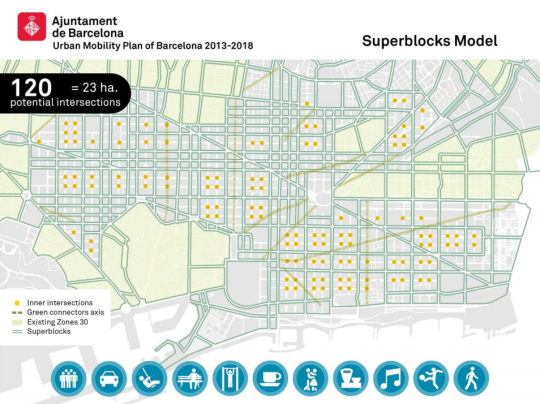
    Barcelona is in the midst of dramatically rethinking its urban fabric to address issues around urban mobility and climate change. Initially laid out in this 2014 Urban Mobility Plan for Barcelona, the city is now implementing something it calls superilles (or superblocks in English).

    Here’s what it looks like:

    The idea is to concentrate transit and vehicular traffic onto the edge of these new superblocks and then convert the interiors into livable spaces for pedestrians and cyclists. Here’s a description from the Agència d’Ecologia Urbana de Barcelona:

    “Superblocks are made up of a grid of basic roads forming a polygon, some 400 by 400 meters, with both interior and exterior components. The interior (intervía) is closed to motorized vehicles and above ground parking, and gives preference to pedestrian traffic in the public space. Though the inner streets are generally reserved for pedestrians, they can be used by residential traffic, services, emergency vehicles, and loading/unloading vehicles under special circumstances. The perimeter, or exterior, of Superblocks is where motorized traffic circulates, and makes up the basic roads.”

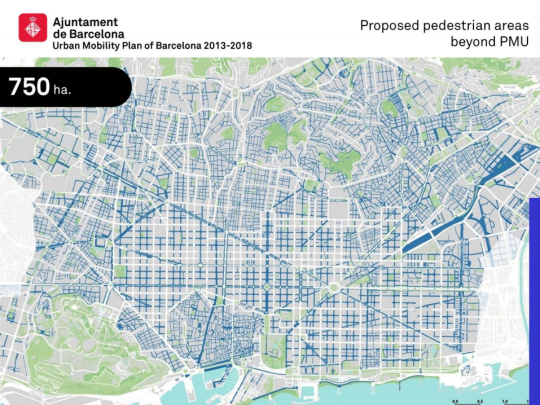
    The result is going to be an absolutely radical shift in the amount of public space given to drivers, pedestrians, and cyclists. When their 2014 report was issued, it was estimated that 73% of public space was allocated to cars (versus pedestrians). This plan will completely flip that ratio. With the superblock model, it is estimated that 77% of public space will now be allocated to pedestrians.

    Here’s what that is expected to look like…

    Before:

    After:

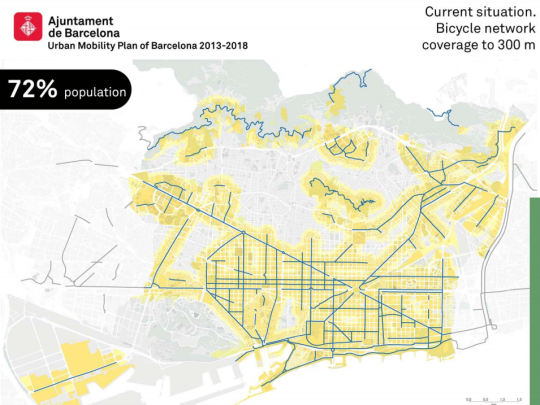
    There are also plans to expand the bicycle network to roughly 95% of the city’s population.

    Before:

    After:

    If any of you are from Barcelona, I would love to hear a local perspective on this mobility plan. Were and are there cries of a war on the car?

    Images: Top image from Tom Walk (Flickr); Maps from Urban Mobility Plan of Barcelona 2013-2018

  • Trust & attention

    Over the weekend I received a marketing email from a real estate company advertising their new mobile app. I didn’t download it.

    Nowadays, every company and brand seems to have a mobile app. If you don’t already have one for your organization, I bet many of you have thought about creating one. This is natural given how profound the shift to mobile has been.

    But I can’t help but feel like we are overestimating the kind of attention that many of these apps will receive. App usage is highly concentrated. We’ll spend hours on Instagram, but almost every other app in existence gets ignored.

    I love how marketer Seth Godin puts it: “the two scarce elements of our economy are trust and attention.” Attention is not scalable. Each of us have a finite amount of attention to give. And there’s lots of competition for it.

    At the same time – to borrow Godin’s thought process – a lot of people will sacrifice trust for the sake of attention. We overpromise because we become desperate. I mean, if you think about it, every company or organization is trying to figure out how to get you to pay attention to them.

    But I’d like to think that trust can also help you garner attention. Once I trust someone or some organization, I’m more likely to give them the time of day. They’ve earned it. And I feel like that’s where things are headed in today’s information economy.

    Trust and attention. Think about it. They’re pretty powerful things, no matter how you spend your days.

  • What’s in a word? A lot.

    image

    One of the things I try to be aware of is the language that I use to describe things. Because the words and conventions we use can impact how we perceive things and they can also reinforce certain inherent biases. (I have a good friend who is an expert on this topic, so he has heightened my awareness.)

    For instance, I find that we tend to equate home and house. In other words, we’ll use the descriptors detached house and detached home interchangeably. And when we say that someone is a homeowner, it can sometimes, or often, mean that they have purchased a house.

    The same does not seem to be true for apartments and condominiums. Rarely do I hear people say that they live in an apartment home or a condominium home. It’s just an apartment or condo.

    This is meaningful because the emotionally charged word is home. It signifies a subjective (and usually comforting) experience, whereas the word house, I would argue, represents a building typology. And so by conflating the two, I often feel that we’re promoting a cultural bias that privileges houses as the ideal building typology. A true home is a house.

    The other word that I often think about in my business is unit. When we talk about multi-family buildings we often – and I’m definitely guilty of this – refer to each suite as a unit. We’ll say things like: “This is a 200 unit building and the unit mix is as follows…”

    Again, I am absolutely guilty of this. But at the same time, I often think about how this word, unit, is probably the furthest thing away from a home. Who wants to live in a unit? That doesn’t sound very pleasant. In fact, it sounds clinical. People want to live in a home. Now that’s a word with positive psychological associations.

    And so by reducing each home to a unit, I think it could be making us lose sight of the fact that each suite will eventually be lived in by someone who will then make it their home. Yes they can be considered a customer who are paying for a product (a great place to live), but I don’t think that should take anything away from its homeyness. 

    I live in a condominium and it is my home. What about you?

    Image: Flickr

  • Let there be light

    My condo has an east exposure. That means I get direct sun in the morning and no direct sun in the afternoon, once the sun has crossed over onto the other side of my tower.

    But a funny thing happens in the late afternoon and early evening. The sun reaches just the right angle and begins to reflect off the apartment across from me. That apartment is about 11m away.

    Once this happens, it then feels like I’m getting direct sun again. It floods my apartment. This may seem like a small thing, but I love it when this happens. It’s happening right now as I write this post.

    So I can only imagine what it must have felt like for the residents of Rjukan, Norway when they got their first taste of winter sun back in 2013.

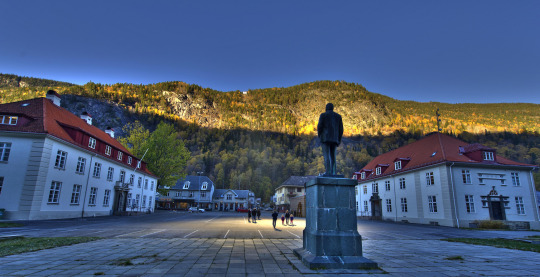
    Rjukan is a small town of approximately 3,400 residents. It’s located about 2.5 hours west of Oslo and is situated within a deep east-west valley. 

    As a result of its geography, the town is cast in shadow for about half of the year, from September to March. The elevation of the sun is simply too low for direct light to reach down and into the valley.

    So what the town did was install a set of solar powered mirrors on top of the mountains. The mirrors – also called heliostats – track the sun and reflect it down into the town’s main square. Now the town gets winter sun.

    Interestingly enough, many residents opposed the mirrors before they were built. They viewed it as a frivolous expenditure. Petitions and Facebook pages were created. But now that the mirrors have been installed, most of the naysayers seem to have changed their tune.

    I think it goes to show just how important light is, but also how difficult change, of many varietals, can be.

    Image: Flickr

  • What it takes to unlock infeasible development land (and some thoughts on parking)

    image

    One of the questions that came up after my recent post about land pricing was: what is it going to take to develop underutilized land on the outskirts of city centers?

    So today I thought I would talk about a new development project that was also discussed at the Land & Development conference I recently attended. I think will begin to answer this question.

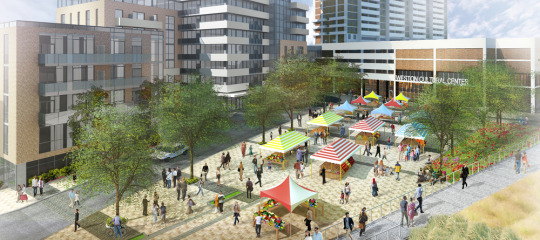
    The project today is known as the Rockport Weston Community Hub & Rental Building. And it’s going to include a community cultural hub, 26 live/work artist spaces, and 300 rental apartments. 

    It’s located in the Weston neighborhood of Toronto, which is designated as a “Neighborhood Improvement Area.” These are lower-income areas that the city considers to be “at-risk.”

    Given this, rents are naturally lower here than in other parts of the city, which means that it’s basically infeasible to develop here. There has been no large scale development in this community since the 1970s!

    To put some numbers to this, the developer said they were projecting rents somewhere around “two and a quarter.” So let’s assume for a second that the average apartment rents will be $2.25 per square foot. 

    At this rate, it means that a 600 square foot one-bedroom apartment will have a face rent of $1,350 per month. This may seem fairly high, but it almost certainly wouldn’t be enough to get a project like this off the ground under normal market conditions. At least, that’s the case here in Toronto with current cost structures.

    So what had to happen was a fairly complicated public-private partnership, which you can read all about here. But at a high level, there seems to have been 3 main economic factors that allowed this project to move forward:

    1) The developer was able to acquire the land for cents on the dollar. As I said in this post, land is expensive. So this helps a lot.

    2) The developer was able to make use of extra parking in an adjacent building. Assuming that underground parking could cost around $50,000 per stall, this is a huge cost savings.

    3) Lastly, the project is benefiting from the public invest made in the airport rail link that now quickly connects this site to both Pearson International and downtown Toronto.

    The moral of the story is that infeasible sites require some sort of subsidy or top up to make them work. Or, there needs to be an exceptional circumstance. Because if the rents aren’t there, nobody is going to build. It’s as simple as that.

    That said, here’s one idea…

    This discussion reminds me of a post I wrote a while back called, The hypocrisy of parking minimums. Frankly, I don’t understand why a city like Toronto still has parking minimums. If anything, we should have parking maximums.

    Underground parking is a huge cost that has to get carried by purchasers and renters in a new building. For example, let’s assume that 300 apartment suites would require 180 parking stalls (ratio = 0.6). Assuming $50,000 per stall, that’s a $9 million cost.

    So the second takeaway is that it’s probably time we took a good hard look at how we think about and plan for parking in our cities. Especially since the entire mobility space is being quickly disrupted.

    Image: Rockport

  • Towards a walletless society, almost

    image

    Today I am one step closer to not only going cashless, but also going walletless.

    This is going to be old news for those of you in the U.S., but yesterday, all 5 of Canada’s big banks signed on to Apple Pay. Before yesterday, you had to have an American Express credit card – which I do not have – to use Apple Pay in Canada. Now you can use a debit and/or credit card from these institutions.

    What’s great about Apple Pay is that it can be used anywhere that contactless, or tap, payments are currently accepted. And since this is pretty commonplace in Canada – more so than in the U.S. I think – Apple Pay can, at least in theory, be used almost anywhere.

    Being the early adopter and geek that I am, I went out for lunch today determined to test out Apple Pay. As I pulled out my phone to pay for lunch, the guy told me: “That’s not going to work. Other people have tried before.” But I tried anyway and, boom, it worked like magic. The transaction amount popped right up on my screen.

    I am pretty excited about this for a couple of reasons. 

    Firstly, it’s more secure. Apple Pay works in tandem with the iPhone fingerprint scanner. So even if I were to lose my phone, nobody would be able to charge anything to it. That’s not the case with a lost wallet. Anyone can tap a credit card to buy something.

    Secondly, Apple is working on allowing reward cards to be stored in its Wallet app. I am terrible about remembering to collect rewards and use gift cards, so anything that consolidates and simplifies is a positive in my view.

    Thirdly, I like to go to the gym and go cycling with just my phone and headphones. I don’t like carrying around my wallet. I’m always afraid that I might lose it or someone might steal it from a locker. So I try and leave it at home. Now I can do that and still pay for stuff – assuming my battery will last that long.

    Of course, it’ll be awhile until we can all really go walletless. I’m not aware of any significant push to digitize government IDs. But it will happen. (Does that mean there will be no more fake IDs for underage drinking?)

    As this transition happens, I can’t help but think of all the small businesses that only accept/use cash and probably hide some of their earnings. I suspect it’s going to be a lot harder to do that in the future.

    I’m also thinking about how transit agencies are going to have to quickly get onboard with this technology. Here in Ontario, we’re still rolling out a card-based payment system. And cards are about to disappear; perhaps sooner than most people think.

    Image: Apple