Daily insights for city builders, delivered every morning at 6 AM ET. I’m Brandon Donnelly — a Toronto-based real estate developer and founder of Globizen. I’ve been writing here since 2013.

Tag: athiscity

  • [Video] Interview with designer Marcel Wanders

    I just got home from Christmas dinner and I am so full that I can barely keep my eyes open. So rather than attempt to write something insightful, I am going to share a 2 minute interview with designer Marcel Wanders.

    [youtube https://www.youtube.com/watch?v=w78Bjfscii0?rel=0&w=560&h=315]

    It’s a short piece, but he covers some interesting topics such as his office culture and the value of Amsterdam for their creative process (specifically the city’s openness and tolerance).

    Regular scheduled programming will resume tomorrow. 

    And sometime before the end of the year I’m going to do a summary of 2015 on ATC and make some predictions for 2016. I haven’t really done the prediction part before, but I think it would be a good practice to start.

    Until tomorrow 😴

  • Merry Christmas from post-tribe Toronto

    Belfast Christmas Market by Peter Holloway on 500px.com

    https://500px.com/embed.js

    Merry Christmas and/or happy whatever you happen to celebrate around this time of year.

    Hopefully things have slowed down for you all and you’re relaxing with family and friends either at home or somewhere on vacation. I’ll be doing that here in Toronto and making pancakes for breakfast, because that’s what I like to do on Christmas morning.

    If you’re in the market for some long form reading material while you relax, I recommend you check out an article in The Walrus called, After the Troubles. It’s by Toronto-based planner Joe Berridge – who is a partner at Urban Strategies – and it’s the story behind his team’s Belfast City Centre Regeneration Strategy and Investment Plan.

    It’s a fascinating and entertaining read, and there are lots of comparisons between Toronto and Belfast. Here’s a little taste:

    “IT WOULD BE HARD to conceive of two cities more different than Belfast and Toronto. One old world, one new; one grand, one utilitarian; one barely ticking over, one growing like topsy. And of course, one tribal, the other the epitome of post-tribe. Belfast is 96 percent white—forget about Catholic-Protestant, that’s the critical urban statistic. And yet it’s important to remember that Toronto itself was once the largest Orange town in the world. (Wikipedia asserts that every mayor of Toronto since its founding was an Orangeman until Nathan Philips, a wonderful Jewish mayor, was elected in 1954.) Even the current mayor, John Tory, draws his name from a bunch of brigands and royalist cattle thieves in the Irish backcountry.”

    I spent a bit of time in Belfast when I was working in Dublin (2007) and so it was particularly interesting for me to read about his assessment of the city. Like Berridge, I found the city eerily empty during off-peak times. But it’s an architecturally rich city and a fascinating city for urbanists because of all that has happened.

    Though now we are talking about “after the troubles.” Things are progressing. And that strikes me as a positive thought while I make my pancakes on Christmas morning.

  • For the love of Brutalism

    Brutalism is an architectural movement that most people, other than architecture nerds, hate. Derived from the French words for raw concrete – béton brut – Brutalist architecture is characterized by its use of exposed concrete and its imposing fortress-like qualities.

    Most people find it too cold, sterile, and impersonal. But this 99% Invisible episode perfectly sums of where I think we sit with this era of building:

    “Back in the 1960s, Victorian style buildings were considered hideous and impossible to repair. We were tearing batches of Victorians down to erect big concrete buildings. But some Victorians were saved—and today, some of them are considered treasures.

    Concrete architecture now finds itself at an inflection point: too outdated to be modern, too young to be classic. And a small, but growing band of architects, architecture enthusiasts, and preservationists, would like us to just wait a bit and see.

    Maybe, with a little time, we’ll come around to love these hulking concrete brutes.”

    Concrete can be a wonderful building material all on its own. I mean, just look at the work of Tadao Ando

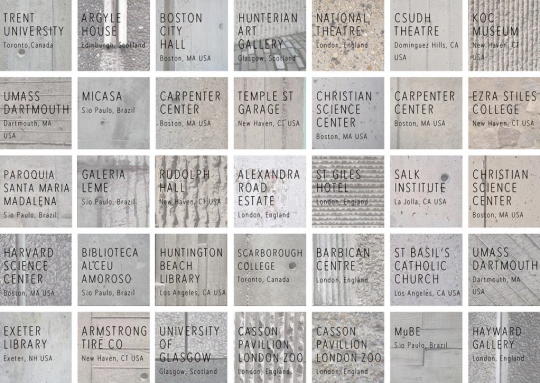
    But all concrete is not created equal. Here is a taxonomy of concrete textures that was also part of that same 99% Invisible episode:

    image

    I say all this because if we believe that Brutalist architecture has no value then we are likely to believe that it doesn’t need to be preserved. And that may very well be the case for some Brutalist architecture. But if history is any indication, some or much of it may also be considered beautiful one day.

    Most cities have a rich history of demolishing (or almost demolishing) buildings and neighborhoods that today we would (or do) treasure. Which tells me that we’re not always very good at figuring out what has value or will have value in the future.

    So maybe some of those brutes are worth a second look.

  • The benefits of sharing — what real estate could learn from tech

    One of the reasons I decided to start blogging was because I saw how open the tech community had become – with respect to sharing their ideas and experiences – and I thought that the same thing could and should be done in real estate, as well as in city building more broadly.

    But in many ways, the real estate industry is the antithesis of the tech industry. We are slow moving and secretive of our ideas. Now, some of this is driven by fundamental differences in terms of how these two sectors operate. It’s a lot easier to test and iterate on your ideas in tech than it is with actual bricks-and-mortar. But I still think about ways in which we, in real estate, could be pushing the envelope.

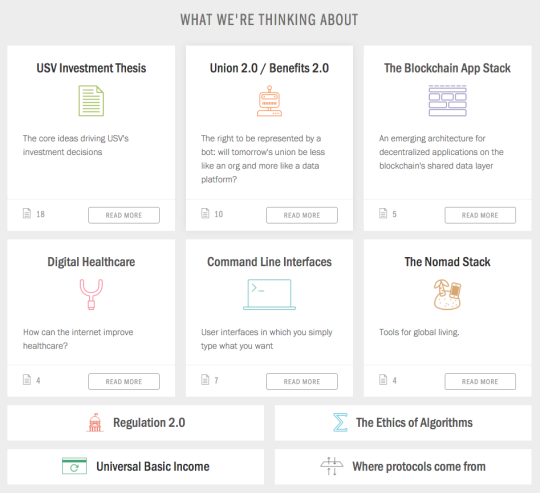
    As one example of what I’m talking about, take Union Square Ventures in New York. They call themselves a “thesis-driven venture capital firm”, which means they come up with a framework and core set of ideas, and then use those to drive their investment decisions.

    You would think that these frameworks and ideas would be pretty sensitive. I mean, they are the core drivers of their business. But their entire website is actually set up around sharing and collaborating – with the public – on these ideas. Here’s a screenshot:

    image

    Each topic is something they are “thinking about” and something they want to make an investment in (or already have). Fascinating.

    Many of you, I’m sure, would argue that there are risks to doing this. But there are also benefits, some of which are driven by collective intelligence. By sharing their ideas and hypotheses with the public, it helps to evolve their thinking. After all, their investment thesis is not a static thing. It grows over time.

    But in addition to this, it also makes it abundantly clear to their customers (entrepreneurs) what they believe in and what they look for. And I am sure this helps them with deal flow. More and more customers aren’t just “buying” a product, they are also “buying” a philosophical underpinning and belief system.

    Can you imagine a real estate firm doing something like this? I can. But it’s not happening yet, as far as I know.

  • Coworking, coliving, and an old architecture school project

    Coworking spaces are big business.

    One of the biggest of those companies is WeWork. As of last month (November 2015), the company had raised close to a billion dollars from investors like JPMorgan Chase, Harvard Management, and Benchmark Capital, and was valued at $10 billion. (Remember though, this is in the private not public markets.)

    If you’re unfamiliar with coworking spaces, check out this post from The Spaces. It’s a great demonstration of how beautiful these spaces can be.

    All of this is interesting because it speaks to the changing nature of work. There are a lot of people freelancing, participating in the “online gig economy” and working on new ideas. And in many of these cases, they don’t want or need traditional office space and/or they want the community that many of these coworking spaces afford – both offline and online.

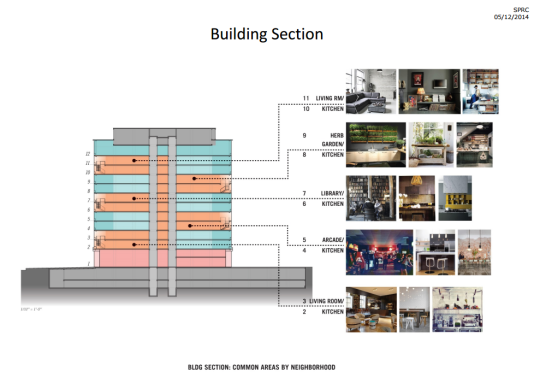
    But it’s not just the office that is changing. It’s also potentially living spaces. Since 2014, WeWork has been talking about their new coliving concept, WeLive. The idea here is to combine smaller living spaces with larger common areas and create an overall live-work community. And they are not the only ones thinking about this.

    Below is a building section of what this might look. It’s from a Vornado Realty presentation. They are working with WeWork to deliver their new WeLive concept in Crystal City, Virginia.

    It’s so interesting to see this concept come to fruition. Back in 2008 when I was in architecture school, I worked with a classmate of mine and designed a modular coliving apartment building. It was called the Philly Flex Dwelling and it worked like this:

    The idea here was to start with standard floor plates and use a structural exoskeleton to minimize interior columns. This way you could insert whatever prefabricated modules you wanted and also re-purpose the structure should you want to change the building’s use in the future. 

    This is not that dissimilar from what was originally proposed for One Bloor West here in Toronto. Though the goal there was column-free retail spaces. 

    The yellow spaces are the shared common areas and the remaining spaces are the residential living “pods.” We also designed a “solar skin” that was perfectly tuned to the building’s orientation and location in Philadelphia. The idea here was to maximize winter sun (for heating) and minimize summer sun (to keep the building cool).

    That was a fun project to work on.

  • 16 mobile theses and how tech might change the built environment

    Caucasian woman standing near passing subway in train station by Gable Denims on 500px.com

    https://500px.com/embed.js

    One of the things that I try and do here on this blog is examine the intersection of design, real estate, and technology. I didn’t explicitly set out to do that, but more and more I find myself thinking that way when I’m writing and when I’m giving talks.

    Part of that is because of my passions, but part of it is because there is a big and important overlap. One example of that is autonomous, self-driving cars. The tech community is enamoured with driverless cars, but everyone involved in the built environment should also be thinking about their impacts. Because it’ll be significant.

    Benedict Evans – who is a venture capitalist with Andreessen Horowitz in the Valley – recently published a post called, 16 mobile theses. It’s a look at 16 topics, trends, and shifts that are happening in the tech space. (There’s also a related podcast discussion.)

    If you’re involved in internet products, you absolutely need to give it a read. But I also think it’s interesting to read it through the lens of a designer or real estate person. Productivity is changing. Notions around the living room are changing. And yes, autonomous vehicles are going to have a profound impact on the urban landscape of our cities – just as cars did initially.

    Below are 3 excerpts from Benedict’s post that I really enjoyed.

    The first is about mobile and just how massive it is:

    “The mobile ecosystem, now, is heading towards perhaps 10x the scale of the PC industry, and mobile is not just a new thing or a big thing, but that new generation, whose scale makes it the new centre of gravity of the tech industry. Almost everything else will orbit around it.”

    The second is about how “networked” is quickly becoming a given:

    “Our grandparents could have told you how many electric motors they owned – there was one in the car, one in the fridge and so on, and they owned maybe a dozen. In the same way, we know roughly how many devices we own with a network connection, and, again, our children won’t. Many of those uses cases will seem silly to us, just as our grandparents would laugh at the idea of a button to lower a car window, but the sheer range and cheapness of sensors and components, mostly coming out of the smartphone supply chain, will make them ubiquitous and invisible – we’ll forget about them just as we’ve forgotten about electric motors.”

    And the third is about those self-driving cars:

    “The move to electric and the move (if and when) to autonomous, self-driving cars fundamentally change what a car is, but also what the whole automotive system might look like. Electricity changes the mechanical complexity of cars and hence changes who might build them and what they might look like. Autonomy and on-demand services change who buys them, meaning the buying criteria will be different. But they could also change the urban landscape just as much as cars themselves did – what do mass-market retail or restaurants look like if no-one needs to park?”

    Can you think of other ways in which tech will impact cities and the spaces we occupy?

  • I’m writing a book on becoming a real estate developer

    typerwriter closeup by Sean Gladwell on 500px.com

    https://500px.com/embed.js

    One of the most common questions I get from readers of this blog is: How do I become / get into real estate development?

    In fact, I get it so often that I’ve decided to write a book as my response. It may be a short one or it may end up a long one. If you’ve emailed or messaged me with this question and I haven’t responded, I’m sorry. There’s a lot of you out there. But I do want to help and that’s why I’ve decided to take on this hobby book project.

    As part of the book, I’ll be talking about my own journey, as well as the actual nuts and bolts of development. But I would also like to feature some much more established players in the business. In order to do that, I’ve decided to crowdsource some of the content for this book. 

    So here’s my ask to you: If you’re a real estate developer and would like to share your story, please complete this short questionnaire. You can be located anywhere in the world.

    My plan is to select a handful of developers from around the world and then feature their stories, one-by-one. I’m confident that there will be a lot of interest in hearing how successful developers established their careers and/or own businesses.

    I’ve been thinking about doing this for quite awhile now. It feels good to get started. 

  • 50% of New York City’s population is estimated to be single. Here’s what that means for housing.

    Here in Toronto there’s a push for more family-sized apartments. That’s what the planners want to hear.

    Because the city has been trying to encourage developers to build more of them for years, but the challenge has always been that they didn’t sell or that they took a long time to sell. The market wasn’t ready.

    But as I discussed earlier this week, that is starting to change. I think Toronto is reaching a tipping point where low-rise housing has simply become too expensive and people are starting to look to alternatives, mostly at the mid-rise scale.

    It’s interesting though that something of the opposite appears to be happening in New York. I don’t know enough about the New York new construction market to really comment on overall unit mixes and sizes, but there definitely seems to be a push to create more affordable micro-units.

    Curbed published this last October:

    “…a report currently under public review, called Zoning for Quality and Affordability, recommends relaxing density caps and eliminating the 400-square-foot minimum for studio apartments, thereby creating more housing for single people. Almost 50 percent of the city’s population is estimated to be single, but only seven percent of the housing stock is studios.”

    And just recently, New York completed its first all-micro-unit apartment building called Carmel Place. Rents start at $2,650 per month for a 265 square foot apartment. 

    As a point of reference, that works out to be $10 per square foot per month and more than 3x the highest rents you could reasonably achieve in the more desirable areas of Toronto, today.

    The model suite is 302 square feet and looks like this:

    All of the above photos are via Curbed.

  • The highs and lows of mid-rise

    Last week
    was developer Urban Capital’s 5th annual “Naughty or Nice” party. It’s obviously a holiday tradition of theirs and it has become a tradition of mine to attend. Judging by my vast collection of photo booth photos, there’s a chance I may have been to all of them. It’s easily one of the best holiday parties in the business.

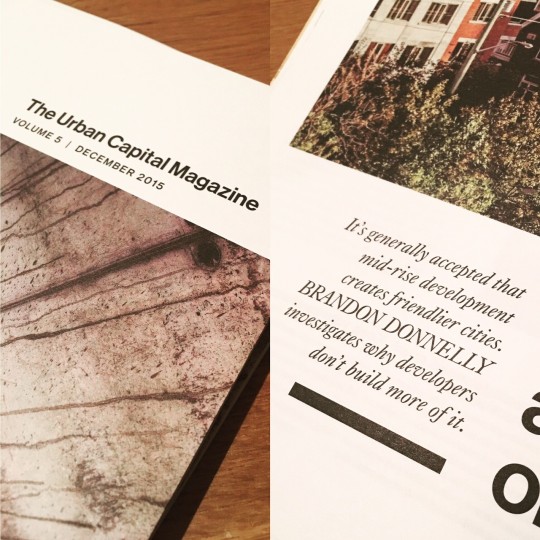
    One of the things that Urban Capital does at its annual party is release its annual magazine. And this year I was fortunate enough to be invited to write a piece for it on the highs and lows of mid-rise development. Put differently, it’s about the challenges facing developers who want to build mid-rise, but also why they’re pretty great for cities.

    If you’d like to have a read, you can do that online by clicking here. And if you’d like to receive a hard copy of the magazine, I can make that happen as well. Tweet at me. Alternatively, you can also pick up the magazine at any Urban Capital sales office.

    I deliberately tried to make it so it wasn’t your typical real estate puff piece: condos are great, yada, yada, you should buy one from us. I tried to make it an intelligent piece on some of the real challenges facing mid-rise developers. And that’s what Urban Capital wanted as well. I hope you enjoy it 🙂

  • Changing Lanes — A fireside chat with Jennifer Keesmaat and Janette Sadik-Khan

    Citi Bike by Pete  on 500px.com

    https://500px.com/embed.js

    When I was in Miami at the beginning of this month I missed an interesting event that I normally would have attended. It was a conversation between the Chief Planner of Toronto, Jennifer Keesmaat, and the former commissioner of the New York City Department of Transportation, Janette Sadik-Khan.

    Sadik-Khan was appointed under the Bloomberg administration and quite famously oversaw a huge number of urban changes in New York. Projects such as the addition of hundreds of kilometers of new bike lanes and the creation of 60 new pedestrian plazas across the city – including the one in Times Square.

    I was bummed I couldn’t attend, but thankfully Keesmaat wrote a post on her blog following the event and the Metcalf Foundation shared videos of the conversation. 

    Here’s a piece that I liked from Keesmaat’s blog post:

    “But she also pointed out that when they demonstrated what could be done, when they quickly mobilized around action, residents clamoured for similar changes in their neighbourhoods. Not surprisingly, this is why her book is called Streetfight – because it is a fight. City building is often the battle of ideologies, and when you’re trying to change the status quo, there is always a significant demographic of the population that is fully committed to maintaining business-as-usual.”

    If you have some time, you can also click here to watch the videos. There’s about an hour and a half worth of video, so you might want to open up a bottle of wine or something.