Daily insights for city builders, delivered every morning at 6 AM ET. I’m Brandon Donnelly — a Toronto-based real estate developer and founder of Globizen. I’ve been writing here since 2013.

Tag: athiscity

  • UberPOOL is the new networking tool

    crossing by Milan Kalkan on 500px.com

    https://500px.com/embed.js

    UberPOOL launched in Toronto last week. It was tested in Toronto last summer and it’s been available in other cities for awhile, but now it’s officially here.

    If you’re not yet familiar with UberPOOL, it basically allows you to share your ride with other people who are headed in the same direction. I’ve heard some people on Twitter complain about route inefficiencies, but I’ve had only positive experiences with it so far.

    The disadvantage of this system is that it’s a bit slower. You’re stopping to pick up other people on the way. But the advantages of this system are twofold. First, it’s cheaper, which means it’s already starting to eat into my transit usage. And second, you get to meet new people everywhere you go.

    This second piece is really interesting to me, because I place a lot of emphasis on getting to know as many people as I can. That’s one of the reasons I blog every day and one of the reasons I spend a lot of time on Twitter. I get exposed to people that I might otherwise not meet. And I believe there’s huge value in that. I want to sit down and have a coffee with everyone. (Time doesn’t always allow that to happen.)

    Because since the beginning of cities, personal connections is one of the things that has made urban life so valuable. Here’s an excerpt from a CityLab article published back in 2013:

    “If you look at the interaction patterns of cities,” Pan says, “You will see that they grow super-linearly with population with the same growth rate as productivity, as innovation, as crime, as HIV, as STDs.”

    All of those facets of urban life have appeared until now to share a somewhat mysterious mathematical relationship. But this research suggests that this particular super-linear growth rate is directly tied to how dense cities enable us to connect to each other. As cities grow, our connections to each other grow by an exponential factor. And those connections are the root of productivity.

    “What really happens when you move to a big city is you get to know a lot of different people, although they are not necessarily your ‘friends,’” Pan says. “These are the people who bring different ideas, bring different opportunities, and meetings with other great people that may help you.”

    Clearly there can also be some negative externalities associated with urban life – such as crime and disease. But it’s also clear that for a many people, the benefits far outweigh the potential negatives. Big cities tend to make us more productive. And as we’ve discussed here before, they can also bring us happiness in ways not associated with economic success.

    If you’ve used UberPOOL before, I would be curious to hear about your experiences in the comment section below.
  • Why Google is worried about being welcoming to employees who want to build new businesses

    Here on ATC, we’ve talked a lot about the changing nature of work and what that could mean for cities. 

    We talk (and debate) about the value of density and of being in close proximity to others so that ideas can percolate – whether that means open office floor plans or community coffee shops.

    But alongside all of this, there are some fascinating structural changes taking place within organizations. Below is an excerpt from a recent New York Times article called, How Larry Page’s Obsessions Became Google’s Business

    But corporate success means corporate sprawl, and recently Google has seen a number of engineers and others leave for younger rivals like Facebook and start-ups like Uber. Mr. Page has made personal appeals to some of them, and, at least in a few recent cases, has said he is worried that the company has become a difficult place for entrepreneurs, according to people who have met with him.

    Part of Mr. Page’s pitch included emphasizing how dedicated he was to “moonshots” like interplanetary travel, or offering employees time and money to pursue new projects of their own. By breaking Google into Alphabet, Mr. Page is hoping to make it a more welcoming home for employees to build new businesses, as well as for potential acquisition targets.

    What I find interesting about the statements I’ve bolded is that they represent a radically different approach to business and employment. Of course, it’s not really a new thing. Google has been encouraging its employees to work on personal projects since, I think, the very beginning. 

    But as you read the above article, you really get the sense that Page believes that this kind of organizational culture is fundamental to the long term competitiveness of the company. It’s something he is genuinely worried about.

    As counter intuitive as it might seem to encourage employees to work on other things besides the core business, one could argue that it’s almost essential in a world of rapid and constant innovation. Would you rather an employee or a competitor discover what’s next in your industry? If it’s the former, you have a chance of absorbing it into your current business. If it’s the latter, you’re already too late.

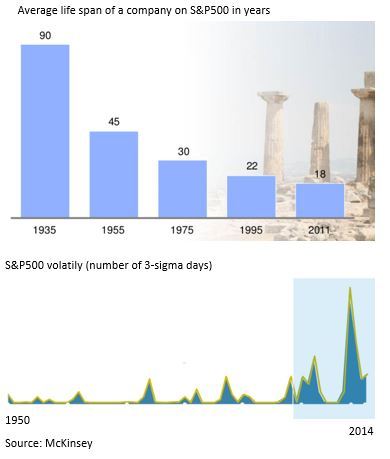
    If you go back to the article I posted earlier this week, you’ll see that creative destruction is happening a lot faster than it did in the past. The average life span of many, or most, companies seems to be decreasing.

    The tech sector seems to be ahead of most other industries with respect to this kind of thinking. But I believe that it will continue to percolate through the economy. And when it does, it will probably have many impacts on the kinds of spaces we design and build in our cities.

  • To connect rather than isolate

    When I was
    a kid growing up in the suburbs of Toronto, I never played in the backyard. I
    played in the streets. That’s where all the kids came together.

    We would
    play baseball in somebody’s driveway, using one of the garage door “squares” as
    the strike zone. We would play football on corner lots, where it was tackle on
    the grass and “two-hand touch” on the street. And we would wax our curbs so
    that we could skateboard them.

    None of these
    spaces were ever really intended for baseball, football, or skateboarding, but
    we kids repurposed them.

    As people,
    including families, continue to move into urban centers around the world, I
    have no doubt that the next generation of children will once again repurpose
    spaces for play. But that doesn’t mean that we don’t have work to do when it
    comes to properly preparing our communities for people of all shapes and sizes.

    One of the
    most interesting design challenges facing us today has to do with our towers.

    Architects
    have long been obsessed with the idea of vertical villages. Le Corbusier’s Unité
    d’habitation
    in Marseille had two shopping streets embedded within the tower
    that were intended to act as public spines. I don’t know how well they did, but
    it was a highly progressive idea for the time.

    Following
    on this idea, I was recently watching a
    TED talk with architect Ole Scheeren
    (thanks Mariane) and I was fascinated
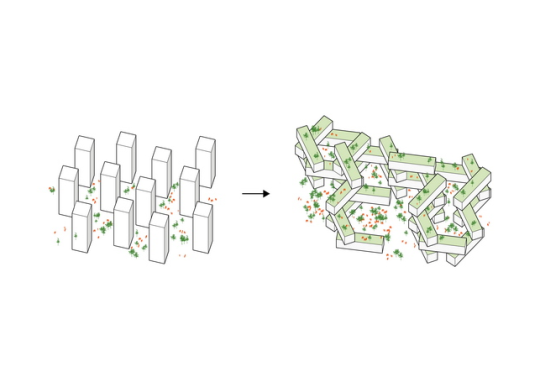
    by his obsession with breaking down the raw verticality of towers.

    His belief
    was that, yes, cities are and will continue to become more dense through tall
    buildings, but that most towers isolate rather than connect people. His work strives to do the opposite.

    And this
    one of the big trends that I think we will see more of in our cites. We will see
    new forms of urban connectedness and a blurring of private, public, and
    semi-public spaces. Screw Euclidean zoning.

    On that
    note, I am reminded that I owe the ATC community a post on my predictions for
    2016. I hope to get that out shortly.

    Diagram via Büro Ole Scheeren

  • What technological deflation could be doing to the economy

    Earlier in the week, I came across this post (via Fred Wilson), arguing that rapid technological progress is causing systemic deflation in the broader economy.

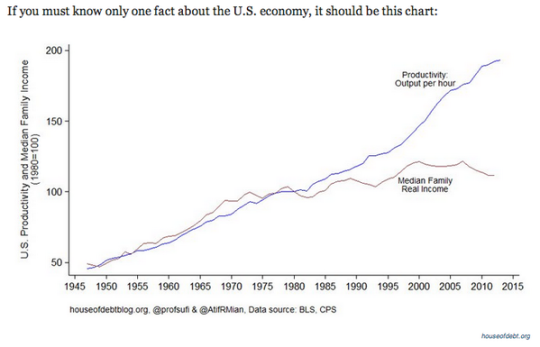
    Here’s a chart that illustrates the author’s point:

    What is happening here is that despite advances in technology and increases in productivity, real wages have been stagnant for decades. (This chart is for the US, but it likely applies to many other countries.)

    This is an interesting paradox. For a long time, increases in productivity were met with corresponding increases in income. So why the divergence?

    The author believes that it’s because the gains brought about by “extreme technological progress” are being unequally applied to the economy. In other words, they do not benefit the majority of people. He then goes on to argue that we could be entering an entirely new macroeconomic era: 

    “Economic growth may be over soon, at least in absolute terms. On the other hand that will be at least partially offset by the technological deflation. So instead of the decline of the innovation it will be just the opposite, the explosion of the innovation that will turn the economy to the decline. And moreover, it will not be a tragedy since we will be able to produce higher standard of living with fraction of the GDP today. Few adjustments needs to be done into our economic system to cope with the change for sure.”

    When you read things like this it makes the idea of a “basic income guarantee” seem far more palatable.

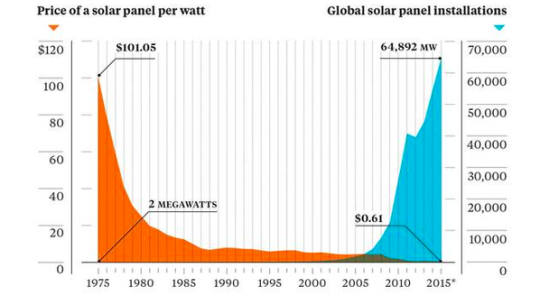
    The other chart that stood out to me was this one below, which shows the declining cost of solar panels and the rise of global solar panel installations. 

    It’s a great reminder that it’s only a matter of time before we wean ourselves off of oil. And, that we could be headed towards some sort of third industrial revolution where the marginal cost of energy is almost zero. Already about 25% of Germany’s electricity comes from renewables.

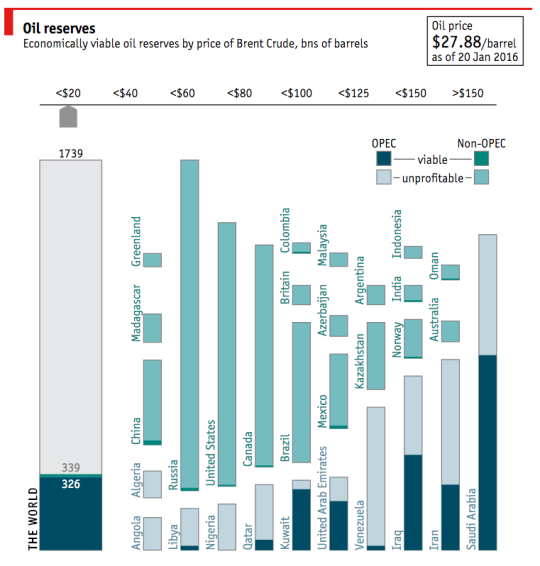
    On that note, I am going to end with a fantastic interactive chart from The Economist (screenshot below) that outlines oil reserves around the world by country. If you click through to their website, you can then toggle the price of oil (per barrel) to see how much of those reserves are actually viable.

    With the price of oil where it is today ($27.88 per barrel as of January 20, 2016), there are only a handful of countries with profitable oil. I am sure you could have guessed which ones.

    What will happen if, or should I say when, that oil is no longer needed? 

  • Hybrid 1-2-3

    For those of you who have been reading this blog since last summer, you’ll know that I’m particularly passionate about the Gardiner Expressway East here in Toronto.

    Last night a public meeting was held to discuss the 3 alternative designs for what has become known as the “hybrid” option. If you’d like a visual summary of the options, click here.

    But essentially as you go from hybrid 1 to hybrid 3, the elevated Gardiner Expressway just gets pushed further north, away from the water. So as you go from 1 to 3, the hybrid option becomes less offensive to the waterfront and its associated public realm, and it opens up more land for development. However, it also becomes more expensive.

    Here’s a graphical summary of the costs, which my friend Gil Meslin tweeted out last night:

    //platform.twitter.com/widgets.js

    Notice that the boulevard (remove) option, which City Council rejected last summer, remains by far the most cost effective option. At a time when the city is searching for cash, I am surprised that nobody is looking here.

    I am also surprised to read that some are commenting on which of the above hybrid options will be the easiest to tear down should we want to remove the Gardiner East in the future. If that’s the lens we are applying, why rebuild it in the first place?

    But enough from me. What do you think? Here’s a Twitter poll I created this morning:

    //platform.twitter.com/widgets.js

  • What is an urbanist?

    Cities are in vogue. And that has brought about buzzwords like urbanism, tactical urbanism, urbanist, and the list goes. But what exactly does it mean to be an urbanist?

    If you look it up in the dictionary, you’ll likely get something along the lines of: someone who is a specialist in city planning. But I bet that there are many people out there who would self-identity as being an urbanist, but who would also not consider themselves specialists in the field.

    The term has evolved to imply other things.

    To this end, Scott Bonjukian (over at The Urbanist) recently wrote a good piece called, Why I call myself an urbanist. And in it he offered up this definition from the former mayor of Seattle, Michael McGinn:

    “At the core, urbanists want more people living in cities, so they support more urban housing of all types. They prioritize walking, biking and transit, and support a high quality shared public realm. Parks, nightlife, theaters, transit and taxis can replace backyards, TV rooms and private cars. That way we can live well with less stuff, sprawl and pollution.

    I’ll go a little further, and say urbanists prefer bottom up, granular, and seemingly chaotic innovation to top-down planning and mega-projects. Think the “Main Street” of neighborhoods with food trucks and lots of little stores, as opposed to tax-subsidized big box stores with legally required massive parking lots. Bike lanes, crosswalks and plazas instead of public garages and new highways.

    Urbanists believe that mixing people and ideas creates wealth in a city. Why else would people choose to live so close to each other? Cities, therefore, should be open to people of every background, ethnicity, race and class to maximize the potential from our human capital.”

    Scott added that most urbanists are probably also environmentalists on some level, and I can certainly see where he’s coming from with that. Regardless, I think the above definition is pretty apt.

    But if you unpack some of the points, this definition raises some interesting questions. For instance, take the first line around supporting housing of all types. 

    This could mean that even if you lived in an inner city transit-served single family neighborhood, but you didn’t support alternate housing types such as duplexes, triplexes, accessory dwelling units and/or laneway houses, then you might not be a true urbanist. You would rather homogeneity over a “chaotic” mix of housing types. And I can certainly think of inner city neighborhoods in Toronto that have fought against “monstrous” duplexes. 

    So I would be curious to hear your thoughts on the above definition of urbanist. Do you agree or disagree? Is there anything you would add or take away? Are you an urbanist? Let us know in the comment section below.

  • Toronto’s King Street to be transformed into a transit + pedestrian corridor

    Take The Car by Jason Cook on 500px.com

    https://500px.com/embed.js

    I try not to focus on local Toronto issues this much, but this morning an important initiative was announced and it’s blowing up my Twitter feed.

    By spring 2017, the city hopes to have a pilot project in place that will transform King Street – running from Liberty Village in the west to the Distillery District in the east – into a priority-transit and pedestrian corridor.

    This isn’t to say the street will be closed to cars. I would imagine that at least 1 lane would remain for cars going each way. Instead it will be redesigned to prioritize transit, pedestrians, and cyclists.

    So why is this exciting?

    The King streetcar is currently broken. If you’ve ever taken it across downtown during rush hour, you know exactly what I mean. It’s infuriating. You might as well be crawling on your hands and knees. One of the goals of this initiative will be to get it working again. Good.

    The shoulders of downtown – along King West and King East – are seeing some of the greatest intensification in the region. So much that it’s common for people in this city to complain that Toronto misplanned it all by allowing this development before the transit was there. Well, this is a quick and inexpensive way to get the transit there. Remember that when the inevitable “war on car” rhetoric ratchets up over the next year.

    The project will be deployed, first, as a pilot project. That will allow the project team to test and iterate. It has also become the way you get things approved in cities. You first make them temporary. 

    But I am certain that we will quickly discover how necessary these changes were.

  • 3 changes to John Tory’s SmartTrack transit plan

    Last week Oliver Moore of the Globe and Mail announced that Toronto mayor John Tory’s SmartTrack transit plan is evolving to feel less like SmartTrack and more like what Metrolinx had been planning all along.

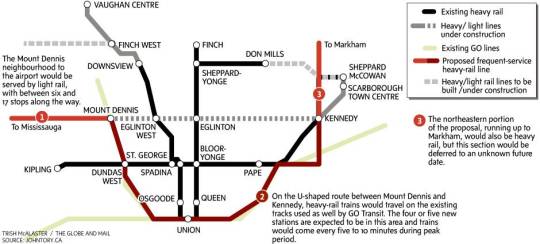
    Here’s the map from the Globe and Mail:

    The 3 big changes are as follows (and numbered accordingly on the above map):

    1. 

    The western end of the line will be replaced by an extension of the Eglinton-Crosstown LRT (currently under construction) running from Mount Dennis to Pearson Airport. This is what was originally proposed.

    2. 

    The “U” running from Mount Dennis in the west, down through downtown, and up to Kennedy in the east is what remains of the original SmartTrack line and will operate as some sort of “heavy rail” service on existing GO Transit lines. The original election campaign plan was to run trains every 15 minutes, but that was deemed too infrequent to attract riders, so now Metrolinx and everyone is trying to figure out how to get it down to every 5-10 minutes and feel more like subway.

    3. 

    The extension north of Eglinton Avenue to suburban Markham (in the northeast) is being pushed out and will be dealt with sometime in the future. Keeping the first phase of SmartTrack south of Eglinton on both ends is beneficial in avoiding the issue of SmartTrack and the Scarborough subway extension cannibalizing each other. (In my opinion, this issue is a perfect example of what happens when transit planning becomes too political.)

    The net result is a plan that is looking less and less like the original SmartTrack. I’m not complaining though because I have never been a big supporter of SmartTrack. I have always thought we should be focusing on the downtown relief subway line and on allowing Metrolinx to just execute on its regional express rail (RER) strategy.

    For more on this topic, check out Steve Munro’s post, SmartTrack: Now You See It, Now You Don’t! He’s far more of an expert than I am on these sorts of issues.

  • Share your big idea for Canada’s #Capital2067

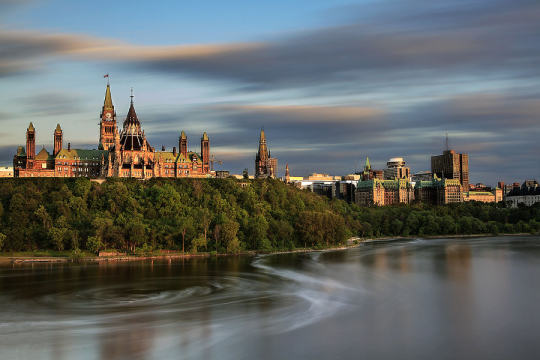
    Parliament Hill by Maryus Bio on 500px.com

    https://500px.com/embed.js

    On Thursday night I spoke at an Urbanism Lab event in Ottawa put on by the National Capital Commission.

    The event was all about the interconnection between the online world of blogging and social media, and the offline world of tangible city building.

    More specifically, one of the goals was to help inspire institutions, such as the National Capital Commission, to better leverage these new channels in order to get their message out.

    Social media and blogging may be ubiquitous, but lots of organizations are still getting their heads around it.

    So today I thought I would do my part and share something with all of you that, truthfully, I didn’t know was underway until I visited Ottawa.

    But first, how many of you (Canadians) are exactly aware of what the National Capital Commission does?

    The NCC is a federal Crown corporation that is focused on 3 specific mandates:

    1. They are the long-term urban planner of federal lands in Canada’s Capital Region. They are also the largest landowner in the region.
    2. They are the principal steward of nationally significant public spaces and buildings, including the Capital’s six “official residences.” Residences such as 24 Sussex Drive.
    3. And they are a “creative partner” on initiatives that tie into both development and conservation.

    To this end, the NCC is now working on a Plan for Canada’s Capital, 2017-2067. This is a 50-year plan that will outline what they do with federal lands, buildings, parks and other symbolic spaces in the Capital. And it will identity which projects would best craft and represent our national identity, as well as strengthen Canada’s influence in the world.

    This is all pretty important and interesting stuff. But unfortunately I didn’t know it was underway. And I also didn’t know what they were looking for “big ideas” from Canadians. These are ideas that will directly shape the 50-year plan.

    So if you have an idea – big or small – for the National Capital Commission, I would encourage you to click here and share it with them. Not only is this city building in the Capital, it’s also nation building.

    Please also feel free to copy and paste your idea(s) in the comment section of this post. These ideas definitely deserve a fulsome discussion. I will post mine once I write it.

  • Brébeuf

    I woke up this morning at 5:30 am in a hotel in Ottawa.

    I then drove to Brébeuf, Quebec to meet some friends for a ski and snowboard weekend. (It’s beautiful here.)

    Upon arriving I was faced with a large hill that my rear-wheel car with all season tires was absolutely not prepared for. So that sucked up about an hour of time.

    After we unstuck my car, we then spent the day skiing and snowboarding at Mont-Tremblant. (First day of the season for me.)

    At this point all I can think about is a good night’s sleep, so I’m afraid that there won’t be much of a post today on Architect This City.

    But please feel free to hijack the comment section and talk about whatever you would like. Maybe we can get some action started there.

    I would actually be really curious to see what topics interest all of you.