Daily insights for city builders, delivered every morning at 6 AM ET. I’m Brandon Donnelly — a Toronto-based real estate developer and founder of Globizen. I’ve been writing here since 2013.

Tag: atc

  • Project Profile: Cabin at 45 Dovercourt

    image

    Last month,
    Curated Properties submitted a
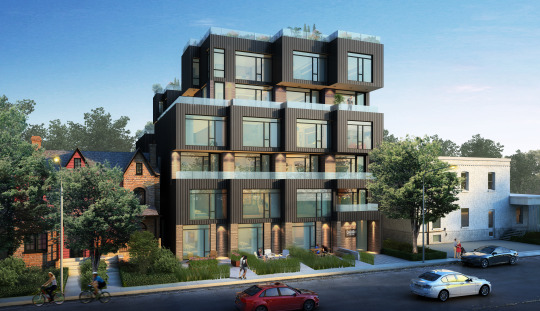
    rezoning and site plan application for a 6-storey, 25-unit building at 45
    Dovercourt Road in Toronto. The project is known to the market as Cabin and you
    can register for it now.

    The project
    immediately caught my attention (because of its design, because of its
    branding, and because I like the work of Curated), so I decided to dig in
    further and get a copy of their architectural drawings. Development
    applications and their supporting documents are all public. Anyone can request
    a copy. But the city isn’t great at making this known.

    Since I’m excited
    to see more of these small scale urban infill projects in the city, today I
    thought I would highlight some of its key features and some of the things that
    are being proposed in order to make a project like this work.

    The Homes

    First of
    all, 100% of the suites are 2-storey. 76% of the suites are also 2 bedroom or
    larger.

    The result
    is that the project is essentially a series of townhomes stacked on top of each
    other. I suspect that this will appeal to more end-users as opposed to
    investors. Hopefully, it will also attract more families to the area.

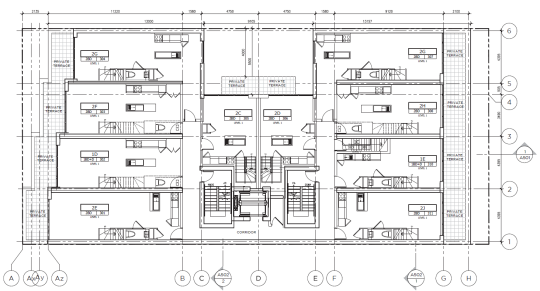
    Here’s the
    third floor plan:
    image

    You
    probably can’t see it, but all of the suites are marked as “Level 1”, obviously
    indicating that there’s more than one level.

    Also worth
    mentioning is the notch or cut out on the north side of the building. This is
    what makes the 2 suites in the middle of the floor plate possible. In order for
    them to have windows, they need to be setback from the (north) property line.
    It also means those suites get terraces.

    The Parking

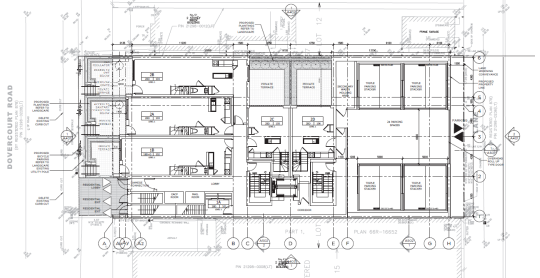
    Turning to
    the ground floor plan, it’s interesting to see that they are proposing 8 triple
    car stackers that will be accessible off the rear laneway (right side on the plan below). That equates to 24 parking spaces in the building (8 bays x 3
    cars per stacker).
    image

    On small
    urban sites like this one, it can be very difficult to accommodate parking. So
    it’s inevitable that we will see more parking stackers in the city and a continual
    reduction in parking minimums.

    The Construction

    Finally, I
    have been told that this project is expected to be framed in wood, as opposed
    to reinforced concrete, which is more typical of condominiums in Toronto.

    As of the
    beginning of this year (2015), the
    Ontario Building Code was modified to allow wood-frame buildings up to 6
    storeys
    . Before this change, the highest you could go was 4 storeys.

    This change
    was done with the intent of reducing construction costs so that it becomes more
    feasible to develop smaller infill sites such as this one. So expect to see
    more of this.

    I know that
    a lot of people would like to remain in the city even when they start having
    children. But it’s becoming increasingly difficult to find affordable low-rise
    homes. And not everyone wants to live in a high-rise tower. 

    That’s why I think
    we will see more, not less, low-rise and mid-rise infill projects like Cabin.
    If you’re interested in this topic, also check out a post I wrote called 3
    stages of intensification
    .

    The rendering at the top of this post is from Curated Properties and the
    drawings are by RAW Design.
  • The Beijing supercity

    image

    A few weeks ago I wrote a post talking about megalopolises and the importance of the Great Lakes region in North America. And I suggested that high speed rail could be one way to better stitch together the region.

    To some, I’m sure this sounded like a bit of a pipe dream. But thinking at the megalopolitan scale is something that I think we are going to need to do. Other parts of the world certainly are.

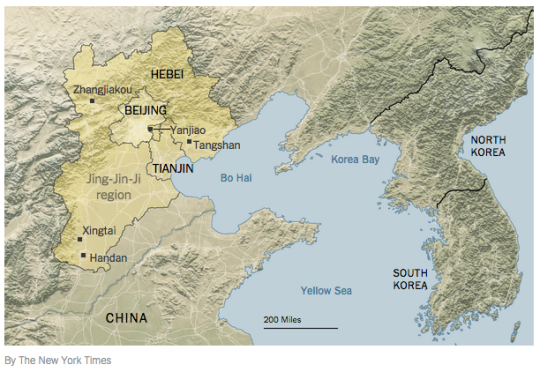
    The Chinese government is in the midst of developing a supercity around Beijing that is called Jing-Jin-Ji. It will span about 82,000 square miles and will house approximately 130 million people. 

    As part of the plan, a high-speed rail network is being built that will bring the region’s major cities within an hour’s commute. The objective is to compete with the Pearl River Delta and the Yangtze River Delta regions in the south.

    It’s a scale of planning and development that most people aren’t used to thinking about. But it’s happening right now.

    Image: New York Times

  • Multifamily vs. single family

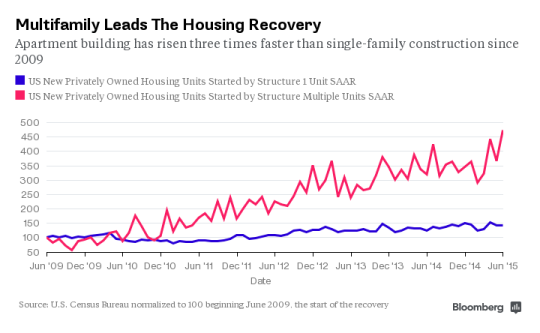
    Since 2009 when the U.S. economy started to recover, housing starts (i.e. new residential construction) have favored multifamily buildings over single family housing. Apartment/condominium construction has grown 3 times faster according to the U.S. Census Bureau (via Bloomberg).

    image

    A lot of this multifamily construction is assumed to be rental apartments, but this category also includes for sale condominiums. The classification has to do with building typology rather than housing tenure. (I would love to see how the above graph breaks down in terms of the latter.)

    The typical explanations for this trend often relate back to Millennials being poor and saddled with student debt. That’s why they’re delaying buying single family homes. But eventually the expectation is that they will resume doing

    (largely) what previous generations have done.

    Money and the economy, I’m sure, have something to do with the above trend. But I’m not convinced that it’s the whole story. 

    There are also shifts happening with respect to consumer preferences and with respect to how we plan and build our cities. That’s why I’m very interested in monitoring family formations and housing choices. 

    At the same time, I’m also a Millennial. And whenever I catch myself thinking a certain way, I assume that there are probably other Millennials out there who feel similarly.

  • The taxi cartel

    https://500px.com/embed.js

    Early this morning Peter Cheney of the Globe and Mail published an article called: How Uber is ending the dirty dealings behind Toronto’s cab business.

    And I highly recommend you read it. He’s been investigating this industry for decades.

    Though the article is specific to Toronto, I know that there are middle people and archaic policies governing the taxi industries in many other cities around the world.

    Here it revolves around taxi licenses issued by the city (known as “plates”), which are expensive and almost impossible to get. Last year the average price of a plate was $118,235 (2014).

    The way it works is that people – typically non-drivers – buy/inherit/get these plates and then charge rent on them to drivers who want to use them. The result is a taxi cartel:

    In fact, Toronto’s taxi plate system is anything but free enterprise. Instead, it is based on the artificial restriction of a natural market, and the granting of licences to a fixed number of participants. Even those who paid top dollar for a plate used to enjoy an annual return of more than 12 per cent. And for those who inherited plates, the return was manna from heaven.

    So it shouldn’t come as a surprise that the taxi industry is grouchy about companies like Uber. But the cost structure of the incumbents is going to need to change if they want to stay in business.

    Jeff Bezos of Amazon is famous for saying, “Your margin is my opportunity.” And that’s exactly what is happening here. A bloated legacy cost structure is being quickly supplanted by better/cheaper.

  • Rethinking the tall building

    Back in February of this year (2015), Philip Oldfield, who is an Assistant Professor of Architecture at the University of Nottingham, gave the following talk at the Illinois Institute of Technology. Click here if you can’t see it below.

    [youtube https://www.youtube.com/watch?v=lOfkx39soIs?rel=0]

    If you’re interested in cities and how tall buildings might make them more sustainable, you’ll enjoy it. It’s filled with a number of interesting stats and takeaways, and it’s about an hour long.

  • The evolving gig economy

    This morning venture capitalist Fred Wilson wrote a post on his blog talking about the gig economy and Hillary Clinton’s economic speech last night. 

    Here’s a snippet from Clinton’s talk:

    Meanwhile, many Americans are making extra money renting out a small room, designing websites, selling products they design themselves at home, or even driving their own car. This on-demand, or so-called gig economy is creating exciting economies and unleashing innovation.

    But it is also raising hard questions about work-place protections and what a good job will look like in the future.

    So, all of these trends are real and none, none is going away. But they do not determine our destiny. The choices we make as a nation matter. And the choices we make in the years ahead will set the stage for what American life in the middle class and our economy will be like in this century.

    The headlines this morning are making it seem like Hillary Clinton is taking direct aim at companies like Uber. But the transcript suggests that she’s being far more balanced than that: these new companies are creating exciting opportunities, and they are not going away, but there are still things to figure out.

    That’s basically how I feel.

    Take, for example, Airbnb. I think Airbnb is a great idea and company. A lot of my friends use it both as consumers and as suppliers of space.

    But for many (most?) condos in Toronto, owners are strictly prohibited from renting out their units on leases that are less than six months. It’s a direct ban on short-term leasing and it’s written into the Condo Corporation’s Declaration.

    And there’s good reason for that. Who wants to buy a condo only to find out that next door is being operated as a nightly hotel? Most people would even prefer that their neighbor is an owner rather than a renter.

    That doesn’t mean I believe Airbnb should not exist. I think we’ll likely end up getting more transparent about how buildings (and portion of buildings) are operating, as opposed to it being a shadow economy. And that could help.

    If you have any ideas for how companies like Airbnb might be better integrated into urban life, I would love to hear from you in the comment section below.

  • The tragedy of the commons

    https://500px.com/embed.js

    In 1968, Garrett Hardin wrote an article where he coined the term: the tragedy of the commons. Hardin was an American ecologist who was obsessed and concerned with the prospect of human overpopulation.

    In his article, the term tragedy of the commons was used to describe a situation where individuals – all acting independently and in their own self-interest – actually end up behaving in a way that is detrimental to the larger group and that negatively impacts some sort of common resource.

    Just in case, here’s another definition via Investopedia:

    An economic problem in which every individual tries to reap the greatest benefit from a given resource. As the demand for the resource overwhelms the supply, every individual who consumes an additional unit directly harms others who can no longer enjoy the benefits. Generally, the resource of interest is easily available to all individuals.

    So what would be an example of a tragedy of the commons?

    You may not have thought of it in these terms, but I bet you that everybody reading this blog has experienced one.

    I will give you two examples.

    1. The first is that of electricity consumption. 

    In most condominiums, there are two types of ways that electricity gets billed and paid. Either the whole building gets one bill (master metering) or each individual resident gets a bill (submetering). 

    In the case of master mastering, each resident’s consumption isn’t tracked and so nobody knows who is consuming what. But in the case of submetering, each individual resident only pays for the electricity that they use.

    Not surprisingly, the data shows that submetering can cut electricity consumption by 10 to 30%. That’s because it creates a 1:1 relationship between usage and cost. There’s now a strong incentive to conserve.

    With master metering, there isn’t a 1:1 relationship between usage and cost. The additional burden/cost of consumption actually gets shared by everyone else in the building. And since each individual is looking to maximize their own benefit, they lose the incentive to conserve. As a whole, this makes the entire group worse off.

    2. The second example is that of congestion on public, un-tolled roads.

    In most cities, public roads are a resource that is “easily available to all individuals” (to use Investopedia’s terminology). They are basically free. The marginal cost of driving another kilometer to work on a road is basically nothing (other than a bit of gas and some time).

    What this does is create a situation where individuals – in their pursuit of maximum individual benefit – start to overload the road. Everybody just wants to get where they need to go and there’s no incentive to conserve the resource (i.e. the road). Once again, the result is that the entire group becomes worse off.

    That’s why building more road rarely/never works. You’re simply increasing a resource that is easily available to all individuals. What we should instead be doing is looking at submetering our roads (i.e. pricing our roads). It’s been proven time and time again to reduce road congestion basically overnight.

    I had never heard of the term tragedy of the commons before today, but I like it a lot. So the next time you’re stuck somewhere in traffic, you can now scream to yourself: What a tragedy of the commons!

  • Sicilian town is giving away free houses

    https://500px.com/embed.js

    Buy real estate. It always goes up. That’s the mantra, right?

    Few things in life are that black and white.

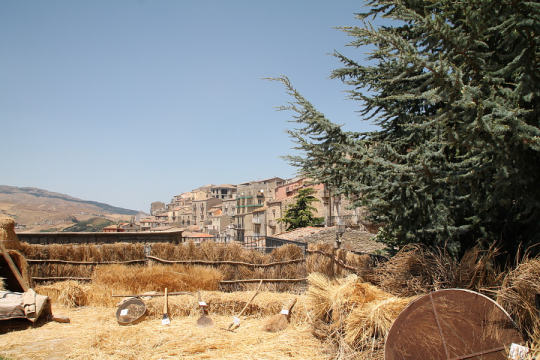
    A small town in Sicily called Gangi is in the midst of a novel urban renewal experiment. They are giving away houses for free to people who will agree to renovate them within a 4 year time period.

    Here’s the “free houses” notice from the Comune Di Gangi explaining how it works and who to contact. You have to be an Italian or EU citizen to participate.

    Free can be a powerful business model, as we see all the time with tech companies. And sometimes cities and towns aren’t all that different.

    So if you’re looking for a vacation home or want to move to Sicily, now might be a great time.

  • Saturday morning bike ride to the Bluffs

    This morning I got up at 7:30am and met a good friend of mine at the St. Lawrence Market for breakfast.

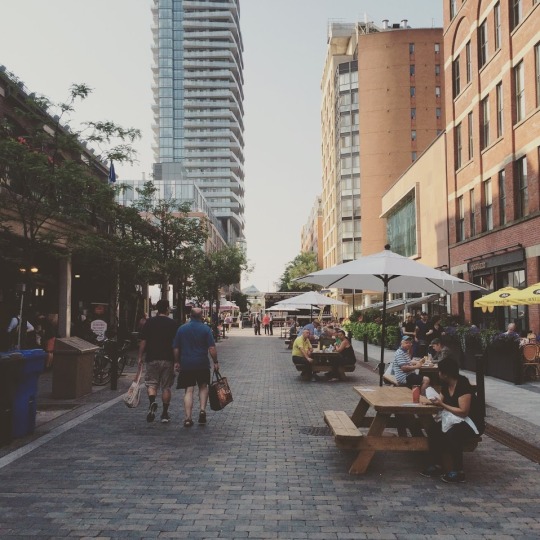
    Market Street is closed to cars today so it’s pedestrian-only. It should be this way all the time. They had a pig roasting on a spit when I walked by and a big stage set up. 

    Below is a photo of what it looks like. Keep in mind that this photo was taken just after 8:00am, which is why it’s not all that busy, yet.

    image

    When Market Street was redone a few years ago, the original vision for the street was for it to be pedestrian-only. But somebody told me that the city didn’t want that. Too bad. It strikes me as a perfect candidate for that.

    After breakfast, we then biked out to the Scarborough Bluffs in the east end of the city. If you click here, you can see the path we took via Strava. It’s only about 15km from downtown. The ride through the Beaches was by far the best stretch. The water was on my right hand side. The pavement was smooth and continuous. And I had George FitzGerald on my headphones for pacing.

    When we got there, this was the view we were presented with:

    image

    It honestly doesn’t feel like Toronto. The water is turquoise and there’s a beautiful beach at the bottom of the cliffs. It felt like paradise.

    If you’ve never been to the Scarborough Bluffs, do yourself a favor and get out there on a beautiful summer day. It’s the dog days of summer and Toronto is a magical place right now.

  • Formula for life

    https://500px.com/embed.js

    Earlier this week I somehow stumbled on an old (2012) Medium story by Ev Williams, called, Formula for Entrepreneurial Success. (Ev is the cofounder of Medium, Twitter, and Blogger. He basically invented blogging.)

    His post includes 5 short recommendations, and is obviously aimed at entrepreneurs, but I think the lessons also apply more broadly to life in general. They resonated with me, so I thought they might also resonate with you.

    So whether you’re starting a company, developing a new building, or just living life, here are Ev’s 5 points:

    1. Work with amazing people. Don’t compromise on who you choose to found your company with and hire. Do not put up with ego-centric personalities or downer attitudes.

    2. Take on big challenges. It’s pretty simple: Hard things are valuable; easy things are not so valuable. Reaching the mountaintop is rewarding because it is hard. If it was easy, everybody would do it.

    3. Focus. Say no to most things: Features. People. Partnerships. “Coffees.” Projects. Only a few of them really matter. (Yes, it’s hard to know which.) Don’t get distracted.

    4. Take care of yourself. When you don’t sleep, eat crap, don’t exercise, and are living off adrenaline for too long, your performance suffers. Your decisions suffer. Your company suffers.

    5. Love those close to you. Failure of your company is not failure in life. Failure in your relationships is.

    If I had to pick one of the items from this list, I’d say I struggle the most with focus. It’s not that I can’t focus and complete tasks, it’s that I’m the kind of person who wants to fill every second of the day with something meaningful. And when people email me wanting to go for coffee or help with something, I want to do it.

    But unfortunately, time is a hugely valuable commodity and you have to be selective.

    So surround yourself with amazing people. Don’t be afraid of big challenges and risks. Focus. Eat well and lift weights (my preference). And love the important people in your life.