Daily insights for city builders, delivered every morning at 6 AM ET. I’m Brandon Donnelly — a Toronto-based real estate developer and founder of Globizen. I’ve been writing here since 2013.

Tag: atc

  • Mega-cities vs. networked cities

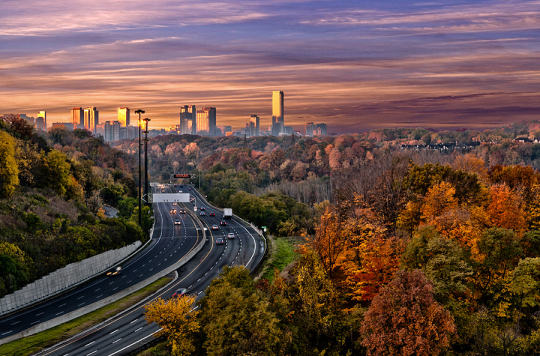
    Morning fog by Yijiang Wu on 500px.com

    https://500px.com/embed.js

    Ed Glaeser, Giacomo Ponzetto, and Yimei Zou recently published a new academic paper called, Urban Networks: Spreading the Flow of Goods, People and Ideas

    The paper looks at whether it’s more advantageous to build huge and consolidated mega-cities or build connected networks of smaller urban centers (perhaps connected by high speed rail). As countries like China rapidly urbanize, this is something that many people are thinking about.

    In China, there is a lively urban planning debate
    about whether to facilitate the increased expansion of the vast agglomerations of Beijing and
    Shanghai or whether to focus on creating networks of cities that are smaller, albeit still much
    larger than almost all of the cities of Western Europe. The current government policy favors
    networks, in the hope that connected smaller cities may be free of the extreme downsides of
    mass agglomeration, such as extreme congestion, pollution and high housing costs.

    Like most things, there are real trade-offs. 

    In the paper, they assume that larger cities lead to more urban amenities, which in turn serves as an important magnet for skilled workers. However, for unskilled workers who may not care/benefit from the same urban amenities, it is possible for them to dislike the bigger cities. In this case, the benefits do not outweigh the negatives of urban expansion and an urban divide is created (rich/poor).

    One of the potential negatives is housing.

    The attraction of denser, not larger, mega-cities is determined also by the elasticity of
    housing supply. When it is easy to add extra homes on a narrow plot of land, as in Texas,
    then density becomes more attractive. European urban networks may well be the right
    answer because history and regulation makes it so hard to build in Europe’s older cities.
    Even though China has usually been quite friendly towards skyscrapers, the sheer scale of
    the Chinese population may still make the case for urban networks.

    If you’re interested in this topic, there’s a section (#2) in the paper on the history of urban networks that you might like.

  • Vancouver never plays itself

    There’s something powerful about seeing/hearing cities being depicted in film, TV, and other kinds of pop culture. It creates familiarity and does a lot to drive the brand of that place.

    But how often are you just seeing one city disguised to look like another? Actually quite often.

    Here’s an interesting video that talks about how the 3rd largest film production city in North America never actually plays itself.

    [youtube https://www.youtube.com/watch?v=ojm74VGsZBU?rel=0&w=560&h=315]

    I know that there are real economic benefits to being a cheap place to film movies, but I would love to see Canadian cities play themselves. There are also big benefits to that.

    Thanks to Scott Bonjukian at The Urbanist for sharing the above video this morning.

  • From map books to Google Maps

    When I was a kid I remember my parents having something called a “Perly’s” in their car. It was basically a map book and it was the best thing around. 

    You would start by looking at a big grid of the city and then you’d find the specific area you were looking for and then flip to that page. If you were on the road a lot for work, a Perly’s was a mandatory addition to your car.

    Things have obviously come a long way since then. It could take you a long time to find the street you were looking for in a Perly’s. I remember doing that from the passenger seat. Now our phones do that for us and if the connection makes us wait for more than few seconds, we get irritated.

    But we’ve also moved beyond just static maps. 

    The other morning I was driving out to the suburbs and I saw this road sign telling me that – given current traffic conditions – it was going to take me 15 minutes to get to HWY 427. 

    image

    Have you ever wondered how they come up with those time estimates?

    There are a few ways to do it. But here in Toronto along the Gardiner Expressway and Lake Shore Boulevard it’s done using your mobile phone. Phones have unique network identifiers called MAC addresses. And when they try and connect via Bluetooth or Wifi they actually send out their MAC address.

    So what happens as you’re driving along is that your phone’s MAC address is being picked up at various locations. And since the distance between these various reception points is known, it’s pretty easy to determine how fast you’re traveling. That’s how they come up with those time/traffic estimates. 

    This data is anonymous but, in theory, the city also knows if people are speeding when the traffic is light.

    This same technology is being used by many retailers and shopping malls to track how people move through their spaces. It’s used to see, among other things, which merchandising strategies are working and what synergies one might be creating (or not creating) with the tenant mix.

    But getting back to traffic, there are obviously ways to collect traffic data without any additional physical infrastructure.

    As I was about to leave the suburbs and head back downtown, my phone somehow knew I was about to do that (perhaps because I was stopped at a Starbucks near the highway) and so it decided to tell me this:

    image

    It wasn’t the best notification to receive on my phone, but I was impressed nonetheless. This traffic data is collected using GPS data transmitted from mobile phones using Google Maps, Apple Maps, and so on. Clearly we’ve come a long way since the days of manually leafing through a thick Perly’s.

    At the same time, it feels like we are still pretty far away from solving the problem of urban congestion. Every big city in the world is grappling with this issue

    Part of the problem, I think, is the belief that there’s some sort of silver bullet – more highways, a magic smartphone app, and so on – that will enable everyone to be able to drive around in their own car by themselves. I don’t believe that’s possible in big cities. And the sooner we get away from that toxic thinking, the quicker we’ll solve this problem.

  • Is venture-based real estate development coming to the Bay Area?

    Golden Gate Bridge by Mariusz Blach on 500px.com

    https://500px.com/embed.js

    Chamath
    Palihapitiya
    is a Sri Lanka born, Canada educated, venture capitalist in
    Silicon Valley, who made a boatload of money as one of the early employees of
    Facebook. He now runs a VC firm called Social +
    Capital
     and owns part of the Golden State Warriors.

    The other
    night he was interviewed at a StrictlyVC event in San Francisco and I think
    that many of his comments would also be of real interest to the Architect This City
    community. He’s super passionate in interviews and always fun to listen to.

    Below is what
    he had to say about the San Francisco startup scene. It really speaks volumes
    about what people will put up with in order to live in an awesome place/city that they love. All of his responses below are from this
    TechCrunch article
    .

    “The city has to be doing more, around
    transportation, around housing… You have to get rid of the nimbyism and you
    need to quadruple, if not quintuple, the amount of housing. You need to tell
    that engineer from the University of Michigan that he can live here on a salary
    of $80,000.

    [In the meantime], we look at our startups, and
    the minute that they start to spend more than 15 percent of their burn – good
    money that we give them – on rent, a huge red flag goes up. When they, on a
    per-head-count basis, are spending so much, we start looking at the
    productivity of the technical team. And if it’s good but not great and they’re
    spending this insane amount of money [versus] a different team in Redwood City,
    we start to ask ourselves: “Are you so convinced that success is going to
    happen in this city at 1.5x the cost?”

    Because for every dollar that someone in
    Mountain View or Redwood City is raising, you [in San Francisco] have to raise
    one-and-a-half to two times that just to get to the same point. So you’re cutting
    your half life in half. To prove that you can take an Uber from some fuckin’
    shitty bar to another shitty bar? Like, I don’t understand.”

    And here he
    talks about the possibility of his venture firm also getting into the real
    estate development business. I couldn’t resist blogging about this.

    “We made a big
    decision with our last fund to build an organization that looks really
    different than a venture firm, and that organization is going to be this
    hybrid, bastard stepchild of Berkshire Hathaway and Blackstone and BlackRock.

    What I mean by this is
    that we want to have a large permanent capital base and we want to make really
    long, discontinuous bets on companies and sectors and trends.

    And one of the things
    we talked about was having a real estate fund …[because] we owe it to our
    companies to alleviate some of these problems when no one else is going to. If
    we went and built one million square feet somewhere of mixed use, where you
    work and live, and we rethink what it means to have a modular living environment
    for a millennial cohort that wants to work at companies and doesn’t necessarily
    have kids, we can do that in a way and give that back to our CEOs as a benefit
    of working with us.

    And you can probably
    make the economics work. Because we only really care about the equity of the
    company anyways. And the equity in the real estate will take care of itself if
    you take the 30-year view. So we’re at the point now where we’re like, wow, we
    should raise a few billion dollars and get into the real estate business and
    solve this problem systematically for our companies. And maybe in that, it
    becomes a blueprint for how others should do it. We’re just basically going to
    act as our own city-state and decide how to do it ourselves.”

    It’s
    interesting to think about what the economics might look like if your primary goal is
    simply to provide space to your portfolio companies (entrepreneurs) so that
    they get more (financial) runway and, therefore, have a greater chance of success. I’d love to see that pro forma.

  • NXT City Night 2015

    I just got
    my tickets for NXT City Night,
    happening Thursday, September 24, 2015 at 6:30pm here in downtown Toronto.

    If you’re
    not familiar with NXT City Prize, it’s an annual urban design competition where
    young Canadians (35 years of age or younger) submit ideas to improve the built
    environment. The top submissions win a total of $9,000 in prize money and the winning idea
    gets paired up with the City of Toronto work on actually implementing it. That’s
    the best part.

    The 2015
    finalists have already been announced, here, but the top submissions
    will be announced at NXT City Night. The Chief Planner of Toronto, Jennifer
    Keesmaat
    , will be there, along with the
    competition’s very impressive jury
    .

    I think it’s
    important to keep in mind that a lot of what makes cities great often happens
    through citizen-led grassroots movements.

    The
    High Line in New York
    – which today attracts over 5 million visitors a year
    and is believed to be responsible for over $2.2 billion in new economic
    activity – was really the work of 2 friends who thought that preserving and
    repurposing the High Line was a cool idea. Which is why in 1999 they founded a
    non-profit called Friends of the High line. Amazing things happen when people and
    passion get involved.

    So I would
    encourage you to grab a ticket and join me at NXT City Night next week. Tickets are
    $25, but if you use the coupon code ATHISCITY,
    you’ll get $5 off your ticket 🙂

    The event is
    also taking place in a spectacular old warehouse building at 56 Maud Street
    (formerly St. Andrew’s Market Hall). That alone is reason enough to come. I’ve been inside before. Get your Instagram ready. But
    if that’s not enough, there’s also:

    • Open bar including Steam Whistle beer and Pillitteri Estate wine
    • Catering from Oyster Boy, Kanpai Snack Bar, Thoroughbred and many more
    • Art installations by Wayward Collective
    • Beats by Jesse Futerman and A Digital Needle
    • Local wares from GetFresh, Shopify, Spacing Store and Swipe

    I hope to see
    you there. Make sure to tweet at me
    if you’ll be there so we can connect in person.

  • How to save 8 minutes on Toronto’s highways

    City in Colour by Greg Patterson on 500px.com

    https://500px.com/embed.js

    Three months ago when Toronto City Council voted
    not to remove the Gardiner Expressway
    East (which in
    my view was a mistake
    ), it did so with a commitment to look at tolling
    options for both the Gardiner Expressway and the Don Valley Parkway (which in
    my view is a positive thing
    ).

    Last week a preliminary report was released
    discussing some of those tolling options. If reading dry city reports is your thing,
    you can do that here.

    The Coles Notes version (CliffNotes for you
    Americans) is that a $3 flat toll on both the Gardiner and the DVP – the same
    cost as riding transit in this city – would be expected to reduce vehicles on the highways by 9% and 12%, as well reduce end-to-end travel times by 3 minutes and 5
    minutes, respectively. There’s obviously a lot more in the report, but these
    figures stood out for me.

    Given how monumental the
    3 minute delay
    was in the Gardiner East debates, it will be interesting to
    see whether people treat a 3 minute time savings in a similar way. I suspect
    they won’t. The cost will be the larger issue.

    I’ve been a
    vocal supporter of tolls and road pricing on this blog
    . One of the main reasons
    for that is because I view the demand for highways as being largely inelastic
    and therefore a potentially great source of transit funding.

    The discouraging part of the above report is
    that its primary goal is to explore tolls for the purpose of “offsetting
    capital, operating, and maintenance costs.” The primary goal is not to come up
    with sustainable sources of transit funding.

    Having these costs paid for by user-fees as
    opposed to general taxes is still a good thing in my view. But an even better thing
    would be to help fund mobility solutions that we know will be far more
    effective at getting people around this region as millions more people move here
    in the coming decades.

    The other discouraging part of the report is
    that near the end it explains that while the City of Toronto Act of 2006 allows
    for toll highways, they cannot be implemented without the Province passing
    regulation.

    It’s a reminder that our governance structures do
    not reflect the current urban reality of this country.

  • The crisis of success

    I’m back and it feels great. I missed blogging the past 2 days. Though, there was something nice about not touching a computer all weekend.

    This morning I got up extra early and listened to a brief conversation between Aaron M. Renn of The Urbanophile and urbanist Richard Florida. The topic is New York’s “Great Reset”, and the impetus was a recent report (of the same name) that was put out by New York University.

    The conversation starts by talking about the resilience of New York City and its ability to accept and then reinvent itself in the wake of “creative destruction.” Destruction such as the financial crisis of 2008/2009. 

    But they then go on to talk about the challenges that New York, as well as many other cities, are now facing. Challenges brought about, not by failure, but by their tremendous success. Challenges such as income inequality and the dwindling middle class.

    The overarching premise is that we are still in the early stages of a new urban and creative economy. And that there’s lots of work to be done in order to figure out how to make it an inclusive one.

    There’s even mention of former Toronto mayor, Rob Ford.

    You can listen to the talk below. If you can’t see the embedded play button, click here.

    [soundcloud url=”https://api.soundcloud.com/tracks/221338706″ params=”color=ff5500″ width=”100%” height=”166″ iframe=”true” /]

  • Resting my eyes

    Today I’m getting laser eye surgery. (If you’re reading this via email subscription, it already happened!)

    This is something I’ve been thinking about doing for many many years. My original plan was to get it done after I finished my MBA. But that time came and went, and so it was about time I took action.

    I’ve always been a bit nervous about doing it, which is why I’ve been procrastinating. I’m an early adopter when it comes to most things in life, but not when it comes to this. Not when it comes to my eyes.

    The major impetus for getting it done is sports. I love lifting weights. I love cycling. I love snowboarding. And I love swimming. All of these things are easier to do when you don’t have to fuss around with contacts. I’m quite nearsighted.

    In any case, I’m going to be taking the weekend off from blogging. I have never done that in the over 2 years that I’ve been writing Architect This City, but this time is different. I need to give my eyes a rest. Doctors orders.

    For this reason, yesterday’s post on affordable housing was a bit longer than usual. And if you’re looking for more to read, you can also check out this list of most popular posts.

    Regular scheduled programming will resume on Monday, which means that if you’re a daily email subscriber, you won’t receive another email from me until Tuesday morning at 6am Toronto time.

    I hope you have a great weekend. See you on Monday 🙂

  • Affordable housing and the economics behind developing new rental apartments

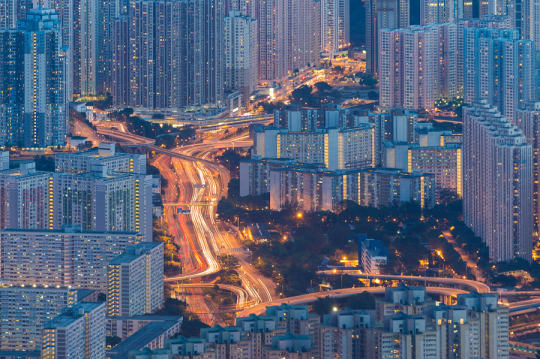
    light trail in concrete jungle by Tassapon Vongkittipong on 500px.com

    https://500px.com/embed.js

    In most big cities around the world, there is a pressing need for more affordable housing. We know that inclusive cities make for better cities. But from San Francisco to Hong Kong, you always hear people talking about how expensive housing is.

    So why is this such a difficult problem to solve?

    Part of the problem, I think, is that many people don’t understand the economics behind building a new building. Oftentimes I hear people say that because developers make so much money, they should just build more affordable housing. Done. Simple.

    But things are not that simple.

    To illustrate my point, let’s walk through the thought process for developing a new rental apartment building.

    In its simplest form, developers are concerned with: revenue – costs = profit. And since many of the costs associated with building a new building just are what they are, it all starts with revenue, which in our case would be rents.

    To build a new rental tower in Toronto, your rents typically need to be at least in the high $2′s per square foot per month. Otherwise the economics don’t work. But to make the math simple, let’s say you need $3 per square foot in rent. That means a 1,000 sf apartment would rent for $3,000 per month.

    That’s not cheap. There are only so many people who can afford these kinds of rents and only so many areas where you can command these kinds of rents, which means there are only so many areas in Toronto where new rental apartments will be built by the private sector.

    If the rents instead happen to be $2 psf – meaning that same 1,000 sf apartment now rents for $2,000 per month – then for-profit developers will not build (barring any unique deal circumstances). Even at $2.50 psf / $2,500 per month, it would be difficult to make the numbers work here.

    And by the numbers, I am talking about tight returns that really only start to make sense in our environment of record low interest rates. Which means that when interest rates start to rise (pushing cap rates up), it may not even make sense to build rental apartments when the rents are in the high $2′s per square foot. This is particularly true if you’re competing against condo developers to buy the land. They can afford to pay more. 

    In this scenario (of rising interest rates), many real estate firms might simply opt to buy existing assets instead of taking on the risk of building anything new. Now all of a sudden your supply of new market rate apartments (not to mention affordable apartments) has dried up. Remember, it’s been decades since Toronto built rental apartments at any sort of meaningful scale.

    It’s for reasons like this that Vancouver launched a program called Rental 100. In a nutshell, it helps to reduce the “costs” variable in the equation mentioned above so that developers are able to meet minimum project returns and build more rental buildings. They do that through things such as reduced parking requirements, additional density, development charge waivers, and so on.

    In some ways, these items are subsidies. The city is giving up revenue that it could have otherwise collected from a developer building, say, a condo. But in other ways, they are freebies. The city could be unlocking development sites that may have otherwise not been developed. In which case it’s not really forgone revenue.

    Vancouver’s Rental 100 program is a market rental housing policy. But there’s no reason that similar thinking couldn’t be applied to create an affordable rental housing policy. It has been done and is being done in many cities.

  • Where will we live?

    image

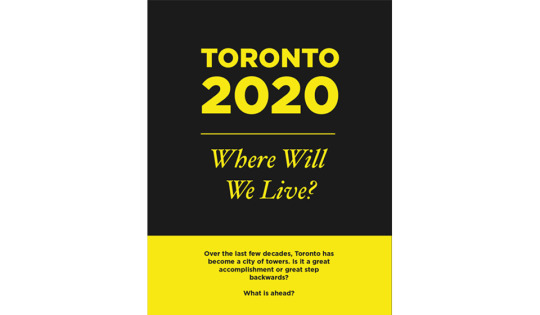
    This evening I participated in a roundtable discussion at WORKshop here in Toronto. It was part of an exhibition that they currently have on called, Toronto 2020: Where Will We Live? They are located in the concourse level of 80 Bloor Street West, so go check them out.

    The discussion this evening was all about the dramatic change in Toronto’s urban form over the last decade. In other words, the condo boom. We covered everything from the life cycle of buildings and urban design to demographics and policy. It was a lot of fun and I am certain the group could have continued talking all night.

    But one thing that I was reminded of this evening is how important it is for great city building to be cross-disciplinary.

    Take, for example, architects and (real estate) developers. 

    The stereotypical developer is greedy and only concerned with money. They don’t care about the impact that their buildings have on the built environment. On the other hand, the stereotypical architect is only concerned with design and not with the economic feasibility of projects. (I’m exaggerating here for effect.)

    The point is that neither of these participants in isolation could build a great city. A beautiful design doesn’t have much value if it can’t be financed and built. And a highly financeable project could end up contributing nothing to the city. In some cases it could actually detract from the built environment.

    So if we really want to build truly great cities, I believe it needs to be a collaborative effort. We need to bridge the divides in thinking and leverage each other’s strengths. 

    I have felt very strongly about this since I first started studying architecture as an undergraduate student, which is how I ended up taking business and real estate classes. I felt and continue to feel that the greatest opportunities exist at the intersection of different ways of thinking.