Daily insights for city builders, delivered every morning at 6 AM ET. I’m Brandon Donnelly — a Toronto-based real estate developer and founder of Globizen. I’ve been writing here since 2013.

Tag: artists

  • Drip, subscription platform for artists and creators

    image

    Kickstarter has just relaunched a subscription service for artists and creators called Drip. It is an acquisition that Kickstarter made a few years ago and so that’s why it’s a relaunchHere is the blog post announcement.

    The simplest way to describe Drip is as follows: “Kickstarter is for projects, Drip is for people.” In other words, instead of backing a specific project, you back the human for, say, $10 a month. It’s a tool for people to fund creators so that they have the freedom to make their work.

    Now compare this model to that of the 19th century Salon in Paris. Arguably the greatest art event in the Western world during its prime, getting exhibited at the Salon was basically a right of passage for artists.

    But the Salon had specific criteria for what it considered to be good and acceptable art. Perhaps most famously, 19th century Impressionism – which some would call the first truly modern art movement in painting – was not considered acceptable.

    The Impressionists routinely had their work refused by the Salon, which is why they ended up having to organize their own shows. Good for them.

    So when I see something like Drip, I think about how amazing it is that we now have platforms where artists and creators have the freedom to make what they want to make and the market – instead of a stuffy institution – can decide what is good and worth supporting. 

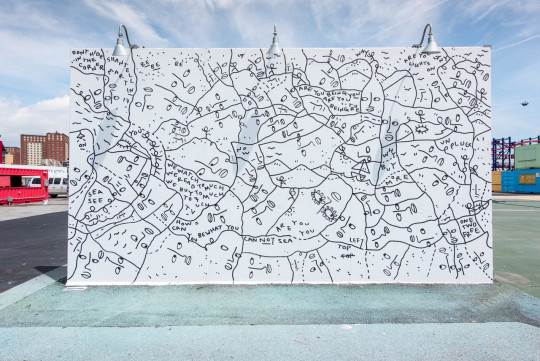
    Check out Shantell Martin if you’re looking to explore Drip. I recently discovered her work and I’m a fan.
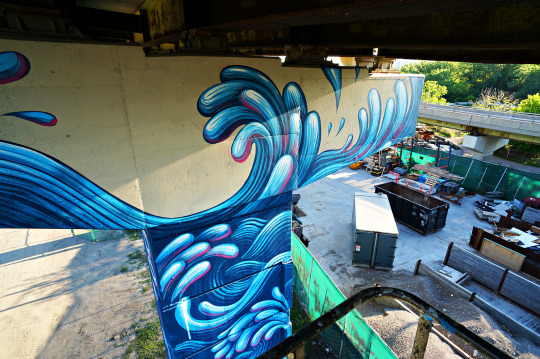
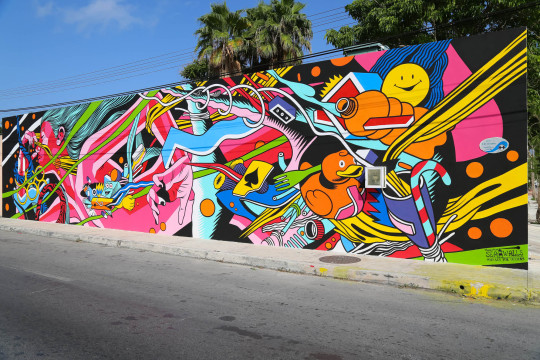
    Image: Coney Art Walls by Shantell Martin

  • A Love Letter to the Great Lakes

    This week, the first ever international street art festival will be taking place in Toronto. It’s called A Love Letter to the Great Lakes and it is running from June 20 to June 25, 2016.

    The goal of the festival is to use public works of art to get people thinking about our water resources and, more specifically, about the Great Lakes. Together, these Lakes represent 20% of the world’s fresh surface water.

    So this week, 21 local and international artists will be painting giant murals in 3 different areas of the city: Queen & Ossington, Queen & Spadina, and at the mouth of the Don River.

    The collaborators for the event include Tre Packard (Pangeaseed Foundation), Jason Botkin (A Love Letter to the Great Lakes, En Masse), Jaqueline West (Herman & Audrey), developer Jeff Hull (Hullmark) and Devon Ostrum (Friends of the Pan Am).

    Below is one of the works already in progress. It’s by Jason Botkin and it’s located on one of the bents of the Gardiner Expressway East at the mouth of the Don River.

    image

    This event caught my attention for 3 reasons.

    First, I think the city is going to be left with some rad looking murals. Here is one from a similar event in Cozumel, Mexico called Sea Walls: Murals for Oceans in Cozumel:

    image

    Second, like many others, I care deeply about the environment. But until we put in place the right economic incentives / disincentives, we need all the awareness building that we can get.

    Third, seeing Jeff Hull on the list of collaborators reminded me that there’s a new breed of real estate developers emerging in our cities. The big bad developer is sometimes (often?) thought to be greedy and insensitive to local communities. But I think the next generation sees itself quite differently. They see themselves more as city and community builders.

    So if you’re in Toronto this week, get on your bike and head over to one or more of the mural sites. Tweet me if you decide to go and maybe we can connect.

  • Hidden gems in the Tenderloin

    I’ve written about the Tenderloin neighborhood in San Francisco before. It’s an infamous neighborhood in the center of the city that has for decades resisted gentrification (which was the topic of my post).

    But as the technology sector continues to urbanize, many fear that it’s only a matter of time before it does eventually gentrify. A new nickname has even emerged for the neighborhood: the Twitterloin.

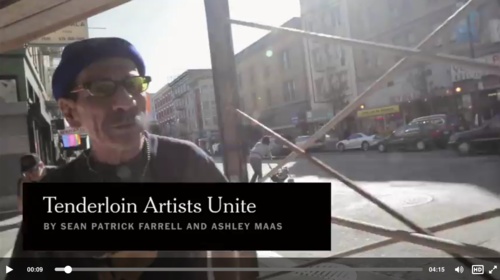
    However, a local nonprofit called the Wildflowers Institute is trying to ensure that gentrification doesn’t erase the cultural assets currently housed in the neighborhood. Through a project called “Hidden Gems”, the group is literally knocking on doors to find active artists within the community (many of whom live in single rooms) and then supporting them through fellowship programs and other investments.

    What’s fascinating about their approach is that they are actively seeking out the informal activities taking place within the community – activities that would otherwise be hidden and then potentially lost. Once discovered, they then do a number of mapping exercises to keep track of this data.

    As somebody who believes city building will become a lot more data driven in the future, I think this is a really interesting initiative. And as gentrification pressures continue to increase in San Francisco, I’m sure this information will help guide the discussions. You can’t account for something you don’t know exists.

    If you’d like to learn more about this initiative, check out this short 4 minute video from the New York Times. I would then love to hear from you in the comment section below.

  • Spectrum of Hope

    image

    Built in the late 1940s, Regent Park was Canada’s first and largest social (public) housing project. Like many housing projects of this era, it was modeled after Le Corbusier’s “towers in a park” ideology, though in this case most of the buildings were only a few storeys tall and hardly towers. 

    It was built to correct what had become a major slum on the east side of downtown Toronto. And like many cities around the world, this type of built form was viewed as the solution. Urban slums were crowded and dirty. Density was bad. The solution was to spread people out and surround them with green space.

    But that didn’t work out so well. Regent Park failed. So today we are once again starting again. Phase by phase, the old is being demolished and the new is being built. However, unlike the last time, I think this time it’ll be for the better

    But there’s something very ironic about this story.

    Before Regent Park became Regent Park, it was called something else: Cabbagetown. That neighborhood of course still exists in Toronto – it’s adjacent to Regent Park – but it’s now a bit smaller having given up a portion of its land to the first iteration of Regent Park.

    Today, what remains of Cabbagetown has become an affluent and desirable inner city neighborhood with, allegedly, the largest stock of Victorian housing in North America. But of course it wasn’t always that way. At the time that Regent Park was being conceived, Cabbagetown was a slum. And that’s why we built Regent Park version 1.0. It was the solution for this entire section of the city.

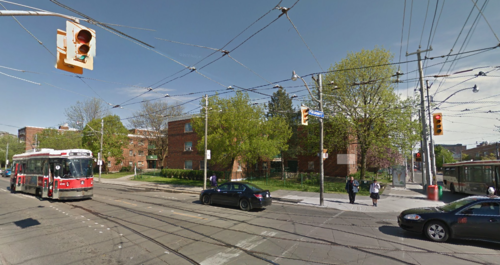
    The photo at the top of this post is the southeast corner of Gerrard Street East and Parliament Street. The building at the corner is the Hotel Gerrard. The photo is from 1919, which means it’s a photo of Regent Park when it was still called Cabbagetown. It’s part of what we demolished to make way for the new. 

    In 2013, that same corner looked like this:

    image

    What’s ironic about all of this, is that the area we spared from grandiose urban renewal plans actually became the richest part. And where we intervened is where things got screwed up. So much so that we’re now starting entirely from scratch, again. All of this just makes wonder whether Cabbagetown, in its entirety, would have ultimately taken care of itself had we just left it alone. 

    But what’s in the past is in the past.

    So to end on a positive note, I’d like to share a short video that somebody recently shared with me called Spectrum of Hope. It was co-directed by 7 young artists from the neighborhood who are calling it “a piece for Regent Park, by Regent Park.”

    //player.vimeo.com/video/106104994?color=ff9933

    Spectrum of Hope from Twice Upon a Time – Toronto/NYC on Vimeo.

    I think it’s a great example of the positive momentum developing in this neighborhood. I hope you’ll give it a watch and then share it around. Click here if you can’t see the video above.

  • In your place

    image

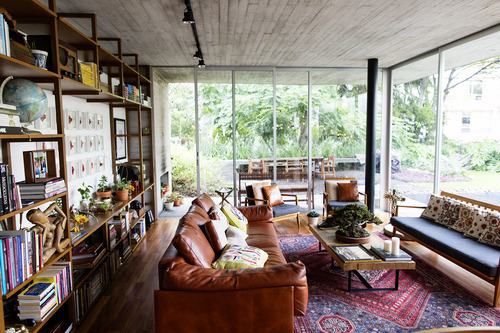
    Ever since I was a kid, I’ve always enjoyed seeing people’s places. I like seeing different homes and I like seeing how people decorate them. Which is why I’m a big fan of photographer Todd Selby’s project, The Selby Is In Your Place

    Starting in June 2008, Selby has gone around and photographed the personal spaces of creative people all around the world–everyone from fashion designers to artists to entrepreneurs. The most recent is the home of Carolina Castiglioni, who is Director of Special Projects at Marni in Milan.

    image

    The project has been a huge success for Todd and his website now receives over 100,000 unique visitors a day. He’s also gone on to publish 3 books. The first was simply called ‘The Selby is In Your Place’. If you’d like to pickup a copy for your coffee table, you can do so here.

  • New ideas need old buildings

    In reading a recent Financial Times article called, Are creative people the key to city regeneration?, I was reminded of a famous line from the late urbanist Jane Jacobs: “New ideas need old buildings.” What she meant by that is the following:

    Cities need old buildings so badly it is probably impossible for vigorous streets and districts to grow without them…. for really new ideas of any kind—no matter how ultimately profitable or otherwise successful some of them might prove to be—there is no leeway for such chancy trial, error and experimentation in the high-overhead economy of new construction. Old ideas can sometimes use new buildings. New ideas must use old buildings.

    And what she was effectively getting at is that we live in a world obsessed with historical data and precedence. To use the words of business thinker Roger Martin: “The enemy of innovation is the phrase ‘prove it.’” Because, if it’s never been done before, how can you prove it? You can certainly imagine it. But you can’t prove it.

    If you’re in the business of building buildings, convincing your lender to give you the money to build something that’s never been done before, is an almost impossible sell. That’s not the way it works. Which is why Jane Jacobs famously said that “new ideas need old buildings.”

    We’ve seen this story play out in countless cities around the world. The creatives move into an scuzzy neighborhood, make it cool and then investment follows. The neighborhood has been proven. But for this cycle to continue, we need a continuous stock of derelict buildings and undesirable neighborhoods, or at least areas that offer the same kind of affordability and flexibility to creative entrepreneurs.

    Often these circumstances have been the result of failure. The proven ideas that got the buildings built in the first place became no longer relevant. And so the buildings were left to expire. But in many global cities, these kinds of areas are an endangered specifies. However, it’s in our best interest to make sure that we don’t lose our creativity alongside them.