
Daily insights for city builders, delivered every morning at 6 AM ET. I’m Brandon Donnelly — a Toronto-based real estate developer and founder of Globizen. I’ve been writing here since 2013.

Tag: artificial intelligence

  • Uber and Waymo announce exclusive partnership in Austin and Atlanta

    Waymo and Uber just announced a partnership that will bring Waymo’s autonomous vehicles to the Uber app in Austin and Atlanta. Notably, this is an exclusive partnership, meaning the only way you’ll be able to summon a Waymo vehicle in these cities will be through Uber.

    The people who follow this space closely, people like Reilly Brennan of Trucks (VC) and Harry Campbell (The Rideshare Guy), think this is a really big deal for a number of reasons.

    One, it signals a bifurcation in the industry where there will be companies, like Waymo, that supply autonomous vehicles, and companies, like Uber, that operate them and manage the overall ride hailing marketplace. As part of this deal, Uber is going to handle all of the maintenance and cleaning of the vehicles. This split is similar to the airline industry.

    Two, it suggests, and this is Harry’s argument, that Waymo needs Uber more than Uber needs Waymo. One of the reasons for this is that a 100% AV fleet is simply too expensive to operate if you’re solving for peak demand loads. Because during off-peak times, you then need to pay for downtime.

    Uber, on the other hand, doesn’t pay for downtime with its human drivers. Most of its drivers are part-time and only plug in when they want to or when the surge pricing becomes too attractive to pass up. So they’re the perfect compliment to an AV fleet. Harry argues that this is part of Uber’s competitive moat.

    And three, it signals that AVs are really starting to arrive, if not already here. The hype cycle certainly hit its trough of disillusionment and everyone switched to thinking that AVs weren’t going to happen for many years, if not decades. But now it’s happening. City by city.

  • Why construction productivity lags other sectors of the economy

    Construction is an essential sector of the economy, responsible for building and maintaining the physical infrastructure that underpins our society. However, it’s no secret that construction productivity lags behind other sectors of the economy, such as manufacturing and information technology. So why is this the case?

    One of the main reasons for the productivity gap is the unique nature of the construction industry. Unlike other sectors, construction projects are often one-off, bespoke endeavors, making it challenging to achieve the economies of scale that are typical of manufacturing or technology. Each project requires a different set of skills, tools, and materials, which can be costly and time-consuming to source and manage. This leads to a lack of standardization and efficiency, which can hinder productivity.

    Another factor that contributes to low productivity in construction is the reliance on manual labor. Despite the increasing use of technology and automation, much of the work in construction still relies on physical labor, which is subject to human limitations and the potential for errors. This can result in delays, rework, and additional costs, all of which impact productivity.

    Moreover, the construction industry faces challenges in terms of supply chain management and workforce development. The industry relies heavily on a complex network of suppliers, subcontractors, and laborers, all of whom must be coordinated and managed effectively. This can be difficult, particularly in light of the current labor shortage and skills gap in the industry.

    To address these challenges, the construction industry needs to embrace innovation and new technologies to improve efficiency, standardize processes, and reduce waste. There is also a need to invest in workforce development and training to upskill the existing workforce and attract new talent to the industry.

    In conclusion, the construction industry faces unique challenges that make it challenging to achieve the productivity gains that are typical of other sectors. However, with the right investments in technology, training, and process improvement, the industry can overcome these challenges and continue to build the infrastructure that our society relies on.


    Maybe you didn’t notice. But if the above doesn’t sound like me and my writing, it’s because today’s blog post is brought to you by ChatGPT (AI). The prompt I used was, “write a short blog post about why construction productivity lags other sectors of the economy.”

    On some level, it’s unsettling that AI can now, almost instantaneously, spit out a blog post like this. It would now be pretty easy to set up a daily blog, like this one here, and use ChatGPT to populate it each day.

    But of course, while that might be interesting initially, it would quickly become a banal baseline. Anyone and everyone could copy what you’re doing. AI is going to change a lot. But our jobs remain the same: find new ways to create value and be remarkable.

  • The artificial intelligence bias

    Machine learning is one of the most important trends in tech right now. But like anything new, it naturally raises a number of important questions and concerns. Benedict Evan’s most recent blog post provides a good explanation of what he refers to as the artificial intelligence bias. Here are a couple of excerpts that I found interesting.

    What machine learning does:

    With machine learning, we don’t use hand-written rules to recognise X or Y. Instead, we take a thousand examples of X and a thousand examples of Y, and we get the computer to build a model based on statistical analysis of those examples. Then we can give that model a new data point and it says, with a given degree of accuracy, whether it fits example set X or example set Y. Machine learning uses data to generate a model, rather than a human being writing the model. This produces startlingly good results, particularly for recognition or pattern-finding problems, and this is the reason why the whole tech industry is being remade around machine learning.

    The rub:

    However, there’s a catch. In the real world, your thousand (or hundred thousand, or million) examples of X and Y also contain A, B, J, L, O, R, and P. Those may not be evenly distributed, and they may be prominent enough that the system pays more attention to L and R than it does to X.

    What AI isn’t:

    I often think that the term ‘artificial intelligence’ is deeply unhelpful in conversations like this. It creates the largely false impression that we have actually created, well, intelligence – that we are somehow on a path to HAL 9000 or Skynet – towards something that actually understands. We aren’t.

    The conclusion:

    Hence, it is completely false to say that ‘AI is maths, so it cannot be biased’. But it is equally false to say that ML is ‘inherently biased’. ML finds patterns in data – what patterns depends on the data, and the data is up to us, and what we do with it is up to us. Machine learning is much better at doing certain things than people, just as a dog is much better at finding drugs than people, but you wouldn’t convict someone on a dog’s evidence. And dogs are much more intelligent than any machine learning.

    Photo by Ales Nesetril on Unsplash

  • Forum on Future Cities: Urban Intelligence

    MIT Senseable City Lab and the World Economic Forum’s Global Future Council on Cities and Urbanization are hosting a conference next month on the impact that artificial intelligence is having on our cities. Here is a summary of the event:

    As AI (Artificial Intelligence) becomes ubiquitous, it transforms many aspects of the environment we live in. In cities, AI is opening up a new era of an endlessly reconfigurable environment. Empowered by robust computers and elegant algorithms that can handle massive data sets, cities can make more informed decisions and create feedback loops between humans and the urban environment. It is what we call the raise of UI (urban intelligence).

    The 2019 Forum on Future Cities, organized by MIT Senseable City Lab and the World Economic Forum’s Global Future Council on Cities and Urbanization, will focus on four aspects of the UI transformation: autonomous vehicles, ubiquitous data collection, advanced data analytics, and governing innovation. Panelists include mayors, academics, senior industry leaders and members of civil society to explore such topics from different points of view, highlighting the scientific and technological challenges, the critical collective decisions we as a society will have to make, and the exciting possibilities ahead.

    The forum takes place on April 12th in Cambridge, Massachusetts. And since it looks to deal with many of the topics that we talk about on this blog, I figured that some of you might be interested in attending. If so, you can register here.

  • A moral compass for autonomous vehicles

    One of the challenges that self-driving vehicles present is not about technology per se, it is about ethics. The typical example scenario is this one: If a pedestrian were to step out in front of an autonomous vehicle illegally, should the car be programmed to hit the pedestrian or veer off the road at the risk of potentially harming its passengers?

    I believe that self-driving vehicles will ultimately result in fewer accidents. Statistically they will be safer. But self-driving vehicles, particularly early on, are going to get a lot of attention when they do get into accidents, even if they are still safer as a whole. And that’s because they will make for good headlines.

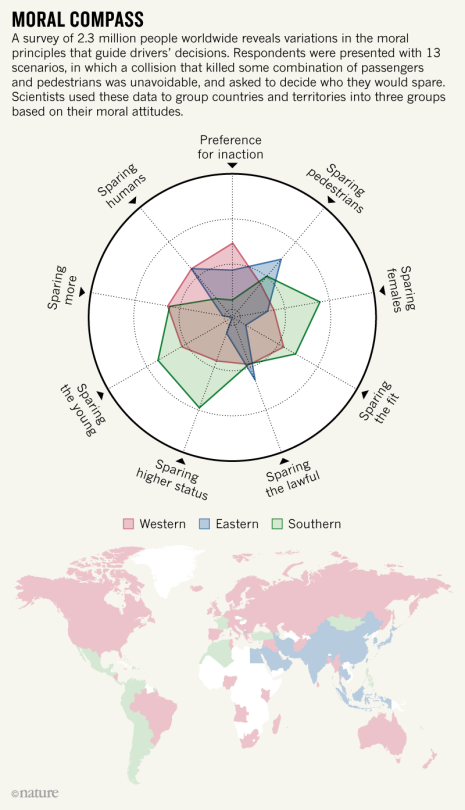
    Safety and statistics aside, in turns out that the answer to the above moral question could depend on where you’re from. Nature recently published what they are calling the largest ever survey of “machine ethics.” And out of this survey they discovered some pretty distinct regional variations across the 130 different countries that responded.

    The responses were able to be grouped into 3 main buckets: Western, Eastern, and Southern. Here is the moral compass that was published in Nature:

    And here are a few examples. In North America and in some European countries where Christianity has historically dominated, there was a preference to sacrifice older lives for younger ones. So that would guide how one might program the car for the case in which a pedestrian steps out in front.

    In countries with strong government institutions, such as Japan and Finland, people were more likely to say that the pedestrian – who, remember, stepped out onto the road illegally – should be hit. Whereas countries with a high level of income inequality, often chose to kill poorer people in order to save richer people. Colombia, for example, responded this way.

    Also interesting is the ethical paradox that this discussion raises. Throughout the survey, many people responded by saying that, in our example here, the pedestrian should be saved at the expense of the passengers. But they also responded by saying that they would never ever buy a car that would do this. Their safety comes first in the buying decision. And I can see that.

    There’s an argument that these are fairly low probability scenarios. I mean, the last time you swerved your car, you probably weren’t driving on the edge of a cliff where any deviation from the path meant you would tumble to your death. But I still think that these are infinitely interesting questions that will need to be answered. And perhaps the answer will depend on which city you’re in.

  • Are you challenging yourself personally?

    I’m not a huge believer in new year’s resolutions, as I much prefer the idea of continuous goal setting and improvement. But I like Mark Zuckerberg’s tradition of pursuing one “personal challenge” every year. One year it was to learn Mandarin. And this year it was to build a personal artificial intelligence tool. If you’re interested in AI, you can learn about the experience and his takeaways in this post.

    I am definitely interested in AI, but right now I’m actually thinking about his approach to personal challenges. This is a time of year when many of us are looking back at what we accomplished over the last 12 months and thinking about what we would like to accomplish in the next 12 months, as well as beyond. I know that I was doing some of that this past weekend. 

    I managed to check off many/most of the items on my 2016 list, but full disclosure: some of them are getting punted to 2017. I also modified certain items. I originally wanted BARED (Becoming A Real Estate Developer) to be a book, but instead it transformed into a new blog series. My most recent BARED post can be found, here.

    However, as I look back at all of the lists I’ve been making, I realize that virtually all of the goals are work related. They’re about completing this, growing that, and so on. That’s obviously important, but what about personal growth? Sure, one could argue that learning Mandarin is actually a prudent business move, but Zuckerberg claims to have been motivated more by personal reasons. And that’s great.

    So I’m revisiting my lists and thinking about ways in which I can challenge myself to grow not just as a professional, but also as a person. Right away, photography comes to mind as an obvious personal challenge, but I’d like to give it a bit more thought. If Mark Zuckerberg can find the time, then there’s no reason that you and I can’t as well.

    Do you have your own set of lists that you keep?