Daily insights for city builders, delivered every morning at 6 AM ET. I’m Brandon Donnelly — a Toronto-based real estate developer and founder of Globizen. I’ve been writing here since 2013.

Tag: art installation

  • AusterityTO

    I don’t know who is behind the guerrilla art project AusterityTO, but it is exceedingly clever. Whoever it is, they are going around Toronto and tagging various objects and moments with museum labels — all of which cite mayor John Tory as the artist. Here is one called “Urinal.”

    And here is the installation description from the website:

    A clever subversion of the seminal work “Fountain” by Marcel Duchamp. Water does not flow from this fountain due to neglected maintenance and lack of attention. It is a sculpture which asks the viewer to imagine what it could be, and to ponder why it isn’t. However, the artist’s title also challenges the viewer, much as Toronto challenges the citizen to find ways to make the most out of what we have: the washrooms are frequently locked, and perhaps this fountain can be repurposed for something else.

    There is growing frustration in Toronto around the quality of our public services and spaces. I can’t open Twitter these days without coming across at least one photo of a busted and/or overflowing garbage bin. And now these sorts of posts are all being tagged with #AusterityTO.

    Images: AusterityTO
  • BREAKFAST unveils Brixel Mirror

    BREAKFAST, a design and engineering studio out of Brooklyn, recently unveiled something that they call Brixels. 

    A Brixel is a variable-sized brick that is controlled by software and can act as a pixel in artwork, building facades, and other kinds of installations. 

    Below is a video of their first installation, called Brixel Mirror. It is a 19 foot wide by 6 foot tall installation compromised of 540 Brixels. If you can’t see it below, click here.

    [youtube https://www.youtube.com/watch?v=Z-5cVpWhp30&w=560&h=315]

    While extremely cool, you may be wondering how applicable this might be to real world uses. But kinetic architecture isn’t a foreign concept and I am sure we’ll be seeing more of it.

  • This river I step in is not the river I stand in

    image

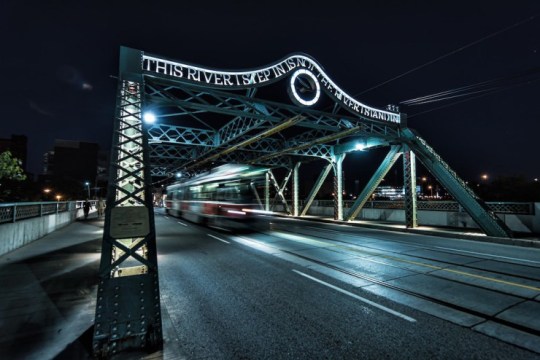
    I was over at the Riverside Bridge yesterday taking photos and I was reminded of Eldon Garnet’s installation called, TIME: AND A CLOCK (1995). 

    The work spans a few physical sites, but perhaps the most well known component is the line of text on the west side of the bridge, which reads in 18″ high letters: “This river I step in is not the river I stand in.” (Photo above from Garnet’s website.)

    If you’re from Toronto, you may be already be familiar with this installation. But I love the message and I think it’s an important one. So I thought I would reiterate it here on the blog. 

    The text is derived from the thinking of the Greek philosopher Heraclitus. Its meaning is a simple one: change is fundamental to the universe. 

    Neighborhoods change. Cities change. Industries change. We change. The river you first step into, is not the same river that you’ll be standing in. That initial river has come and gone, replaced by a new river. In the words of Heraclitus, “No man ever steps in the same river twice.”

    As people, organizations and cities age, there can be a tendency to resist change. I believe in fighting that tendency. 

    Because that’s how established rich companies get destroyed by young poor companies. They – the incumbents – underestimate the importance of change. They forget that the river is constantly flowing.

  • AMYGDALA — An installation that converts social media sentiment into audiovisual art

    It’s becoming harder and harder to think of tech as a distinct silo. Tech is embedding itself into so many traditional industries that, one day, every company will probably be a software/technology company in some regards. 

    It’s for this reason that I often think and write about tech and its impacts on the built environment.

    An interesting example of this phenomenon is a recent art installation by fuse* called AMYGDALA. What it does is translate collective social media sentiment (specifically from Twitter) into an audiovisual art installation housed within an urban space.

    Here’s how they describe the project:

    “The news and thoughts of users spread across social networks in real time. And so an event with worldwide implications immediately involves millions of people sharing their own opinions and emotions: happiness, anger, sadness, disgust, amazement or fear. Thus, imagining Internet as a living organism, we might think that its emotional state may be given by the overall emotions shared by users at any given time. AMYGDALA listens to shared thoughts, interprets states of mind and translates the data gathered into an audiovisual installation capable of representing the collective emotional state of the net and its changes on the basis of events that take place around the world.”

    And here’s a video of it in action (click here if you can’t see it below):

    [vimeo 154049756 w=500 h=281]

    What I like about the project is how it takes something digital and ephemeral and then both aggregates and translates it into something physical within the urban environment. It’s a perfect visual representation of how technology and networks are – for better or for worse – seeping into our daily lives.

  • 8,000 glowing balloons are recreating the Berlin Wall

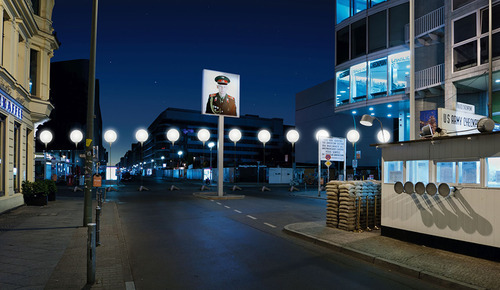
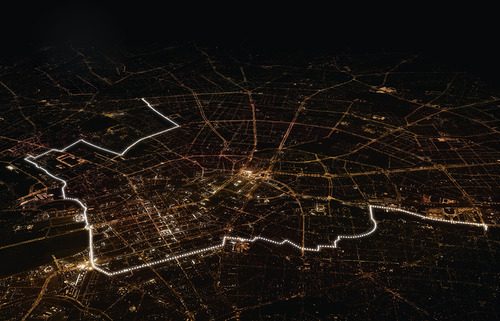
    Starting today and running until the end of the weekend, 8,000 glowing balloons will recreate a 15 km long section of the former Berlin Wall. It’s to commemorate 25 years since the fall of the wall

    Here’s an aerial view of what it’ll look like:

    I think this is a fascinating art installation. And I wish I could be there to see it first hand. My friend Nick Iozzo is there right now with his wife, so hopefully they’ll respond to this blog post with some highlights.

    Lots of cities today feel divided in some way.

    Here in Toronto, we talk about the divide between the core and the inner suburbs – the latter of which has become known as Ford Nation. We also talk about an east vs. west divide, though it’s not really a legitimate concern. Developer Urban Capital actually has an event next week on this very topic that I’ll be attending. They’re calling it: “an intelligent discussion on a not so important topic.”

    But none of these divides are anything like the divide faced in Berlin. The Berlin Wall was arguably the most visible physical manifestation of the entire Cold War. Once a major point of entry for Eastern Bloc emigrants, East Berlin was basically bleeding people before the wall went up in 1961. It was designed to keep East Berliners in place.

    I can’t even imagine what it would be like to live in a place like that.

    Images: Daniel Buche