Daily insights for city builders, delivered every morning at 6 AM ET. I’m Brandon Donnelly — a Toronto-based real estate developer and founder of Globizen. I’ve been writing here since 2013.

Tag: architecture

  • White peaks

    I like airports. And this past weekend was my first time in Denver’s. Its most obvious feature is its white fabric roof, which is intended to evoke the snow-capped mountains that surround the region (as well as teepees apparently).

    Here’s what it looks like from the inside:

    And here’s what it looks like from the outside (via Wikipedia):

    What I like about it is that it speaks to the place. In our increasingly global world, more and more of our buildings now look the same. This is what Modernist architects wanted, but I’d argue that that was a different time and place.

    Today, there’s something nice about landing in a new city and feeling like you’re somewhere different. There’s something special about architecture that speaks to its environment.

    Is there an airport that stands out for you?

  • A new model for the architecture profession

    Last week I provided a few suggestions for how architects might be able to transition over to real estate development. And I ended by saying that I loved architecture school, but that it could use a few more business and entrepreneurship classes. Today, I’d liked to expand on that idea.

    When I was doing my Master of Architecture at Penn, I spent a lot of time thinking about hybrid models for the architecture profession. I was trying to figure out a way to reconcile my love of design with my desire to be more of a building entrepreneur.

    I was interested in what Jonathan Segal was doing down in San Diego with his “architect as developer” approach. And I was really taken by a lecture that Joshua Prince-Ramus (formerly of OMA, now REX) gave where he talked about how architects have marginalized themselves (away from being the master builder) by shying away from liability.

    Out of all the models, conflating architecture and development seems to me like a real possibility. I believe that good developers understand good design and that good architects understand what’s good for the market. So why not merge the two?

    We know that the architecture profession is facing significant challenges; fewer and fewer architecture school grads are getting licensed and actually become a bona fide architect. Some think this calls for licensure reform, but I’m also interested in revisiting the model in its entirety.

    Imagine if every architecture school taught students how to design a building and then go out and actually get it leased up and built. Is this too much to ask of one discipline?

    I can see firms naturally splitting up roles between those who prefer the design side and those who prefer the selling and business side, but is there any reason why the same firm couldn’t be handling both?

  • Transitioning from architecture to development

    A few years ago during a class at the Rotman School when we were all introducing ourselves, I had a professor ask why all architects seem to want to become developers. He asked it because there were 3 architects (or at least architect-trained) in the class who were either currently working in development or planning to move into development following their MBA.

    Indeed, it is pretty common for architects to make this jump. So much so that I’m often asked (as recently as last night) about how I made the transition from architecture to development. Given the frequency of this question, I figured it would be worthwhile to turn my response into a blog post—particularly since I did make the decision to write more about what it means to be a developer.

    The first thing I should say is that I’ve never really worked as an architect. I interned at an architecture firm one summer, but that’s about it. I’m not licensed as an architect and I have no plans of ever becoming licensed. Therefore, I’m technically not allowed to call myself one, which is why I often say “architect-trained.”

    However, this doesn’t mean that I didn’t face a certain degree of stigmatization while I was completing my Master of Architecture and looking for my first real estate job. The real estate community often perceives architects as being impractical, fanciful and generally poor with money and business.

    Part of this, I think, has to the with the fact that design schools often don’t like to talk about making money. It’s taboo. Design is supposed to be something purer and grander than money. Maybe that’s why it’s not uncommon for even the most famous of architects—such as Louis Kahn—to die deeply in debt.

    But I think this perspective is bullshit. Which is why I spent every single one of my electives during my Master of Architecture over at the business school taking finance, economics and real estate classes. I was determined to be just as good as the MBAs at “the numbers.” And even became a teaching assistant for a real estate economics class.

    So my first piece of advice to architects looking to make the transition to development is that you need to overcome the perception that you don’t understand money and business. You need to demonstrate that you can crunch numbers and that you know how to make money for investors.

    This could mean getting an MBA or Master of Real Estate Development, taking extracurricular classes, starting a blog, or just convincing somebody in real estate to give you a chance so that you have it on your resume. Whatever it is, you need to reposition your personal brand so that it no longer says architect.

    This is important because, from my experience, if a real estate company is used to hiring people with business degrees, then it’s going to be tough to get them to pay attention to you and your architecture degree. They just don’t understand the value that you might be able to bring to the organization (and you do bring value).

    My second piece of advice is to find developers who have an architecture background and specifically reach out to them. There are lots of us. They’ll be sympathetic to your background and will probably give you more time of day. But you’ll need to come prepared with the right tool chest. Demonstrate to them that you have the skills necessary to be a developer (see above).

    As I’ve said before, developers are, in many ways, a jack of all trades. So the more you can master all of those trades, the more likely you’ll get some hiring manager to take a risk on you. But when you do finally make that transition, I believe that you’ll be better for it.

    Not only because architects understand the building process, but because architects are trained to have an inherent sense of responsibility for the built environment. We get upset when building are ugly and public spaces suck. But we also know what will make them better.

    The way I see it, by becoming a developer you’re really just learning how to execute on your ideas. It’s one thing to know what makes a building beautiful, but it’s another thing to go out and raise the capital and build the damn thing.

    So I don’t regret any of my architecture degrees. I got so much out of them. And I firmly believe that design is only going to become more important. Designers, after all, are the new rock stars. We just need a few more business and entrepreneurship classes in architecture schools.

  • The story behind the name “Architect This City”

    I was having drinks with an old friend a couple of weeks ago and I told her about my blog. She immediately asked me what it was called. At the time, it was just called “Cities.” And truthfully, I hadn’t given the title much thought. I just knew that I wanted to take a multi-disciplinary approach to examining cities.

    After that night I started thinking more about the idea of a proper title for my blog and I came to the conclusion that I did need something more creative. I should have a stronger brand and identity. So I experimented with a few names and, as you’ve probably noticed, I settled on “Architect This City.”

    Now that I’ve been using the name for a few weeks, I thought I would share my thinking behind it.

    I wanted the name to convey 3 things. (1) I wanted it to be clear that this blog was about cities. (2) I wanted it to be something personal to me. (3) And I wanted to somehow demonstrate that this blog isn’t a siloed look at any one particular discipline, such as architecture, planning or real estate. It’s more than that.

    Given my background in architecture and the fact that “city” is in the name, I think that objectives 1 and 2 made it through. But what I hope is also clear from the name is that the term “architect” is supposed to refer to something much broader than just building design. It’s about the underlying systems, processes and structures of our cities—which could tie into the real estate market, our governance structures or some new technological innovation. Cities are complex and there are many “architects.”

    Finally, I wanted the name to be a directive—a call to action. I wanted it to be a reminder that cities don’t just build themselves. They require careful thought, planning and deliberation. And that’s fundamentally what this blog is all about: city building.

    What do you think about the new name? I’d love to hear your thoughts in the comment section below.

  • I got 88 buildings

    The NH Deutscher Kaiser Hotel building in Munich looks like this:

    It’s a fairly conventional tower on top of a podium.

    However, photographer Victor Enrich decided to reimagine what this tower and podium could look like. In fact, he did it 88 times. Here’s the video. And here’s one example:

    The realism of each is incredible. It’s also a fascinating—albeit outlandish—study of what could be.

  • Mirvish+Gehry and the story of 4 heritage buildings

    I am a real estate developer and I believe in progress. But I also fundamentally believe in balancing progress and preservation. I’ve said this before.

    This morning, Alex Bozikovic of the Globe and Mail, published a piece on the epic Mirvish + Gehry proposal for Toronto’s Entertainment District. It’s called, “Frank Gehry and David Mirvish’s tall order in Toronto.

    Now, I’ve said before that I like this project. I don’t mind the height and I don’t buy the argument that there aren’t enough public spaces in the area. There’s David Pecaut Square directly to the south that could use a few more warm bodies in it.

    But as I also said before, I think the key concern here is one of heritage. There are 4 heritage designated buildings on the site dating back to as early as 1901. Here’s where they sit:

    image

    The Anderson Building (1915) is particularly unique. Here’s a larger photo (via blogTO):

    image

    So while I’m excited by the prospect of a real Gehry project in Toronto, I think we need to figure out a way to find a balance. Preserve the facades, build on top, or relocate them. Do something besides wipe the slate clean.

    As Bozikovic rightly points out in his article, “Toronto has a sophisticated culture of working with heritage buildings.” There are lots of great examples of how we managed to move forward as a city, without erasing our past.

    And in many ways, I see this ability to work with and build upon heritage buildings as an emerging Toronto vernacular. I mean, what could be more appropriate for the most diverse city on the planet than an architectural style—of our own—that blends and layers history with disparate design ideologies.

    I sense an opportunity.

    We could have Gehry’s white sinuous curves drape over the heritage buildings. Make them become a literal unveiling of Toronto’s past and a metaphor for the sophisticated way in which we build upon legacy.

    It’s too easy to just demolish everything. We’re better than that.

  • Who knew Gherkins were so aerodynamic

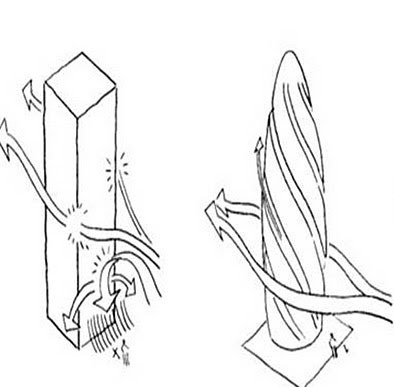
    Lately I’ve been learning a lot about wind and how certain building forms can create dramatically different microclimates.

    In light of this, I’ve gained a new appreciation for the 30 St Mary Axe tower in London (colloquially known as “the Gherkin”). I’ve always been a fan and I was well aware of its sustainability initiatives, but I didn’t fully grasp how much wind played a role in its design.

    Because of its cylindrical shape and the fact that the tower tapers as you move towards the top, the bulk of the wind hitting the building either flows around it or gets pushed upwards, towards the sky. This is in contrast to a typical square or rectangular building where the bulk of the wind often gets pushed down towards street level.

    image

    The benefit of this is that it obviously creates a more pleasant environment for pedestrians at street level. However, in addition to this, it also means that the wind loads against the building were brought down to a minimum and so the structure of the building could also be reduced. 

    This is the kind of architecture I love: architecture that performs.

  • The essence of the stock market is speculation

    Dutch architecture firm OMA (Office for Metropolitan Architecture) has a subtle way of being incredibly subversive in their architecture.

    The recently completed 1.9 million square foot Shenzhen Stock Exchange (SZSE) building is presently making the rounds online and I personally find it incredibly striking. It has the same timelessness about it that makes me love Mies’ Toronto Dominion Centre.

    But it wasn’t until I read the description on OMA’s website that I decided to blog about it. Here’s the first paragraph:

    “For millennia, the solid building stands on a solid base; it is an image that has survived modernity. Typically, the base anchors a structure and connects it emphatically to the ground. The essence of the stock market is speculation: it is based on capital, not gravity.

    All of these factors suggest an architectural invention: our project is a building with a floating base. As if it is lifted by the same speculative euphoria that drives the market, the former base has crept up the tower to become a raised podium.”

    It’s a powerful, yet potentially controversial, symbol, as one could argue that efficient markets should, at least in theory, operate not on ramped speculation but upon fundamental values. However, if markets are an expectations game, perhaps you could simply argue that the building symbolizes a perceived bright future.

    Either way, very interesting.

  • enochliew:

    House W by 01Arq

    Elegant detail where the sliding doors extend to the roof line beyond the ceiling, resulting in a minimal box without the appearance of a bulky top.