Daily insights for city builders, delivered every morning at 6 AM ET. I’m Brandon Donnelly — a Toronto-based real estate developer and founder of Globizen. I’ve been writing here since 2013.

Tag: architect this city

  • 8 years of writing every day

    This weekend was the 8 year anniversary of writing this daily blog. It’s hard to imagine that it has been this long. Perhaps because COVID has accelerated the last little while and made it difficult to remember what day or year it is sometimes.

    I am often asked what the end game is for this blog. What am I hoping to get out of it? The truth is there is no real end game. I like reading and writing. I like being constantly curious about the world. I like discipline. I like meeting and connecting with new people. And I like having my own little place on the internet, however small it may be.

    I get dozens of emails each week from people and companies wanting to pay for sponsored posts on this blog. I’m not sure how legitimate these inbounds are, but I ignore all of them. That’s not what this blog is for or about.

    In the early days of writing this blog it was called Architect This City and the focus was a bit narrower: real estate, design, planning and all things cities. That is still more or less the case, but I do often stray from these topics. Sometimes into personal topics. Sometimes into my photography. And more recently into the world of crypto and blockchains. This is one of the reasons why I decided to move to just blogging under my own name. There’s more flexibility.

    Sidebar: I recently bought my first NFT — a CryptoBabyPunk. I’m not at all suggesting that you should do the same. It could be worthless in the future. But I continue to be fascinated by what’s happening in this space and I’ve committed myself to experimenting and learning a lot more.

    Writing something each day is extremely difficult. Some days it only takes 15-20 minutes. And other days, when I’m not in the mood or I’m exhausted from doing too many other things, it can take over an hour. It’s a big time commitment and on more than one occasion I’ve questioned whether my time was better spent elsewhere. But then I think about all of the benefits that I derive from this daily practice.

    They say that the definition of a habit is that you don’t feel normal until you’ve done it. And this blog has certainly become a habit of mine. It forces me to wake up every morning and consider at least one interesting thing that may be happening in our cities and our world. I don’t intend to stop anytime soon. So thank you all for reading over the years.

  • Our Plan Toronto

    The City of Toronto is currently reviewing its Official Plan, which is a city planning document that acts as a kind of master guide for land user matters. It is a pretty important document in that it dictates, among other things, what kind of development should go where. One way that it is often explained is that our OP is the “vision”, whereas our zoning by-laws are the “precision.”

    This update will be completed by next summer. Why? Because the Province of Ontario said so. (That’s how things work around here. I think cities should have more power.)

    Toronto is expected to grow by more than 700,000 people and add some 450,000 jobs by 2051. Where these people and jobs will be accommodated is a big part of the exercise here.

    As part of this review, the City of Toronto published this Story Map. It is pretty neat. It looks at how the city has grown over the years (the above image is Toronto’s 1943 Master Plan). It explains a little bit about how planning works. And it has a bunch of stats on how people live and work in the city. I just used it to confirm my hunch that there are exactly zero single-family homes in my neighborhood.

    Looking at the above map from 1943, it is, of course, interesting to see how much the city has grown. But it also interesting to note that many of the neighborhoods that now form part of the city were just “New Residential Areas with Prospective Populations.” They were colors and numbers on a map in areas that had yet to be built out by developers.

    When I see this, I can’t help but wonder what the narrative was like at the time with respect to these new developments. Were people upset? Were people happy? Did people even notice what was happening on the edges of their city? Because sprawl, and that’s what this was, is quite different from intensification.

    Our focus today is on the latter. It is about building up as opposed to out. There’s no more room for yellow shaded areas with numbers. This means that we will end up using our land and other resources more efficiently, but it also presents a whole host of issues. Change is hard. Intensification is hard. Part of the job of this document is to navigate some of these challenges.

    If you’d like to get engaged with the city’s Official Plan review, head over here.

  • Pine Hill Homes launches call for artists to design new laneway house facade

    My realtor friend Mark Savel tagged me in this earlier today.

    Pine Hill Homes has recently completed a laneway suite here in Toronto and they have now put out a call for artists to come up with something creative for its front facade. I think this is a great / fun idea and so I’m sharing it today on the blog.

    I think it also speaks to one of the differences between laneway suites and the main houses that now host them. Could you imagine a builder doing a call to artists for the front facade of a house not on a laneway? It seems less likely to me. But I think that the laneway side is viewed as a little less precious, and that creates an opportunity for playfulness.

    This, in my mind, is a great thing.

    If you decide to participate and your work is selected, you’ll have all of your materials paid for and you’ll also get an honorarium. I don’t know how much the honorarium is, or where this house is actually located, but I’m sure you can find these things out by contacting Pine Hill.

    I’m looking forward to seeing what ultimately gets selected and put up.

  • Unicorns overwhelmingly originate in big cities

    In the world of startups, a unicorn is used to refer to a company with a market cap greater than $1 billion. A decacorn, the latest benchmark, is what it sounds like in that it’s a company with a market cap greater than $10 billion.

    While unicorn status is just one measure, valuations are an important yardstick for cities and countries. How many big new companies are you creating? That is a critical question because, presumably, these big new companies are going to create a bunch of new jobs and generate a lot of new wealth for people.

    This recent blog post by Elad Gil is a great summary of what’s happening in the world from this perspective. The raw data is also available if you’d like to dig deeper.

    Here are the number of new unicorns since October 2020 by city:

    Silicon Valley, not surprisingly, continues to dominate, followed by New York.

    Here is a breakdown for the United States as a whole:

    Miami and Austin have been in the news a lot over the past year and their startup scenes may very well be on the rise relative to other US cities. But it’s interesting to see other smaller cities on this list, like Salt Lake City, who are, at least right now, holding their own.

    I found this last set of two charts particularly interesting:

    They are showing unicorn count (first) and unicorn market cap (second) as a percentage of their respective countries. For example, Silicon Valley is sitting at about 47% and 51%, respectively. So about half of all unicorns in the US have originated from this geography.

    But for most other cities on this list, the percentage is much higher and, in many cases, it is 100%. (Silicon Valley is perhaps relatively low because the US has lots of other big and important cities.) For me, this shows the continued dominance of cities. If you’re building the next great unicorn or decacorn, the data tells us that you’re probably doing it in a big city somewhere. And I don’t see that changing anytime soon.

  • Releasing the shackles on mid-rise development

    I love mid-rise buildings. I think they are an incredibly livable scale of housing, which is why I am looking forward to moving into Junction House when we begin occupancies next year. But as we have talked about many times before on the blog, the mid-rise economics are challenging in this city, which is why we also don’t have any other Avenue-style mid-rise projects in the pipeline right now. We haven’t been able to find land where the math works.

    Here are two excerpts from a recent Globe and Mail article — titled “Toronto’s mix of planning rules limits growth of mid-rise housing” — that speaks to this dynamic:

    For well over two decades, Toronto’s official plan has called for transit-oriented intensification along the “Avenues,” much of it expected in the form of mid-rise apartments that can be approved “as of right” – meaning without zoning or official plan appeals. Such buildings are often seen as more livable and human scale than 50- or 60-storey towers.

    Yet, ironically, the highly prescriptive Mid-Rise Guidelines – combined with skyrocketing land, labour and building costs, as well as timelines that can run to six years for a mid-sized building – have turned these projects into pyramid-shaped unicorns, often filled with deep, dark and narrow units dubbed “bowling alleys.”

    “The economics are so frail,” says architect Dermot Sweeny, founding principal of Sweeny & Co., who describes the angular plane requirements as “a massive cost” because they make the structure more complicated and expensive while reducing the amount of leasable or saleable floor space.

    The critiques extend beyond the industry. Professor of architecture Richard Sommer, former dean of the John H. Daniels Faculty of Landscape, Architecture and Design at the University of Toronto, describes the controls in the guidelines as “very crude.” “They’re built around a mindset of deference to low-rise communities.”

    My opinion is that, at a minimum, we need to revisit the “guidelines” that govern these kinds of projects and we need to make this scale of development “as-of-right.” In the same way that laneway suites work, where you simply apply for a building permit, we need to make it just as easy for mid-rise housing. There just too many barriers and too many opportunities for something to come up that could hold up the entire project for months or years.

    Building at a variety of scales is important for the fabric and vitality of our cities. Unfortunately, I have all but made up my mind that small doesn’t work unless it’s as-of-right. I would love to build another laneway house and I fully expect that to happen at some point in the near future. But I just can’t seem to get my head around another mid-rise building right now. I wish that wasn’t the case. And it’s certainly not because of a lack of effort.

  • China is building and megalopolises are now national policy

    Well here are some interesting figures (via MIT Technology Review):

    • In the past two decades, about 400 million people moved into China’s cities — so more than the entire population of the United States
    • By 2035, about 70% of China’s entire population is expected to be urban (up from 60% today and up from 30% two decades ago)
    • To accommodate this scale of growth, China’s national urban development approach has shifted to something that now revolves around city clusters, or megalopolises (term coined by French geographer Jean Gottmann back in the 1950s to describe the Boston-Washington corridor in the Northeastern US)
    • By 2035, there are expected to be five major city clusters (see above)
    • One of the reasons for this is to improve cooperation across the various clusters — less competition and less redundancy
    • But it’s also about creating smaller more manageable cities — is this what one needs to do after a certain scale, go polycentric?
    • To service these clusters, China is rolling out a network of 16 new high-speed rail lines
    • By 2035, China expects to have 200,000 kilometers of rail, with a third of it being high-speed — assuming this happens, China will be home to 60% of the world’s high-speed rail coverage
    • Current cost estimates for the construction of this network comes out to about US$150 million per kilometer
    • 1-2-3 Rule: The plan is that everyone should be able to get around a city within 1 hour; a city cluster within 2 hours; and travel between the country’s clusters inside of 3 hours

    China is building.

  • Patio season: on

    Shot on a DJI Mavic Mini and edited in Lightroom.

  • A story about oranges

    A friend of mine circulated this tweet storm over the weekend. It is an explanation of how NYC’s housing market works using the example of oranges. The author ends by saying that, “it is a parody and an exaggeration, but I promise you it’s not much of one.”

    The crux of this story about oranges is that if you don’t deliver enough to meet market demand, you’re going to invariably run into a problem of affordability. If people really want oranges, they are going to bid up the price of whatever oranges they can get their hands on. The same is true for housing.

    But there are, of course, some obvious differences between homes and oranges. People don’t live in oranges. And I would imagine that there are other ways to get your daily recommended intake of vitamin C.

    As far as I know, people also don’t buy oranges with the hope that they can derive a rental income stream and/or that they will be worth more tomorrow. And so I’m sure that many of you will be quick to point out that it is perhaps the speculative nature of housing that makes it different from most oranges.

    Still, there’s no denying that, in most cities around the world, we do a lot to make it exceedingly difficult to build new housing. We constrain supply — such that we perpetually underserve the market — and then we wonder why prices continue to rise.

    Disagree with this take? Let me know in the comment section below.

  • Crowdsourcing unsafe cycling conditions with a small yellow handlebar button

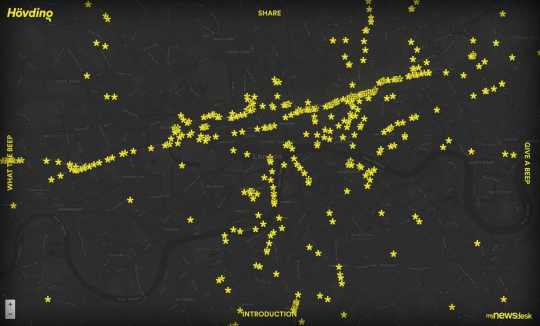
    Hövding – a Swedish company best known for its radical airbag cycling helmets (definitely check these out) – is currently crowdsourcing unsafe conditions and cyclist frustration in London.

    Working with the London Cyclist Campaign, they distributed 500 yellow handlebar buttons. Cyclists were then instructed to tap these buttons whenever they felt unsafe or frustrated with current cycling conditions. 

    Here’s what the button looks like:

    Every time the button is hit, the data point gets logged to a public map and an email gets sent to the Mayor of London reminding him of his promises around cycling. Both of these things happen via the rider’s smartphone.

    Here’s what the public map looks like at the time of writing this post:

    Not only does it tell you pain point locations, but it also seems to suggest the primary cycling routes. I think this is a brilliant initiative because, it’s entirely user-centric. It’s telling you how people feel on the ground.

    Supposedly, Hövding is actively looking for other cyclist groups around the world to help them distribute their buttons. So if you’re a group in Toronto or in another city, I would encourage you to reach out to them. The more data the better.

  • Rental apartment expansion in Detroit

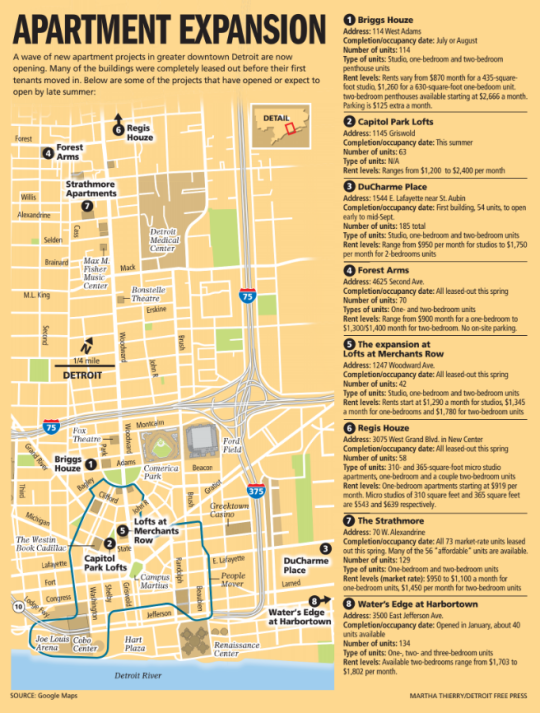
    The Detroit Free Press recently published a summary of some of the new rental apartments coming online in and around downtown Detroit. Here’s the map that they published along with their piece:

    image

    Based on this article, demand is outstripping new supply and rents are starting to push above $2 per square foot. This strikes me as a solid number given that there are also for sale lots/houses in the city going for $10,000.

    Going back to some of the posts I have written about rental apartment development in Toronto, you might remember that $3 psf is roughly our magic number given current cost structures.

    In some special circumstances you might be able to get a project off the ground with rents closer to $2 psf, but that’s an exception to the rule. There are many areas in the Toronto region with $2 psf rents and few, if any, new rental apartments.

    But Detroit is obviously a different city, as is every real estate market.

    Land would be cheaper. Many of these new rental apartments are conversions of existing buildings (which were probably bought for cents on the dollar). And I wouldn’t be surprised if there are tax abatements and other incentives to encourage more development. 

    I also wonder if people in the city aren’t being at least partially drawn to multi-family buildings because of the safety and security benefits. That’s something that certainly came up when I was in Detroit last weekend.

    Regardless, this is a good news story for Detroit, which is not always the story you hear people telling of the city.