Daily insights for city builders, delivered every morning at 6 AM ET. I’m Brandon Donnelly — a Toronto-based real estate developer and founder of Globizen. I’ve been writing here since 2013.

Tag: apple store

  • I finally tried Apple Vision Pro

    I know I’m late to the party on this, but I finally tried Apple Vision Pro this weekend. I was in the Apple Store at the Toronto Eaton Center getting the battery replaced in my phone, so I decided to do a demo. And let me tell you — I was totally blown away. I messaged everyone I knew (after I got my phone back) and told them that they need to try it.

    To be clear, though, very few people right now want to actually buy this computing device. Initially, Apple was thinking that it would sell upwards of 800,000 units this year. But now it expects to sell somewhere closer to 400,000. Maybe. The device is too expensive, too bulky, and the use cases just aren’t there for someone to feel they need to buy it.

    I also found that, when I was looking at the world around me, I could tell I was looking at a video. It wasn’t exactly perfect. (Vision Pro creates a mixed-reality experience by recording the world around you and then playing it back to you.) But that’s okay. The hardware will get better. The price will come down. And the developer community will build a bunch of killer apps that nobody has even thought of yet.

    None of this changes the fact that the device is still an astonishing technical achievement. The eye tracking works perfectly. All of my hand gestures were flawlessly picked up. And the overall experience was entirely immersive — from 3D videos (recorded on regular iPhones) to a butterfly landing on my hand and a velociraptor flaring its nostrils right in front of me.

    What was most impactful to me is that I could easily imagine a future where all of this works. Is this a more exciting way to watch sports? Yes. I sat courtside and Lebron dunked in my face. Is this a better way to watch movies on a plane? By far. Will this be used to help build buildings and coordinate design & engineering disciplines? Yes, absolutely, among many other things.

    It is also easy to imagine how spatial computing is likely to dovetail with other innovations such as AI and blockchains. Mixed-reality or extended reality blurs the line between physical and digital. And in my mind, AI becomes the way in which we will want to interact with this new computing world. (It’s not easy to type on a virtual keyboard.)

    At the same time, digital artifacts will come to be viewed much differently when they’re all blended in. An NFT sitting in a cold wallet is going to feel a lot different than an NFT hanging in a fully immersive 3D gallery that is viewed by millions of people. This strengthens the case for blockchains, and the ownership of digital objects, products, and services.

    Maybe this is really far into the future. I don’t know. But regardless, if you haven’t already, I would encourage you to book a demo at your local Apple Store. However cool and great you think it will be, it will be better. I’m not suggesting you should buy one, but I am suggesting that you need to try it out and see a glimpse into the future.

    And if any of you are working on Apple Vision Pro software that is somehow connected to the design and construction industry, I would love to hear from you and learn more about what you’re up to. I have complete conviction that this will form the future of our industry. The best place to reach out is here.

  • Productizing the delivery of new housing

    One of the co-founders of Juno — a new mass-timber and modular housing company — was recently interviewed by Dezeen. Prior to cofounding Juno, BJ Siegel was Apple’s design director and spent 19 years designing and working on their stores. And so this is the lens that he and his partners are bringing to the real estate development space. (I also just learned this morning that their head of real estate is a former classmate of mine from Penn.) Here is an excerpt from the Dezeen article that speaks to their goal of productizing the delivery of new housing:

    The third is Apple really challenged us to think about the way we deliver the project more like the way they deliver products through a kind of owner-furnished direct source supply chain model.

    And that actually spurred a lot of investigation as to how to translate that work from a product into this industry [real estate development], which is really kind of not focused on that.

    So that really was a big, big focus.

    The company recently announced that they have broken ground on their first project in Austin, Texas. It is a five storey 24-unit residential project that is being positioned as “middle-income, market-rate” housing. They’ve reduced the building down to about 33 standardized parts and are using a secret type of mass timber that is manufactured in the US. Supposedly it’s better than cross-laminated timber, but the company is keeping it as part of their secrete sauce right now.

    Juno is not the first company to identify this gaping problem in the development and construction space. The typical construction process is antiquated, inefficient, and filled with far too much waste. Which is why modular / pre-fabricated housing has been a goal of architects, builders and others for generations. Eventually we will figure out how to better productize the delivery of new housing and bring down its costs. And in my view that will be a great thing for consumers.

    Rendering by Engraff Studio via Dezeen

  • Leica Store Kyoto

    Yesterday I sent out this tweet about the, relatively new, Apple store in Kyoto

    It is the first in the city and I like what they did with the facade of the building. It is decidedly modern and yet there are hints of a local vernacular.

    Photographer Jonathan Castellino responded and suggested that I check out the new(ish) Leica store, which is also in Kyoto. 

    So here is that store (if you can’t see the video below, click here):

    [youtube https://www.youtube.com/watch?v=ouckkaj3XVc&w=560&h=315]

    I shoot on the Fujifilm X-T3, but Leica certainly makes some exquisite (and expensive) cameras. The Leica Store Kyoto does not deviate from that recipe.

  • Apple and the Milanese piazza

    image

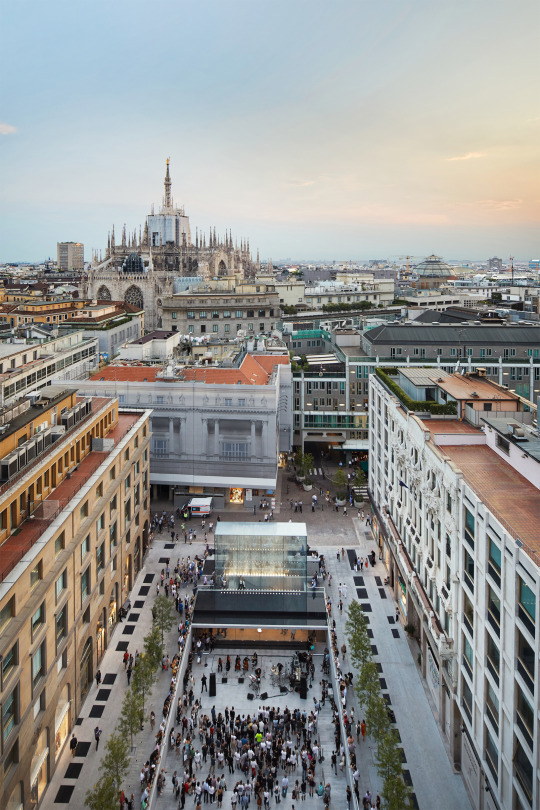
    This past July, the Apple Piazza Liberty opened in Milan. Above is a photo from the opening via Apple. There’s a band playing in the middle of the piazza.

    The store is central to Apple’s vision of transforming its retail locations into “town squares.” And in this case, the store is quite literally an Italian piazza.

    There’s a lot that is interesting about this store and this strategic move, as well as what this could signal about the future retail. (Curbed discusses that here.)

    The urbanists who read this blog will likely lament the privatization of public space. Because at the end of the day, it is a gray area. Can I hang out an Apple Town Square all day and just read a book?

    But at the same time, this is not necessarily a new idea. From the very beginning, the modern shopping mall was intended to be a new kind of town square. Or at least that’s how Victor Gruen saw it.

    However, what is perhaps new is this appropriation of public spaces for the purposes of what is arguably a new kind of retailing experience – one that almost feels paradoxical. 

    In the case of Apple Piazza Liberty, as well as in some of its other town squares, the actual retailing space is mostly hidden. Here it is underground. (How much to rent the basement?)

    And yet, Apple’s presence feels monumental and almost sublime. Glass box, waterfall, and subtle Apple logo sitting in the middle of a beautiful Milanese piazza.

    What a statement.

    Image: Apple

  • So, what’s a town square?

    Earlier this week, Apple let us know that it is now calling its stores “town squares.” Not surprisingly, this elicited more than a few reactions. The Verge called it a “pretentious farce.” Others called it arrogant. Who is Apple to think that its stores could ever come close to a real town square?

    It also raised important questions around the actual “publicness” of the spaces within our cities. Traditionally, town squares have indeed been public. But our cities are now also filled with many privately owned public spaces (POPS). Most of the time you don’t know the difference. Though sometimes you do

    The reality is that there is a longstanding tradition of private retail-oriented spaces trying to simulate the experience of a town square, and certainly of a gathering space. The creator of the modern mall, Victor Gruen, always thought of his “garden courts” as a kind of substitute for traditional urban spaces. This was him trying to nobly urbanize the suburbs.

    What is perhaps unique about Apple’s town square nomenclature is that – beyond simply wanting to be a Starbucks-esque “third place” – they seem to be telling us that they want to usurp the public nucleus away from the proverbial “garden court” and place it in their individual stores. 

    And the reactions we have seen are because that feels far fetched.

    However this plays out, this is a very clear acknowledgement by Apple that in today’s world being a store simply isn’t enough. That’s no longer interesting. Consumers have far easier options at their disposable. You need to give us more of a reason to visit you in your store or, dare I say, your town square.

  • Assembled realities of the New York landscape

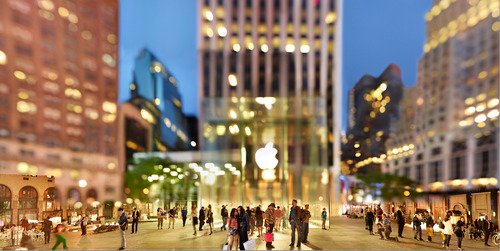
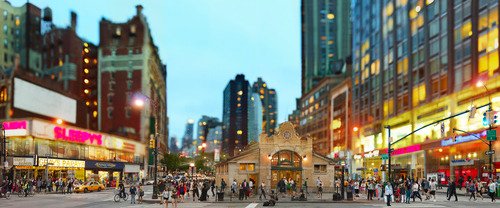
    New York photographer Jeff Chien-Hsing Liao has an upcoming solo exhibition at the Museum of the City of New York next month called Assembled Realities. I just heard about it through CityLab.

    Here’s a bit of background on his work:

    Pushing the boundaries of traditional documentary photography, Liao (b. 1977) creates large-scale panoramas by combining multiple exposures of the same location taken over the course of several hours. The resulting composite photographs are often fantastical; complex, hyper-real views that no single shot—or the eye—could capture.

    And here’s two more of his photos:

    For higher resolution versions, click here.

    I love how his photos begin to distort reality and how they focus your attention – in many cases – on New York’s vibrant street life. I thought you might all enjoy them as well.