
Daily insights for city builders, delivered every morning at 6 AM ET. I’m Brandon Donnelly — a Toronto-based real estate developer and founder of Globizen. I’ve been writing here since 2013.

Tag: apple pay

  • New York City rolls out contactless fare payment at every single subway station

    I’m late to the party here, but I was reading this morning about how New York City recently completed the rollout of its One Metro New York (OMNY) fare payment system. What this does is allow you to use contactless payment systems, like Apple Pay, to get on the subway. ONMY is now available across the five boroughs on every bus and at all 472 subway stations (feel free to impress your friends at virtual parties with this stat).

    Metrolinx here in Toronto is similarly piloting contactless payments on the Union Pearson Express. You now have the option of tapping a credit card, a phone, or a watch. Maybe this doesn’t seem like such a big deal, but I still remember when the PRESTO payment card was first rolled out — it felt late to me. Apple added near-field communication (NFC) to iPhone in 2014, and at that point I think it was fairly obvious that standalone payment cards wouldn’t be around much longer.

    That time has arrived for New York City and will be hopefully arriving shortly for Toronto. And I think it will be particularly useful for tourists who may not have a Metrocard (NYC) or PRESTO card (Toronto) and just want to jump on a train. I’ve only taken the subway a handful of times during this pandemic, but I’ll be back at it once the world fully resumes. And I definitely can’t wait to take the UP Express to the airport again (and to the Junction).
  • The Apple Card fine print

    Apple announced a number of new products and services this week, including Apple TV+ and a new Apple credit card, which will initially only be available in the US.

    It all aligns nicely with their goal of growing their service/subscription businesses and weaning themselves off of an over-dependence on iPhone revenue.

    Below is a video summary of the new Apple Card. In typical Apple fashion, it sounds and looks like an elegant solution and I already want to one.

    I thought this topic would make an interesting follow-up to my recent post about whether cities should be banning cashless businesses so as to not discriminate against the “unbanked.”

    Because embedded in the above credit card is the following cashback reward structure:

    • 3% back on Apple purchases
    • 2% back on purchases made with Apple Pay (iPhone)
    • 1% back on purchases made with the (optional) physical card

    And so what this “card” will do is pay you to always use your phone. The cashback reward system is also instantaneous and you’ll be able to spend that Daily Cash (that’s the name) just like you would actual cash.

    Do you think this would change how you pay for things? I think for most people it will.

  • Towards a walletless society, almost

    image

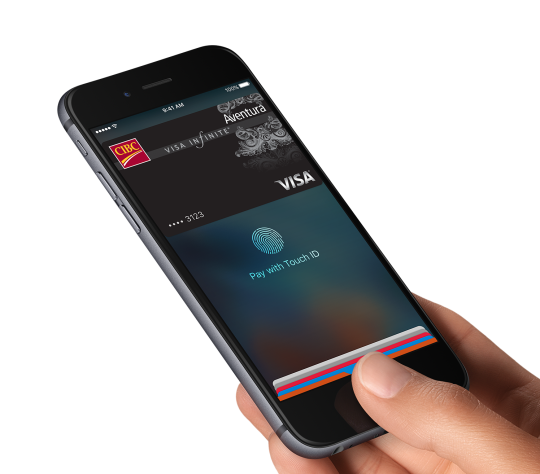
    Today I am one step closer to not only going cashless, but also going walletless.

    This is going to be old news for those of you in the U.S., but yesterday, all 5 of Canada’s big banks signed on to Apple Pay. Before yesterday, you had to have an American Express credit card – which I do not have – to use Apple Pay in Canada. Now you can use a debit and/or credit card from these institutions.

    What’s great about Apple Pay is that it can be used anywhere that contactless, or tap, payments are currently accepted. And since this is pretty commonplace in Canada – more so than in the U.S. I think – Apple Pay can, at least in theory, be used almost anywhere.

    Being the early adopter and geek that I am, I went out for lunch today determined to test out Apple Pay. As I pulled out my phone to pay for lunch, the guy told me: “That’s not going to work. Other people have tried before.” But I tried anyway and, boom, it worked like magic. The transaction amount popped right up on my screen.

    I am pretty excited about this for a couple of reasons. 

    Firstly, it’s more secure. Apple Pay works in tandem with the iPhone fingerprint scanner. So even if I were to lose my phone, nobody would be able to charge anything to it. That’s not the case with a lost wallet. Anyone can tap a credit card to buy something.

    Secondly, Apple is working on allowing reward cards to be stored in its Wallet app. I am terrible about remembering to collect rewards and use gift cards, so anything that consolidates and simplifies is a positive in my view.

    Thirdly, I like to go to the gym and go cycling with just my phone and headphones. I don’t like carrying around my wallet. I’m always afraid that I might lose it or someone might steal it from a locker. So I try and leave it at home. Now I can do that and still pay for stuff – assuming my battery will last that long.

    Of course, it’ll be awhile until we can all really go walletless. I’m not aware of any significant push to digitize government IDs. But it will happen. (Does that mean there will be no more fake IDs for underage drinking?)

    As this transition happens, I can’t help but think of all the small businesses that only accept/use cash and probably hide some of their earnings. I suspect it’s going to be a lot harder to do that in the future.

    I’m also thinking about how transit agencies are going to have to quickly get onboard with this technology. Here in Ontario, we’re still rolling out a card-based payment system. And cards are about to disappear; perhaps sooner than most people think.

    Image: Apple

  • Towards a cashless society

    I increasingly never carry cash on me. I just never think to take out money and, when I do, I hate paying for things and getting change back. That change just ends up in a “change jar” in my apartment and then never comes out ever again. I keep telling myself that I need to buy coin rolls but that never seems to happen.

    Lucky for me, it’s pretty clear that many cities and countries are quickly headed towards a cashless society. It’s pretty easy to get by in most cities today without cash. Here in Toronto, I use Uber and my PRESTO card to get around. I can use my phone for many purchases like coffee. And I can use my credit/debit cards for everything else. I never really thought about it until recently, but I have unintentionally gone almost completely cashless.

    But of course it’s not just cash that is going to disappear; it’s also our physical wallets. Just this week Fred Wilson wrote a post on his blog about how he forgot his wallet at home and how Apple Pay came to the rescue at Whole Foods. I can’t wait until more banks roll this out in Canada. It’s also encouraging to see that under “coming soon” on the Apple Pay website, the Toronto Transit Commission is listed. I guess that means it will be integrated with PRESTO.

    However, this transition is not happening in the same way everywhere. There are many countries that still prefer cash. According to CNN (November 2015), only about 10% of people in Indonesia and the Philippines would prefer to pay with a credit card. And it’s for this reason that Uber now accepts cash in a number of countries. It’s what those customers wanted. I find this interesting though, because not having to carry cash is one of the main reasons I use Uber.

    Of course, there’s also the question of what happens to people who are currently not connected in anyway to electronic forms of money. I get asked by people on the street for change at least every day when I walk around Toronto. But there is actually no way for me to transmit the money I have to them. I don’t carry cash and I certainly don’t carry change.

    I would be curious how many of you have gone or are close to going cashless. And if you are operating cashless, did you even notice the transition happening?