Daily insights for city builders, delivered every morning at 6 AM ET. I’m Brandon Donnelly — a Toronto-based real estate developer and founder of Globizen. I’ve been writing here since 2013.

Tag: apparel

  • The future of clothing

    Today’s post is going to be a bit of a departure from our regularly scheduled programming. But it’s so cool that I had to share it. It’s a company called Vollebak, and they use science and technology to make highly technical clothing (or, as they call it, the future of clothing). It was founded by two brothers.

    Every month they launch a new clothing concept. (Sign up here if you want to get on their list.) But each new piece they develop could take anywhere from one to five years to actually produce. Usually we’re talking about new production methods and materials that have never before been used for clothing.

    Examples include an indestructible puffer jacket designed to help us withstand up to -40 degrees; a solar charged jacket; a “black squid jacket” that reflects visible light to go from black to bionic; and a plant/algae t-shirt that is grown and can later be composted.

    But the piece I’m really eyeing is this blue morpho ski/snowboard jacket. It uses two billion microscopic glass spheres to try and replicate the wings of a blue morpho butterfly. During the day the jacket is matt blue. But as soon as you shine light onto it, it looks like the above photo.

    This would be useful if you were, say, caught in an avalanche and a helicopter searchlight was trying to find you. Hopefully that’s a use case that none of us have to experience. But it could also be invaluable if you were out walking or cycling at night and you wanted to make sure that cars could see you.

    (Please note how I somehow managed to make this post mildly relevant to cities.)

    Image: Vollebak
  • “BRAND”

    image

    For a number of reasons, I am fascinated by the streetwear label, Off-White

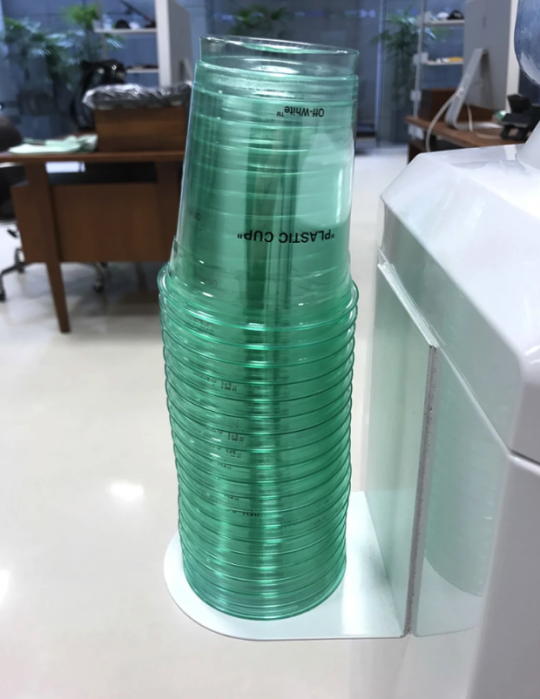
    It is one of the hottest labels in fashion, and yet there’s a part of me that doesn’t really get it. It’s mostly bold text, usually in quotations, on various apparel items. A set of Wellington boots might be plastered with “FOR RIDING.” A winter coat might be plastered with “DOWN JACKET.” And when they collaborate with Nike, the shoes might be tagged with “AIR.” Quotations included. Is that fashion?

    But then you hear Virgil Abloh – the founder of Off-White, who by the way was also trained as an architect before becoming creative director for Kanye West – talk about his brand and it starts to make more sense. The quotation marks are supposed to signal “ironic detachment and a comment on the idea of originality.” Okay, so a little more sense.

    Part of his inspiration comes from the work of Marcel Duchamp. In 1917, Duchamp shocked the art world with, Fountain. Some would consider this to be the most pivotal art piece of the 20th century. It was an off the shelf urinal that he simply signed, dated, and placed on a pedestal. Though initially rejected as art, it eventually redefined what art could be, shifting it from, “new physical creations to [the] moulding [of] ideas.”

    The corollary to this was that anything could be art, even something as utilitarian as the catch basin that you pee into. And this insight is something that Abloh has used to fuel his label. But he has taken it a step further. He has leveraged the ubiquity of these everyday-items-elevated-to-art as a way to elevate his own brand. Here’s a quote by Abloh from the Guardian:

    “The idea [that] an everyday object is art. Branding is generic and if I adopt the generic, then it becomes my branding, but it normally occurs in life.”

    In other words, he is co-opting generic and ubiquitous items – like, for instance, the patterning on caution tape – for his Off-White designs. And if you believe that a bit of brand equity is at least partially driven by brand ubiquity, well then you might start to see the value in this approach. He is simply assigning authorship to things that are already omnipresent.

    But, is that fashion? I guess that depends on whether you consider Duchamp’s Fountain to be art.

    Image: SSENSE

  • A demand-driven apparel world

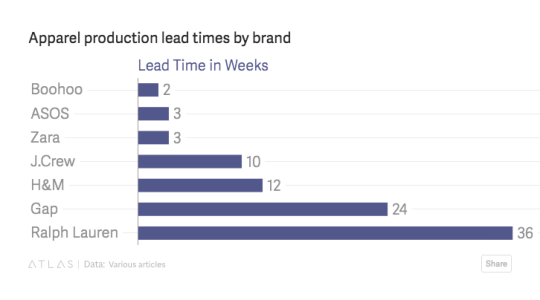
    Here is an interesting article from Loose Threads that talks about the profound impact that data and fast fashion are having on apparel brands, transforming them from supply-driven businesses to demand-driven ones. It adds a bit more nuance to the trope that tech is disrupting retail simply because people are choosing to buy online.

    The argument, here, is about a more fundamental shift in commerce. Brands are now forced to move faster than ever before. Product lead times are dropping (see below via LT). Customer feedback loops are almost instantaneous because of social. And the result is that customers are now the driver: Figure out what people want right now and then create that supply as quickly as possible.

    image

    Fast fashion certainly isn’t a new concept, but the data, algorithms and demand planning systems are only becoming more robust. Merchandise buying – historically the work intuitionists trying to predict what customers will want seasons into the future – is now an automated process that optimizes itself following every click, abandoned shopping cart, and social media like. 

  • Experiences over fashion — or is that really the case?

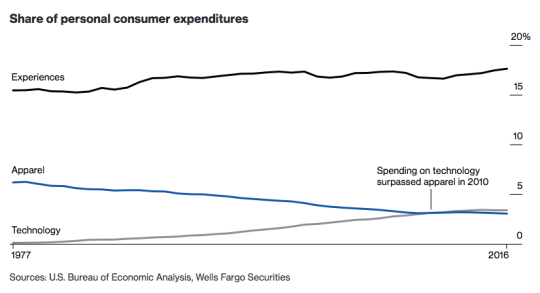
    Bloomberg recently published this interesting piece talking about the death of clothing. The reasons are as follows: we’re spending more on experiences, as well as technology (tech spending surpassed apparel spending in 2010); casual dress in the workplace has become more widely accepted; fast fashion companies like H&M and Zara are putting downward pressure on prices; and social media influencers – instead of big companies – are now the ones showing us what to buy and wear.

    Here is a graph from the article comparing experiences, apparel, and technology expenditures: 

    image

    The first thing I noticed is that experiences, while still increasing, haven’t really spiked since 1977, even though everybody seems to be talking about how social media-fueled Millennials are all about experiences. I was also surprised to see that the share of US employers that allow casual dress every day seems to be closing in on 50%. (Informal survey for the comments and for Twitter: Do you wear casual clothes to work? I’m a no.)

    But perhaps the biggest contributors to this decline are fast fashion and low-cost manufacturing. Stanley Pignal – South Asia business and finance correspondent for the Economist – pointed out on Twitter that since 1982 inflation in US apparel was only 123% compared to 248% for overall CPI. So maybe a lot of the above reasoning is just a distraction.

  • Introducing: ATC city tees

    image

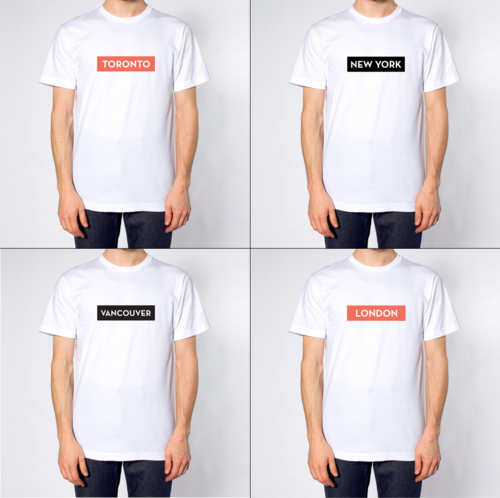
    I’ve just launched a set of city tees over at shopATC. To start, there are 4 cities (Toronto, New York, Vancouver, and London) and each one is available in either black or (ATC) orange. They’re printed on a super soft American Apparel tee and cost only $30 each. I picked the cities based on readership levels. I hope you like them.