Daily insights for city builders, delivered every morning at 6 AM ET. I’m Brandon Donnelly — a Toronto-based real estate developer and founder of Globizen. I’ve been writing here since 2013.

Tag: amsterdam

  • Coupe d’une maison parisienne

    This is an interesting article by ArchDaily, looking at the “evolution of the house plan in Europe” between 1760 and 1939. The article focuses on London, Paris, Amsterdam, and Moscow and includes floor plans, photographs, as well as well-known illustrations like the one shown above. Created by Bertall in 1845, the drawing shows a section through a Parisian house and is called The Five Floors of the Parisian World.

    What it shows is the declining opulence that used to exist in Paris’ apartment blocks as you moved upward. If you were rich, you lived on the second floor, right above the ground floor lobby. The ceilings were higher on this floor and maybe had a balcony overlooking the street. If you lived on the third floor it meant that you were a less rich. And if you lived in the top floor attic, you were poor. That is what this comic is showing.

    Now, all of this changed over time as new technologies, namely the elevator, were brought to multi-family buildings. All of a sudden it became convenient to live higher up and all of a sudden people wanted better views and to get further away from the chaos of the street. What I’m curious about, though, is how posterity dealt with the lower ceiling heights on these upper floors.

  • Canal houses and rental barracks

    Feargus O’Sullivan’s CityLab series on European housing typologies started in London, but has since gone on to cover Berlin’s mid-rise tenements — called Mietskasernen — and Amsterdam’s canal houses. The series is exactly the sort of thing that I like to geek out about. In fact, I can see a book on this topic staring at me from my bookshelf.

    If you end up taking the time to read the articles, you’ll be reminded of a couple of things about the way cities work. One, the way we use buildings changes over time. Two, the kind of architecture we pursue is always a reflection of the socioeconomic milieu at that particular moment in time. And three, the way we perceive buildings also changes over time.

    In the case of Amsterdam’s canal houses, their original function was live/work. They were residences, but they were also warehouses. Amsterdam’s maritime dominance meant that it was more profitable to store things, instead of just house people. (Sometimes as much as half of the house was dedicated to storage.) Trade patterns had moved from the Mediterranean up to the North Atlantic, and that worked out pretty well for the Dutch in the 17th century.

    In the case of Berlin, their typical mid-rise “rental barracks” went from reviled to coveted as the buildings aged, elevators made the penthouses desirable, and people started to appreciate some of their idiosyncrasies. It’s an example of what I was getting at when I spoke to the CBC for this article about Toronto’s skyscraper boom. Some things, including buildings, take time. They need to settle in.

  • Two-up, two-down

    Feargus O’Sullivan is doing a series in CityLab right now on the “home designs” that define four European cities: London, Berlin, Amsterdam, and Paris. The first one is on London’s classic “two-up, two-down” design, which refers to a two storey home with a living room and kitchen on the ground floor and two bedrooms on the second. It’s a simple design, but one that has supposedly endured.

    O’Sullivan argues that for many, or perhaps most in Britain, this is what a “home” feels like. It’s grade-related and there are two floors. Indeed, only 14% of British people live in an apartment, compared to 57% in Germany (a majority). This percentage is much higher in London, with about 43% of people living in an apartment. But about 25% of the population still lives in some sort of attached house.

    Home equals house. And for us North Americans, this is of course relatable. But the Germany example is a reminder that this is not necessarily universal. Attitudes toward housing are cultural. And cultures can and do change. I am seeing that happen right now in Toronto. Some of us are becoming less like the British and more like the Germans.

  • Making cities resilient to climate change

    This past fall, Goldman Sachs published an important report about “making cities resilient to climate change.” In it, they remind us that the scientific consensus is that the world has already warmed from the pre-industrial era (and will likely continue to do so) and that a great many of us live near water (and will likely be impacted going forward).

    About 40% of the world’s population lives within 100 kilometers of a coast, and about 10% of the world’s population lives in a coastal settlement that is less than 10m above sea level. Above is a list of some of those cities, along with their average elevation in meters. The cities with single digit elevations include Bangkok, Miami, Alexandria, and Amsterdam.

    Goldman’s prediction is that this need for “urban adaption” could lead to one of the largest infrastructure build-outs in history. And that cities all around the world should already be thinking about how they will finance and equitably execute on greater resilience (assuming they aren’t already).

    Click here to download a full copy of the report. The diagrams showing the average change in global mean surface temperatures against the pre-industrial period are something you should all look at it. The 2015-2019 change is pictured above.

    Charts: Goldman Sachs

  • Glass curtains in Amsterdam

    For the same reasons that I liked the Interlock in London, I am a big fan of this storefront in Amsterdam by UNStudio. It is contextual, but it also something entirely new. To me, it resembles a triptych of curtains being pulled to the side, which is probably a fitting metaphor for a high fashion street. The developer is Warenar and it looks like the space is still available. So if you’re in the market for a retail storefront on Amsterdam’s PC Hooftstraat, here you are.

    Photos by Evabloem

  • Look what fits in a parking lot

    Brent Toderian likes to start Twitter hashtags that revolve around city building. One of his most recent is #LookWhatFitsInAParkingLot. For this one, he asked the Twittersphere to consider the things we love in cities that might fit inside a parking lot.

    Here is one of the best responses — Dodger Stadium edition:

    https://twitter.com/pw3n/status/1176349879154556931?s=20

    Venice, Amsterdam, and Shibuya (Tokyo) were all overlaid — at the same scale — on the surface parking surrounding Dodger Stadium. There are about 16,000 parking spaces, which actually take up more land than the stadium itself.

    To be fair, I bet if you overlaid parts of Los Angeles on this same parking, it would look similarly astounding. But that shouldn’t change what you take away from this post: parking is very land consumptive.

  • The Knight Frank Global Affordability Monitor 2019

    Here’s a chart from Knight Frank’s 2019 Global Affordability Monitor that I think you’ll find interesting:

    It compares real home price growth and real household income growth (after tax) over the last 5 years for 32 world cities. The bolded percentages represent the former and the non-bolded percentages represent the latter.

    Consider the variations here.

    Amsterdam saw a real home price change of 63.6%, but a household income change of only 4.4% (although the circle looks to be in the wrong spot if this number is correct).

    Moscow, on the other hand, saw flat home prices (0.1%) and a 22.7% increase in household income.

    Though San Francisco is the star in terms of income growth.

    Sao Paulo, unfortunately, saw a dramatic decline in both home prices and incomes. It’s in the bottom left corner.

    When I look at this chart, I don’t see a strong correlation between household incomes and home prices. And the proportions of the chart tell you that the y-axis is moving more than the x-axis.

    But if the top number exceeds the bottom number, then you could come to the conclusion that housing affordability has gotten worse over the last 5 years.

  • A new typology of cities

    Earlier in the week, my friend Rodney Wilts of Theia Partners sent me a JLL report called, World Cities: Mapping the Pathways to Success. I am admittedly only getting around to it now.

    The report proposes a new typology of world cities that looks like this:

    image

    It is based on 10 overall categories of cities, grouped into 4 main buckets. The first bucket is “Established World Cities”, within which there is the “Big Seven”, and then the “Contenders.”

    The Real Estate Highlights that accompany each category of city is a good place to start if you’re looking to do a quick scan of the report.

    Here’s a taste:

    One-quarter of all capital invested in commercial real estate globally currently lands in one of the “Big Seven” cities. And London and New York are easily at the top.

    Cities that recently graduated from “New World City” status – namely Toronto, San Francisco, Sydney, and Amsterdam – are all struggling to address housing and infrastructure deficits.

    “Lifestyle” cities – such as Vancouver, Auckland, and Oslo – are some of the most active investment markets. Biggest rental growth for prime offices (since 2000) in the “New World Cities” category.

    Click here for the full report.

  • Battle of the Bungehuis

    image

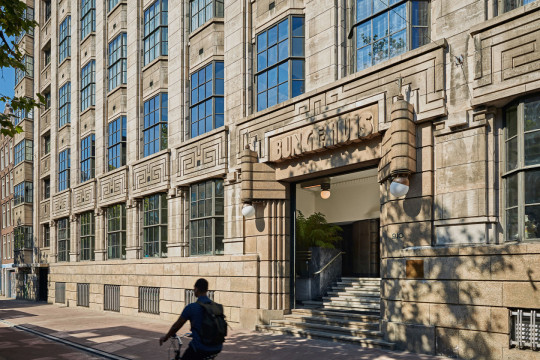
    This past July, Soho House Amsterdam opened up in the storied Bungehuis building. Not really news, other than the fact that FT just published this article talking about the building’s history and some of the project’s hurdles, which I of course found interesting.

    Completed in 1934, the Bungehuis originally served as the offices for a prominent trading company. The architect was ADN van Gendt. When he died during the building’s construction, Willem Jacob Klok took over.

    Also noteworthy about the building’s construction is that, according to Wikipedia, twenty houses had to be demolished in order for it to be constructed.

    This underscores a point that I have made before on the blog. Cities are not static. Most of us probably look at the Bungehuis and consider it to be quite a handsome piece of architecture. Some of us may even go so far as to say that we don’t make buildings like they used to.

    Soho House is on record saying that they were “not very budget-conscious” during the renovation because of the sense of responsibility that they felt around the building and its history.

    image

    But I think it’s important to note that this building was initially built for a for-profit company and things had to be demolished in order for it to come to fruition. 

    I can’t say for sure whether this development was opposed in the 1930s, but it may have been. Cities and buildings have a way of ingratiating themselves over time.

    In any event, starting in the 1970s, the building became home to the arts faculty at the University of Amsterdam. And as recent as 2015, it became home to the Bungehuis occupations – a protest occupation started by students and staff of the University who were opposed to a slew of academic cuts.

    image

    Then in a state of poor repair, the building was ultimately sold to Aedes Real Estate, who now leases it to the Soho House Group for their private club and 79 room hotel. Above is a picture of the club’s rooftop pool and lounge.

    The big hurdle, or at least one of them, was the fact that Amsterdam currently has a moratorium on new hotels – as a way to try and mitigate “overtourism” – unless it can be demonstrated that it will represent “an extraordinary addition to the existing stock.”

    Since Soho House Amsterdam opened in July, I guess we know the answer to that test. But it sounds like it may have been a battle. That wouldn’t be a first for this building.

    Images: Soho House Group

  • The un-hotel

    According to Condé Nast, the coolest hotel trend for 2018 is the “un-hotel.” Here’s what they mean by that: “Instead of many rooms under one roof, these new un-hotels have different rooms in various locations, united only in character and concept.”

    I wrote about one of these un-hotels, the Vipp Shelter, back in the spring. I was interested both in how the company was using their hotel as a kind of shop and how they had adopted this decentralized approach to hospitality.

    Different rooms in different locations has got to create some diseconomies. But the appeal is clear. We are all craving new experiences.

    To me, it feels like a hybrid between an Airbnb and a boutique hotel. You get to “travel like a local”, but you’re still staying with a brand and there’s likely some sort of unifying concept across the portfolio.

    Check out the SWEETS hotel in Amsterdam.

    Image: SWEETS hotel