
Daily insights for city builders, delivered every morning at 6 AM ET. I’m Brandon Donnelly — a Toronto-based real estate developer and founder of Globizen. I’ve been writing here since 2013.

Tag: america

  • Fashion nothingness

    Fashion, like architecture, says a lot. It is, according to Wikipedia, an “aesthetic expression at a particular time, place and in a specific context.” So it’s interesting to consider how fashion might translate, and not translate, around the world. This recent article by The Economist, called “The United Nations of Uniqlo,” offers up one comparison, albeit a generalized one, between Japanese and American clothing preferences. (It’s an article about the Japanese fashion label Uniqlo.)

    Japan:

    At first glance there seems nothing obviously Japanese about Uniqlo’s wares. But a strong strain of minimalism pervades Japanese culture. Buddhism remains an important influence on Japanese society even in an increasingly secular age, and among its core tenets are renunciation and detachment – concepts that mean being able to suppress one’s lust for the material elements of daily life. Mario Praz, an Italian critic, contrasts the Japanese style with the suffocating abundance of Victorian interiors in Europe and America which, he says, stemmed from horror vacui (fear of emptiness). More recently, young people in the West have also grown less enamoured with acquiring stuff, hence the widespread popularity of another Japanese export: Marie Kondo, a professional declutterer.

    America:

    The American market has proved harder to crack. The 56 Uniqlo stores in America fall far short of Yanai’s plan, in 2012, to open 200 there. They still operate at a loss. “When you think about the American market, you don’t always think of subtlety,” said Steve Rowen of Retail Systems Research, a consultancy. “This is a social-climber society. Even if you want to fly under the radar, there still has to be some indication that you’re fashion forward.” Once that urban millennial with a starter job begins to make real money, Rowen postulated, “they move past a brand like Uniqlo pretty quickly.” Americans are perhaps willing to embrace invisibility only until they are rich enough to want to be seen.

    You could probably also fashion a similar argument around housing preferences. The Japanese are known for their minimalist houses, as well for completely different views on housing in general. But we shouldn’t forget that good minimalism is expensive. Remember: “Only the rich can afford this much nothing.” Maybe that’s what Uniqlo needs to do in America. The problem is that its nothingness isn’t expensive enough.
  • The Oklahoma Land Rush of 1889

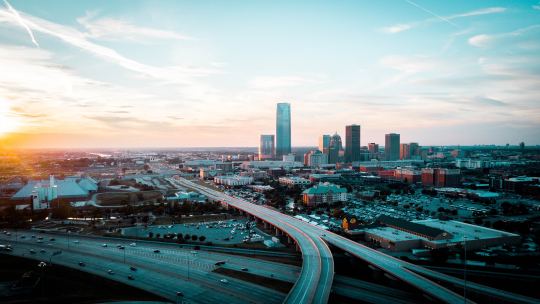
    One of our partners sent me a terrific article last week by Sam Anderson on the founding of Oklahoma City

    I have said this before on the blog, but I am deeply fascinated by the origins of cities because, oftentimes, the story isn’t all that lucid. Why right here? As Anderson points out in his article, usually cities “creep into existence.” 

    But not Oklahoma City:

    Oklahoma City was born in an event called, with extreme dramatic understatement, the Land Run. The Land Run should be called something like “Chaos Explosion Apocalypse Town” or “Reckoning of the DoomSettlers: Clusterfuck on the Prairie.” It should be one of the major events in American history. Dramatizations of it should be projected onto IMAX screens with 3-D explosions, in endless loops, forever. Every time you walk into a mall, you should be accosted by fuzzy-headed Land Run characters shouting, “What is America?!” “What does America even mean?!” Because the Land Run was, even by the standards of this very weird nation, absurd. It was a very bad idea, executed very badly. It would be hard to think of a worse way to start a city. Harper’s Weekly, which had a reporter on the ground, called it “one of the most bizarre and chaotic episodes of town founding in world history.” A century later, the scholar John William Reps reviewed the evidence and concurred. The founding of Oklahoma City, he wrote, was “the most disorderly episode of urban settlement this country, and perhaps the world, has ever witnessed.”

    To learn how Oklahoma City went from a population of 0 to 10,000 in about half a day, check out the full article.

    Photo by Gerson Repreza on Unsplash

  • Birth rates in the United States last year

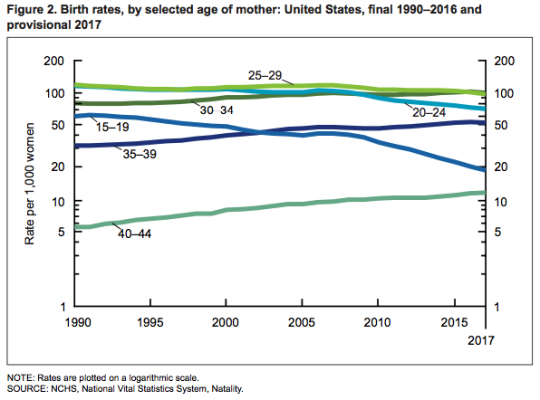
    The National Center of Health Statistics just released this update on births and birth rates for the United States in 2017. The provisional number of births last year was 3,853,472, which represents a 2% reduction from 2016 and the lowest number in 30 years. The general fertility rate was 60.2 births per 1,000 women aged 15-44, which represents a 3% reduction from 2016. Also a record low.

    Here is a chart from the report showing birth rates for selected age ranges from 1990 to 2016 (the 2017 numbers are provisional):

    image

    Many of the age ranges have remained stable. Notable are the decline in the teenage (15-19) birth rate and the increase in births to women aged 40-44. The teenage birth rate declined 7% from 2016 and has averaged a decline of nearly 8% a year since 2007. And the birth rate for women aged 40-44 has generally been rising since 1982.

    I am sure that you can all think of many explanations for the above phenomena without even diving into the report. I find all of this relevant because demographics obviously impact the real estate business and how we build cities.

  • American optimism

    Below is an excerpt from Warren Buffet’s latest annual letter to Berkshire Hathaway shareholders (2016). It represents an entire section dedicated to American optimism, which is something you’ll notice in most (all?) of his letters. I’m a big believer in optimism, because I find it has a way of creating self-fulfilling prophecies.

    ————————————————————

    Our efforts to materially increase the normalized earnings of Berkshire will be aided – as they have been throughout our managerial tenure – by America’s economic dynamism. One word sums up our country’s achievements: miraculous. From a standing start 240 years ago – a span of time less than triple my days on earth – Americans have combined human ingenuity, a market system, a tide of talented and ambitious immigrants, and the rule of law to deliver abundance beyond any dreams of our forefathers.

    You need not be an economist to understand how well our system has worked. Just look around you. See the 75 million owner-occupied homes, the bountiful farmland, the 260 million vehicles, the hyper-productive factories, the great medical centers, the talent-filled universities, you name it – they all represent a net gain for Americans from the barren lands, primitive structures and meager output of 1776. Starting from scratch, America has amassed wealth totaling $90 trillion.

    It’s true, of course, that American owners of homes, autos and other assets have often borrowed heavily to finance their purchases. If an owner defaults, however, his or her asset does not disappear or lose its usefulness. Rather, ownership customarily passes to an American lending institution that then disposes of it to an American buyer. Our nation’s wealth remains intact. As Gertrude Stein put it, “Money is always there, but the pockets change.”

    Above all, it’s our market system – an economic traffic cop ably directing capital, brains and labor – that has created America’s abundance. This system has also been the primary factor in allocating rewards. Governmental redirection, through federal, state and local taxation, has in addition determined the distribution of a significant portion of the bounty.

    America has, for example, decided that those citizens in their productive years should help both the old and the young. Such forms of aid – sometimes enshrined as “entitlements” – are generally thought of as applying to the aged. But don’t forget that four million American babies are born each year with an entitlement to a public education. That societal commitment, largely financed at the local level, costs about $150,000 per baby. The annual cost totals more than $600 billion, which is about 31⁄2% of GDP.

    However our wealth may be divided, the mind-boggling amounts you see around you belong almost exclusively to Americans. Foreigners, of course, own or have claims on a modest portion of our wealth. Those holdings, however, are of little importance to our national balance sheet: Our citizens own assets abroad that are roughly comparable in value.

    Early Americans, we should emphasize, were neither smarter nor more hard working than those people who toiled century after century before them. But those venturesome pioneers crafted a system that unleashed human potential, and their successors built upon it.

    This economic creation will deliver increasing wealth to our progeny far into the future. Yes, the build-up of wealth will be interrupted for short periods from time to time. It will not, however, be stopped. I’ll repeat what I’ve both said in the past and expect to say in future years: Babies born in America today are the luckiest crop in history.

  • This is not right

    I have largely avoided commenting on politics and Trump on this blog, but at this stage it is almost impossible to do that.

    Donations are starting to pile up for the American Civil Liberties Union (ACLU) as the tech community, and many others, begin to respond to Friday’s executive orders. Lyft announced a $1 million contribution to the non-profit group.

    Today, venture capitalist Fred Wilson wrote: Make America Hate Again. And yesterday, his business partner Albert Wenger wrote: Misleading the World on Immigration.

    At 6 AM this morning, Richard Florida started a tweet storm where he argued that “Trump’s immigration insanity” will fundamentally threaten the core of America’s innovation hegemony. 

    (He also argued that Canada, and more specifically Toronto, serve to “gain substantially”, as there will no doubt be a doubling down on tolerance to attract the best talent from around the world.)

    The Canadian tech community penned an open letter to reinforce the message that, here in Canada, diversity is our strength. This echoes similar messages from Prime Minister Justin Trudeau and Mayor John Tory.

    Mass protests have broken out at US airports (links to photos) spanning San Francisco to New York. 

    And I am seeing folks from Toronto offer up their homes (publicly on Twitter) to anyone who might be stranded at Pearson International Airport as a result of the orders. Many have even tweeted out their phone numbers.

    Everywhere I look this weekend I am seeing these sorts of messages. So while I could remain quiet, that doesn’t feel right. And that’s because what is happening is not right.

  • Why can’t cities reach equilibrium?

    The October issue of The New Yorker has an interesting piece called: Naked Cities – The death and life of urban America.

    I find the article ends up rambling a bit, but I like the idea presented right at the beginning. The idea that cities can never really find equilibrium. They’re either dying, or victims of their own success.

    Here’s that paragraph:

    Cities can’t win. When they do well, people resent them as citadels of inequality; when they do badly, they are cesspools of hopelessness. In the seventies and eighties, the seemingly permanent urban crisis became the verdict that American civilization had passed on itself. Forty years later, cities mostly thrive, crime has been in vertiginous decline, the young cluster together in old neighborhoods, drinking more espresso per capita in Seattle than in Naples, while in San Francisco the demand for inner-city housing is so keen that one-bedroom apartments become scenes of civic conflict—and so big cities turn into hateful centers of self-absorbed privilege. We oscillate between “Taxi Driver” and “The Bonfire of the Vanities” without arriving at a stable picture of something in between.

    I like this because there’s truth to it. But at the end of day, this is just one of the many challenges facing great city building. 

    To solve the problem of affordable housing you could just be a city in decline. But that’s not much fun. So the better option, however difficult it may be, is to figure out how to manage the negative externalities associated with winning.

  • This Built America: Shinola

    If you’ve been reading this blog since last year, you’ll know that I’m hugely interested in Detroit. I went for a visit last fall and I hope to go back sometime this summer. I think the city has tremendous potential and I would love to see it come back. I’m rooting for it.

    Between people like Dan Gilbert and consumer brands such as Shinola, there’s a palatable sense of momentum developing in the city. Here’s a short video of the Shinola story from This Built America–which is a project focused on the people and companies that are rebuilding America and its manufacturing base.

  • Why the homeownership rate is higher in Mexico than in the US

    If you check out the “What I read” page that I recently added to Architect This City, you might notice a blog by Charlie Gardner called the Old Urbanist. I discovered it a few months ago (when he added ATC to his blog roll) and it’s good stuff.

    Last week he posted this interesting piece comparing homeownership rates and house sizes in both Mexico and the US. His finding is that there’s a fundamental mismatch in America in terms of the size of housing and the size of households. One and two person households now represent more than half of the market, and are on the rise, and yet 40% of houses in the US have 3 bedrooms.

    Because of this mismatch, he’s arguing that households are being poorly served by the US housing market and that it’s driving down homeownership levels. It currently sits around 65%, which is a drop from over 69% during the mid 2000s. Contrast this to Mexico, where there’s a greater number of one and two person households and the homeownership rate is 80%! Oh, and where only 6% of homes are financed using a mortgage.

    So what the Old Urbanist is suggesting is that we need to embrace smaller homes. He doesn’t explicitly say it, but he mentions the opportunity to redevelop laneways and alleys, which many of you will know I fully agree with. It’s a great post and I suggest you have a read if this topic interests you.

  • Annual US Federal infrastructure budget

    I was browsing through Vishaan Chakrabarti’s new book, A Country of Cities: A Manifesto for Urban America, and I was struck by a diagram outlining the annual US Federal infrastructure budget. Here it is:

    It comes as no surprise, but it’s still a good reminder of how heavily subsidized roads and sprawl are. So the next time somebody argues that suburban sprawl is a natural market outcome, remind them of how much government encouragement it took.

  • Are department stores going to die?

    Here’s an interesting graph I found on Businessweek that outlines retail sales growth in America over the past decade:

    image

    What’s interesting is not that furniture stores suffered during the housing crisis of 2008-2009 – this much is obvious – but that there seems to be a few other trends at work.

    For one, warehouse club sales have gone from being the highest growth to the slowest growth sector (excluding, for a second, department stores). The urbanist in me wonders if this has to do with “The Great Inversion.” That is, the trend towards more and more young people choosing to live in inner city neighbourhoods – where warehouse club penetration is low – as opposed to the suburbs.

    The other notable sector is department stores. It’s the only sector that seemingly hasn’t been able to rebound along with the rest of the economy. I think this points to another larger trend at play: there are structural problems with the department store model. They’ve been beaten up by category killers, the internet and the fact that individual retailers seem to want to manage their own brands and experiences from top to bottom.

    I know that for me, personally, I rarely shop at department stores. What about you?