Daily insights for city builders, delivered every morning at 6 AM ET. I’m Brandon Donnelly — a Toronto-based real estate developer and founder of Globizen. I’ve been writing here since 2013.

Tag: alphabet

  • Current state of autonomous vehicles

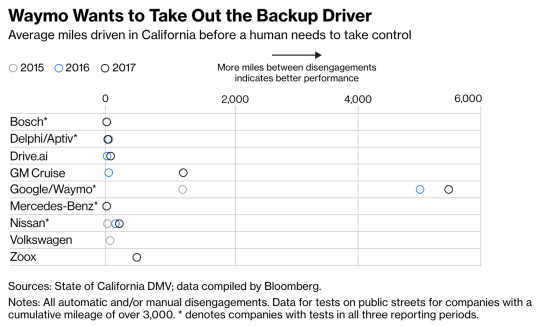
    This is an interesting piece by Bloomberg summarizing the current state of autonomous vehicles and in particular the (supposed) dominance of Waymo (Alphabet’s self-driving vehicle arm). Many believe they will be the first real entrant into the market.

    The company is currently running an “Early Rider” program in 25 cities. But its Phoenix trials are the furthest along, which isn’t at all surprising given the city’s car orientation and suburban fabric. Already Waymo has started offering passenger rides without a backup driver in the car.

    Overall, the company has come forward with four main business priorities:

    • Ride hailing
    • Trucking
    • Personal vehicles
    • Public transit

    But I still think that we’ll see a blurring of these priorities, if not outright cannibalization, as the cost per mile plummets. I mean, why own a personal vehicle if it is flat out easier and cheaper to just hail a robotaxi? 

    Here is an excerpt from the article talking about pricing:

    Tasha Keeney, an analyst at ARK Invest, says that Waymo could choose to offer an autonomous ride-hailing service today at around 70 cents a mile—a quarter of the cost for Uber passengers in San Francisco. Over time, she says, robotaxis should get even cheaper—down to 35 cents a mile by 2020, especially if Waymo’s technology proves sturdy enough to need few human safety monitors overseeing the autonomous vehicles remotely. “You could see software-like margins,” Keeney says.

    I can’t wait to be driven around for cents on the dollar. Click here to read the full article.

  • Letter from Toronto on Google’s city of the future

    Politico Magazine recently published this article about Sidewalk Toronto. It’s called: Google Is Building a City of the Future in Toronto. Would Anyone Want to Live There? 

    If you’re familiar with what Sidewalk Toronto is up to, the first bit will likely cover things you already know. But later on it gets into an interesting discussion around data privacy, among other things.

    One argument is that if you strip any personal identifiers from the data you collect, then you’ve effectively eliminated the issue of privacy. 

    But what about “collective privacy?” 

    What if you could, for example, identity signs of concentrated drug usage within certain districts, communities, or even buildings? Does that start to get a little too personal?

    This is the great debate surrounding Quayside, the area that Sidewalk is focused on. The article also touches on what Quayside could mean for the future of Toronto.

    Just about all players involved believe that if Sidewalk can be successful at Quayside, it has a shot at the adjoining 800-acre Port Lands, a swath of problem space big enough to become home to a dozen new neighborhoods in a growing metropolis. Townsend, the consultant, says of the Port Lands: “That’s a city they’re going to build there. This is just the warmup, this little piece.”

    Full article, here. There’s also an audio version in case that’s your preferred consumption method. It’s about 40 minutes long if you do it that way (and don’t speed it up).

  • Become a Sidewalk Toronto Fellow

    Sidewalk Toronto is currently looking for “12 smart, creative, and caring people who are interested in the future of Toronto’s waterfront and how we [Sidewalk Toronto] can responsibly incorporate technology to improve urban life.”

    Each Fellow will complete a 2-day orientation session in Toronto; 6 days in Amsterdam and Copenhagen; 5 days in New York City and Boston; 3 days in Vancouver; and then do a final 2-day working session back in Toronto before presenting their takeaways.

    This feels like a response to the criticism that Sidewalk Toronto wasn’t doing enough to listen to the community and that it simply wanted to build a tech-infused neighborhood that could serve us more ads – but it’s cool nonetheless. 

    If you’re between 19-24 years old and you live in Toronto, you can apply here. It sounds like a fun opportunity for young city builders. I know that I certainly would have been all over it when I was in that age bracket.

  • The neighborhood of the future (part 2)

    I have been traveling since the weekend and so I am behind on my reading. One of the benefits of writing this blog every day is that I am forced to read as much as I can. I have to be a sponge.

    Right now, I am still reeling in excitement over the Sidewalk Toronto announcement and getting caught up on that reading. 

    This week Sidewalk Labs published the entire vision section of their RFP response to Waterfront Toronto. This is the response that won them the Quayside partnership. It’s 196 pages and can be downloaded here.

    I’m still making my way through the package, which I am obviously going to do, but I thought this was a great diagram:

    image

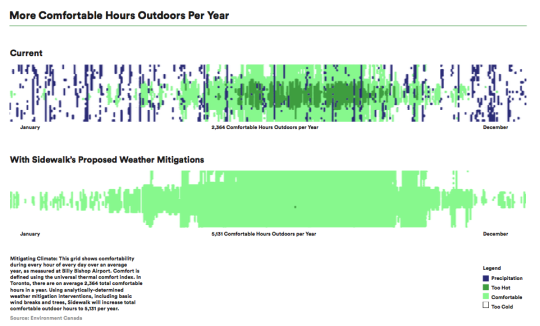
    As is stated in their RFP response, inclement weather affects pedestrians and cyclists more than drivers. Toronto’s most notable response has been our PATH system, which pulls both people and retail below grade, away from the elements.

    But Sidewalk’s research suggests that with the right wind, sun, and precipitation strategies, they may be able to 2x the number of comfortable outside hours per year here in Toronto. That’s what the above diagram shows.

    Of course, there is so much more in their RFP response. But I need more time to digest it all. I’ll be sure to report back to all of you once I have done that. If you don’t feel like going through all 196 pages yourself, you can watch this 4 minute YouTube video instead.

  • The neighborhood of the future

    image

    Daniel Doctoroff (chairman and CEO of Sidewalk Labs and former deputy mayor of New York City) and Eric Schmidt (executive chairman of Alphabet and former CEO of Google) recently contributed a piece to the Globe and Mail about “why Toronto is the ideal place to build a neighborhood of the future.” 

    It’s about the partnership they working on with Waterfront Toronto. I wrote about that announcement, here.

    Here is an excerpt from the Globe article:

    “The eastern waterfront will be a place where residents, companies, startups and local organizations can advance new ideas for improving city life. It’s where a self-driving test shuttle will take its first steps toward becoming a next-generation transit system that’s cheaper, safer and more convenient than private car-ownership. It’s where new insights into advanced construction methods will start to reveal a path toward more affordable housing development. It’s where explorations into renewable energy and sustainable building designs will show promise toward becoming a climate-positive blueprint for cities around the world.”

    These are some of the first details that I have heard about their vision for Toronto’s eastern waterfront. 

    Some of you are probably worried – after reading the above excerpt – that by focusing on self-driving vehicles, we are setting ourselves up to repeat our previous mistakes. But if self-driving vehicles are destined to become a reality (and it certainly feels that way), it is critical that we understand their impact and how they might best dovetail with the public transit systems we already have in place.

    I am thrilled that all of this will be happening right here on our doorstep.

    Photo by Brxxto on Unsplash

  • Sidewalk Labs, Amazon HQ2, and the Milanese Leonardo

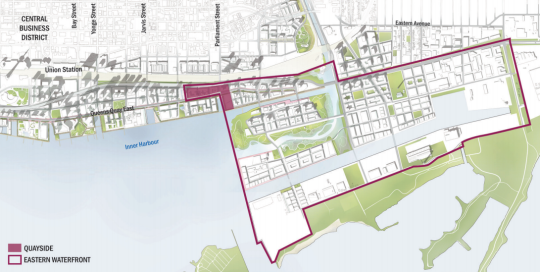
    Earlier this week the WSJ announced that Sidewalk Labs (Alphabet Inc.’s urban innovation organization) is close to a deal with Waterfront Toronto to develop a new 12-acre section of the eastern waterfront. Sidewalk Labs would be their innovation and funding partner. It’s not final yet and it’s still subject to board approval, but the sentiment is that it should go.

    There aren’t a lot of details about the project – other than the fact that it will be fairly big, up to 3 million square feet – but the overall intent is digital city building. It’s about imagining what a city could be if you built it today “from the internet up.” More info about Sidewalk Labs, here.

    I thought of this project as I read Seth Godin’s daily blog post this morning in bed. Here are two snippets from that post:

    When a new technology arrives, it’s often the nerds and the neophiliacs who embrace it. People who see themselves as busy and important often dismiss the new medium or tool as a bit of a gimmick and then “go back to work.”

    There’s never a guarantee that the next technology is going to be the one that moves to the center of the conversation. But it’s certain that a new technology will. It always has.

    Openness matters.

    I’m anxious to learn more details about the project, but this is obviously very exciting. It also creates momentum and strengthens the case for Amazon HQ2 in Toronto. The above 12-acre Quayside area is only the tip of the iceberg. There’s the rest of the eastern waterfront and also East Harbour.
    image

    Some people have been critical of this city’s push for Amazon HQ2. Anthony Lacavera, chairman of Globalive Capital, called this “the biggest Trojan Horse of all time.” His view is that Amazon would simply use HQ2 Toronto as a mechanism for cheaper labor (USD > CAD) and to siphon the best and brightest down to the US.

    Now, I agree that it would be more impactful to create the next Amazon then to simply lure in its second headquarters. Big entrepreneurial successes are what fuel the darwinian evolution of startup hubs. The founders, early employees and investors make boatloads of money and then they start reinvesting that back into the ecosystem by, among other things, backing the next generation of entrepreneurs.

    But does this necessarily mean that an Amazon HQ2 would be detrimental to Toronto by acting as a conduit to the US? Will it discourage entrepreneurship? Should we eschew all US firms out of fear that this may in fact happen? I don’t think so.

    There’s tremendous value in concentrating smart people in one place – ideas build on ideas. And I don’t think technology has been able to disrupt that, at least not yet. One example of this is a theory that Paul Graham calls the Milanese Leonardo:

    You can see how powerful cities are from something I wrote about earlier: the case of the Milanese Leonardo. Practically every fifteenth century Italian painter you’ve heard of was from Florence, even though Milan was just as big. People in Florence weren’t genetically different, so you have to assume there was someone born in Milan with as much natural ability as Leonardo. What happened to him?

    And his reasoning is as follows:

    Nothing is more powerful than a community of talented people working on related problems. Genes count for little by comparison: being a genetic Leonardo was not enough to compensate for having been born near Milan instead of Florence. Today we move around more, but great work still comes disproportionately from a few hotspots: the Bauhaus, the Manhattan Project, the New Yorker, Lockheed’s Skunk Works, Xerox Parc.

    Xerox Parc (Palo Alto Research Company) is a great example of the kind of positive externalities that can happen as a result of smart people being in close proximity to each other while they wrestle with similar problems. It has been well documented that it was Steve Jobs’ visit to Xerox Parc that inspired many of Apple’s early innovations.

    So my view: let’s increase Toronto’s urban metabolism and make it the Florence of 1450.

    Ed Clark – who is leading the charge for HQ2 in Toronto – has been clear that large taxpayer subsidies are not on the table for Amazon. That would not be fair to the existing companies in this city. If that is what it is going to take, then we are not going to win. We will win based on our city, our human capital, and our openness to the rest of the world. That feels right.

    Welcome Sidewalk Labs. Welcome Amazon. This city is open for business and to new ideas. 

    Image: Waterfront Toronto

  • What e-commerce may do to our streetscapes

    Sidewalk Labs recently ran a thought experiment where they came up with 5 possible scenarios for the future of retail and, more specifically, what they may mean for our streetscapes. You can read all about them here, but my mind lumps them into 3 broad categories.

    First, there’s the temporary/pop-up/independent scenario. This one is all about flexibility and speed. It’s about web-first retailers who don’t have, need or want permanent stores and about empowering small scale business owners. This makes sense. The internet has decentralizing forces.

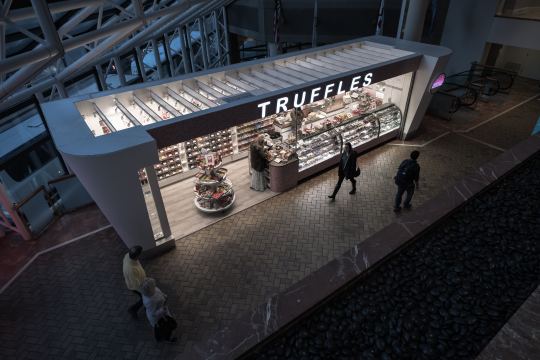
    The second one takes retail in the opposite direction. It’s about going all in on physical stores; upsizing them and making them even more over the top and Instagram-able. This one also seems intuitive given that we’re already seeing this trend with malls. Many/most are dying and the surviving ones are trying to go as high end as possible.

    The last scenario takes vacant and underutilized retail on the fringe and turns them into “digital dispensaries.” This one is entirely utilitarian and void of any streetscape/urban considerations. It’s about autonomous electric vehicles picking up your goods through drive-thrus and on-demand drones dispatching your toilet paper after you hit that Amazon Dash Button.

    This feels like a good list. I think you could argue that the writing is on the wall for all of these scenarios.

    Photo by Lance Anderson on Unsplash

  • Project Sidewalk

    One of Alphabet’s subsidiaries is a company by the name of Sidewalk Labs. Some of you, I’m sure, have been following it. The goal of the company is to leverage technology in order to solve some of our biggest urban challenges.

    Initially, they were fairly under the radar, but more recently they’ve become a lot more public with their projects and their mission. Here is a snippet from a recent blog post written by their CEO, Daniel L. Doctoroff

    “The world is poised for a fourth urban-tech revolution — an age of connectivity capable of reshaping cities as much as the steam engine, electricity, and automobile have in the past. New technologies will help citizens and elected officials tackle those intractable urban challenges that Larry outlined last summer, but making sure this age imposes fewer social costs than those previous shifts is critical.”

    Earlier this week it was also announced that the company is likely to enter the real estate development business and construct a new city precinct in order to pilot some of their ideas and projects. The initiative is called Project Sidewalk. 

    Here is an excerpt from the Wall Street Journal:

    “According to people familiar with Sidewalk’s plans, the division of Alphabet is putting the final touches on a proposal to get into the business of developing giant new districts of housing, offices and retail within existing cities.

    The company would seek cities with large swaths of land they want redeveloped—likely economically struggling municipalities grappling with decay—perhaps through a bidding process, the people said. Sidewalk would partner with one or more of those cities to build up the districts, which are envisioned to hold tens of thousands of residents and employees, and to be heavily integrated with technology.”

    When I read this, I immediately thought of the Port Lands area in Toronto. Not because Toronto is decaying – far from it – but because it’s a massive 880 acre site that is both adjacent to downtown and entirely underutilized. I can’t wait to see this area transformed into a thriving waterfront community.

    In any event, if or when Project Sidewalk gets off the ground, it will be very interesting to see what a Google-backed real estate development company looks like.

  • Making alpha-bets

    GBike by Mohamed Yahya on 500px.com

    https://500px.com/embed.js

    On Monday, Google broke the internet when it announced that it was reorganizing itself into a holding company structure called Alphabet.

    That means that Google, Inc. will now become a subsidiary, along with many other companies, of Alphabet Inc. and all shares of Google will automatically convert into the same number of shares in Alphabet.

    This is huge, but also something that was likely inevitable given the passions of the founders. Apparently Larry Page has been thinking about this move for years.

    As it stands pre-Alphabet, Google (with its main internet products) is basically a cash cow funding all of Google’s other experiments. But this muddied the waters and made it difficult for investors to clearly see how much the main internet products were making and how much the founders were spending on self-driving cars, delivery drones (Project Wing), and other new ideas.

    Now everything will be separate.

    But what’s really exciting about the reorganization is that it sets the stage for Alphabet/Google – which is arguably already one of the most important companies in the world – to become even more impactful in a wide variety of industries and disciplines, some/many not traditionally associated with tech. Each wholly owned subsidiary will have their own CEO and the founders rightly believe, I think, that this overall structure will afford them more “management scale.”

    Within Google will remain search, advertising, maps, YouTube, and the Android mobile operating system. But already Alphabet is the parent company of the following other businesses:

    • Calico, an anti-aging life extension company
    • Sidewalk, a smart cities company whose mission is to improve life in cities
    • Nest, an “internet of things” company that makes connected devices for your home
    • Fiber, a company that offers super fast internet
    • Google Ventures (venture capital) & Google Capital (private equity)
    • Google X, which is the lab developing self-driving cars and delivery drones (Project Wing)

    If you can’t tell, I’m bullish on all of this. The approach really resonates with me and I can’t wait to see what Alphabet becomes. If you’d like to read the full and official blog post announcement, click here

    Cheers to trying new things and making big bets.