Daily insights for city builders, delivered every morning at 6 AM ET. I’m Brandon Donnelly — a Toronto-based real estate developer and founder of Globizen. I’ve been writing here since 2013.

Tag: albert wenger

  • This is not right

    I have largely avoided commenting on politics and Trump on this blog, but at this stage it is almost impossible to do that.

    Donations are starting to pile up for the American Civil Liberties Union (ACLU) as the tech community, and many others, begin to respond to Friday’s executive orders. Lyft announced a $1 million contribution to the non-profit group.

    Today, venture capitalist Fred Wilson wrote: Make America Hate Again. And yesterday, his business partner Albert Wenger wrote: Misleading the World on Immigration.

    At 6 AM this morning, Richard Florida started a tweet storm where he argued that “Trump’s immigration insanity” will fundamentally threaten the core of America’s innovation hegemony. 

    (He also argued that Canada, and more specifically Toronto, serve to “gain substantially”, as there will no doubt be a doubling down on tolerance to attract the best talent from around the world.)

    The Canadian tech community penned an open letter to reinforce the message that, here in Canada, diversity is our strength. This echoes similar messages from Prime Minister Justin Trudeau and Mayor John Tory.

    Mass protests have broken out at US airports (links to photos) spanning San Francisco to New York. 

    And I am seeing folks from Toronto offer up their homes (publicly on Twitter) to anyone who might be stranded at Pearson International Airport as a result of the orders. Many have even tweeted out their phone numbers.

    Everywhere I look this weekend I am seeing these sorts of messages. So while I could remain quiet, that doesn’t feel right. And that’s because what is happening is not right.

  • The Toronto startup ecosystem in numbers

    When I met with all of the lovely folks from Amsterdam last week, one of the things that I mentioned about intensification is that it is almost certainly a contributing factor towards innovation, agglomeration economies, and the overall startup ecosystem here Toronto. 

    I don’t know to what extent, but I feel it happening. And there’s lots of research correlating urban density with innovation

    The continued densification of Toronto means it is constantly becoming easier to schedule that morning coffee before going into the office or to pop into that meetup after work. And those sorts of things are hugely valuable in today’s economy.

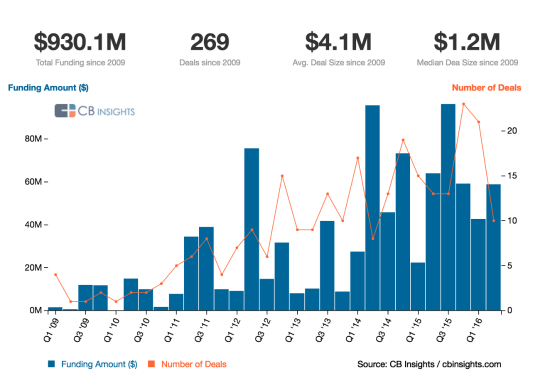
    I talked about a number of local startups in my presentation, including 500px, Wattpad and Wealthsimple. But I didn’t show any hard data. So I’d like to do that today. Below is a chart showing total venture funding (internet/software) and the number of deals (Seed to A/B/C/D) in Toronto since 2009:

    image

    It was taken from this Medium post. Supposedly this places us 12th in the world as far as startup cities go.

    Again, who knows how much of this venture growth has been helped along by intensification. After all: “Silicon Valley proper is soul-crushing suburban sprawl.” But I would bet money that it’s moving the needle in the right direction.

    Here is another relevant post by venture capitalist Albert Wenger where he talks about the great startup ecosystem that Toronto is growing. He posted it earlier today.

    All of this is important because some of these deals will spawn big companies. And those companies will the hire lots of people, as well as consume space. 

    Real estate developers like to talk about how they create jobs. And we do. But we can’t have a city of people just building buildings. People and businesses need to fill that space and that hinges on entrepreneurs who are willing to go out there and forge something new for themselves. Fortunately, Toronto seems to have a growing number of those kinds of people.

  • Home prices and negative interest rates

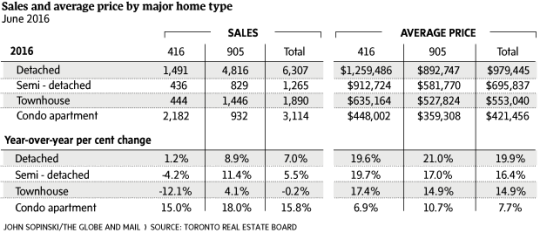
    This morning, I am looking at the following chart of average home prices in the Greater Toronto Area:

    It’s from this Globe and Mail article.

    These are staggering numbers. The average price of a detached home in the suburbs (905 area code) increased 21% year-over-year. In the city (416 area code), the increase was 19.6% YOY. These numbers are almost unbelievable.

    The article focuses on low supply (decrease in listings) and high demand. And that is certainly a big part of what’s going on here in this city, as well as in many others.

    But of course, the backdrop to all of this is our low / zero / negative interest rate environment.

    Larry Summers has a great post on his blog (which I discovered this morning via Fred Wilson) that talks about this “remarkable financial moment.” In some instances, real interest rates are actually negative! (You should read his post.)

    There are always people threatening that interests rates just have to go up. But Larry, as well as others, continue to argue that natural real interest rates are likely to remain close to zero going forward.

    Fred mentions Albert Wenger on his blog this morning and I have written about him before as well, here. In his book World After Capital, Albert argues that capital is no longer the scarce resource of our time. Instead, it has become attention.

    If you believe all of this to be true, then perhaps the numbers at the top of this post aren’t so unbelievable after all.

  • World after capital

    Albert Wenger is currently in the process of writing a book called World After Capital. The book isn’t finished yet. It still exists in a crude rough draft form. But already he has made it freely available online. You’re also welcome to comment and contribute to the book as he works on it.

    Why has he done it this way? 

    Because this format of publishing is in line with where he believes the world is heading. He believes we are headed towards a world where new forms of surplus – brought about by technological innovation – will create greater levels of freedom: economic freedom, informational freedom, and psychological freedom.

    His overall thesis is that the world has been moving through a series of scarcities. As hunter and gathers, the scarcity was food. In our agricultural period, we learned how to create food surpluses (which freed up more of our time), but it then produced land scarcity. Once the industrial revolution hit we once again freed up more of our time through surpluses, but then the scarcity became centered around capital. We also started to negatively impact the environment. Today, as we clearly move away from the industrial economy towards a knowledge and information economy, Albert believes the new scarcity is attention. (I wrote a related post about a month ago.)

    If you’re interested in this topic and don’t feel like diving into his book, I suggest you watch this 23 minute presentation by Albert Wenger. I watched it this morning and he talks about everything I mention above. 

    Here’s one of his slides that I felt was important to share:

    Why it’s interesting to think about this shift is because there will inevitably be positive and negative outcomes associated with it; there will inevitably be groups who, probably because of self-interest, would rather cling to the past; and because there are pressing global issues that we need to be focusing our attention on – issues such as climate change.

    I can’t help but wonder about all the ways this shift could reverberate through the economy and our cities. Earlier this week I wrote a post about architecture as a tool for capital. But with our current fixation on “starchitecture”, one could argue that we have already transformed architecture into a new tool – a tool for grabbing attention. If you believe that attention is the new scarcity, then this makes perfect sense.

  • Towards a post privacy world — what the Ashley Madison hack could mean for cities

    Blinded View by Markus Jentes on 500px.com

    https://500px.com/embed.js

    Ashley Madison is a website that helps married people have affairs. 

    Recently the website was hacked and over 33 million accounts were exposed. This included full names, email addresses, mailing addresses, and so on. Not surprisingly, this has gotten a lot of press. The site was/is marketed as being private and secure. And clearly that is not what it is right now.

    But there are people in the tech community, such as venture capitalist Albert Wenger, who believe that is merely a glimpse into the future – a “post privacy future.” He even argues on his blog that we as a society should be more accepting of the leak and that the release of this data could lead to a “more measured view of affairs.” (There are many who argue that humans are not intended to be monogamous.)

    For many, or probably most of you, I’m sure this position seems pretty radical. After all, this leak will likely destroy many marriages.

    But Wenger’s position on privacy is a fascinating one and he’s written a lot on the topic. The tension he sees is one between individual privacy vs. collective intelligence. In this part of the world, our society values the former over the latter. But he believes that we are headed towards a world where almost everything, yes everything, will eventually become public. Again, radical position. But consider how much we publicly share about our personal lives today versus 10 or even 5 years ago.

    What’s perhaps more relevant to the Architect This City audience though is what this could mean for many other industries beyond tech.

    I often think about what a “post privacy future” could mean for city building. Imagine if every architect, real estate developer, engineer, and other participant made public all of their work. This would mean that all designs, financial models, sales data, and so on were made widely available to anyone who wanted to see them.

    The thought probably scares many of you in the industry, but consider what it would mean for our collective intelligence. There’s a strong argument to be made that we would all be better off and that the process of building would become far more efficient. In fact, if truly everything were public, it could in theory eliminate most of the market’s concerns about overbuilding, a condo bubble, and all the other stuff that gets talked about.

    The reason people speculate on these market factors is because we don’t have all the data. We don’t actually know what’s going to happen. We have no idea. I know I certainly can’t predict the real estate market.

    So why aren’t we quickly becoming more public?

    Wenger raises the game theory principle known as the prisoner’s dilemma:

    “So one way to think about secrecy is that it leads to lots of prisoner’s dilemma style situations. Individuals (or companies) would be worse off if they were the only ones disclosing, but if everyone disclosed (or at least the majority), then everyone would be much better off. In the language of game theory, we are in a bad equilibrium.”

    In other words, if only one real estate developer disclosed her project’s financial information to the public, then she would probably be worse off against her competitors. But if every developer in the city did it, then the market as a whole would be better off because everyone would then benefit from collective intelligence.

    Using the example of infidelity, if one person is caught having an affair, then that person is more than likely worse off. But if over 33 million people are caught having an affair and it reinforces the statistic that between 30-60% of married people in the United States will have an affair at one point in their lives, then maybe it forces us as a society to rethink what marriage means today. And maybe that makes us all better off.

    This is a pretty far out there argument, though the city building example is probably more palatable than the Ashley Madison one. Regardless, I would love to hear your thoughts in the comment section below. 

    Are we heading towards a post privacy world?

  • Marginal cost = 0

    Earlier this week I wrote a post called: The pull from services to products. And in it I made mention of the fact that part of what’s driving this pull towards products is that the marginal cost of servicing additional users or customers is almost nothing in a world of internet services and products.

    Well the reality is that this phenomenon is driving a hell of a lot more. It could – and probably will – fundamentally change almost all aspects of the economy.

    I know that sounds like a pretty audacious statement, but if you watch the following 10 minute talk by Albert Wenger (Union Square Ventures) you might start to feel the same way. He outlines 5 changes being driven by the fact that in the digital world, marginal cost = 0. The impacts go well beyond tech, capturing sectors such as transportation and industrial real estate.

    [youtube https://www.youtube.com/watch?v=sVEtTzlqsoE?rel=0]

    If you can’t see the video, click here.

  • Disrupting everything

    Last year when I started working on Dirt—which was really my first startup—I had a number of people say things to me like: “Wow, that’s quite a change, going from real estate into tech.” But that’s not the way I saw and see it.

    I don’t think you can silo industries like that anymore. Technology is touching everything. Some would even go so far as to say that every company in the world is, or will be, a software and technology company.

    The way I looked at it was that I was starting a technology-enabled real estate company. I was hoping to leverage the internet to improve the way things are done in an existing industry. Of course, by improve I really mean disrupt—which is arguably the biggest buzzword in the tech community today:

    “Disruption is not so much a trend as an especially lucrative world philosophy favored by technophilic entrepreneurs. It’s the only path towards progress. If you’re not disrupting something you might as well go collect kindling and roast raccoon meat in the hills of Cupertino.”

    A good example of how disruptive innovation is reaching all sectors of the economy, including government, is the New Haven-based startup called SeeClickFix (which I discovered via This Big City). What it does is allow citizens to report non-emergencies (like potholes) to their local government. Governments can then respond and manage these tasks. (Sorry Rob Ford. Now you don’t need to return all those phone calls.)

    But moreover, I think it shows that technology is not only going to disrupt business and industry, it’s going to disrupt the way cities function and the way we live. I don’t know what that’s ultimately going to look like, but I can already feel it underway.

    Albert Wenger, of venture capital firm Union Square Ventures, recently argued—in a talk at DLD—that we are still in the midst of a transition from the Industrial Age to the Information Age. And I buy that. With every new disruption, we’re one step closer to completely making that transition. But we’re not quite there yet.

    The Industrial Age drove people out of cities. It made cities dirty and undesirable. But in the Information Age, cities are damn important and it’s where people want to be. Look at all the people rushing back to urban centers.

    So if technology has the power to disrupt business, industry, and cities, I suggest we stop just thinking about technology in isolation and remember the powerful words of Marshall McLuhan: “The medium is the message.” Don’t just focus on the obvious or you’ll miss a tidal wave of change happening beneath the surface.

  • Industrial vs. internet scale

    I was watching this talk with Albert Wenger of Union Square Ventures last night. He was recently in Toronto for a Wattpad board meeting (USV is an investor).

    It’s an interesting discussion that touches on education, healthcare, Canada’s tech ecosystem, as well as a bunch of other things. But one point that Albert made that I particularly like is the comparison between industrial and internet scale.

    In both cases, it’s all about growth and scale. The bigger a firm can get, the better.

    But with industrial production, scale is all about driving down the marginal cost. This is also known as economies of scale. As firms increase in size, efficiencies are found that allow the unit of production to drop in price. This, in turn, creates defensibility, because smaller firms simply can’t compete in the market.

    With internet platforms the situation is different. Sure, there are still economies due to scale, but their competitive advantage is often derived from the fact that, on the margin, every new user increases the value for every other user on the network. This is called a network effect.

    A perfect example of this is Facebook. People use Facebook because all of their friends are there. And as more and more friends join, it becomes increasingly more valuable. Without friends, a social network has little value. This make starting one fairly difficult. However once started, network effects are incredibly difficult to dismantle. This is their defensibility.

    Another network effect example that Albert mentions is search (i.e. Google). This one isn’t so obvious. It may not seem like there are network effects with search, but there are. As a search user, you enter a query and then select from a list of results. In doing so you’re actually helping the search engine figure out what the best and most relevant results are for the keyword(s) you just entered. Again, in the end, everybody benefits.

    I found this interesting because, in the case of internet platforms, scale is directly related to value proposition. The bigger something gets, the more useful it becomes. Now, you could maybe argue that the same is true for industrial production, but it’s a bit more tenuous. The direct link is cost.