Daily insights for city builders, delivered every morning at 6 AM ET. I’m Brandon Donnelly — a Toronto-based real estate developer and founder of Globizen. I’ve been writing here since 2013.

Tag: airport

  • We’re building an airport!

    One of our partners shared this video with me today:

    And it is possibly one of the greatest 39 seconds of interview you’ll ever watch.

    It is a video of Jim Fahy interviewing James Horan about the construction of Ireland West Airport. The important context is that Horan was a parish priest in Knock, County Mayo, and he desperately wanted an airport so that pilgrims could more easily visit the Knock Shrine.

    However, critics felt that an airport in County Mayo was just not feasible. The area was too foggy and too boggy (I had to look this one up).

    But Horan successfully campaigned to have one built and he did somehow find the money. Though maybe not the following week. The campaign apparently took a lot out of him, and he died shortly after the airport opened.

    But in the end, he got it built.

    It takes a special kind of person to accomplish what most people view as boiling the ocean (i.e. an impossible outcome). And when you watch the video, it will become obvious to you that James Horan was that kind of person.

  • The car revolution is being powered by software

    Frederic Filloux publishes a regular newsletter called the Monday Note. It’s generally all about tech and new emerging business models. His latest post, called “Code, on wheels,” is about Tesla and the software revolution that is currently underway in the car industry. And it’s a good reminder of just how unique Tesla appears to be as a car company and how software is bound to infiltrate all aspects of our economy. Already you’re hearing people make a distinction around “pure” software companies. This is necessary because of how ubiquitous it has become.

    Here is a a longish excerpt from Filloux’s article:

    But the ultimate leap in value will be the creation of an application ecosystem. The limit will only be the imagination of app creators. As an example, airport operators are likely to develop apps to manage car traffic and passenger flows. Here is a use case: Your flight departing from San Jose Airport leaves in an hour. Your dual app system — one in your phone, the other in the car — checks the flight status, the gate, and the traffic. It notifies you when it’s time to leave. Once in the vicinity of the airport, the app guides you to the parking space nearest to the gate. An alternative and slightly more futuristic scenario involves you dropping your car in front of the terminal, then letting the autopilot send the car to the long-term parking lot a few miles away (this will soon become feasible as geofenced environments such as airports will be well-suited for Level 4 autonomous driving).

    Again, this implies major changes in the way car software is currently handled. These scenarios require the car and the phone apps working seamlessly, exchanging data in real-time with the airlines, the airport, the navigation system of the car, the parking infrastructure, and eventually, the autopilot. We are not there yet, but by that time, the dust will have settled: either carmakers will have developed their own OS — along with the SDKs to foster the development of third-party apps — and/or, tech giants will have taken-over, leveraging their current market positions in the phone sector to impose their own norms. I always thought that Apple had that in mind when it hired legions of engineers for its Titan project and filed applications for self-driving cars to the California Department of Motor Vehicles. I doubt that they completely gave up on the idea of replicating what they achieved for the 500 billion smartphone market with the 3 trillion dollar car sector.

    There are many in the planning world who are quick to dismiss autonomous electric vehicles as being more of the same. They’re still cars, right? For better or for worse, the internal combustion engine was massively transformational to cities — just as previous advances in transportation were. But what comes next is still mostly unknown because, even if you assume that autonomy is a foregone conclusion, it’s unclear how this and an app ecosystem could change how “cars” function in our cities. What will be the spatial impacts?

    It is, however, clear to me that when things do start to really change, it will be because of software.

    Photo by Jannis Lucas on Unsplash

  • Largest airport in the world

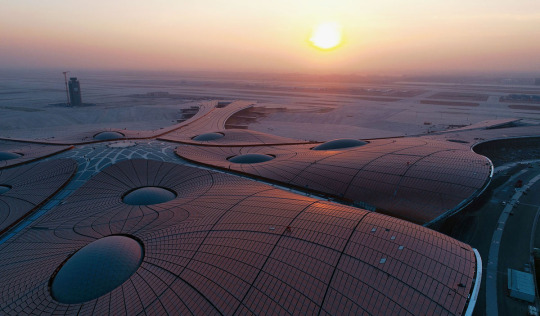
    I just finished scrolling through these photos (from the Atlantic) of Beijing Daxing International Airport, which is currently under construction about 46 kilometers south of Tiananmen Square. The first phase is expected to open in the second half of this year. It will be about 7.5 million square feet and be capable of handling some 72 million passengers per year (100 million at full build out). 

    Supposedly all of this will make it the largest airport in the world, which is pretty impressive considering Beijing Capital International Airport is already one of the busiest in the world. It too moves around 100 million passengers a year and is likely to overtake Hartsfield-Jackson Atlanta in the near term (if it hasn’t already).

    But in addition to being the biggest and baddest, two other things stand out to me about the design of Beijing Daxing. 

    The first is its starfish design. This was done to minimize the amount of walking between security and gate. Check-ins happen in the middle of the starfish and then the most you’ll ever have to walk is 600m (to end of one of the limbs). That’s in line with what most people would consider a reasonable urban transit radius.

    The second is the fact that the check-in area provides an aerial view of the gates below. You can see this layering in the photos from the Atlantic. This was done to create a visual connection between passengers and their family and friends. Usually, the goodbye waves happen at or before security. Here you get a bit more time. (Will security be an issue?)

    For the full set of photos from the Atlantic, click here. I have a thing for airports, so I thought this was a great set.

    Image: Wang Mingzhu via the Atlantic 

  • Flights per day

    I recently wrote about this visual essay – showing the world’s population – from The Pudding.

    They have some great essays. So I went exploring today. 

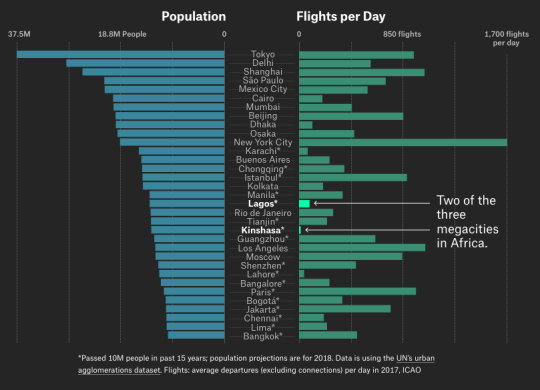
    Here is one that looks at the phenomenon of “poor-country urbanization” by way of the number of flights per day from a city.

    The argument is that a low number of daily flights means that the city, despite perhaps having a large number of people, is actually quite disconnected from the global economy.

    Typically, people moving from rural areas to urban areas has tended to translate into rising incomes. It has lifted people out of poverty.

    But today we’re seeing examples of poor urbanization, where the migration is less about opportunity and more about necessity.

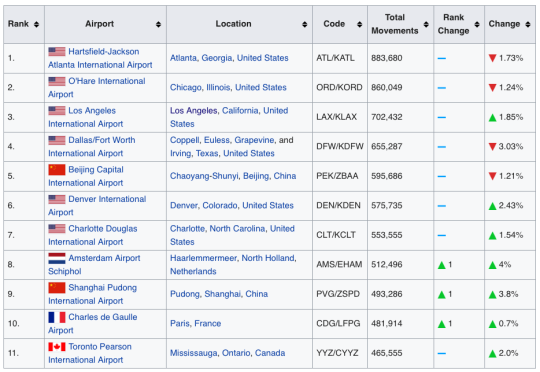
    While maybe crude, this measuring stick of flights per day piqued my curiosity. So here are some preliminary figures from the Airports Council International for 2017:

    The primary example mentioned in the essay is that of Kinshasa, which is the capital of the DRC. 

    It has a population of around 13 million people, but only 13 departing flights per day. (I’m assuming its “total movements” would be higher.)

    Based on the above list, ATL has ~2,461 total movements per day (defined as an aircraft either landing or taking-off). And YYZ has ~1,275 movements per day.

  • What the UPX fare reduction means for the west side of Toronto

    Last week Metrolinx slashed fares on Toronto’s Union to Pearson Airport express train (UPX), by a lot. From $27.50 to $12 for people without a PRESTO card and from $19 to $9 for people with a PRESTO card. They listened to the pundits. And there were a lot of them regarding this topic.

    At these fares, the UPX is decidedly cheaper than a taxi or Uber, but more than regular transit, which I think makes sense given that it’s a better overall experience. I would take this train all day long.

    But the other thing that Metrolinx did was also reposition the train service as an inner city commuter service by matching fares with GO transit for non-airport trips within the city. As one example, this means that you can now go from Bloor & Dundas West in the west end to downtown Union Station for $5.30 in cash or $4.71 with a PRESTO card. This is in comparison to $3.25 in cash on the subway.

    But this is huge, because look at the options for this transit trip:

    • UPX Train: 8 minute trip; service every 15 minutes
    • GO Train: 12 minute trip (additional stop); service every 20-30 minutes during peak times and roughly every hour during off-peak times (so no drinks after work)
    • Subway: 26 minute trip; most frequent service

    This is a significant connectivity upgrade for the west side of the city. One that reinforces my belief that, next to Union Station, Bloor/Dundas West is the best connected mobility hub in the Toronto region. This now a perfect location for companies and people who need quick access to both the Financial District and the airport. Unfortunately though, I don’t think we’ve taken full advantage of this connectivity in terms of what we’ve allowed and disallowed to be built in the area to date.

    I’ll end by saying that I think the pundits have been overly critical of the UPX train. Everyone loves to talk about it as a failure. But look, every organization and person makes mistakes. If you’re not making mistakes, then you’re not pushing yourself hard enough. The key is to iterate and refine as you charge along. So go make some mistakes today 🙂

    Image: UP Express

  • Let’s fix the UPX train, together

    I am a big fan of the UP Express train that runs from downtown Toronto to Pearson Airport. 

    I love the station architecture, the branding and identity, the trains themselves (with wifi), and the local retailers they house at Union. I also happen to live a stone’s throw away from the downtown station. So I can go from door to bum in seat within 10 minutes.

    But despite all this, it has become clear that something needs to be done to fix the UPX train. Just last weekend a friend of mine and fellow urbanist, who was visiting Toronto from Vancouver, sent me a text message saying: “This UPX train is really nice, but why is it so expensive?”

    Indeed, that seems to be the general consensus. Here is the opening paragraph from a recent Globe Editorial article:

    Toronto’s high-end airport express train is a failure. A city that urgently needs better transit has been saddled with a deluxe boutique rail service that cost $456-million to build and runs nearly empty, 19 ½ hours a day.

    So today I thought we could collectively brainstorm some ideas for how Metrolinx – the public agency that operates the train – should address this issue.

    I’ll start by sharing my thoughts as a rider and then, hopefully, you all will share yours in the comment section below. I know that there are people from Metrolinx who subscribe to this blog, so I am sure your feedback will get through to them.

    My thoughts are twofold. Like many others, I think the pricing is off. But at the same time, I think there should be a focus on enhancing the value proposition of the service.

    Bur first, let’s talk about price.

    At the time of writing this, a one-way trip from Union Station to Pearson Airport on the UPX is $27.50. If you happen to have a PRESTO card, it’s $19.

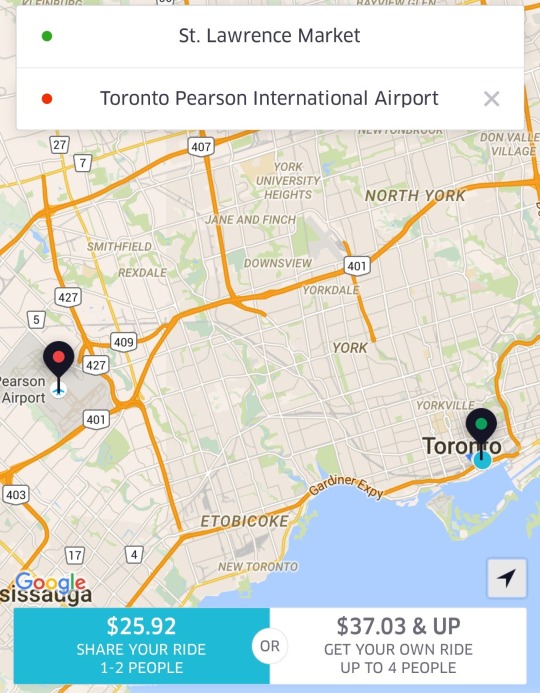
    The alternative for many is probably a taxi. So let’s also look at some Uber fare estimates. For someone like me leaving the St. Lawrence Market area, I’m looking at $25.92 with UberPOOL (meaning I’m sharing the car with 1-2 other people) or $37.03 if I insist on riding solo.
    image

    Against the non-PRESTO fare, UberPOOL is a cheaper option and it’s door-to-door service. Against the PRESTO fare, UPX is potentially $6.92 cheaper. But if you’re someone who has to take the subway to the UPX station, then it’s only $3.67 cheaper (add $3.25 for the subway) and it’s not door-to-door service. So for the vast majority of people, I suspect that UberPOOL would win out in this particular scenario.

    If you happen to be traveling with someone, then UberPOOL and UberX are probably going to be cheaper no matter how you slice it. And again, you’re getting door-to-door service. So I think the consensus is right: fares need to come down.

    But I don’t think Metrolinx should be solely focused on price. They should also be thinking about ways to create additional values for riders. 

    One of my favorite travel experiences is that of Hong Kong’s airport train. There, they have airline check-in counters in the city so you can collect your boarding pass and check your baggage up to a day before your actual flight. This is a huge value add because it means you can check out of your hotel, liberate yourself of your luggage, and spend the day in the city before leaving on the train to catch your flight. You can’t do that with an Uber. And lugging bags around a busy city, sucks.

    My point with all of this is simply that you can’t expect people to pay more or roughly the same, if they are not getting additional value. And right now, the train isn’t door-to-door and taxis are. (Though, the train has a travel time advantage during peak times.) So you either make it cheaper or you create additional value. Or, you do some combination of the two, which is where my head is at.

    What are your thoughts? Please respond in the comments below so all the feedback is public. Thanks.

  • How much should a ride on the Union Pearson Express cost?

    When I was in Chicago a few weekends ago, one of the things we did was take the train from Midway Airport to downtown. We were a large group, but since it was only $2.25 and we figured it would be easier and faster than contending with traffic, we decided to take it.

    Since it was their local transit service (as opposed to a dedicated airport rail line), the train came within a few minutes and it took us about 25 minutes to get to the Loop. It was a great experience. And I would take it again the next time I go to Chicago.

    I mention this because there’s been a lot of debate in Toronto recently about the potential ticket price for the new Union Pearson Express train to the airport. Some are suggesting that it could cost upwards of $30 for a one way ride, which would also take 25 minutes and would leave every 15 minutes.

    The concern is that at this price, the train will only serve the business community and the rich. And indeed, it’s a lot more than the $2.25 I paid when I landed in Chicago earlier this month. But at the same time the Union Pearson Express promises to offer a more refined travel experience than your regular old subway train. So how should it be priced?

    Pricing exercises are really interesting because, as David Fitzpatrick pointed out in a recent tweet, increasing the price of the ticket will lower ridership. And at a certain point, this will cause overall revenues to also decline (the loss in ridership stops being made up by the higher ticket price). So, in theory at least, there exists a magic, profit maximizing number.  

    Of course, profit may not be the only goal. One might also be interested in reducing the number of vehicles on the road, promoting sustainability, and generally providing people with a convenient way to get to and from the city’s biggest airport. And should this be case, then those factors also need to be worked into the pricing model.

    Now, I don’t know what that magic number should be off hand, but I do think we need to be clear on our goals as that decision is made.

    I personally believe that we underprice roads in this city, which is why we have such a supply and demand imbalance (i.e. gridlock). And so if we decide that rail travel should be a premium service, then I don’t think it’ll do much to correct that imbalance.

  • White peaks

    I like airports. And this past weekend was my first time in Denver’s. Its most obvious feature is its white fabric roof, which is intended to evoke the snow-capped mountains that surround the region (as well as teepees apparently).

    Here’s what it looks like from the inside:

    And here’s what it looks like from the outside (via Wikipedia):

    What I like about it is that it speaks to the place. In our increasingly global world, more and more of our buildings now look the same. This is what Modernist architects wanted, but I’d argue that that was a different time and place.

    Today, there’s something nice about landing in a new city and feeling like you’re somewhere different. There’s something special about architecture that speaks to its environment.

    Is there an airport that stands out for you?