Daily insights for city builders, delivered every morning at 6 AM ET. I’m Brandon Donnelly — a Toronto-based real estate developer and founder of Globizen. I’ve been writing here since 2013.

Tag: air travel

  • Any wear, anywhere

    Yeah, I can’t say I’m excited to try this. Japan Airlines has just launched a new year-long pilot allowing its passengers to reserve and rent clothes. The way it works is that you tell them what you’re traveling for and then you get something like a “spring/fall x smart casual” variety pack delivered to your hotel or Airbnb.

    The clothes, which look something like this, are a mix of excess stock and second-hand stuff, and so it is being positioned as a more sustainable choice. You’re both using clothes that might otherwise go to waste and you’re reducing the amount of weight that you’re traveling with. (You still need to bring your own underwear.)

    And this could add up:

    The site handling the clothing rental system claims that a 10kg reduction in a flight passenger’s luggage results in an estimated 7.5kg reduction in carbon dioxide emissions. A 7.5kg reduction in CO₂ emissions, it adds for reference, is the equivalent of forgoing using a hairdryer for 78 days (based on an average use of 10 mins per drying session).

    I suppose this could also be positioned as a convenience: why lug a suitcase full of clothes around when you can just reserve what you want and have it waiting for you at your hotel? But I also suppose that you need to be okay wearing well-used clothes. Maybe this matters less, though, if the clothes are really nice and fashionable?

    I don’t know. It’ll be interesting to see if there’s a market for this.

    I would also say that even though I may not be excited about rental clothes, I take great pride in packing efficiently for travel. Unless I’m going snowboarding, I basically do not check a bag. I can do 2 weeks just fine with a carry-on and, to be honest, there’s something liberating about reducing your belongings to only what is necessary.

    So who knows, maybe bringing only underwear and toiletries would be even more liberating.

  • Busiest airports in the world

    There were nearly 7 billion global flight passengers last year, and these were the busiest airports:

    Overall, volumes are up 54% compared to 2021 (not surprising). But we are still down about 26% compared to pre-pandemic levels (2019). The one exception — at least when it comes to this top 10 list — is Denver. It’s right back to where it was in 2019. I wonder why.

    I find this list interesting because, one the one hand, airports are what connect global cities to the rest of the world. If you’re a big and important city, you need a big and important airport. But on the other hand, having a busy airport could also mean that you’re a hub in the hub-and-spoke airline model.

    And that’s what Atlanta is. It is the world’s largest airline hub and the primary hub for Delta Air Lines. Apparently, it was also the first airport to adopt the hub-and-spoke model following deregulation of the industry in the 1970s. Which could be why it’s still number one on this list.

  • Mid-year consumer trends update

    The New Consumer has just published its 2022 mid-year update. Some of you might remember that I wrote about their inaugural consumer trends report at the end of last year.

    It’s interesting, but not surprising, to see a lot of things returning to their means. Spending on home furnishings, for example, is coming down, whereas luggage and bag sales are up. Home fitness has also come way down as people return to gyms. It’s time to leave home.

    At the same time, it has become a lot more expensive to leave home, assuming you need to drive. Motor fuel increased 49% year-over-year as of May 2022. It’s the CPI category with the biggest change. But even with this, transit ridership has yet to fully rebound. NYC is sitting at around 60%.

    To download a free copy of the full presentation, click here.

  • Jets and real estate

    Jackson Hole Airport (JAC) has one runway. It is 6,300 feet long by 150 feet wide and it was originally constructed in 1959. In 1965, the first of many proposals was put forward to lengthen the runway to 8,000 feet so that jets could fly into the airport. But it was never adopted. Subsequent proposals were made in 1992 and 1999, but they were again highly contentious and similarly never adopted. The runway remains 6,300 feet long.

    However in the early 1980s jets began using the existing runway and the area started to boom. According to this old New York Times article from 2002, the town’s growth exactly parallels the introduction of jet service at JAC. The town doubled from 9,000 people in 1980 to 18,000 people in 2000. Its per capita income also shot up from a steady $20,000 in 1984 to more than $67,000 in 2011 – making Teton County one of the richest in the US.

    Tourism destinations and second home markets like Jackson Hole are heavily dependent on access. In 2003, a total of 211,788 passengers flew through JAC airport and, in 2016, it was over 340,000 people. But second home markets are also the first to get hit during macroeconomics shocks. Following the 2008 financial crisis, passenger volumes at JAC didn’t recover until 2014.

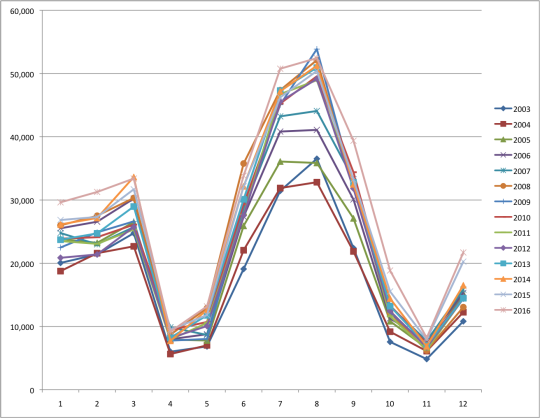
    If you look at air traffic throughout the year you’ll also see that it is highly seasonal. Below is a chart showing monthly passenger volumes at JAC from 2003 to 2016 (data from the Bureau of Transportation Statistics). Some of you may be surprised to see that more people visit Jackson Hole in the summer, compared to the winter. But what’s perhaps even more conspicuous is the sharp drop off during the swing seasons.

    image

    I am thinking about all of this not only because I just got back from Jackson Hole, but also because I am very interested in the demand drivers that fuel the real estate in many of these mountain towns. It’s easy to get it wrong. Unlike major urban centers – which often operate under a perpetual supply deficit – you can’t just build and necessarily expect people to come.

    Revelstoke Mountain Resort, for instance, first opened in 2007 with grand aspirations of building one of the largest ski resorts in North America. But they got crushed in 2008 and have never fully recovered – at least relative to their original plans. Maybe the answer is a bigger airport.

  • European cities by rail connectivity

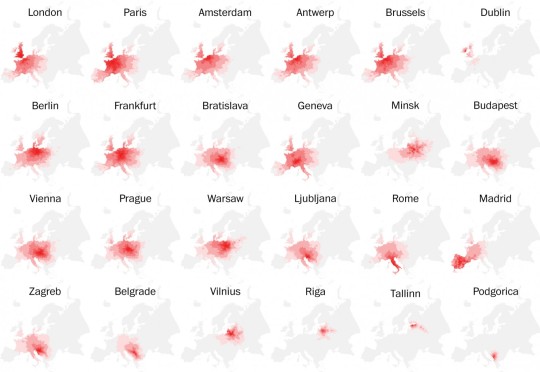
    This is a terrific set of maps published by The Washington Post (2015) using data originally collected and published by Peter Kerpedjiev:

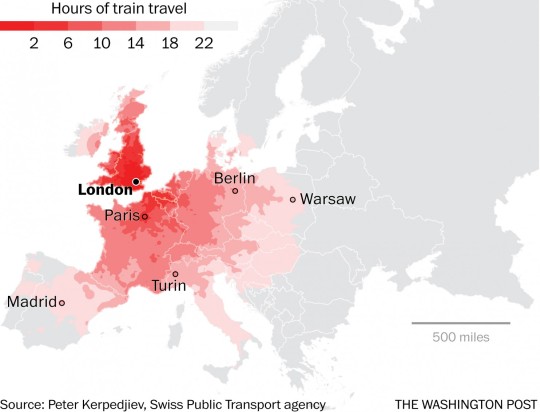
    What they show is how far you can travel in a 24 hour period using only trains and brisk walking from a collection of 28 European cities. In a few cases, such as from London to Dublin, a ferry ride is also included.

    Here’s a zoom in on London:

    The obvious takeaway is that Western Europe is very well connected, whereas many parts of Eastern Europe are not. Some cities, such as Tallinn (Estonia) and Podgorica (Montenegro) are almost completely disconnected.

    Of course today there’s stiff competition from air travel.

  • Let’s fix the UPX train, together

    I am a big fan of the UP Express train that runs from downtown Toronto to Pearson Airport. 

    I love the station architecture, the branding and identity, the trains themselves (with wifi), and the local retailers they house at Union. I also happen to live a stone’s throw away from the downtown station. So I can go from door to bum in seat within 10 minutes.

    But despite all this, it has become clear that something needs to be done to fix the UPX train. Just last weekend a friend of mine and fellow urbanist, who was visiting Toronto from Vancouver, sent me a text message saying: “This UPX train is really nice, but why is it so expensive?”

    Indeed, that seems to be the general consensus. Here is the opening paragraph from a recent Globe Editorial article:

    Toronto’s high-end airport express train is a failure. A city that urgently needs better transit has been saddled with a deluxe boutique rail service that cost $456-million to build and runs nearly empty, 19 ½ hours a day.

    So today I thought we could collectively brainstorm some ideas for how Metrolinx – the public agency that operates the train – should address this issue.

    I’ll start by sharing my thoughts as a rider and then, hopefully, you all will share yours in the comment section below. I know that there are people from Metrolinx who subscribe to this blog, so I am sure your feedback will get through to them.

    My thoughts are twofold. Like many others, I think the pricing is off. But at the same time, I think there should be a focus on enhancing the value proposition of the service.

    Bur first, let’s talk about price.

    At the time of writing this, a one-way trip from Union Station to Pearson Airport on the UPX is $27.50. If you happen to have a PRESTO card, it’s $19.

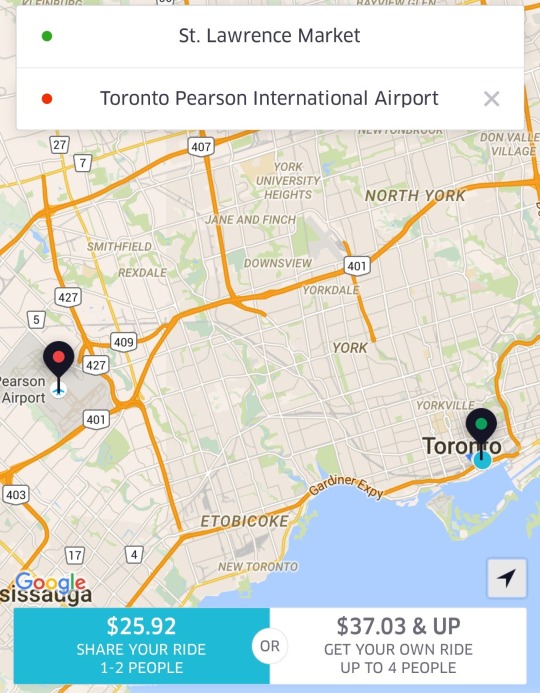
    The alternative for many is probably a taxi. So let’s also look at some Uber fare estimates. For someone like me leaving the St. Lawrence Market area, I’m looking at $25.92 with UberPOOL (meaning I’m sharing the car with 1-2 other people) or $37.03 if I insist on riding solo.
    image

    Against the non-PRESTO fare, UberPOOL is a cheaper option and it’s door-to-door service. Against the PRESTO fare, UPX is potentially $6.92 cheaper. But if you’re someone who has to take the subway to the UPX station, then it’s only $3.67 cheaper (add $3.25 for the subway) and it’s not door-to-door service. So for the vast majority of people, I suspect that UberPOOL would win out in this particular scenario.

    If you happen to be traveling with someone, then UberPOOL and UberX are probably going to be cheaper no matter how you slice it. And again, you’re getting door-to-door service. So I think the consensus is right: fares need to come down.

    But I don’t think Metrolinx should be solely focused on price. They should also be thinking about ways to create additional values for riders. 

    One of my favorite travel experiences is that of Hong Kong’s airport train. There, they have airline check-in counters in the city so you can collect your boarding pass and check your baggage up to a day before your actual flight. This is a huge value add because it means you can check out of your hotel, liberate yourself of your luggage, and spend the day in the city before leaving on the train to catch your flight. You can’t do that with an Uber. And lugging bags around a busy city, sucks.

    My point with all of this is simply that you can’t expect people to pay more or roughly the same, if they are not getting additional value. And right now, the train isn’t door-to-door and taxis are. (Though, the train has a travel time advantage during peak times.) So you either make it cheaper or you create additional value. Or, you do some combination of the two, which is where my head is at.

    What are your thoughts? Please respond in the comments below so all the feedback is public. Thanks.